
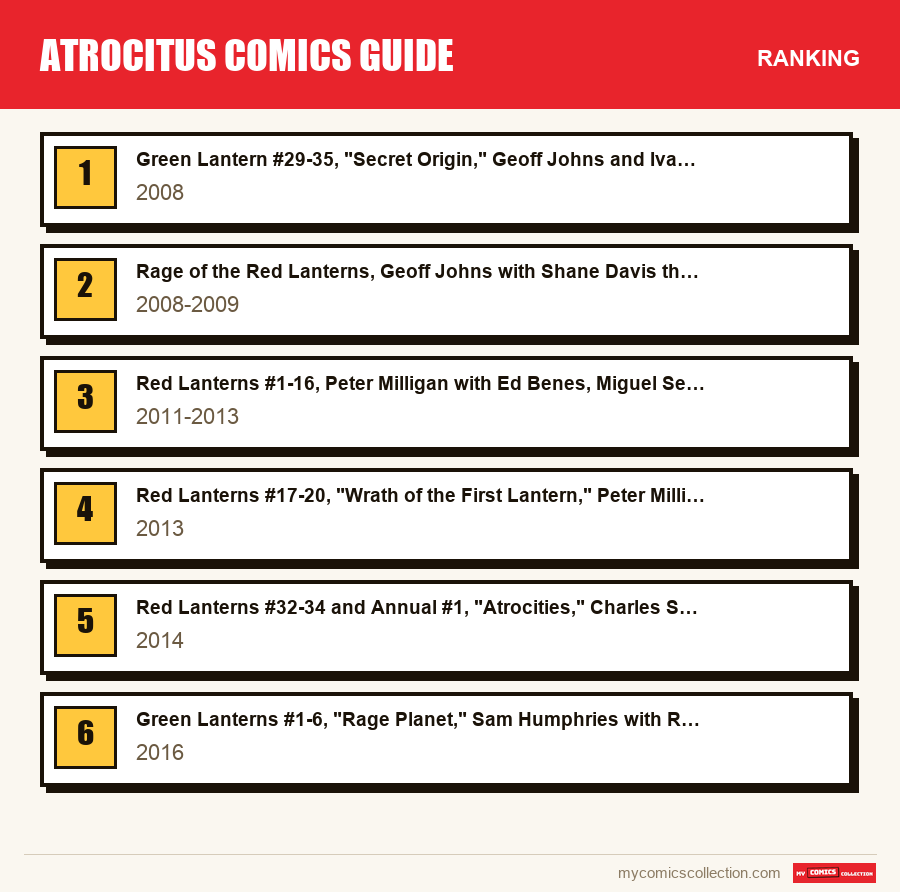
For the best Atrocitus comics, start with the "Secret Origin" arc in Green Lantern #29-35 (2008) by Geoff Johns and Ivan Reis, which establishes his legend. Follow it with "Rage of the Red Lanterns" (2008-2009), then Peter Milligan's Red Lanterns series (2011-2013), where he finally headlines a title. Save the 2013, 2014 and 2016 arcs for last: they tell of his death, his return and his role as an adversary.
Atrocitus is a character of rage, which is why his stories read so differently from one another: the same vengeful demon is the big villain in one arc, a squad leader in another and the protagonist of a monthly series. Picking the right entry point therefore means picking which Atrocitus you want to follow.
As always in this guide, we only state verified facts (creators, issue numbers, dates); the analysis is our own, with no reproduction of protected art or dialogue.
His first appearance
Atrocitus debuts in Green Lantern (fourth series) #25, dated January 2008, written by Geoff Johns; Ivan Reis and Ethan Van Sciver are credited with the art on the issue. Geoff Johns and Ethan Van Sciver are the character's creators. The appearance in this issue is a cameo: Atrocitus only shows up briefly, like a promise of what's to come.
He settles in more firmly in Green Lantern #28, written by Geoff Johns and drawn by Mike McKone, the epilogue to the Sinestro Corps War, in which Atrocitus founds the Red Lantern Corps. Keep two landmarks in mind, then: issue #25 for the first appearance, issue #28 for the starting point of the Red Corps. Our page on the Sinestro Corps War sets out the context for that epilogue.
This double entry explains why publication order matters. Issue #25 depends on the Sinestro Corps War, which Geoff Johns has been running for several months, and issue #28 serves as its epilogue; Atrocitus is therefore born in the middle of a larger saga, in the background of the conflict between Hal Jordan and Sinestro. Only with "Secret Origin" does his personal story move to the foreground. Follow the cover date to recover the real order of the issues.
1: Green Lantern #29-35, "Secret Origin," Geoff Johns and Ivan Reis (2008)
Seven chapters, from May to November 2008, drawn by Ivan Reis, inked notably by Oclair Albert, with Julio Ferreira on several issues. The story retells the origins of Hal Jordan and weaves in those of Atrocitus: a survivor of a massacre carried out by the Manhunters, he gathers his rage and ties himself to the death of Abin Sur, the Lantern whose ring chose Hal. Atrocitus plays the antagonist here, not the hero.
This read is for anyone who wants to understand where the red rage comes from, ahead of the events that follow. It works with no prior knowledge, since Geoff Johns retells Hal Jordan's story from the beginning. Hal Jordan and Sinestro eventually capture Atrocitus, which gives the arc its chase tension. Read it in trade paperback: the seven chapters follow one another without a break. Our Green Lantern reading guide places it in the timeline.
2: Rage of the Red Lanterns, Geoff Johns with Shane Davis then Ivan Reis (2008-2009)
The arc opens with the one-shot Final Crisis: Rage of the Red Lanterns, a chapter titled "Prologue: Blood Feud," written by Geoff Johns and drawn by Shane Davis. It continues in Green Lantern #36-38, written by Geoff Johns and drawn by Ivan Reis: Sinestro is held on Ysmault, and Hal Jordan, who comes to free him, receives a red ring in issue #37. Issue #38 also contains a six-page story, "Origins & Omens."
This is the arc where Atrocitus steps from the shadows into the light: his Corps takes on Sinestro, and Hal Jordan ends up on the other side of the rage. It targets the reader already familiar with the Lanterns, curious to see the Red Corps at work around Atrocitus. The whole thing is short and reads in one evening. Look for a trade paperback of the arc before the separate single issues.
3: Red Lanterns #1-16, Peter Milligan with Ed Benes, Miguel Sepulveda and other artists (2011-2013)
In this series launched in November 2011, Peter Milligan writes, and Ed Benes draws the first seven issues with Diego Bernardo. Atrocitus is a title character here: he questions the weakening of his own rage and swears to punish those he deems guilty. Miguel Sepulveda draws a long run of issues starting with #10, up to #18. An issue #0, dated November 2012, is titled "Atrocitus: The Second Prophecy."
This entry is for anyone who wants to follow Atrocitus day to day, surrounded by his Corps, rather than in another hero's shadow. It asks for a bit of patience: the tone is dark and the series ties into the Green Lantern mythology of the time. To understand Atrocitus's neighbors, the page on Guy Gardner helps place one of the characters the series crosses paths with later.
4: Red Lanterns #17-20, "Wrath of the First Lantern," Peter Milligan with Miguel Sepulveda and Will Conrad (2013)
Four 2013 issues that tie into a crossover event shared by several series: issue #17, "Sympathy for the Devil," is part four of the event, #18, "The Decision," is part eight, and #19, "The Death of Atrocitus," is part twelve. Peter Milligan writes. Will Conrad draws issue #19, in which Atrocitus is the central character; the story continues in Green Lantern #20 of the fifth series. Issue #20, "A Death Long Coming," shows the aftermath.
This is the dramatic turning point of the series: the title of issue #19 announces his death, and the arc depicts a Corps leader threatened by his own troops while he pursues the First Lantern, the name of the event's adversary. It is for readers who have followed the series from the start, since the emotional charge rests on what came before. For anyone who only wants the turning point, the four issues read as a short block.
Do you collect this series?
Track what you own, what you are missing and what your collection is worth. 7-day trial.
Start my trial →
5: Red Lanterns #32-34 and Annual #1, "Atrocities," Charles Soule with several artists (2014)
Charles Soule writes the four-part arc. It starts in Red Lanterns #32, where Guy Gardner has to decide whether the new Red Lantern, Supergirl, is fit to face Atrocitus himself. The arc ends in issue #34 and in Annual #1, where Atrocitus picks Guy Gardner's home planet as the battlefield.
Here, Atrocitus is the adversary of his former companions, a reversal of Peter Milligan's series. This read is for anyone who followed the Soule period and wants to see how the Red Corps turns against its founder. It reads better if you know Guy Gardner, and fairly well after the previous entry.
6: Green Lanterns #1-6, "Rage Planet," Sam Humphries with Robson Rocha and other artists (2016)
In the series launched in summer 2016 with Jessica Cruz and Simon Baz, Sam Humphries writes a first six-issue arc named "Rage Planet." Robson Rocha draws issue #1, inked by Jay Leisten. Atrocitus is the adversary of the two new Lanterns there; his previous outing goes back to Green Lanterns: Rebirth #1, the same year.
This read is the most accessible for a reader who arrived with the 2016 relaunch, since the arc requires little prior knowledge. It shows Atrocitus through the eyes of newcomers and says nothing more about his origins: read it after entry 1 if you want to catch the irony of the face-off.
Where to start based on your profile
You're discovering the character: read "Secret Origin" (#29-35), then "Rage of the Red Lanterns." You want to follow him over the long haul: take Peter Milligan's Red Lanterns, from #1 to 20, with issue #0 as an interlude. You like events: read the #17-20 block for his death and return. You prefer a recent read: jump to "Rage Planet" in 2016.
You're coming from the Sinestro Corps War or Blackest Night: start over from the epilogue in issue #28 before "Secret Origin," since it explains why the Red Corps exists. Art fans can compare Ivan Reis's linework in the 2008 stories with Miguel Sepulveda's in the 2012 series; our page on the major Green Lantern artists helps place these artists.
A word on reading method: Atrocitus is best read in blocks, not as isolated single issues. Each block in this ranking has its dominant artist (Ivan Reis in 2008, Ed Benes then Miguel Sepulveda in 2011-2013, Will Conrad for the 2013 death, Robson Rocha in 2016), and these changes in linework are enough to spot the era at a glance on a cover. If you are building a collection around the character, shelve your trade paperbacks in the order of this guide's entries rather than in publication date order.
The key issues to know
Green Lantern #25 (January 2008) is the first appearance of Atrocitus, as a cameo, and #28 (2008) founds the Red Lanterns. "Secret Origin" (#29-35, 2008) tells his origin, and the one-shot Final Crisis: Rage of the Red Lanterns (2008) opens the Red Corps arc, followed by issues #36-38 (2008-2009). During Blackest Night, the Red Corps takes part in the event; Atrocitus appears in it, notably in Green Lantern #45 (2009). Red Lanterns #1 (November 2011) launches the series; #19 (2013) carries Atrocitus's announced death and #20 his return. "Atrocities" (2014) makes him the Corps's adversary, and Green Lanterns #1 (2016) pits him against the new Lanterns.
Each single issue you are considering should answer a simple question: which moment of Atrocitus does it tell, his founding of the Red Corps, his announced death or his return? Compare several completed sales of the same issue and judge the copy's condition before its supposed rarity. For a character whose appeal is narrative, the trade paperbacks of "Secret Origin" and of Peter Milligan's series cover the essentials at a far more modest spend than hunting down key single issues. Our page Green Lantern collection for beginners details this choice.
Frequently asked questions
In Green Lantern (fourth series) #25, dated January 2008, written by Geoff Johns. It is a cameo. The character is created by Geoff Johns and Ethan Van Sciver, and issue #28 (2008) then founds the Red Lantern Corps.
With "Secret Origin," Green Lantern #29-35 (2008), by Geoff Johns and Ivan Reis. The arc tells his origin without requiring any prior reading. Then move on to "Rage of the Red Lanterns," and then to Peter Milligan's Red Lanterns series.
Peter Milligan writes issues #1-20, then Charles Soule takes over starting with issue #21. Ed Benes draws the first issues, Miguel Sepulveda a long run starting with issue #10, and Will Conrad issues #19 and #20.
Issue #19 of Red Lanterns (2013), written by Peter Milligan and drawn by Will Conrad, is titled "The Death of Atrocitus." He reappears as early as issue #20, "A Death Long Coming," and then in the following arcs.
The "Rage Planet" arc, in Green Lanterns #1-6 (2016), written by Sam Humphries. Robson Rocha draws issue #1. It pits Atrocitus against the new Lanterns Jessica Cruz and Simon Baz and requires little prior knowledge.
Do you own a Green Lantern or a Red Lanterns featuring Atrocitus? Get the copy's condition estimated before you sell it or have it graded.
Estimate my comic