
In short
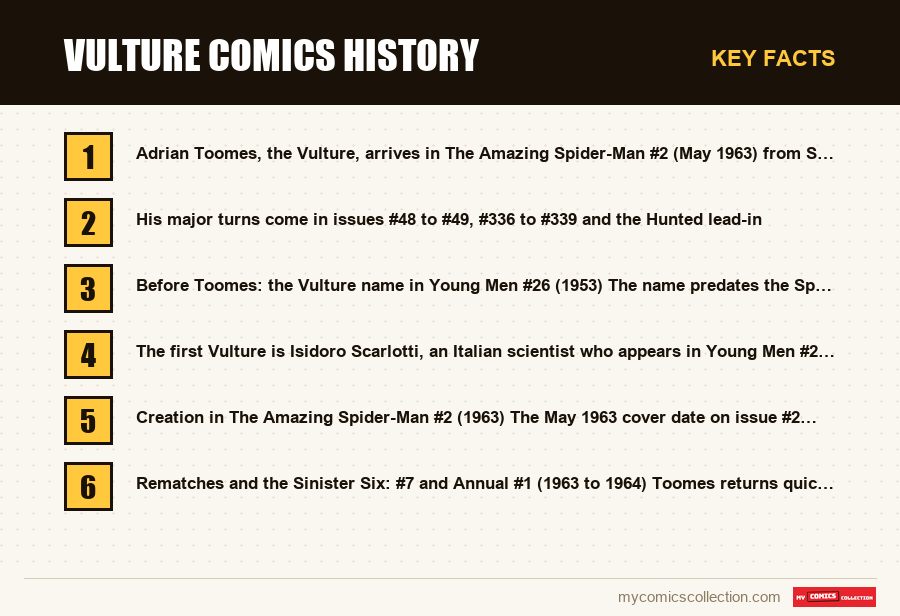
Adrian Toomes, the Vulture, arrives in The Amazing Spider-Man #2 (May 1963) from Stan Lee and Steve Ditko, an elderly electronics tinkerer in a winged harness. He is a founding member of the Sinister Six, loses the costume to a cellmate, shares the name with later wearers, and keeps returning as a weathered street-level threat. His major turns come in issues #48 to #49, #336 to #339 and the Hunted lead-in.
Adrian Toomes is one of those characters who ages in real time on the page. He debuts as a man past his prime, and almost every decade since has asked what a flier with a failing body and a long criminal record can still do against a teenager from Queens.
Every Toomes issue number, cover year and creator named below was matched to reference listings before it went in, and any detail we could not match was dropped. The commentary on what each period means for a shelf is ours alone and avoids price talk.
Before Toomes: the Vulture name in Young Men #26 (1953)
The name predates the Spider-Man character by roughly a decade. The first Vulture is Isidoro Scarlotti, an Italian scientist who appears in Young Men #26, dated December 1953, created by Joe Gill and Carl Burgos. Toomes is the second character to carry the name, and the Vultures who follow are best read as a family of costumes sharing a brand rather than a single continuous character.
For a collector this matters in one practical way. When a listing says "Vulture first appearance," ask which Vulture is meant. The Scarlotti story and the Toomes story are different characters in books a decade apart, and only one of them belongs to the Spider-Man run you are probably building.
Creation in The Amazing Spider-Man #2 (1963)
The May 1963 cover date on issue #2 marks the arrival of Toomes. Lee and Ditko built him in the second number of a brand-new series, and with him the book gains a flying menace. In the story, Toomes robs across New York in a winged harness until Spider-Man builds a device that stops the harness from working, knocking Toomes unconscious, and he is arrested.
The design is the thing that lasts. A man in a green winged harness reads as a bird of prey at a glance, and the harness gives Ditko a way to stage fights above the street, where a web-swinger is at a disadvantage. The same issue is a double debut with the Tinkerer, which is why the dedicated issue guide spends its time on the book itself. This page follows the character after that, across six decades.
Rematches and the Sinister Six: #7 and Annual #1 (1963 to 1964)
Toomes returns quickly. In The Amazing Spider-Man #7 he modifies his harness and tries to rob the Daily Bugle payroll, which establishes the pattern that defines him for years: a technician who improves his equipment after each defeat and aims at the same targets. The Bugle is not a random location. It ties the Vulture to Peter Parker's working life, and it keeps the rogue rooted in the same few city blocks.
The oversized special of October 1964 widens his world. Doctor Octopus builds a villain team there, and Toomes takes a seat at the table, and in the story he is the last of the group Spider-Man faces before Octopus himself. The hero lassoes him, and Toomes then gives up the location of Octopus's lair before he is jailed. That sequence tells you something about the character that holds up for decades. He is a professional, not a fanatic, and a professional will trade information when the plan fails.
That annual is also the book that begins the long tradition of the Vulture as a member of larger teams rather than a headliner. To read the same annual from the bandleader's chair, turn to the Doctor Octopus comics history.
The stolen suit: Blackie Drago in #48 to #49 and #63 to #64 (1967 to 1968)
Issue #48 of The Amazing Spider-Man brings a second major turn, and its new character, Drago, is credited to Lee and Romita Sr. Toomes is in prison and believes he is dying. He tells his cellmate Blackie Drago where a spare Vulture outfit is hidden, and Drago, who had caused the accident that hurt Toomes, takes the suit and escapes. The issue is dated 1967. In #49 Drago teams up with Kraven the Hunter.
The reversal lands in #63 and #64. Toomes recovers from his injuries, escapes prison, and defeats Drago in #63. In #64 he nearly beats Spider-Man, injuring the hero's arm, until Spider-Man tricks him into close range and damages his power pack, forcing a retreat. The takeaway for the character is that the Vulture is not a single suit. The identity belongs to the wearer who can make it work, and Toomes proves that by taking it back from a man who had stolen it.
If you are following the title past the Ditko years, the Drago storyline is a clean example of a book changing hands creatively while its villains stay in play, with John Romita Sr. credited as co-creator of the new wearer.
Another Vulture: Clifton Shallot in #127 to #128 (1973)
The next wearer of the name is Clifton Shallot, who debuts in The Amazing Spider-Man #127, dated February 1973. The creators credited are Ross Andru, Gerry Conway and John Romita Sr. Shallot is a different kind of Vulture. His story in #127 and #128 is built around his mutation, and it makes the point that the name can attach to a very different person than the elderly flier of the 1960s.
It is easy to overlook this pair because it does not feature Toomes. But for anyone tracing how the name works, #127 is the issue where it is clearest that Marvel treats Vulture as a title that can pass between people. The Conway run is also covered from the writer's side under Gerry Conway's author page, which helps if you are building the 1970s stretch of the series.
Hostages, a nursing home and Nathan Lubensky: #224, #240 to #241 and #336 to #339
By the early 1980s Toomes is a recurring, grounded menace rather than a spectacle. In The Amazing Spider-Man #224 he hides in a nursing home where Nathan Lubensky lives, Peter Parker recognizes him, and Toomes grabs Nathan as a hostage before shoving his wheelchair at Spider-Man and escaping. The scene is small, but it introduces the supporting character who will matter to the Vulture's story later on.
In #240 and #241 Toomes returns to avenge himself on Bestman, his embezzling former partner. The motive is personal and financial, which is exactly the register of the original character, a man with a grievance against a former partner.
The payoff comes in #336 to #339. Toomes is hired by the Kingpin to assassinate a high-ranking casino runner. In a separate clash, Nathan grabs Toomes, suffers a fatal heart attack and dies in May Parker's arms. This arc ties the Vulture to the Parker family's circle of friends in a way few rogues are tied, and it is the story that gave the character weight beyond the gimmick.
Do you collect this series?
Track what you own, what you are missing and what your collection is worth. 7-day trial.
Start my trial →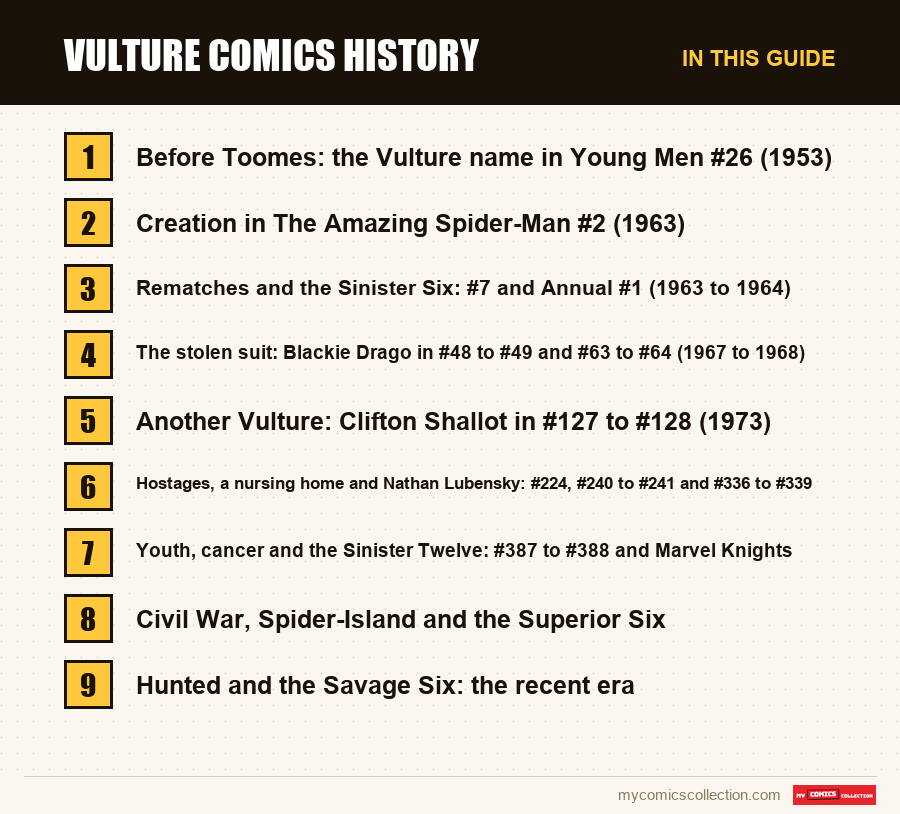
Youth, cancer and the Sinister Twelve: #387 to #388 and Marvel Knights
The mid-1990s sequence of issues #387 and #388 is the most unusual stretch of the Vulture's career. In #387 Toomes uses a device to swap youth with Spider-Man, but the effect wears off within hours. In #388 he absorbs the life force of a Mary Parker android, regains his youth, and is cured of cancer. His old age returns after David Kalen's power negates the youth effect, but the cancer does not return.
It is worth reading these as a character experiment. The Vulture's age and illness had been part of the identity since #48, and this story tests what he does when both are removed.
In Marvel Knights Spider-Man (2004) he is a member of Norman Osborn's Sinister Twelve in #9 to #12, wearing a helmet after the Black Cat slashed his face, and issue #2 of the same series shows his friendship with Electro. For readers following the Osborn thread, the Black Cat comics history shows the other side of that wound.
Civil War, Spider-Island and the Superior Six
The late 2000s and early 2010s put Toomes into the larger event machinery. In Civil War #2 (2006) Captain America's Resistance captures him together with Grim Reaper and Trapster, chains him to a pole and breaks his nose before S.H.I.E.L.D. takes him into custody. He is later shown in his cell after Spider-Man unmasks, saying he thinks the hero will have trouble.
During Spider-Island, in The Amazing Spider-Man #674 and #675, Toomes leads a gang of thieves with vulture-like wings. He secretly controls their wings, and Spider-Man catches the gang with magnetically sensitive webbing. In Superior Spider-Man Team-Up #5 to #7 he is one of the Superior Six, forced into heroic deeds as an act of redemption until the team breaks free and nearly destroys New York.
In this period the Vulture works as a recurring piece in someone else's story. That is a legitimate way to enjoy him, but it also explains why the late-period appearances are scattered across event books rather than collected in one place.
Hunted and the Savage Six: the recent era
In the lead-in to Hunted, The Amazing Spider-Man vol. 5 #16 shows Taskmaster and Black Ant capturing Toomes for Kraven the Hunter, and Arcade groups him with other captives as the Savage Six. The point is notable for the relationship between the two characters. The old flier who once chased the hero is now prey for a hunter, and the story takes the Vulture back to a smaller, more fragile place.
Other recent appearances include Miles Morales: Spider-Man #10 and Uncanny Spider-Man #1. Treat them as supporting-cast roles and not as a definitive modern run.
The key issues across the Vulture's history
- The Amazing Spider-Man #2 (1963): debut of Adrian Toomes, with the Tinkerer.
- The Amazing Spider-Man Annual #1 (1964): Toomes joins the original Sinister Six.
- The Amazing Spider-Man #48 (1967): Blackie Drago steals the Vulture suit.
- The Amazing Spider-Man #63 (1968): Toomes escapes prison and defeats Drago.
- The Amazing Spider-Man #127 (1973): debut of Clifton Shallot as a Vulture.
- The Amazing Spider-Man #339 (1990s): the end of the Lubensky arc that begins in #336.
- The Amazing Spider-Man #388 (1990s): the youth and cancer story concludes.
- Civil War #2 (2006): Toomes is captured by Captain America's Resistance.
How to follow the Vulture in a collection
Start with the main The Amazing Spider-Man run, since almost every turning point above sits in it. Build the 1963 to 1968 block first (#2, #7, Annual #1, #48 to #49 and #63 to #64), then add #127 to #128 for the Shallot detour, and finally the Lubensky and youth arcs in the 300s. The annuals are a separate numbering sequence, so double-check that a listing says Annual #1 and not issue #1 of anything else.
For reprints, match the issue numbers to a collected edition's contents page before buying. The Vulture often appears as one of several characters in a collected volume, and the table of contents tells you whether the issue you want is actually included. You can also browse more guides on the blog to compare editions as you go.
Frequently asked questions
Collectors looking for the Toomes debut want the second issue of the Spider-Man series, with a May 1963 date and a Lee and Ditko credit. An earlier character called the Vulture, Isidoro Scarlotti, appears in Young Men #26 in December 1953, created by Joe Gill and Carl Burgos, but he is a different person and not part of the Spider-Man series.
Blackie Drago takes the suit in The Amazing Spider-Man #48 after Toomes tells him where it is hidden, and Toomes retakes it in #63. Clifton Shallot debuts in #127 in February 1973. Jimmy Natale, created by Mark Waid and Mike McKone, later joins the line of wearers in the same series.
Yes. Toomes holds a spot among the six villains Doctor Octopus brings together in the 1964 annual. In that story he is the last of the group Spider-Man faces before Octopus, and he gives up Octopus's lair before being jailed.
Nathan Lubensky is a resident of a nursing home where Toomes hides in The Amazing Spider-Man #224. In issues #336 to #339, during a later clash, Nathan grabs Toomes, then dies of a heart attack in May Parker's arms.
Read The Amazing Spider-Man #2, Annual #1, #48 to #49 and #63 to #64 for the classic arc, then #336 to #339 for the Lubensky story and #387 to #388 for the youth experiment. Our guide to the best Vulture comics gives a longer reading order.
Own an early Vulture issue? Get a quick estimate for your copy.
Estimate my comic