In short
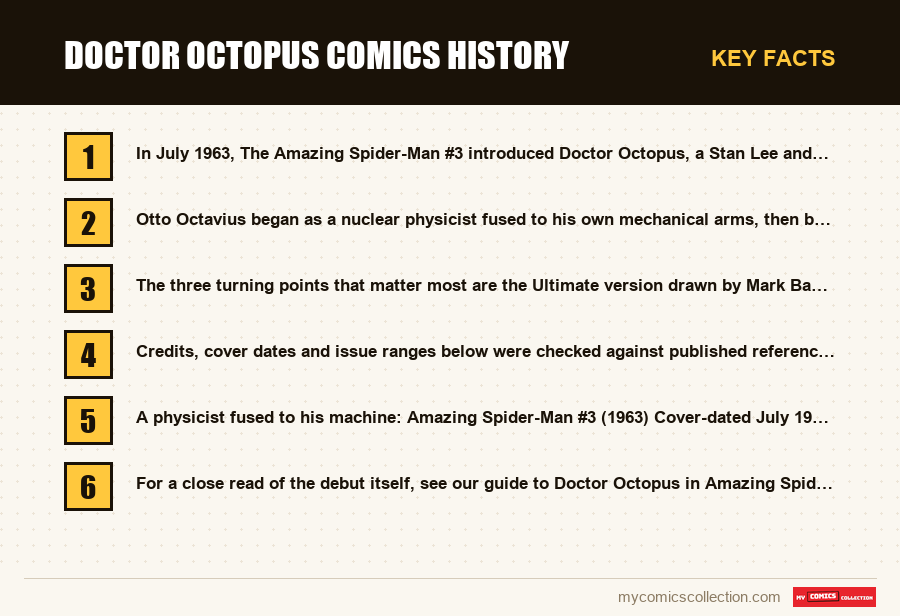
In July 1963, The Amazing Spider-Man #3 introduced Doctor Octopus, a Stan Lee and Steve Ditko creation. Otto Octavius began as a nuclear physicist fused to his own mechanical arms, then became the organizer of the Sinister Six in Annual #1 (1964) and the Master Planner of #31-33. The three turning points that matter most are the Ultimate version drawn by Mark Bagley, Dan Slott's Ends of the Earth (2012), and the body swap in #700 that led to The Superior Spider-Man (2013-2014).
Few Spider-Man villains have been rewritten as often as Otto Octavius, and few have survived the rewrites so intact. The scientist with four steel tentacles is a fixed image, yet the man inside the harness has been a laboratory casualty, a suitor, a strategist, a dying man and, for a stretch of two years, the person wearing Peter Parker's body. Following him through the comics means following how Marvel's editors and writers changed their minds about what a Spider-Man villain is for.
Credits, cover dates and issue ranges below were checked against published references for six eras: the 1963 debut, the 1960s arcs, the 1990 team stories, the Ultimate run, Slott's 2012 finale and the Superior Spider-Man volumes. The reasons we give for a story's weight, and the shelving advice, are opinion, and the page carries no prices.
A physicist fused to his machine: Amazing Spider-Man #3 (1963)
Cover-dated July 1963, The Amazing Spider-Man #3 is where Otto Octavius walks in, courtesy of Stan Lee and Steve Ditko. The result is a nuclear physicist who builds a rig of mechanical limbs to handle hazardous material, then watches a laboratory accident weld the rig to his body. The character who walks out of that accident is not a thief or a monster. He is a scientist whose own invention has turned on him.
That choice defines everything that follows. Peter Parker is a teenager whose science, an irradiated spider, made him strong. Octavius is an adult whose science made him dangerous. The mirror is built into the debut, and nearly every later writer who takes the character seriously returns to it. For a close read of the debut itself, see our guide to Doctor Octopus in Amazing Spider-Man #3.
The conductor of villains: Annual #1 and the early returns (1964)
Octavius does not stay a one-issue threat. He returns in The Amazing Spider-Man #11-12 and then anchors the first Annual, cover-dated October 1964 and again credited to Lee and Ditko. After escaping custody, Octavius signs up five enemies of the hero (Electro, Kraven, Mysterio, Sandman, the Vulture) and holds Aunt May and Betty Brant as bait. Spider-Man beats the team one by one.
The annual changes the character's function. In #3 he is a fighter with a gimmick; in the annual he is an organizer, the man who sees that five defeated enemies can be turned into a weapon if someone coordinates them. Octavius has generally stayed the leader through the team's many lineups since, and that habit of leadership is what separates him from the villains he recruits. Our Sinister Six reading guide traces the team across the decades.
The Master Planner: Amazing Spider-Man #31-33 (1965-1966)
The Ditko era peaks with The Amazing Spider-Man #31-33, where Octavius operates under the alias Master Planner, organizing thefts of atomic equipment while Peter Parker races to recover the means of saving Aunt May. Ditko drew the run until issue #38 and Lee wrote it, so the full trilogy sits inside the original creative team.
What changes for the character is scale. Before this story Octavius is the villain Spider-Man meets; after it he is a villain who can nearly take the hero apart. The final chapter in #33 is remembered because it pins Spider-Man under heavy machinery, and it is the scene readers most often cite when they argue that the sequence is a high point of the early series. Whatever you make of that ranking, the three issues give Octavius his reputation as an intellect who plans rather than a thug who swings.
After Ditko: Aunt May, a near-wedding and a tragedy (1966-1970)
When Steve Ditko left after #38, John Romita Sr. took over the pencils with #39 (August 1966) while Stan Lee kept writing until #100. In the years that follow, Octavius gets the strangest turn in his early life: he comes close to marrying Aunt May. It sounds like farce on paper, and that is part of its function. A villain who can sit at a kitchen table is a villain with a social life, and the Romita era wanted its cast to feel like neighbors.
The Lee era gives Octavius a darker association in 1970. In The Amazing Spider-Man #90 (November 1970), Captain George Stacy dies while watching Spider-Man battle Doctor Octopus on a rooftop high above the city. Stacy is Gwen's father, and his death is one of the heavy debts Peter Parker carries until Gwen herself dies in #121 (June 1973). The blame for Stacy's death does not sit entirely on Octavius, but it is his battle that puts the captain in the street.
The 1990 returns: Sinister Six, rebuilt and betrayed
By 1990 the monthly book is in the middle of David Michelinie's long writing run. In that stretch Octavius stages "The Return of the Sinister Six" in The Amazing Spider-Man #334-339, recruiting Electro, Sandman, Mysterio, the Vulture and Jason Macendale's Hobgoblin for a world-domination plot. Sandman ends up helping Spider-Man stop it. The structure repeats the 1964 annual on a larger canvas, and it shows how much the character had become a template: the villain who builds a team from the defeated.
The companion story runs in the separate Spider-Man series, in issues #18-23, under the title "Revenge of the Sinister Six." Here the team turns on Octavius, with Electro, Mysterio, the Vulture and Hobgoblin moving against him, and he defeats them using new adamantium arms. The reversal matters. A conductor who is betrayed by his orchestra has to rely on the one thing he built himself, his arms, and the story turns Octavius from a leader into a survivor.
The Ultimate Octavius (2000-2010)
In 2000 the Ultimate imprint rebooted the hero as Ultimate Spider-Man, with Brian Michael Bendis scripting and Mark Bagley drawing, and Octavius gets rebuilt from scratch. In this version he is a scientist working for Norman Osborn, and the explosion that turns Osborn into the Green Goblin also fuses four cybernetic arms to Octavius. The origin is therefore folded into the hero's own origin rather than set beside it.
The version's most consequential story is the Ultimate Clone Saga, where Octavius is revealed to have played a major role in creating Peter Parker's clones. Bagley penciled the series until issue #111 (2007), when Stuart Immonen took over. The Ultimate Octavius dies in the "Death of Spider-Man" storyline, murdered by Norman Osborn.
For anyone building a character collection, the Ultimate material is worth separating from the main-universe issues. The same name, the same arms and the same city appear, but the continuity is its own, and mixing the two lines on a single checklist invites confusion about what happened to whom. The cleanest approach is to keep a short list for each universe and note where they diverge.
Do you collect this series?
Track what you own, what you are missing and what your collection is worth. 7-day trial.
Start my trial →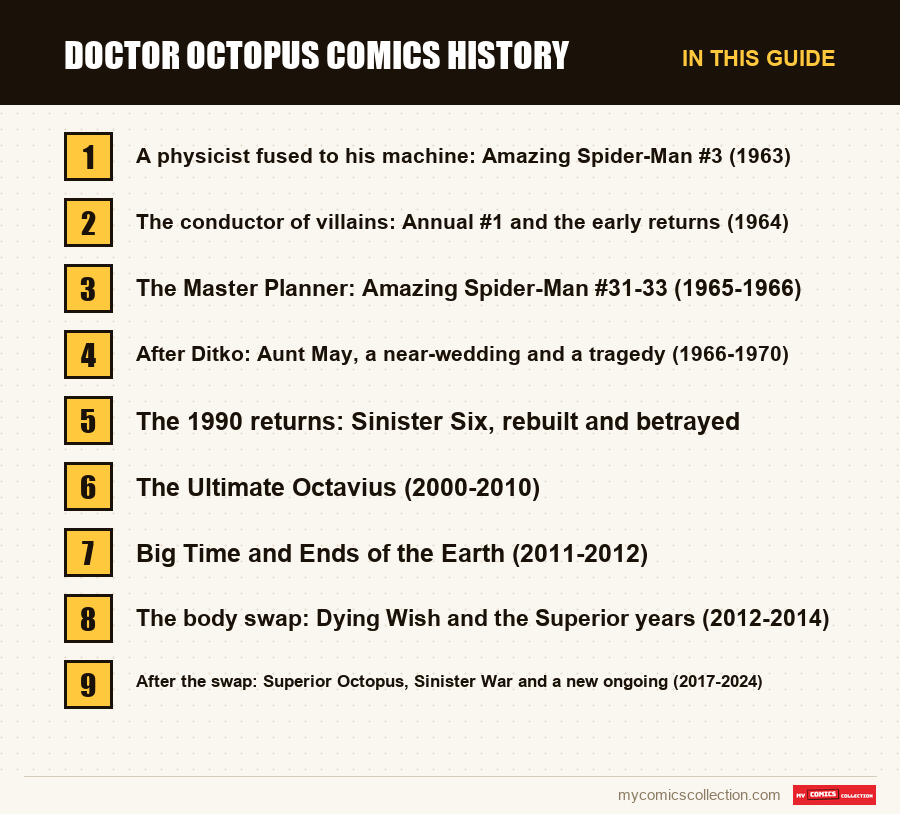
Big Time and Ends of the Earth (2011-2012)
Dan Slott became the sole writer of The Amazing Spider-Man with issue #648 in January 2011, launching the "Big Time" era, and the Sinister Six begins to reappear around that point. The storyline that matters most for Octavius is "Ends of the Earth," which ran through issues #682-687 in 2012. In it Octavius leads the team in a plan to conquer the world, using what the story calls the Octavian Lens, a device that speeds up the greenhouse effect, and an international gathering of world leaders at the Palazzo Senatorio meets to hear his offer. Spider-Man stops him.
The plot is a clear escalation from the villain who once wanted to marry Aunt May: Octavius has gone from the private to the global. Slott wrote the whole stretch, so the Big Time premise and the 2012 climax read as one design. Our Dan Slott archive lists the related guides.
The body swap: Dying Wish and the Superior years (2012-2014)
The turning point of the modern era comes in the "Dying Wish" storyline. Octavius's Superior Spider-Man persona debuts in The Amazing Spider-Man #698 (November 2012), and in #700 Octavius and Peter Parker swap bodies, with Peter dying in the process. That issue closes the original numbering. Then comes The Superior Spider-Man #1, released in January 2013: Dan Slott writes, and the art is split among Ryan Stegman, Humberto Ramos and Giuseppe Camuncoli.
For the next 33 issues, running from January 2013 to September 2014, Octavius tries to be a better Spider-Man than Peter. The "Goblin Nation" storyline runs through issues #27-31 and reveals Norman Osborn as the Goblin King. In issue #30, Octavius allows Peter to take back control of his body, and the series ends with issue #31 settling the fate of Peter's mind. A relaunched The Amazing Spider-Man #1 followed in 2014.
The stretch makes Octavius a protagonist, and the reason it works is the groundwork laid across fifty years. A reader who knew only the 1963 debut might find the premise absurd; a reader who has followed his arc from the Master Planner to the Ends of the Earth finds it a logical culmination. Our Superior Spider-Man reading order lays out how to read the run.
After the swap: Superior Octopus, Sinister War and a new ongoing (2017-2024)
The swap left a mark that later writers have kept using. The Superior Octopus identity debuted in The Amazing Spider-Man #25 in May 2017, and a second Superior Spider-Man volume launched in December 2018 with Christos Gage writing and Mike Hawthorne drawing. In the "Sinister War" storyline, Kindred promises to restore Doctor Octopus's lost memories if he gathers more allies, and the rebuilt Sinister Six, with Mysterio among the recruits, appears in the fifth volume of The Amazing Spider-Man, issues #67-70.
In October 2023 Superior Spider-Man Returns marked the character's tenth anniversary, and it led into a new ongoing series from November 2023, written by Dan Slott and drawn by Mark Bagley, the artist who had drawn the Ultimate version of Octavius.
The key issues across his history
- The Amazing Spider-Man #3 (1963): the debut of Doctor Octopus, by Stan Lee and Steve Ditko.
- The Amazing Spider-Man Annual #1 (1964): Octavius assembles the original team.
- The Amazing Spider-Man #33 (1966): the closing chapter of the Master Planner trilogy.
- The Amazing Spider-Man #90 (1970): Captain George Stacy dies during Spider-Man's rooftop battle with Doctor Octopus.
- The Amazing Spider-Man #334 (1990): the opening of "The Return of the Sinister Six."
- The Amazing Spider-Man #700 (2012): the body swap that ends the series.
- The Superior Spider-Man #1 (2013): Dan Slott and Ryan Stegman launch the Octavius-as-Spider-Man run.
- The Superior Spider-Man #30 (2014): Octavius allows Peter to take back control of his body.
How to follow Doctor Octopus in your collection
The numbered Amazing Spider-Man run is the backbone here, because nearly every landmark above sits in it; slot the 1964 Annual next to #3. Treat the Ultimate material as a separate shelf, and keep The Superior Spider-Man as a self-contained run of 33 issues with its own relaunches in 2018 and 2023. The numbering is the main trap: the original series ends at #700 in 2012, the 2014 restart begins again at #1, and later volumes restart again, so a bare issue number is ambiguous without a year or a volume.
Reprints are a second trap. Collected editions of the Ditko run reuse stories in different formats, and the cover date on the original issue is the reliable way to tell an original from a later printing. A checklist that records the volume, number and cover year for each entry stays clear of both problems. For a wider map of the series, see the key issues of The Amazing Spider-Man.
Frequently asked questions
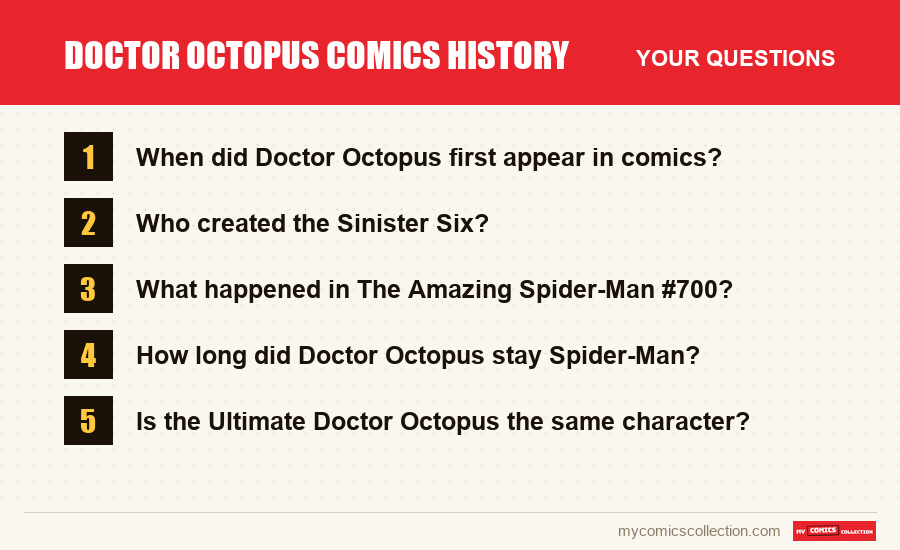
Stan Lee and Steve Ditko produced the debut, The Amazing Spider-Man #3, whose cover reads July 1963. Otto Octavius is a nuclear physicist whose mechanical arms are fused to his body in a laboratory accident, and the character has remained one of the hero's central enemies ever since.
Stan Lee and Steve Ditko launched the team in The Amazing Spider-Man Annual #1 (October 1964). Octavius was the recruiter of the original five, and he has usually kept the leader's chair across later lineups.
Issue #700 concludes the "Dying Wish" storyline, in which Peter Parker and Doctor Octopus swap bodies and Peter dies. The original series ends there, and The Superior Spider-Man #1 follows in January 2013, written by Dan Slott, with Octavius living as Spider-Man.
The first volume of The Superior Spider-Man ran 33 issues from January 2013 to September 2014. In issue #30 Octavius allows Peter to take back control of his body, and a relaunched The Amazing Spider-Man #1 followed in 2014.
No. Bendis and Bagley built that Octavius for the Ultimate line, a continuity separate from the main one. That Octavius works for Norman Osborn, is fused to his arms in the same explosion that creates the Green Goblin, and dies in the "Death of Spider-Man" storyline.
If you hold a copy of The Amazing Spider-Man #3 or the 1964 Annual, you can have it valued before you decide how to keep it.
Estimate my comic