In short
Look for The Amazing Spider-Man #3, dated July 1963 on the cover, to find Doctor Octopus in his debut. Lee scripted and Ditko illustrated this one. Otto Octavius, a nuclear physicist, builds mechanical arms for his research; a radiation accident welds the rig to him and sends him toward crime. The issue is the third of the series, and it introduces the character who later founds the Sinister Six.
If issue #2 gave Spider-Man a villain with a flying gadget, issue #3 gave him one with a body that the gadget had become part of. The book is short, fast and strange in the way early Marvel comics often were, and it set up a character who would outlast most of the cast of the first year.
For this page we checked the July 1963 date, the Lee and Ditko credit, the origin details of the first story, the later issues named below and the contents of the first Masterworks volume against published reference material. What we say about grading and about how to buy is analysis, and no prices appear anywhere in it.
The issue at a glance: date, credits and what it contains
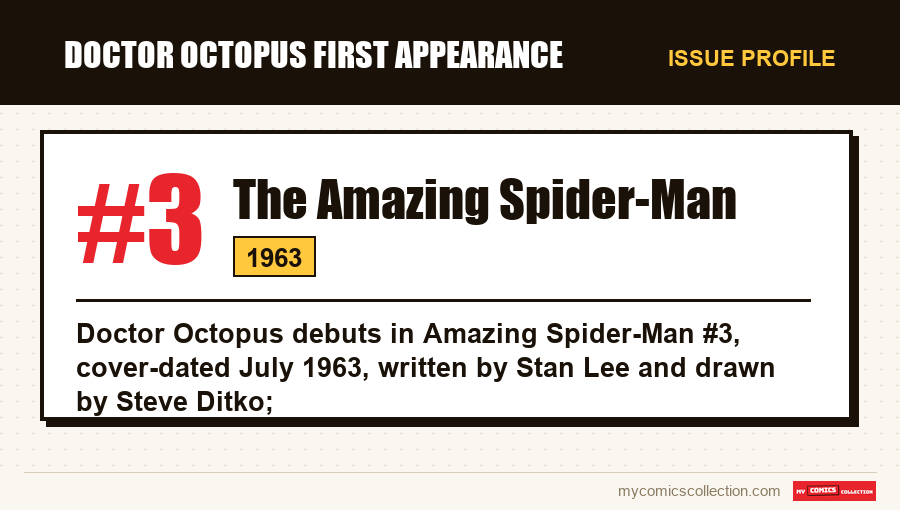
The Amazing Spider-Man #3 is cover-dated July 1963. Reference histories give Lee and Ditko the whole stretch from issue #1 to #38, with Lee on script and Ditko on pencils. In the early numbers Ditko also shaped the plots, which is why the visual invention of the book, from the arms to the laboratory, is so closely tied to his drawing.
The issue's selling point is a single debut: Doctor Octopus. It is a one-villain book, unlike the issue before it, which introduced both the Vulture and the Tinkerer. When you identify a copy, check three things on the cover and indicia: the title The Amazing Spider-Man, the number 3, and the July 1963 date. Those three together distinguish it from reprints, which reuse the story under different cover dates and different formats.
The book sits between the Vulture issue and the later Silver Age numbers that introduce the Sandman and the Lizard, and it puts a scientist, rather than a thief or a monster, opposite Peter Parker. That choice shapes everything the character becomes.
How Doctor Octopus is introduced
The origin in the first story is compact. Otto Octavius is a nuclear physicist who designs mechanical arms, controlled by a connection to his own brain, to handle dangerous materials in his research. During a radiation leak and explosion, the apparatus becomes fused to his body. He later gains telepathic control over the arms, takes a hospital hostage and adopts the name Doctor Octopus, a name taken from a derogatory nickname given to him by his co-workers.
That construction is worth pausing on. Spider-Man's own powers come from a radioactive accident, and Octavius's transformation comes from a radiation accident too. The parallel is not accidental, and later writers lean on it: the physicist whose science made him dangerous and the student whose science made him powerful are mirror images. When a reviewer says that Octavius is the man Peter might have become without a sense of responsibility, this is the structure they point to.
The first story is also notable for what it does with the hero. Doctor Octopus is noted for defeating Spider-Man in their first battle, which makes the meeting more threatening than the two issues before it.
We have left the specific resolution of the story out of this page. It is a ten-minute read, and the pleasure of the issue lies partly in watching how Ditko stages the confrontation.
Who created Doctor Octopus, and how
Lee and Ditko are the credited creators. Lee's own account of how the character came about is that he usually began with a name and built the figure around it: he thought of an octopus, wanted the character to have extra arms "just for fun," and then had to work out how to make that plausible. That is the most reliable sentence we have on the origin of the idea, and it is a good example of the Marvel method in the early 1960s, where a name or an image arrived first and the science was worked out afterward.
Ditko's contribution was the execution. The four metal limbs, the visual rhythm of a man whose arms move in a different way from his body, and the staging of the fights are his work on the page. The character looks like a gadget villain at first glance, but the drawing keeps him human, and the round dark glasses Ditko gave him in 1963 are still the shorthand for him today.
For the draftsman behind Octavius, read the profile of Steve Ditko; for the scripter, a reading path through Stan Lee.
Why issue #3 is a key book
The case for #3 rests on what Doctor Octopus becomes. He reappears in The Amazing Spider-Man #11 and #12, and in #31 to #33, the three-issue sequence in which he is revealed as the Master Planner. The Annual numbered 1, with an October 1964 date, is where he assembles the original Sinister Six, a roster that counts the Vulture among its members. He is also noted for coming close to marrying Peter's Aunt May.
It helps to separate what kind of key this is. It is a debut of a major antagonist, not an origin of a hero, and its appeal is the permanence of the character: he has been the lead villain of the series for decades, and he is the face of the Sinister Six. There is also a film layer. Alfred Molina played Doctor Octopus in Spider-Man 2 (2004), and the character has returned in later screen projects. A screen appearance does not change which comic is the first, but it is the reason a casual buyer might ask about #3.
It also helps to keep the issue in position. Issue #3 sits close to the beginning of the series. The first ten issues are the most contested numbers of the run, and they are collected together in the first Masterworks volume. If you are pursuing that stretch, our guide to issue #1 and the page on Spider-Man's debut frame the period.
Do you collect this series?
Track what you own, what you are missing and what your collection is worth. 7-day trial.
Start my trial →
Reprints and the issues most often mixed up with it
The original comic is the first printing. Volume 1 of the Masterworks hardcovers for this title appeared in November 1987 and gathers the Amazing Fantasy #15 story with the series' first ten numbers, which puts Octavius's debut inside. Other formats exist, so check the contents of the specific edition before describing it to anyone.
Several mistakes recur in listings. A seller may mean the first Sinister Six story, which is the Annual of October 1964 and not #3. A buyer may be looking for the Master Planner sequence, which is #31 to #33. Another confusion is with the Superior Spider-Man era, in which Otto Octavius takes over Peter's life, a modern story with no relation to the 1963 book beyond the character. If a listing says "Doc Ock first appearance," the only issue that matches is #3.
A reprint, however attractive, is a different object. If the date in the indicia is not July 1963 or the paper looks modern, the book is a later edition and should be priced and described as such.
What to check before buying a copy
For a 1963 newsstand comic, the checks follow a fixed order, and the first few reveal most problems.
Begin with the spine and the staples. Spine stress lines and color breaks show where the comic was folded and read. Staples should look original; rust, replacement and loose pages are signals. A comic from the first year of the series that has a clean spine and honest corner wear is often a better buy than a copy with a perfect front and a doubtful back.
Examine the cover in raking light for color touch, reglossing, glue, tape and fills along creases. These are the most common restoration traces on early Marvel books, and they are easier to see at an angle than straight on.
Look at the interior pages, particularly the edges and the centerfold. Browning, brittleness and chipping tell you about storage, and a copy that is bright on the cover but brittle inside has had a different life from what the cover suggests. Check that no pages or coupons are cut or missing.
If the book is encapsulated, read the label. A label will say whether the copy is unrestored or carries a restoration note, and that note is part of what you are buying. For an ungraded copy, have the seller photograph the spine, staples, corners and inner pages before you commit. Line them up against other examples of #3 to learn what ordinary aging looks like on this particular book.
One more habit pays off with a July 1963 book: look at the front cover for the Doctor Octopus figure and the logo, where the ink and the paper show the most handling, and check the back cover for stains and writing. Owners of the period often wrote names or dates on covers, and a small inscription is not damage in the usual sense, but it should appear in the description. Compare the page edges with the cover as well, since a trimmed or uneven edge can indicate that the book was cut down to hide wear.
Do not rely on the grade alone. Two copies with the same number differ in eye appeal, and a lower-grade copy that is honest and stable can be a better long-term piece than a higher-grade copy with unknown work. Our free comic valuation can give you an idea of where a copy you own sits, and we deliberately quote no figures on this page.
The appearances that follow, in the order to buy them
A compact set built around Doctor Octopus has a clear logic, and it fits on a short shelf.
Start with #3 if the budget allows. Then add #11 and #12, where he returns, and the three-issue sequence in #31 to #33, which is the story many fans consider the center of his early career. The first Annual of October 1964 follows, as the debut of the Sinister Six. Beyond the Silver Age, the later stories that reshape him, including the Superior Spider-Man run, are in our ranked guide to the best Doctor Octopus comics, which treats the character's career as a whole. This page is about the book you hold.
For someone starting from nothing, the first Masterworks volume is a way to read the opening of the series before committing to original issues, and a single mid-grade copy of #3 is a respectable anchor for a collection. A reader who only wants the stories can skip the originals entirely; a collector who wants the debut should make sure the copy is what the listing says it is.

Frequently asked questions
Issue #3 of The Amazing Spider-Man, from July 1963, by Lee and Ditko. Otto Octavius is introduced as a nuclear physicist whose mechanical arms fuse to his body in a radiation accident. The same issue sends him on a hospital hostage plot.
No. That story runs in the first annual of the series, October 1964, with Doctor Octopus at the head of the team. Issue #3 is his debut, and the Master Planner reveal comes later, in issues #31 to #33.
Not as a debut. The Vulture arrives in the May 1963 issue numbered 2, and Doctor Octopus follows in #3. The two villains meet as members of the same team in the October 1964 Annual, which has the first Sinister Six story.
For reading, yes: the opening Masterworks volume (November 1987) collects Amazing Fantasy #15 with the first ten issues. For collecting the first appearance, the original July 1963 comic is the object, and the reprint is a different book.
Check the spine, staples, corners, cover gloss and interior paper, and read any third-party label for a restoration note. Ask for photographs if the book is raw. Condition and honesty about repair matter more than a number alone, and no single check settles it.
Own a copy of The Amazing Spider-Man #3 or another Silver Age Spider-Man key? Get a free estimate of where it stands.
Estimate my comic