The Superior Spider-Man reading order covers a Dan Slott series published from January 2013 to September 2014, running 33 issues (legacy numbering #701 to 733), drawn by Ryan Stegman, Humberto Ramos and Giuseppe Camuncoli. Read The Amazing Spider-Man #698 to 700 first, then The Superior Spider-Man #1 to 31 in order, with the two annuals in the right places, then move on to The Amazing Spider-Man vol. 3 #1 (2014). Issues #32 and #33, which came out afterward, lead into Spider-Verse.
The series rests on a premise Spider-Man fans know well: changing who is behind the mask without changing the title. Reading it takes no long research, as long as you do not pick the wrong entry point, do not forget the annuals and know what the parallel series are worth.
As always in this guide, we only state verified facts (creators, issue numbers, dates); the analysis is our own, with no reproduction of protected pages or dialogue.
What to read before
Only one prelude is essential: the end of the The Amazing Spider-Man series, in its numbering of the time. Issues #698, #699 and #700 form the run-up to The Superior Spider-Man #1. Issue #700 marks the end of that ongoing series.
Heads up, spoiler about the premise of this series: issue #700 contains the death of Peter Parker in the story titled Dying Wish. The starting point of The Superior Spider-Man depends directly on it, which is why we flag it here rather than hide it. Everything else is left to your reading.
These three issues are written by Dan Slott, who will go on to write the entire following series. If you are discovering this writer through this run, our page Dan Slott: where to start places this prelude within his overall body of work. If you want to understand why the series restarts at one while continuing a historical count, also read Amazing Spider-Man legacy numbering.
There is no need to go back any further. The real prerequisite is having read a bit of classic Spider-Man; the Spider-Man reading guide offers entry points if that is not you.
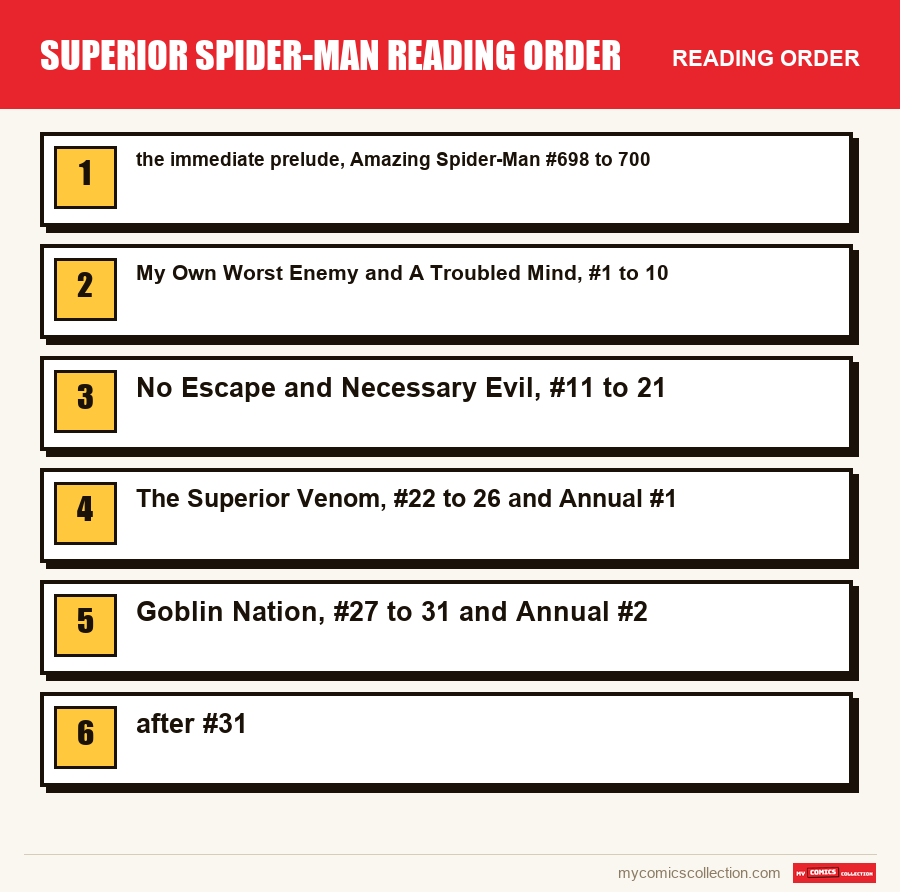
Phase 1: the immediate prelude, Amazing Spider-Man #698 to 700
Read these three issues in one go, in order. They combine the end of a cycle and the setup for what follows. Issue #700 closes the The Amazing Spider-Man series of that era, which then relaunches under another title. In a collection, they form a coherent block with the first issues of the new series; trade paperbacks often group them together, in fact (see the section on editions).
A reading tip: take the time to read all of #700 before opening The Superior Spider-Man #1. The two issues answer each other very closely, and reading the second without the first deprives the reader of understanding the starting situation.
Phase 2: My Own Worst Enemy and A Troubled Mind, #1 to 10
The series starts in January 2013. It is written from start to finish by Dan Slott; the art goes to Ryan Stegman, Humberto Ramos and Giuseppe Camuncoli, depending on the arc.
- My Own Worst Enemy: #1 to 5. The setup arc. The Spider-Bots, patrol drones, appear here, and the Sinister Six is fought. These are the five issues that set the tone of the series.
- A Troubled Mind: #6 to 10. The arc where the Avengers summon the hero and put him through tests, from #6 to #8. It deepens the character's psychology and makes it a performance in its own right rather than a simple stand-in for Peter Parker.
These ten issues read in a single stretch. There is no essential tie-in to slip in here: the series stands on its own, and it is designed so that a reader misses nothing by following it alone.
Phase 3: No Escape and Necessary Evil, #11 to 21
- No Escape: #11 to 16. A longer arc, six issues, where the situation darkens.
- Necessary Evil: #17 to 21. A five-issue arc where Spider-Man 2099 comes into play through time travel, which bears directly on the balance of the story. If that character interests you, our Spider-Man 2099 reading guide will help you place him.
These two arcs form the middle of the series, from #11 to #21: if the tone suits you up to here, what follows is in the same vein, with more consequences. The series is written by Dan Slott throughout this period, with artists alternating from one arc to the next.
Phase 4: The Superior Venom, #22 to 26 and Annual #1
The The Superior Venom arc occupies issues #22 to 26 and continues in The Superior Spider-Man Annual #1. This annual is written by Christos Gage and drawn by Javier Rodríguez and Alvaro Lopez; in this story, Spider-Man hunts Blackout after the kidnapping of Peter Parker's aunt. It sits in the same collected volume as the arc and is read alongside it.
Our advice: read the five issues of the arc, then the annual right after. For context around the symbiote, the Venom reading guide page gives the editorial landmarks without retelling the plot details.
Phase 5: Goblin Nation, #27 to 31 and Annual #2
The last arc of the main series is Goblin Nation, in issues #27 to 31. It comes with The Superior Spider-Man Annual #2, written by Christos Gage and drawn by Javier Rodríguez, centered on Phil Urich and Ben Urich. This annual is read with the arc.
Warning: the arc is described as the conclusion of the series, and reading any online recap risks robbing you of the surprise. If you want to read it all without knowing anything, go straight from #26 to #27 without consulting any summary. For context on the Green Goblin, you can turn to the Green Goblin reading guide, to be opened after the arc rather than before.
Do you collect this series?
Track what you own, what you are missing and what your collection is worth. 7-day trial.
Start my trial →
Phase 6: after #31
The direct follow-up to #31 is The Amazing Spider-Man vol. 3 #1, relaunched in late April 2014 with Dan Slott on the script. Warning, spoiler: this issue marks Peter Parker's return to the Spider-Man costume. Read it right after Goblin Nation and annual #2.
Two more issues, #32 and #33, come out afterward in August 2014. They fill a gap left by an earlier story and lead into the Spider-Verse event: read them after Amazing Spider-Man vol. 3 #1, just before tackling that event.
To go further, a new Superior Spider-Man series was published in 2018 and 2019 in twelve issues, with Christos Gage on script and Mike Hawthorne on art. It belongs to a different cycle and is not needed to understand the 2013 series.
The tie-ins you can skip
Two parallel series accompany the main series, with Superior Spider-Man Team-Up picking up from Avenging Spider-Man. They are not needed to understand the plot:
- Avenging Spider-Man: issue #15.1, then issues #16 to 22;
- Superior Spider-Man Team-Up: twelve issues, #1 to 12.
Why treat them as optional? Because Dan Slott's series tells its story from end to end: the arcs from #1 to 31 stand on their own, and these series add encounters with other characters rather than plot milestones. If you want to read them, sort them by cover date and read them between two arcs of the main series, never in the middle of an arc. It is a common-sense rule that avoids breaking the rhythm of an arc's five or six issues.
Also count the annuals in your reading plan: they are not optional in the strict sense, since they are tied to two arcs, but they are written by a different writer, Christos Gage, and read like standalone chapters.
Single issues or collected editions: how to read it
Here are the collected editions of the 2013 series and their exact contents:
- Six trade paperbacks: My Own Worst Enemy (#1 to 5), A Troubled Mind (#6 to 10), No Escape (#11 to 16), Necessary Evil (#17 to 21), The Superior Venom (#22 to 26 and annual #1) and Goblin Nation (#27 to 31 and annual #2).
- Two Complete Collections released in 2018: the first collects Amazing Spider-Man #698 to 700 and Superior Spider-Man #1 to 16, the second issues #17 to 31 with both annuals.
- Three oversized hardcover volumes: the first covers Amazing Spider-Man #698 to 700 and Superior Spider-Man #1 to 5, the second issues #6 to 16, the third issues #17 to 31 with the annuals.
- One omnibus, released in June 2023: it gathers Amazing Spider-Man #698 to 700, Superior Spider-Man #1 to 31 and both annuals.
The omnibus is the most complete for the main series: it covers the prelude, the 31 issues and the annuals. It does not contain issues #32 and #33. The Superior Spider-Man Returns omnibus, released in February 2026, collects those two issues among other things, along with Superior Spider-Man Team-Up #1 to 12 and the 2018 series. For a collector of single issues, plan to shelve #1 to 31 in ascending order, with the annuals set apart in the same box.
The key issues to know
We quote no price: a figure given here would be out of date by the time you read it. Here are the issues whose importance is established by the unfolding of the series.
- The Amazing Spider-Man #700: last issue of the ongoing series of the time, and the pivot of the whole story that follows.
- The Superior Spider-Man #1: the series opener, in January 2013, from the pen of Dan Slott.
- The Superior Spider-Man #4: the issue where the Spider-Bots appear, at the heart of the My Own Worst Enemy arc.
- The Superior Spider-Man #31: end of the Goblin Nation arc, and conclusion of the main series before the two transition issues.
- The Annual #1 and #2: written by Christos Gage, numbered separately from the series.
To value a copy, first check which cover you are holding: a standard cover and a variant cannot be compared. Then look for sales of issues of the same printing and the same condition. If you buy a lot, check that the annuals are in the lot: they are not numbered like the series. For the general logic of value in event issues and crossover series, see Spider-Man crossovers.
Recap: the complete order
- The Amazing Spider-Man #698 to 700 (Dan Slott), the prelude.
- The Superior Spider-Man #1 to 5, My Own Worst Enemy arc.
- The Superior Spider-Man #6 to 10, A Troubled Mind arc.
- The Superior Spider-Man #11 to 16, No Escape arc.
- The Superior Spider-Man #17 to 21, Necessary Evil arc.
- The Superior Spider-Man #22 to 26, The Superior Venom arc, then Annual #1.
- The Superior Spider-Man #27 to 31, Goblin Nation arc, then Annual #2.
- The Amazing Spider-Man vol. 3 #1 (2014), the direct follow-up.
- The Superior Spider-Man #32 and #33 (August 2014), transition to Spider-Verse.
- Optional: Avenging Spider-Man #15.1 and #16 to 22, Superior Spider-Man Team-Up #1 to 12, sorted by cover date.
Frequently asked questions
Start with The Amazing Spider-Man #698 to 700, which form the prelude, then follow with The Superior Spider-Man #1. If you want to go straight to the series, #1 reads on its own, but #700 gives you the keys to the starting situation.
The 2013 series runs 33 issues, published from January 2013 to September 2014, which are legacy issues #701 to 733. The main arcs cover issues #1 to 31; issues #32 and #33 set up Spider-Verse. Two annuals are added on top.
The two annuals, written by Christos Gage, are read with the arcs they attach to, the first with The Superior Venom, the second with Goblin Nation. Superior Spider-Man Team-Up is optional: the main series stands on its own.
The June 2023 omnibus covers Amazing Spider-Man #698 to 700, Superior Spider-Man #1 to 31 and both annuals. It does not contain issues #32 and #33 or the parallel series. The two-volume Complete Collections cover the same scope.
It belongs to a different cycle: twelve issues written by Christos Gage and drawn by Mike Hawthorne, published in 2018 and 2019. It is not needed to understand Dan Slott's series, which you can read on its own, from the #698 to 700 prelude through Amazing Spider-Man vol. 3 #1.
Do you own issues of The Superior Spider-Man, annuals included? Get them appraised.
Appraise my comic