
In short
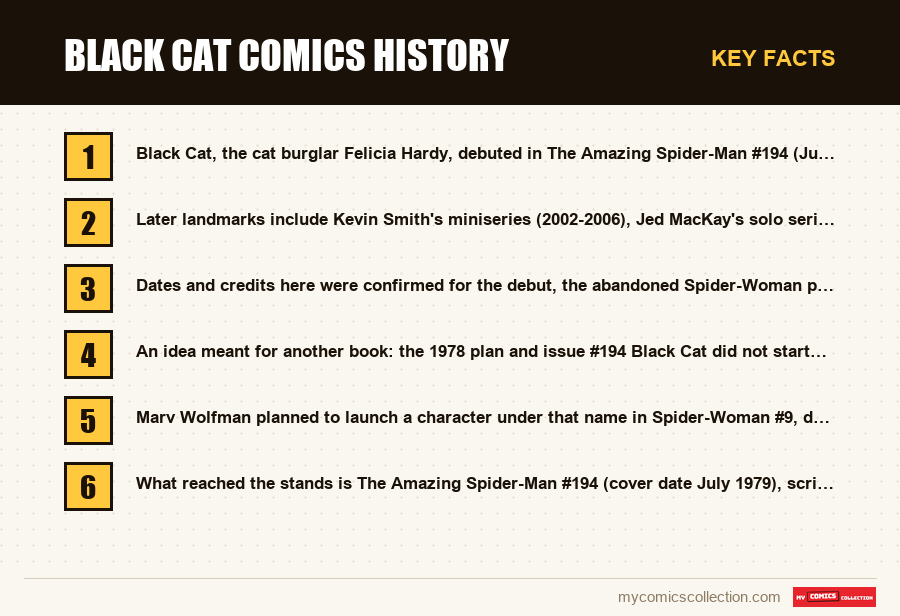
Black Cat, the cat burglar Felicia Hardy, debuted in The Amazing Spider-Man #194 (July 1979), created by Marv Wolfman and Dave Cockrum, with Keith Pollard drawing the issue. She began as an acrobatic thief with a family reason to steal, became Spider-Man's partner and romantic interest, and gained bad luck powers through the Kingpin. Later landmarks include Kevin Smith's miniseries (2002-2006), Jed MacKay's solo series (2019) and a 2025 relaunch by G. Willow Wilson.
Felicia Hardy has spent more than four decades moving between the two sides of the law, and her publication history reads like the same decision made again and again by different writers. She starts as a thief who happens to meet Spider-Man, turns into a partner, a heartbreak, a hero for hire and a crime boss, and each shift tells you something about what the editors of the day wanted from Spider-Man's supporting cast.
Dates and credits here were confirmed for the debut, the abandoned Spider-Woman plan, the 1990 short story, the Smith miniseries, the Wolverine team-up, the Heroes for Hire run and the solo books from 2019 to 2025. Judgments about what a story means for the character, and the advice on shelving, are ours. No prices appear.
An idea meant for another book: the 1978 plan and issue #194
Black Cat did not start life in Spider-Man's title. Marv Wolfman planned to launch a character under that name in Spider-Woman #9, dated December 1978, but the version that eventually appeared shared only the name and a few powers with that plan. When Wolfman moved to The Amazing Spider-Man, the character moved with him, and Dave Cockrum designed her costume and appearance.
What reached the stands is The Amazing Spider-Man #194 (cover date July 1979), scripted by Wolfman and drawn by Keith Pollard. Felicia appears as a costumed burglar who is organizing a breakout for her father, the cat burglar Walter Hardy, and the story runs into #195. The detail that sets her apart from the villains of the 1960s is motive. Her job is built around family, a father she is trying to free, and the hero arrives as an obstacle on her path rather than as the target of her plan.
That origin also shapes how collectors treat the issue. It is a full first appearance, with the character named, costumed and central to the plot, so there is no ambiguity about which number to look for. Our first appearance guide goes through the details of the issue itself.
The Wolfman years: a thief, a father and a partner
Wolfman wrote The Amazing Spider-Man from #182 to #204, so the character spent her first stretch of life with her creator at the keyboard and with the artist of her debut, Keith Pollard, on the book. The family thread resolves in a way that shapes the character for decades: Felicia had believed her father died in a plane crash, but her mother Lydia had concealed that he was in prison. Felicia broke him out so that he could die at home, and he died shortly afterward.
The arc matters because it gives Felicia a wound that does not belong to Spider-Man. Most of the hero's enemies exist because of a conflict with him. Felicia exists because of a loss of her own, and her relationship with Peter Parker develops on top of that, not in place of it. The pattern is visible in the way the writers kept returning to her: she shows up when the series wants a complicating attraction, not a straightforward threat.
By the time Wolfman leaves the series with #204, she is already marked as a character who comes back. The writers who follow take the idea further, but the groundwork is in place within the first twenty-odd issues of the book.
Returns and a partnership: #204-205 and #226-227 (1980-1982)
The next landmarks come in pairs. Felicia returns in The Amazing Spider-Man #204-205, in 1980, and again in #226-227 in 1982. A later collection, Spider-Man vs. Black Cat, published in November 2015, gathers #194-195, #204-205 and #226-227 as one reading line. Read in order, the six issues sketch her arc: opponent, then short-term ally, then a partner whose feelings for Spider-Man get more complicated.
The pairing structure is useful for collectors because it makes the character easy to track. Each return is a two-issue story, so a checklist of three pairs covers her early life in the main title with no gaps. The risk is the opposite one: because the pairs are short, it is easy to buy one half and forget the other.
Luck, a shrine and a mask removed
The middle of the character's history is where the supporting cast stops being decoration. A mysterious benefactor, later revealed to be the Kingpin, grants Felicia bad luck abilities, and Doctor Strange later removes the lingering effects and turns the power into cat-like abilities. The sequence gives the character a power set that is tied to her personality: a thief whose luck is the thing she cannot control.
Her bond with Spider-Man develops alongside it. Felicia builds a shrine to him in her apartment, and later Doctor Octopus critically injures her, which links her story to the villain whose own history we trace in our Doctor Octopus reading guide. While she recovers, Spider-Man unmasks himself to her, and she tells him to put the mask back on: she prefers the mystery to the ordinary man underneath.
After Peter marries Mary Jane Watson, Felicia dates Flash Thompson, who ends the relationship and reveals he has known her secret identity. These beats make her a mirror of Peter's own choices: she is the road he did not take, and the stories that follow keep using her in that way.
A short story with a strange production history: Marvel Comics Presents #57 (1990)
In August 1990 Marvel Comics Presents #57 carries an eight-page story called "The Crown Jewel Caper," written by Dwight Jon Zimmerman and penciled by Mike Harris. The issue has an unusual production detail: publication was delayed because the original inked art was held as evidence in a murder trial, and Josef Rubenstein re-inked the story from Zimmerman's photocopies. It is a small item, but it is a good example of the character's presence in the anthology format of the era, where a short story gave a supporting player room to carry a plot alone.
Collectors who follow the character through short stories should treat anthology issues as a separate thread. They are easy to miss on a checklist built from the main title, and they say something about her reputation: a supporting character with enough pull to anchor a short feature.
The love story that stalled: The Evil That Men Do (2002-2006)
This miniseries pairs Kevin Smith's script with Terry Dodson's pencils and Rachel Dodson's inks. It began in 2002, went on hiatus after issue #3 until 2005, and ended with issue #6 in 2006. For six issues Felicia is the subject of the story rather than a complication in someone else's, and the long gap in the schedule is part of the miniseries' legend.
The delays matter for anyone building a shelf. Issues #1 to #3 and issues #4 to #6 come from different years, so a reader who picks up the first half in single issues often waits a long time for the second. A collected edition of all six issues followed in May 2007, which is why many readers treat the collected edition as the cleanest way to read it as one story.
Do you collect this series?
Track what you own, what you are missing and what your collection is worth. 7-day trial.
Start my trial →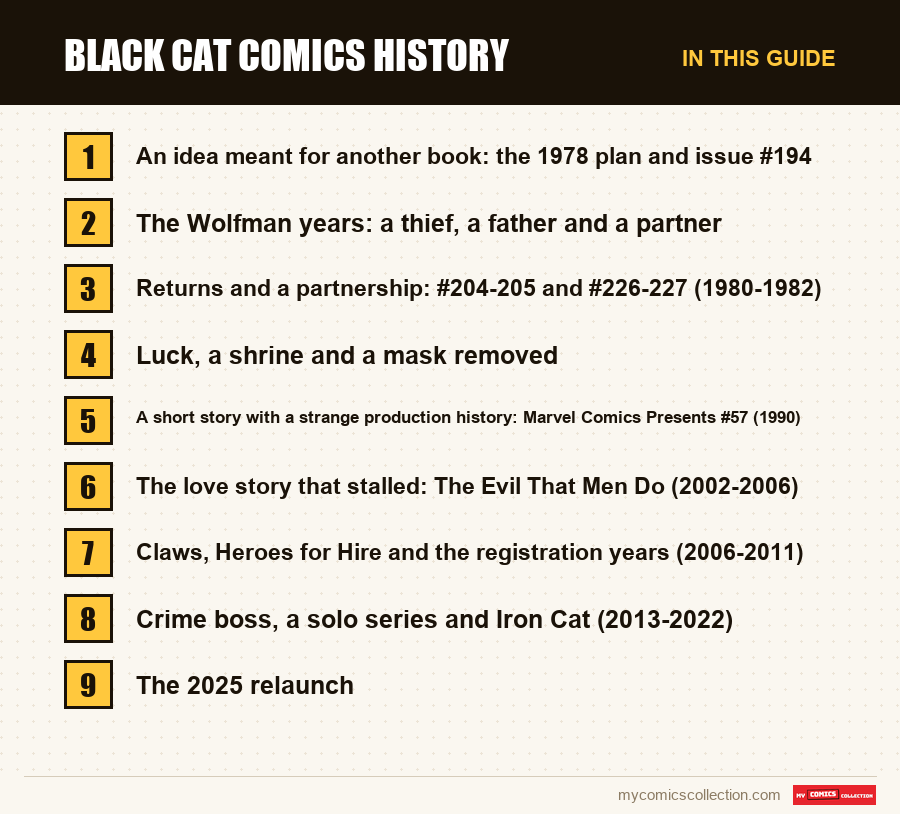
Claws, Heroes for Hire and the registration years (2006-2011)
Felicia steps outside Spider-Man's orbit in the 2006 miniseries Claws, issues #1-3, a pairing with Wolverine credited to Jimmy Palmiotti and Justin Gray on script. A sequel, Claws II, began in July 2011. In the same period she appears as a lead character in the 2006 Heroes for Hire series, and during Civil War she registers under the Superhuman Registration Act and joins Misty Knight's Heroes for Hire.
The sequence shows that the character works outside the neighborhood. In a crossover with Wolverine she carries the story on her own temperament, and in an ensemble title she shifts from outlaw to professional. Both books are useful for a collector who wants to see how far the character can be moved from her original setting without losing her voice.
Crime boss, a solo series and Iron Cat (2013-2022)
After the Superior Spider-Man treats her as a common criminal, Felicia becomes the leader of a criminal organization before returning to vigilantism. The turn echoes her family history as the daughter of a career burglar. Jed MacKay's Black Cat series debuts in June 2019, and the 2020 relaunch restarts the numbering at #1.
The solo run is followed by Giant-Size Black Cat: Infinity Score #1 in December 2021, Mary Jane & Black Cat: Beyond #1 in January 2022 and the five-issue Iron Cat in 2022. It is the widest spread of formats the character has had, and it shows how far her standing has risen from supporting role to lead.
The 2025 relaunch
The three modern runs, by MacKay, by the Iron Cat team and by Wilson, share one habit that earlier decades did not: each treats Felicia as the lead of her own book, not as a presence in a Spider-Man story. That is a long way from a first appearance in 1979 that served a two-issue plot, and it explains why the character now fills a shelf of her own beside the Spider-Man runs.
In May 2025 Marvel announced a new Black Cat series written by G. Willow Wilson with art by Gleb Melnikov, due to begin in August 2025. It continues the pattern of a new creative team reinterpreting Felicia for a new decade, now with a different writer and artist than the MacKay series.
The key issues across her history
- The Amazing Spider-Man #194 (1979): the debut of Black Cat, by Marv Wolfman and Keith Pollard.
- The Amazing Spider-Man #195 (1979): the second half of the debut story.
- The Amazing Spider-Man #204-205 (1980): the first of the paired returns in the main series.
- The Amazing Spider-Man #226-227 (1982): the second paired return.
- Marvel Comics Presents #57 (1990): "The Crown Jewel Caper," by Dwight Jon Zimmerman and Mike Harris.
- The Evil That Men Do #1 (2002): the miniseries opens, with Felicia as its subject.
- Claws #1 (2006): Black Cat teams with Wolverine.
- Black Cat #1 (2019): Jed MacKay launches the solo series.
How to follow Black Cat in your collection
Anchor the shelf in The Amazing Spider-Man itself: #194-195, then #204-205 and #226-227. The collected edition Spider-Man vs. Black Cat is a convenient checklist for those six issues. After that, separate the line into miniseries (The Evil That Men Do, Claws) and ongoing runs (the 2019 and 2020 Black Cat volumes), and keep anthology items such as Marvel Comics Presents #57 on their own list.
The numbering is the main trap. The 2019 series and its 2020 relaunch both carry an issue #1, and later volumes restart the count again, so a bare number is ambiguous without a year. Record the volume and cover year beside each entry. For the character's wider context in the title, see our Amazing Spider-Man #194 guide.
Frequently asked questions
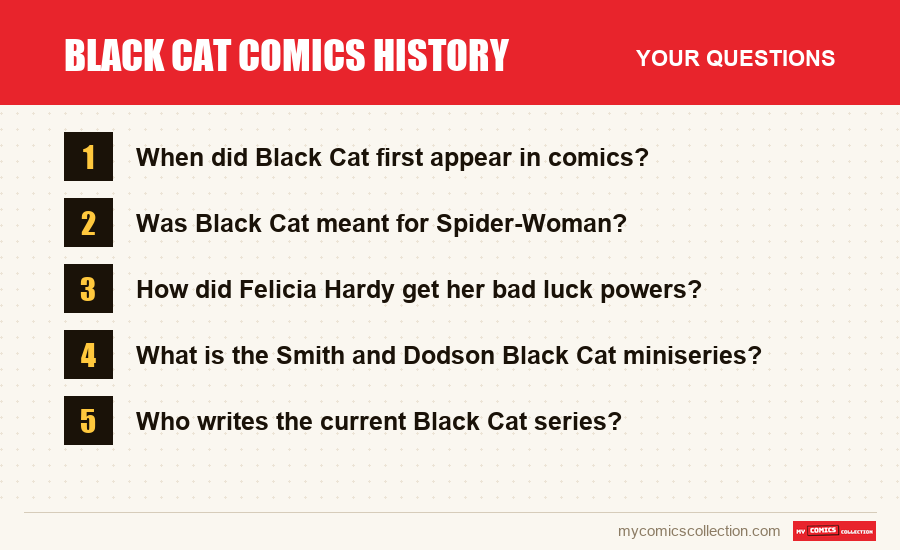
The debut sits in The Amazing Spider-Man #194, July 1979. Marv Wolfman and Dave Cockrum are credited as her creators, Keith Pollard drew the issue, and the story carries on into #195. Felicia debuts as a burglar organizing her father's escape from prison.
Marv Wolfman planned to introduce a character called Black Cat in Spider-Woman #9, dated December 1978. The version that eventually appeared in Spider-Man's title shared only the name and some powers with that plan, and Dave Cockrum designed her costume and appearance.
A mysterious benefactor, later revealed to be the Kingpin, gave Felicia bad luck abilities. Doctor Strange later removed the lingering effects and transformed the power into cat-like abilities. The Kingpin kept his role secret at first, which is why the source of her luck reads as a mystery in the stories of the time.
The Evil That Men Do runs six issues, scripted by Kevin Smith with Terry Dodson on pencils and Rachel Dodson on inks. It began in 2002, went on hiatus after issue #3 until 2005 and ended with issue #6 in 2006, which is why many readers prefer the collected edition.
Jed MacKay wrote the Black Cat series that debuted in June 2019 and relaunched in 2020. In May 2025 Marvel announced a new series written by G. Willow Wilson with art by Gleb Melnikov, due to begin in August 2025.
If you own The Amazing Spider-Man #194 or #195, you can have the copy valued before you decide how to store it.
Estimate my comic