In short
Adrian Toomes first flies as the Vulture in issue #2 of The Amazing Spider-Man, with a May 1963 cover date. Lee scripted, and Ditko drew and helped plot. The same issue introduces the Tinkerer and sends Peter Parker to the Daily Bugle as a freelance photographer. Toomes is the second character to use the Vulture name, after Isidoro Scarlotti of Young Men #26.
Issue #2 is the book where Spider-Man stops being a single-origin story and becomes a series with a rogues' gallery. One issue earlier, Peter Parker faced the Fantastic Four and a Chameleon; here, for the first time, a costumed criminal who will keep returning for decades arrives in the sky above New York.
Before writing this page we checked the May 1963 cover date, the Lee and Ditko credit, the presence of the Tinkerer, the Greenstreet anecdote and the dates of the later Vulture issues against published reference material. The sections on grading, restoration and reading order are our own analysis and quote no prices.
The issue at a glance: cover date, credits and contents
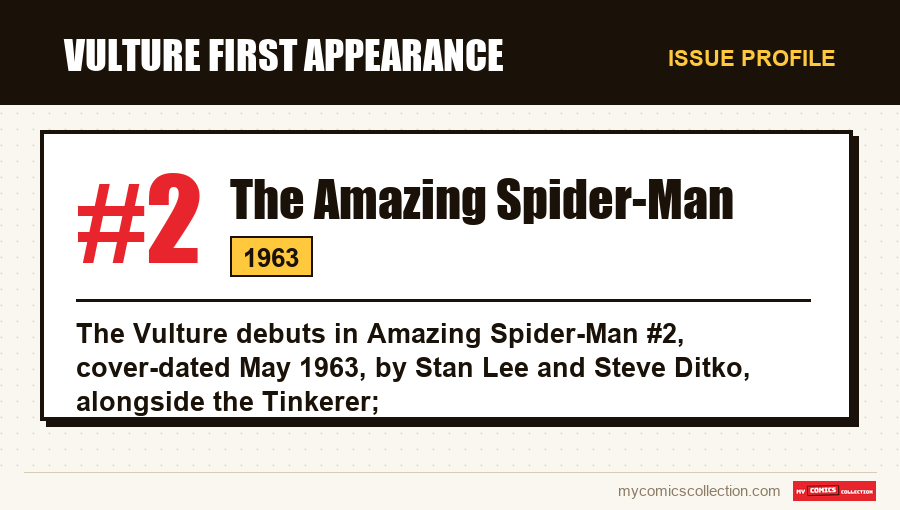
The Amazing Spider-Man #2 carries a May 1963 cover date. On this May 1963 book Lee holds the writing credit and Ditko the art, and series credits list Ditko as co-plotter for his whole run. That detail matters for a collector, because it tells you why the book reads the way it does: Ditko was shaping pacing and set pieces, not only inking Lee's outlines.
Toomes headlines the lead feature. The back half of the comic belongs to another new villain, the Tinkerer, whose scheme is a ring of washed-up stuntmen and thugs who plant bugs in radios and use what they hear to blackmail state officials and politicians. So the issue is a double debut, a fact worth stating on any listing, because the Tinkerer is a legitimate first appearance in his own right.
The issue also marks the start of Peter Parker's freelance photography work for the Daily Bugle, which is the engine of the series for years afterward: Peter needs money, the newspaper needs pictures of the masked menace, and the two needs feed each other.
When you hold or evaluate a copy, three identifiers are enough to confirm that you have the right book: the title The Amazing Spider-Man, the issue number 2, and the May 1963 date in the indicia. Later reprints and collections reuse the story but change the cover, the paper and the printing details, so the identification is rarely hard. What takes time is judging the condition of a sixty-year-old newsstand comic.
How Adrian Toomes enters the story
Toomes is introduced as an elderly man with a gift for electronics. His device is a harness that lets him fly, and his costume turns that harness into a pair of green wings and a feathered collar. The point of the first story is the technical duel: the Vulture can outmaneuver Spider-Man in the air, where a hero who swings from webs is at a disadvantage, and Peter has to solve the problem with an idea rather than with strength.
That construction is the template for the title in its early period. A new antagonist appears with a gimmick, the gimmick overwhelms Spider-Man at first, and the teenager under the mask wins by reasoning about how the device works. The Vulture's flying harness is a more compact version of the same formula that will later give readers Doctor Octopus's arms and the Sandman's body.
It is also worth noticing what the first appearance does not give you. The detailed backstory of Toomes as a businessman betrayed by his partner Gregory Bestman is not the content of the debut; it is built up in later stories. The version of the character most readers know from the Silver Age is a bitter older man with a grudge, and the specifics of that grudge were filled in as the writers returned to him. If you are buying #2 for the debut, you are buying the design and the first conflict, not the full biography.
Who created the Vulture, and how the design came about
Lee and Ditko are the creators credited on the first appearance. The look of Toomes on the May 1963 pages came out of a disagreement between the two men: Ditko recalled that Lee pictured a stout villain modeled on the film actor Sydney Greenstreet, and Ditko chose a gaunt, bony build for the old flier. That thin, hawkish Vulture is the silhouette later artists have kept.
That anecdote is useful to a collector for a reason beyond trivia. It shows how much of the visual identity of the Marvel Silver Age came from the artist's solutions to practical page problems. Ditko's angular, economical figures suit a villain who spends the fight in the air, and the narrow silhouette reads clearly even at the small size of a newsstand printing.
The name itself had been used before. Isidoro Scarlotti wore it in Young Men #26, created by Joe Gill and Carl Burgos, an older Timely-era appearance that has nothing to do with Spider-Man. Toomes is therefore Spider-Man's Vulture and the second character to carry the name. When a seller or a search result blurs the two, the distinction is yours to keep: if you want the character who fights Spider-Man, the key book is The Amazing Spider-Man #2. For the Timely-era title, see our guide to where to start with the Vulture, which also covers the later stories.
Why the issue is a key book
There are three separate reasons that #2 sits near the top of any Spider-Man want list, and they are worth keeping apart because they affect different buyers.
The first is the debut of a villain who stays in the series. The Vulture reappears in The Amazing Spider-Man #7, where he tries to rob the Daily Bugle payroll. In #48 a second man, Blackie Drago, takes up the costume, and in #63 and #64 Toomes defeats Drago, reclaims the identity and nearly beats Spider-Man, injuring his arm before Spider-Man forces him to retreat. In the first annual (October 1964) he signs on with Doctor Octopus for the original Sinister Six story.
The second is the double debut. A comic that introduces two named villains is easier to justify on a want list than one that introduces a single minor character, and the Tinkerer is a lasting member of the supporting rogues. He returns in issue #160 (September 1976), again losing to Spider-Man, and is named in #182 (July 1978) as a helper to other villains.
The third is position. Issue #2 is among the earliest numbers of the series, and the earliest numbers are where the pressure from collectors is highest. Anyone assembling the first ten issues, or a set that starts at Amazing Fantasy #15, needs this one; our guide to issue #1 covers the opening of the series, and the page on Spider-Man's first appearance covers the character's debut.
The Vulture's screen life adds a modern layer of interest. Michael Keaton plays Toomes in Spider-Man: Homecoming (2017), as the head of a New York salvage company that is shut down after the Battle of New York and who then turns to a black-market weapons ring. A film version changes the biography, so it does not alter which comic carries the first appearance, but it explains why new buyers keep asking about #2.
Do you collect this series?
Track what you own, what you are missing and what your collection is worth. 7-day trial.
Start my trial →
Reprints, collections and issues often confused with it
The original comic is the only form of the issue that counts as the first printing. Collected editions have carried the story since. The first Marvel Masterworks hardcover for this series, published in November 1987, reprints Spider-Man's Amazing Fantasy debut plus numbers 1 through 10, so the Vulture story sits within it. Other formats exist, but verify the contents of any specific edition before telling a buyer what it reprints.
Three confusions come up repeatedly in listings. The first is mixing up #2 with the issue where the Vulture returns, #7, which is a sound read and a modest book but not the debut. The second is confusing Toomes with Blackie Drago, whose debut as the Vulture is in #48. The third, as noted above, is the Timely-era Vulture in Young Men #26, a different character in a different publisher's book.
A facsimile or reprint of a Silver Age comic is a legitimate object, but it is not the same object. If the indicia does not read May 1963 in the original format, or if the paper and printing look modern, you are looking at a later edition. This point is covered in more detail for the series' very first title in our guide to the value of Amazing Fantasy #15, where the same reprint question applies.
What to check before you buy a copy
A comic of this age rarely survives unrestored by accident. These are the checks that matter, in the order that tends to reveal problems fastest.
Start with the spine. Newsstand comics of 1963 were folded, stapled and handled by children, and spine stress, color breaks and splits show where the book was read. A copy with a clean spine and a few small corner flaws is usually more convincing than a glossy copy with a suspiciously perfect front.
Check the staples and the centerfold. Rust around the staples, a loose centerfold or a replaced staple are signs of handling or of an attempt at repair. The two staples should look consistent with each other and with the age of the paper.
Look at the cover under raking light. Color touch, reglossing, tape residue and glue from a repaired tear all show up at an angle that they do not at a straight view. If the cover shine is uneven or the color looks richer along a crease, ask whether the copy has been restored.
Ask about the grading label. A copy that has been graded by a third-party service is labeled either as unrestored or with a restoration note, and the label is part of the value. Read what the label says, compare it with the book in front of you if you can, and treat a restoration note as information about the object rather than as a flaw to ignore. When the copy is raw, request clear photos of spine, corners, staples and inside pages, then set them beside other copies of May 1963 so you recognize what normal aging looks like here.
Finally, check completeness. Make sure the coupon area, the pages with the Tinkerer story and the advertisement pages are intact. A cut coupon is a small defect in a 1960s comic but it is a real one, and it should be disclosed.
The same questions apply if you are estimating a copy you already own. A valuation depends on the grade, the label and the market at the time of sale, so we avoid quoting numbers here. If you want a rough sense of where your copy sits, our free comic valuation is built for exactly that question.
Later Vulture appearances worth reading and owning
After #2, the Vulture's best-known Silver Age stories come in a short sequence, and a collector who wants the character can build a small, coherent set around the debut.
The Amazing Spider-Man #7 is the direct follow-up, a payroll robbery at the Daily Bugle that confirms the Vulture as a recurring threat. The Amazing Spider-Man #48 is where Blackie Drago takes the costume, and #63 and #64 resolve that storyline when Toomes returns and takes his place back. The first Amazing Spider-Man Annual (October 1964) places the Vulture in the original Sinister Six, which makes it a natural companion to a Sinister Six reading list. The Amazing Spider-Man #240 and #241 follow Toomes as he leaves retirement to take revenge on Bestman, the former partner who embezzled from him.
That is a set of five or six numbers that runs from 1963 to the early 1980s and tells you most of what the character is. For a reader rather than a collector, the entry point is our ranked list in best Vulture comics; here, the angle is the book you hold, not the whole career.
A practical approach is to buy in this order: the debut if you can afford a copy in the condition you are comfortable with, otherwise a collected edition for reading and a modest copy of a later issue such as #7 or #63 to hold the character in the collection. The book in your hands should be one you enjoy, and the Vulture's 1960s appearances are brisk and readable.

Frequently asked questions
Issue #2 of The Amazing Spider-Man, May 1963, by Lee and Ditko. Its lead story brings in Adrian Toomes. The same issue also introduces the Tinkerer, so a copy carries two villain debuts in a single comic.
No. In Young Men #26 the Vulture is Isidoro Scarlotti, a creation of Joe Gill and Carl Burgos from the Timely years. Adrian Toomes, the villain who fights Spider-Man, is the second character to use the name and debuts in The Amazing Spider-Man #2.
The Tinkerer, Phineas Mason, also debuts in this issue. His original scheme involves washed-up stuntmen and thugs planting bugs in radios and blackmailing officials. The issue is also where Peter Parker begins freelancing as a photographer for the Daily Bugle.
It is a respected Silver Age book but a different kind of key. The Amazing Spider-Man #7 shows the Vulture trying to rob the Daily Bugle payroll, so it matters for the character's run. Issue #48 and issues #63 and #64 add the Blackie Drago story. The debut remains #2.
A label is useful but does not replace looking at the book. Read whether it is marked unrestored or carries a restoration note, then compare spine, staples, corners and cover gloss with photographs. Two copies with the same number can differ in appeal, so judge the specific comic.
Own a copy of The Amazing Spider-Man #2 or another Silver Age Spider-Man key? Get a free estimate of its market position.
Estimate my comic