As of October 2, 2026, no episode of VisionQuest has aired yet: it is therefore impossible to say what the series has confirmed or contradicted. What is established and datable, on the other hand, is its calendar: eight episodes, the first two screened at the London festival on October 12 then put online on October 14 on Disney+, the following six at a pace of one per week until November 25, 2026. And the official synopsis, which describes a run with a bounty on the synthezoid's head, not the dismantling by agencies that the 1989 paper arc told. Two documented precedents, WandaVision and Agatha All Along, show that identity reveals arrive mid-run, not in the first episode. Hence the only useful thing to do now: write down what you anticipate, date it, and prepare the means to correct yourself.
There is a painful moment in the life of a collector who follows adaptations: the one where the series finally starts and you discover that what you had anticipated for months does not match what is on screen. That moment is inevitable. It is even healthy. What is not healthy is arriving at it without having noted what you were anticipating, because then you rewrite your own forecast as the facts fall, and you never correct anything.
This article is a follow-up article. It does not redo the inventory of the issues the series points to: that work already exists elsewhere on this site, issue by issue, and it is far more useful in its current form than spread out a second time here. It does something else, which had not been done: it sets up the reassessment method that the next eight weeks will require, and fits it to the real airing calendar.
Let us be precise about the date, since everything depends on it. We are writing on October 2, 2026. Airing begins on the 14th. No episode is visible, no episode content is verifiable, and any sentence about "what the series has revealed" would be pure invention. What we can do, and what we do below, is prepare the reading of the facts that are going to arrive, relying on two earlier series whose course is fully documented.
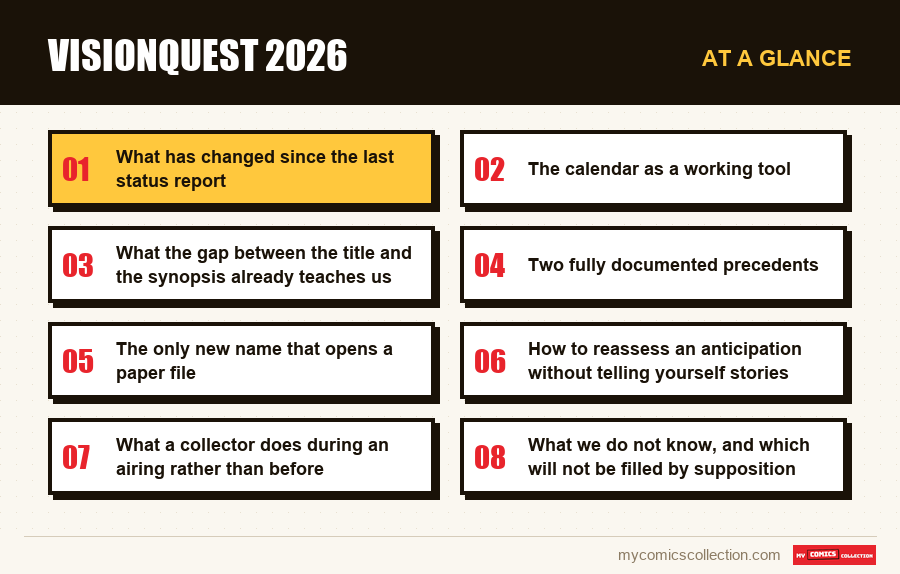
What has changed since the last status report
Between the writing of the key-issue guides devoted to this series and today, the state of the information has moved on three points, all verifiable and all structuring. None concerns narrative content: they concern the form of the airing and the makeup of the cast.
First point, the airing structure is now known in detail. The series has eight episodes. The first two are screened at the London film festival on October 12, 2026, two days before going online. The remaining six then come out at a rate of one per week. It is a classic pattern at this broadcaster, and it has a direct consequence for anyone following the secondhand market: the material for speculation does not arrive in a block but in weekly steps, over six weeks.
Second point, the official synopsis is published, and it describes something different from what the title promised. After his resurrection in the 2021 series, the synthezoid lives in hiding and tries to understand who he is by conversing with various artificial personalities inscribed in his programming. A bounty is put on his head, and he takes to the road with a teenager who might be his reincarnated son. It is a story of a run and identity, not a retelling of the 1989 story where government agencies dismantle the android piece by piece. Whether the series is a direct adaptation of that arc remains open, and it is publicly open: production sources do not assert it.
Third point, the cast has filled out, and one of the additions opens a precise paper file we discuss below. Alongside the already known roles, the cast includes several artificial personalities played by distinct performers, an associate of the bounty hunter whose name is not specified, and at least one role still undisclosed. This last category counts as much as the others: a role kept secret two weeks before airing is almost always a role that serves as a reveal.
The calendar as a working tool
An airing calendar is not magazine information. It is the skeleton of a protocol. Eight episodes, two grouped dates then six weekly ones, that makes seven appointments and six weeks of interval between the start and the end. Here is what each step does and does not allow.
October 12: the festival screening
The first two episodes are shown in a theater before going online. The first public reactions and first reports therefore appear before the general public has seen anything. It is the most misleading window of the whole series: information circulates, it is partial, and it is not yet verifiable by yourself. Decide nothing that day.
October 14: the first two episodes
The first moment when you can see for yourself. Two episodes at once is a lot of material, and it is also the attention peak of the whole series. Historically, openings establish the already announced characters rather than revealing new ones: the informative value is strong on tone, weak on surprises.
October 21 to November 4: episodes 3 to 5
The phase where the story departs or not from its announced source. It is here that you can finally settle the question left open by the synopsis: is the 1989 story adapted, cited, or simply borrowed for its title. That answer is worth more than any casting rumor.
November 11 to 25: episodes 6 to 8
By comparison with the two series examined below, it is the zone of identity reveals, hence the zone where a specific issue can find itself designated overnight. It is also the worst window to buy, and the best to observe.
After November 25: the review
When the series is over, you finally know what it designated. Decisions taken at that moment are the only ones that rest on a complete fact. They are also the least comfortable, because supply has already thinned on what counted.
Between October 8 and 11, 2026, a New York convention also opens, with its panels scheduled. Announcements are expected there, and it is possible they touch this series or its sequel. At the time of writing, nothing has been said there: treat any sentence starting with "announced at the convention" as information to check before use, not as a fact.
What the gap between the title and the synopsis already teaches us
A lesson of method is available immediately, without having seen a single episode, and it corrects a very widespread reasoning error. The faulty reasoning goes like this: a series takes the exact title of a story arc, so it adapts that arc, so the issues of that arc are the target. Each step seems to flow from the previous one, and the first is true. The next ones are not necessarily. Taking up a title is a brand gesture, not a narrative commitment. The published synopsis describes a run with a bounty on the character's head and a teenage traveling companion, that is, an itinerant story structure that the 1989 arc does not have at all.
That does not mean the 1989 issues do not count. They count, for a reason that has nothing to do with the adaptation: it is there that the white version of the character exists for the first time, and that fact is independent of any screen. The detail of these four issues, their credits and the editorial controversy surrounding them are treated in the guide devoted to the White Vision, and the 1985 series that houses them in the one devoted to the West Coast Avengers. What the gap between title and synopsis changes is the status of the anticipation: we go from a comfortable near-certainty to a hypothesis that will have to be tested episode by episode.
Let us therefore formulate the hypothesis properly, since that is the exercise. Before airing, the dominant anticipation was that the series would adapt the 1989 story and concentrate attention on its last issue. The official synopsis weakens it without destroying it. The test that will settle it is simple and observable: if government agencies and the android's dismantling appear as the story's engine in episodes 3 to 5, the anticipation holds. If the run remains the engine and the 1989 story is evoked only as a memory, it is contradicted. Writing this test now means forbidding yourself to rewrite it later.
Two fully documented precedents
To calibrate expectations on a series under way, you need finished series. Here are two, from the same producer, on the same broadcaster, and tied to the same character or his narrative family. Their interest is not anecdotal: their course gives the position of reveals within a series, which is exactly the information we need.
The 2021 series
Same airing pattern as the one awaiting us: two grouped episodes, then one per week. The real identity of the neighbor character, a witch from the paper catalog, is revealed in the seventh episode of nine. And a second character, presented in the fifth episode as the return of a familiar face from another franchise, turns out in the last episode to be nobody: his real name is that of a random person, and the production acknowledged having deliberately played with the audience's expectations on this point.
The 2024 spin-off series
Same producer, same broadcaster, same narrative family. A teenager accompanies the heroine throughout the first half of the series under the simple name "Teen," his identity masked in the story by a magical device and, in communication, by the absence of any precision. The sixth episode reveals he is an identifiable character from the paper catalog, whose body houses the soul of a son of the synthezoid and the witch. In the seventh episode, a second character, introduced as a federal agent, turns out to be an incarnation of death itself.
From these two cases, you do not draw a law. You draw a position of probability, and it is enough to organize six weeks: across two comparable series, the reveals likely to designate a specific issue occurred two-thirds of the way through, never at the opening, and never in the communication that preceded. The detail of the current series' characters and their paper equivalents is established in the correspondence report published before airing: it is against that document that you will have to compare, and that is why it was written before rather than after.
The only new name that opens a paper file
One addition to the cast deserves particular treatment, because it illustrates the method better than an abstract reasoning, and because it was not documented at the time of the correspondence report.
The cast includes the role of Lisa Molinari. This name exists in the paper catalog, and it is identifiable there down to the issue: she is the character who takes the alias Coat of Arms, who first appeared in Dark Reign: Young Avengers number 1, put on sale May 13, 2009 with a July 2009 cover date, written by Paul Cornell and drawn by Mark Brooks, in a story titled "Young Masters." That same issue introduces the whole group of which she is a part, which makes it an issue with several first appearances rather than a single one.
The detail that matters for our series lies in her personal history: before becoming Coat of Arms, she knew in juvenile detention the reincarnated son of the witch and the synthezoid, that same teenager whom the official synopsis announces takes to the road with the hero. The link is therefore not decorative. It is structural, and it was verifiable before airing.
Let us apply the method to this case, because it is the exercise the next six weeks will demand about ten times. Verified: the name appears in the cast, the character exists on paper, her first issue is dated and credited, and her past links her to another announced character. Deduced, therefore fragile: that the series will exploit this common past, and that the role will be important enough for anyone to care about her first issue.
This deduction assumes that the character is written on screen like her paper equivalent, which is not the rule in these adaptations, and that the costumed alias will appear, while nothing in the communication announces it. Two stacked hypotheses, neither of which is supported. Hence the test: if this character has a real narrative function and if her common past with the teenager is used, the question of the 2009 issue becomes legitimate; otherwise, the name remains a cast curiosity. This test will fall between October 14 and November 25, and it costs nothing to wait.
How to reassess an anticipation without telling yourself stories
Here is the protocol, which holds for this series and for all the following ones. It is short because it has to be kept for six weeks by someone who has other things to do.
Write the anticipation beforehand, and date it
In one sentence, per character or element: what you think the series will do, and which issue that would designate. With the date of writing. Without this trace, reassessment is impossible, because memory spontaneously adjusts the recollection of what you believed to what you learned. A collection's register serves for this too.
Tell confirmation from coincidence
A character who appears on screen does not confirm an anticipation about his importance. A two-minute appearance and a leading role produce the same raw fact and opposite consequences. Note what you saw, not what you conclude from it.
Write in advance what would prove you wrong
For each anticipation, a refutation condition formulated beforehand. An anticipation that nothing could refute is not an anticipation, it is a preference. And a preference should never trigger a purchase.
Decide nothing on the night of an episode
Decisions made in the hours following a reveal are made at the exact moment when available supply is thinnest and attention strongest. Nothing in an eight-episode calendar requires deciding that night. A delay of a few days costs almost nothing and removes the majority of regretted purchases.
Do the review after the end, not during
Go back over your dated sentences after the last episode, and mark each confirmed, contradicted or undecidable. The third category is the most instructive: it says which questions you were asking when no answer was possible.
A word on what this protocol is not. It does not try to predict a price movement, and relies on none. The general mechanism by which an announcement, a shoot, then a release shift the market's attention is a subject in itself, covered in the guide devoted to the calendar of adaptation speculation. Here, we only speak of practical epistemology: how not to lie to yourself during the six weeks when the facts arrive.
What a collector does during an airing rather than before
The difference between an awaited series and one under way is not just a matter of information. It changes the nature of the useful gestures.
Before airing, the useful gesture is preparation: knowing which issues are at stake, which are already in your boxes, which are missing. During the airing, this work is too late, and that is precisely why it must have been done. An up-to-date record of what you own spares you the silliest expense, which is the duplicate bought in a rush on a title you already had.
The second gesture is to finish rather than to start. If a set is already begun, completing it during a period of strong attention remains more defensible than opening a new project on a character you know nothing about yet: you know the state of the set, the price at which you acquired the other issues, and what you still have to find. The list of missing issues is the tool suited to this period.
The third gesture is negative, and the hardest: not sending an issue to certification on the strength of an episode. The processing time is counted in weeks or months, often more than the duration of attention to the series. You commit a cost and a tie-up on a bet whose horizon is shorter than the process itself. The question of the right time to have a copy graded should not be settled by an airing night.
Finally, an observation gesture, which costs nothing. Note what disappears from supply and how fast, without noting amounts you could not verify. The thinning of supply on a given title is a more reliable and more accessible signal than a secondhand value estimate. And on the issues concerned here, one fact remains true whatever happens: the late-1980s print runs are abundant, and abundance does not resolve in six weeks.
What we do not know, and which will not be filled by supposition
Transparency about the gaps is part of the work, not an admission of weakness. Here is the exact state of uncertainty as of October 2, 2026.
We know neither the episode titles, nor their content, nor their narrative breakdown. No published list gives them. We do not know whether the 1989 story is adapted, cited or only borrowed for its title: the question is open in the sources themselves. We do not know what the cast's undisclosed role is. We know of no recent price guide movement on the issues concerned, because no source consulted publishes any for this period: any numeric sentence would be made up, and you will find plenty elsewhere.
We finally do not know whether the series will have a sequel, which is nonetheless the variable that most surely determines whether attention holds or falls back. This list is long, and it is normal: we are writing twelve days before airing begins. It has a virtue, however. Each of these gaps will be filled on a known date, by an observable fact, and you will then know which of your reasonings held up. Few collecting bets offer a verification calendar this clean.
What to remember
An anticipation is not a prediction to defend, it is a hypothesis to test. A series' passage from awaited to aired status does not hand out certainties: it hands out, week after week, facts each of which confirms or demolishes a small part of what you believed.
For this series specifically, three sentences are enough. The calendar is known and it is your main tool: eight episodes, from October 14 to November 25, 2026. Comparable precedents place the useful reveals two-thirds of the way through, which leaves you four weeks to observe before anything important falls. And the official synopsis has already weakened the most widespread anticipation, that of a direct adaptation of the 1989 story, without destroying it.
The rest is a matter of discipline. Write what you think, date it, say what would prove you wrong, and decide nothing on the night of an episode. The lists of issues concerned already exist and are stable: that of Jocasta, that of Ultron, that of the White Vision. What is not stable is what the series will make of them. And that, nobody knows yet, including those who write about it with aplomb.