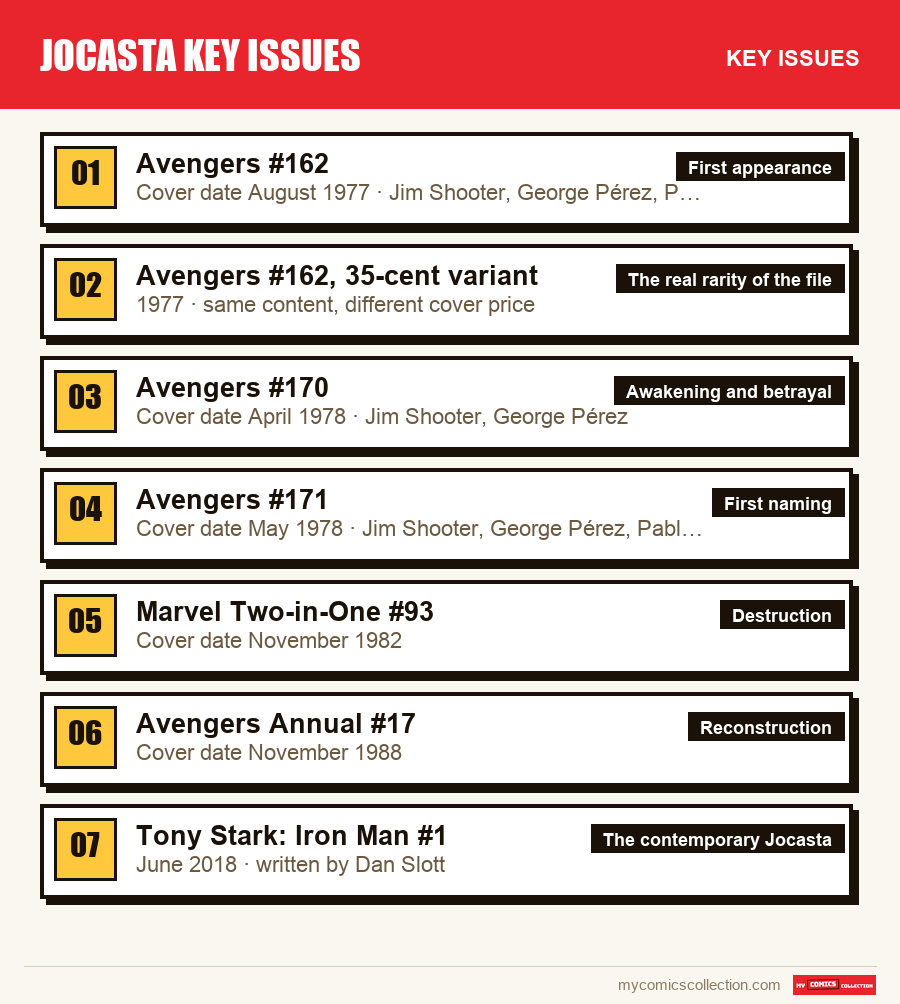
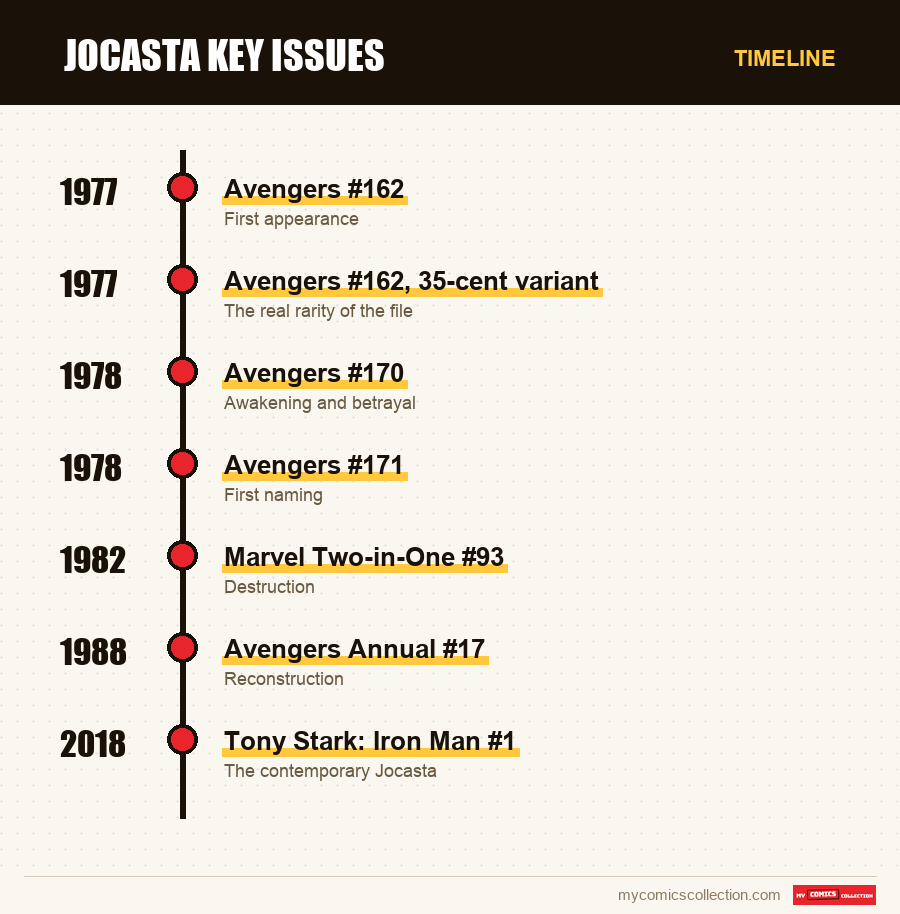
Jocasta's founding issue is Avengers #162 (cover date August 1977), "The Bride of Ultron!", by Jim Shooter writing and George Pérez drawing, inked by Pablo Marcos. The robot is built there by Ultron to receive the life force of Janet van Dyne, the Wasp, thanks to a manipulated Hank Pym. A peculiarity: the character is not yet named there. Her name only appears in #171 (May 1978), and it is in #170 (April 1978) that she awakens and betrays her creator. This file also covers a much rarer piece: the 35-cent variant of #162, from the price test Marvel ran in 1977. Jocasta comes to the screen on October 14, 2026 in VisionQuest on Disney+, played by T'Nia Miller.
There are two families of key issues. Those that nobody needs to introduce to you, because they have been on every list for thirty years and their price already reflects that fame. And those that sleep: comics printed in quantity, easy to find, whose only missing piece is a reason for the general public to take an interest. Jocasta belongs to the second family, and that situation changes on October 14, 2026.
We are writing on October 1st, 2026. The VisionQuest series has not aired, nobody has seen it, and it is therefore impossible to say whether the character will be a standout or decorative. On the other hand, the production facts are public, the editorial history is documented, and the mechanism by which an adaptation shifts demand onto an old comic is perfectly well known. It is this mechanism that deserves to be understood, far more than any numeric forecast.
This article therefore lays out the list of issues to aim at, in order of importance, then explains frankly why most bets of this kind return nothing, and under what conditions this one could be an exception.
Who Jocasta is, on one page
Jocasta is a robot built by Ultron, with an intention that can be summed up bluntly: he wanted a companion. Since he did not know how to fabricate a consciousness from scratch, he chose to steal one. His target was Janet van Dyne, the Wasp, whose life force and brain patterns he set out to transfer into a metal shell of his own design.
The detail that gives the character all her weight is the accomplice. To carry out the operation, Ultron uses Hank Pym, whom he manipulates by making him believe it is a matter of saving his wife's life. Hank Pym is the scientist who created Ultron. He therefore ends up helping his own creation copy his wife's mind. Few narrative setups are so effectively cruel, and that is exactly what Jim Shooter builds in the pages of #162.
The transfer is interrupted and Janet van Dyne survives, but it does not fail completely: the shell keeps part of what was copied. Not Janet's memories, but her personality, her emotions, her moral conscience, down to her ability to communicate with insects. On awakening, Jocasta therefore turns against the one who built her and helps the Avengers stop him.
The nuance with Vision, Ultron's other creation, is worth noting: Vision also turns against his creator, but he had been given the brain patterns of a hero. Jocasta inherits the morality of a victim. Her betrayal is not a reprogramming, it is the logical consequence of what Ultron stole.
The point that complicates the first appearance
Before talking about the issues, we need to settle an ambiguity that many listings maintain, sometimes in good faith.
In Avengers #162, Jocasta exists physically, she is at the center of the story, she is on the cover. But she is not named, and she is not yet a character in the full sense: she is a body being filled. The issue ends, moreover, on an enigma, a communication passed through ants that Janet van Dyne did not send, which suggests the bride is more human than believed.
In Avengers #170, she awakens, acts on her own initiative and betrays Ultron. It is the first time she behaves as an autonomous character.
In Avengers #171, she receives her name. Ultron explains there that his aborted plan had partially succeeded, and the episode is part of the Korvac Saga, with the arrival of Ms. Marvel on the Avengers' side.
Three issues, three different statuses. The market retains only one reference, #162, but it is not the issue where the character truly becomes herself. And a listing that says "first appearance of Jocasta" without specifying the number is unusable: ask for it, and check it on the cover photo.
The issues to aim at, in order of importance
Avengers #162
"The Bride of Ultron!" The founding issue, and the only one that truly matters to the market. Ultron transfers Janet van Dyne's life force into a robotic shell; the Avengers trace him to an abandoned research center on Long Island; Iron Man threatens to destroy the bride to interrupt the transfer. Ultron escapes. Several Avengers remain in a coma following the earlier clashes, a detail that places the episode in a period markedly darker than the stock image of the series.
Avengers #162, 35-cent variant
It is the most useful piece of information in this article, and the least known. In 1977, Marvel tested a price increase from 30 to 35 cents by printing, for the titles concerned, a second version at the new price, distributed only in a handful of American cities. #162 falls in that window. The content is identical, only the price box on the cover changes. The quantities distributed were very small compared with the normal print run, which makes this variant a piece of a different order of scarcity than the standard edition.
Avengers #170
The issue where the robot becomes a character. Jocasta awakens with what remains of the Wasp's essence, so with emotions and a conscience, and immediately chooses her side against the one who built her. For anyone more interested in the story than in the label, it is the most satisfying of the three.
Avengers #171
The issue where the name Jocasta is spoken, and where Ultron himself explains that his plan had partially succeeded. The episode belongs to the Korvac Saga and sees Ms. Marvel join the team to track Jocasta down to Ultron's lair, whose circuits end up disrupted by the Scarlet Witch.
Marvel Two-in-One #93
Jocasta is destroyed at the end of a clash with Ultron. An ending issue, and a clue to the place the character then held: her fate is settled not in the series where she was born, but in a crossover title.
Avengers Annual #17
Jocasta is reassembled, then sacrifices herself again. The issue sets up the motif that will define the character for thirty years: a machine endowed with a stolen consciousness, who each time chooses to disappear rather than serve.
Tony Stark: Iron Man #1
It is the series that redefined the character for the current generation of readers. Jocasta is employed there by Stark Unlimited as head of robotic ethics, a position that places her at the center of the series' debates on the status of artificial intelligences, notably around the virtual world Project eScape. She is in a relationship with Aaron Stack, a.k.a. Machine Man, whose position on these questions is far more radical than hers.
Several extensions deserve a mention without justifying a targeted purchase. Her head is recovered by Madame Menace in Iron Man Annual #11 (September 1990), then her consciousness is transferred into Iron Man's armor in Iron Man volume 3, from #18 to #24 (July 1999 to January 2000). She then joins a team in Avengers: The Initiative #17 (November 2008), becomes an active member of Mighty Avengers from #21 (March 2009), then mentors the students of Avengers Academy (from August 2010). In The Unstoppable Wasp, in 2019, she adopts the surname Pym, a choice that says a lot: her mind comes from Janet van Dyne, but she sees herself in the lineage of the scientist who created the one who created her. Finally, Iron Man 2020 (volume 2, January to August 2020) places her in the A.I. Army.
A point that matters more than it seems
Jocasta was never officially inducted among the Avengers. She accompanies the team in the early 1980s, notably in Avengers #202 and #203 (December 1980 and January 1981), and ends up leaving without a word in #211 (September 1981), convinced she has been set aside once again. The irony of the issue is that Iron Man and Captain America were just about to grant her a reserve member status.
This detail explains why the file never took off despite an old first appearance and top-tier creators. A character without stable membership has no recruitment issue, no group cover, no place in the member lists. She therefore generates none of the secondary entry points that, elsewhere, multiply sought-after issues. Jocasta has a first appearance and next to nothing else.
What the arrival on screen changes, and what it does not
The facts first. VisionQuest is announced for October 14, 2026 on Disney+, in eight episodes, the first two the same day then one per week. Terry Matalas is the showrunner. Paul Bettany returns as Vision, James Spader returns as Ultron, and T'Nia Miller plays Jocasta. The starting point is a reset Vision who tries to understand who he is by conversing with artificial personalities housed in his own memory. It is, to our knowledge, the first live-action incarnation of Jocasta.
Here is now what this calendar mechanically produces, independently of the series' quality.
What changes. Demand stops being limited to readers of 1970s comics. People who had never heard the name will look for it, and some will want to own the issue where the character was born. In a narrow market, it does not take many extra buyers to empty out the copies in good condition offered for sale: it is not the price that rises first, it is the available supply that thins.
What does not change. The number of copies printed in 1977, which is high. After the first surge, copies come back out: those who owned the comic without thinking about it discover that it is sought and put it up for sale. That is how most of these episodes end, with a return to the earlier level.
Why most of these bets return nothing
It must be said clearly, because it is the most useful information in this article: most anticipations based on a secondary character's arrival on screen produce no gain. Four reasons, all verifiable on past cases.
The character stays secondary on screen. A casting announcement says nothing about screen time. A character can be announced, appear in two scenes, and arouse no lasting curiosity. It is the most frequent case, and it is undetectable before airing.
The name on screen does not match the comic. Adaptations rewrite. If VisionQuest's Jocasta has no tie to Janet van Dyne and is not built by Ultron in the terms of #162, viewers who go back to the source will find a comic that does not tell what they saw. Interest then falls off very quickly.
The rise arrives before you. The casting announcement has been public for months, and attentive buyers bought then. Buying in October 2026 a comic everyone is talking about is buying at the price of the wait.
The comic is too abundant for demand to move it. It is the dominant factor on a 1977 Marvel title: demand multiplied by three on a practically unlimited supply gives nothing.
A point of method to finish: this reasoning only holds if you compare sales actually closed, at identical grade, before and after. Asking prices in listings always rise at the announcement of an adaptation, because they cost nothing to the one who posts them.
Under what conditions this file could work
Three conditions, and they must be met together, not just one of them.
A substantial role. Not an end-of-episode appearance, but a presence across several episodes with a stake of her own. The eight-episode format with a weekly release is rather favorable: it gives curiosity time to settle in, unlike a film where everything is decided in two weekends.
Sufficient fidelity to the origin. If the series takes up the tie with Ultron and, better still, with the Wasp, then #162 becomes the source document again and keeps its status. Otherwise, it remains one 1977 comic among others.
A follow-up on screen. Lasting rises come from characters who come back. A single appearance produces a spike; a recurrence produces a plateau.
And a factor outside the adaptation, which is worth more than the three previous ones combined: the 35-cent price variant. Its scarcity is structural, it existed before the announcement and will exist after. That is the whole difference between a piece whose value rests on current events and a piece whose value rests on the number of copies that physically existed.
The course of action
First check what you have
Avengers #162, #170 and #171 are ordinary issues of the late 1970s. Anyone who owns a lot of Avengers from this period may already have them. Before buying anything, go through your collection: it is exactly what the app is for, and the file can close in three minutes.
Look at the price box of your #162
If you already own the issue, it is the first thing to do. 30 cents is the standard edition. 35 cents is the test variant, and you are holding a piece of a whole other level. The value gap between the two is considerable, and it comes down to a number printed in a corner of the cover.
Decide what you are buying: a read or a piece
To read the full arc, take #162, #170 and #171 in decent condition without worrying about grade. To build a piece, only one issue matters, #162, and it is the grade that makes all the difference.
Do not have a standard copy graded in a rush
On a standard 1977 edition bought in October 2026, the cost of grading is certain and the gain hypothetical. The only exception is the 35-cent variant, where authentication is part of the value. To understand what a grade covers before deciding, the CGC grading guide details how to read the scales.
Note the date and the price paid on the day of purchase
It is the only data that will tell you, in two years, whether the anticipation worked. Without a recorded starting point, only an impression remains, and impressions always err in the direction of the purchase you made. An estimate taken before airing is worth more than any memory.
The traps specific to this file
Confusing Jocasta and Ultron's other creations. The catalog has several and listings mix them up. Vision is the best known, with his own first appearance in Avengers #57, covered in our guide to Vision key issues. A notice promising the first appearance of "an Ultron robot" with no name or number is worthless.
Believing a 1977 comic is necessarily rare. Age does not create scarcity: late-1970s print runs were counted in the hundreds of thousands of copies. What is rare is very good condition, because these comics were sold at newsstands and read, and it is the price variant, distributed in only a few cities.
Buying the three issues at full price in the same week. #170 and #171 do not carry the notation that triggers searches, so they have no structural reason to rise. If a listing offers them at a first-appearance rate, it is profiting from the news.
Ignoring modern series. It is the symmetrical mistake. If the television series makes Jocasta a figure of machine ethics, it is the Tony Stark: Iron Man issues that new readers will look for. They are everywhere today, and it is the most reasonable purchase of the lot.
The last word
The Jocasta file is honest because it is small. A first appearance in 1977, an awakening in 1978, a name in the next issue, a destruction in 1982, a return in 1988, a contemporary resurgence in 2018. Six reference points, and a single real rarity, which owes nothing to television.
If VisionQuest makes the character a standout, #162 will benefit. If the series makes her a silhouette, you will have acquired cheaply a Shooter and Pérez issue that tells one of the most unpleasantly brilliant ideas in Avengers history. In both cases the purchase is defensible, which is not common in this kind of situation. The only mistake would be to put in an amount you would regret if the series did not find its audience. As of October 1st, 2026, nobody has seen it.