In short
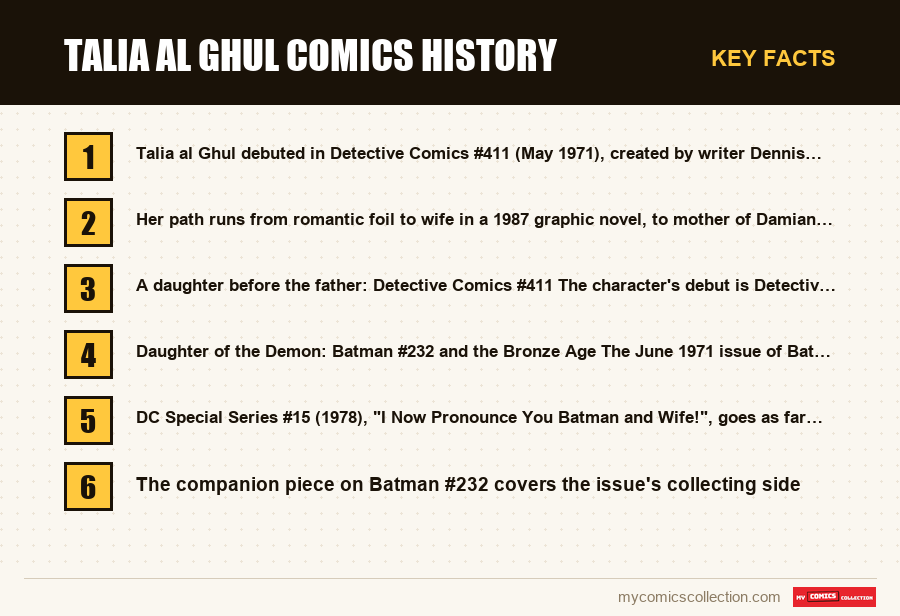
Talia al Ghul debuted in Detective Comics #411 (May 1971), created by writer Dennis O'Neil and artist Bob Brown, with Dick Giordano credited for the concept. Her path runs from romantic foil to wife in a 1987 graphic novel, to mother of Damian Wayne in Grant Morrison's 2006 run, to mastermind of Leviathan, and in 2022 to Deathstroke's enemy in Shadow War.
Talia is the rare Batman character who has been a love interest, an heir, a villain and a mother, sometimes in the same decade. Her comics history is less a list of fights than a chronicle of how DC kept changing what she wants from Bruce Wayne. Read in order, the stages show a character who starts as a romantic temptation and ends as an independent power.
For Talia, each creator named below and each cover date comes from a checked credit; where the month was not confirmed, a bare year appears instead. The interpretation of each stage, and the collecting method at the end, is analysis rather than quotation, and no pages or dialogue are reproduced.
A daughter before the father: Detective Comics #411
The character's debut is Detective Comics #411, dated May 1971. The story is "Into the Den of the Death-Dealers!", written by Dennis O'Neil and drawn by Bob Brown, and Dick Giordano is credited with the concept. In that issue she is introduced simply as "Talia," a woman Batman rescues from Dr. Darrk, and the family name that now defines her comes later.
The order of arrival is the key to the character. She is on the stands before her father, so the first image of the family is a relationship, not an organization. That ordering sets the pattern for much of her history: Talia is the one who opens a door between Batman and a larger conspiracy, and writers keep returning to that doorway.
For buyers, the page-one rule is the same as with any dual debut: the daughter's appearance and the father's are separate issues with separate cover dates, and listings sometimes swap them. Keep the cover date next to the title when you log a copy.
Daughter of the Demon: Batman #232 and the Bronze Age
The June 1971 issue of Batman, #232, carries "Daughter of the Demon," and it brings her father into the series: Ra's stages her kidnapping as a test of Batman as a suitable husband and successor. Her place in the issue is the title: she is defined by her father before she is defined by anything she does.
The issue matters because the Bronze Age is where her defining tension is set. A daughter loyal to a ruthless parent, attracted to a hero her parent wants to recruit, has two possible exits, betrayal of one side or the other. O'Neil built the character so that both exits stayed open, and the stories that followed used each in turn.
The decade closes with a stranger piece of continuity. DC Special Series #15 (1978), "I Now Pronounce You Batman and Wife!", goes as far as a wedding between Batman and Talia. That issue shows how far the character's role had moved by the end of the 1970s: the daughter of a villain had become a candidate for Bruce Wayne's spouse. The companion piece on Batman #232 covers the issue's collecting side.
The 1987 turn: Son of the Demon
A noncanonical graphic novel from 1987 by Mike W. Barr, Batman: Son of the Demon, changes her function once more. It is a noncanonical story in which Batman marries Talia and she becomes pregnant. She fakes a miscarriage to end the marriage, and the child is adopted as Ibn al Xu'ffasch, "son of the bat."
The book's weight in a collector's history is out of proportion to its length. A relationship that had been implied in the 1970s is turned into a marriage, and a pregnancy gives the character a future that would eventually produce Damian Wayne. The label "noncanonical" matters here: the story is a sealed unit, and later writers borrowed from it selectively.
In 1992, Dennis O'Neil returned to the family in Batman: Birth of the Demon (1992), a graphic novel on how Ra's met Talia's mother. A 2012 issue of Batman Incorporated by Grant Morrison and Chris Burnham later revised that origin, which tells you how provisional any account of her parentage has been.
The 1990s and early 2000s: Bane, LexCorp and the League
Between the graphic novels and the new century Talia is used as a pivot inside crossovers. After the Legacy storyline (1996), her engagement to Bane is called off, as Detective Comics #701 and Robin #33 show, and Batman: Bane (1997) features a nightmare of Bane's about her. Birds of Prey #26 (2001), written by Chuck Dixon, keeps his obsession with her going.
Her LexCorp storyline is a corporate detour: under the name "Talia Head" she runs LexCorp once Lex Luthor becomes President, then sells its assets to the Wayne Foundation after his downfall, a plot point tied to President Luthor: Secret Files and Origins #1. The shift from daughter-of-a-conspirator to corporate executive is one of the odder turns in the file, and it shows how comfortable DC was with placing her in business suits.
These appearances are supporting rather than defining. They are the kind of issue a character-focused collector adds late, after the foundational comics are secured. For the Bane threads, Bane's comics history sets the context.
Death and the Maidens: Nyssa, and the end of her father's era
Greg Rucka's Batman: Death and the Maidens (2003), a limited series drawn by Klaus Janson, brings in Talia's sister Nyssa. In the story Nyssa brainwashes Talia, Ra's is killed, and the two sisters take over the Demon. Of everything in this timeline, this story is the one that most changes her relationship to the organization, because she moves from heir to co-director.
What changes for the character is her agency. Before the miniseries, almost every Talia story orbits the men in her life: father, lover, rival. After it, she has an institution and the responsibility that goes with it. The same shift is the reason later writers could use her as a leader in her own right, and the reason this miniseries is a first stop for a reader who wants her as a figure of power and not as a love interest.
In the same period, Countdown to Infinite Crisis revealed Talia as a core member of the Secret Society of Super-Villains. Taken together, the years 2003 to 2005 move her out of the Batman-and-daughter box.
Do you collect this series?
Track what you own, what you are missing and what your collection is worth. 7-day trial.
Start my trial →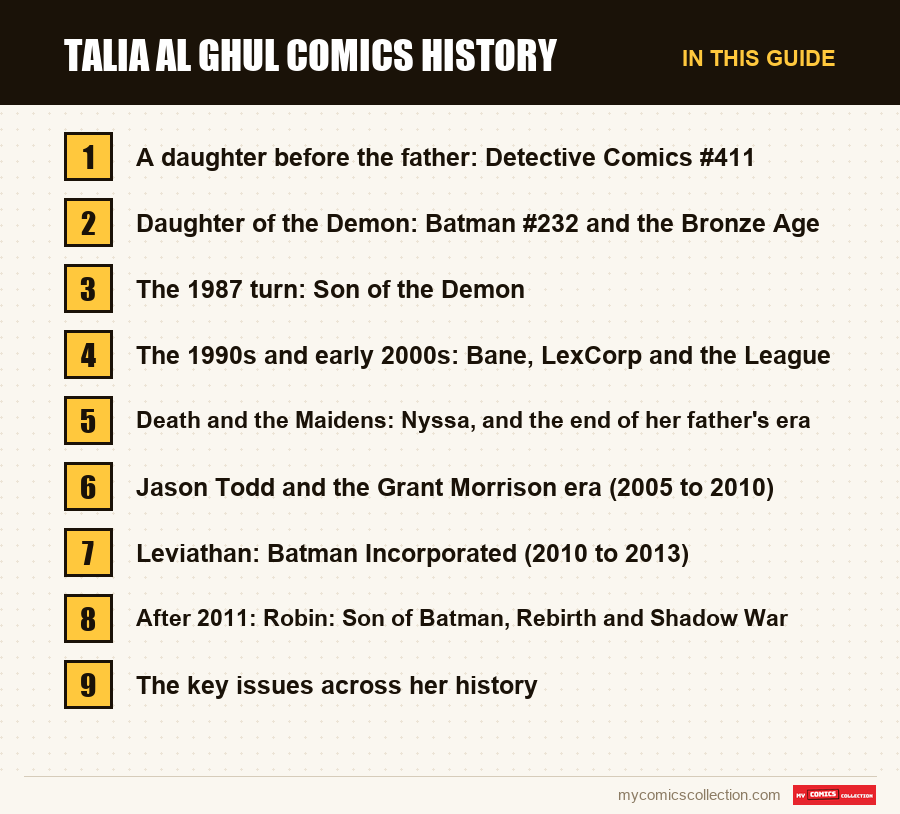
Jason Todd and the Grant Morrison era (2005 to 2010)
Talia returns to Batman's orbit through Batman: Under the Hood (2005), in which she revives Jason Todd in a Lazarus Pit, and Batman Annual #25 (March 2006), where she finances his training as the Red Hood. For readers following the second Robin, the Jason Todd key issues page covers the same stretch from the other side.
The decisive piece is Batman #655 (September 2006), the first issue of Grant Morrison's "Batman and Son," drawn by Andy Kubert, which introduces Damian Wayne. Morrison reinterprets the Son of the Demon idea, making Damian a product of Talia's assault on Batman, and he is raised in the League of Assassins. She leaves Damian in Bruce's care, and the boy kills the villain Spook, which strains his relationship with Batman. For the son's side of the story, see Damian Wayne's comics history and the guide to his first appearance.
This is where Talia becomes a mother in publication terms. She hides Damian's existence from Bruce for years, and she originally intended the boy as a host body for Ra's. Red Hood: The Lost Days #1 to #6 (2010) revisits Jason Todd with Talia in the story, and Batman and Robin #11 (April 2010) and #12 (May 2010) are cited for the conflict between Talia and Damian. Morrison's work is collected on his author page.
Leviathan: Batman Incorporated (2010 to 2013)
The first volume of Batman Incorporated runs from November 2010 to December 2011, written by Grant Morrison, with Yanick Paquette pencils and Michel Lacombe inks. The closing moments of the Leviathan Strikes! one-shot reveal Talia as the mastermind behind Leviathan. That revelation turns a mystery organization into her work, and it makes her the antagonist of an entire series.
Volume 2 follows from May 2012 to July 2013, with Chris Burnham on pencils. Batman Incorporated vol. 2 #2 (June 2012) is a Talia origin issue, by Morrison and Burnham, and it is the issue that revises the account in Birth of the Demon. Her plan is to take over Gotham through Leviathan agents. She places a bounty on Damian and declares war on Batman, and her clone of Damian, called Heretic, kills Damian.
The ending is blunt. Batman and Talia fight in the Batcave, Bruce defeats Heretic, whom Talia then kills, and Kathy Kane, now head of Spyral, shoots Talia (Batman Incorporated vol. 2 #13, August 2013). Ra's al Ghul later takes the bodies of Talia and Damian. If you want one point where the character's arc closes and her trajectory as a mother and a villain collide, this is it.
After 2011: Robin: Son of Batman, Rebirth and Shadow War
Those Leviathan issues were already published after the 2011 reboot. Afterward, Robin War leads to an unlikely partnership between Talia and Damian, and she appears in Robin: Son of Batman, which runs from issue #1 (June 2015) to #13 (June 2016). That series carries the Lu'un Darga storyline and Talia's return to the League, after the amnesia she shows in Robin Rises: Alpha (December 2014).
In DC Rebirth she warns Damian in Teen Titans vol. 6 #1 (October 2016) about Ra's's plot against the Teen Titans. The character has thus gone from killer of her son's clone to ally who passes warnings.
The most recent major stage is Shadow War (2022). The event sets the League of Assassins against Deathstroke Inc., and it ends with Talia killing a Deathstroke who is revealed to be an impostor, Geo-Force. The issues include Shadow War Alpha #1, Deathstroke Inc. #8 and Robin #14, from March to May 2022. A March 2021 collection, Batman Arkham: Talia al Ghul, gathers material on the character for readers who want a single book.
The key issues across her history
- Detective Comics #411 (May 1971): the debut, by Dennis O'Neil and Bob Brown.
- Batman #232 (June 1971): "Daughter of the Demon," where Ra's stages her kidnapping to test Batman.
- DC Special Series #15 (1978): "I Now Pronounce You Batman and Wife!"
- Batman: Son of the Demon (1987): the graphic novel marriage and pregnancy.
- Batman: Death and the Maidens (2003): Nyssa, Ra's's death and the new leadership.
- Batman #655 (September 2006): Damian Wayne's debut and the "Batman and Son" arc.
- Batman Incorporated vol. 2 #2 (June 2012): the Talia origin issue.
- Batman Incorporated vol. 2 #13 (2013): Kathy Kane shoots Talia.
How to follow Talia in a collection
Treat the character as two collections. The first is the 1971 pair, Detective Comics #411 and Batman #232, which are separate issues and should be tracked separately. The second is the modern run: Batman #655 and the Morrison material through Batman Incorporated, which depends on reading in order, since Leviathan and the Damian storyline unfold across two volumes of the same series.
The numbering trap is the two volumes. Batman Incorporated has a first volume from 2010 and a second from 2012, and a third from 2022 with different creators, so a seller who lists "Batman Incorporated #2" can mean different issues. Always check the volume and the year. For the ranked reading path, use the best Ra's al Ghul comics, and for her father's own timeline, Ra's al Ghul's comics history. The graphic novels from 1987 and 1992 are easiest to follow as a set.
Frequently asked questions
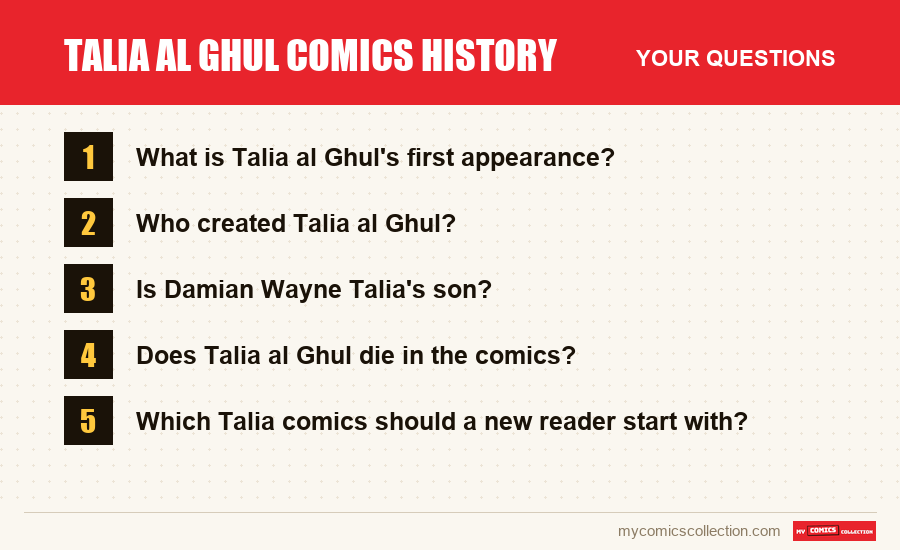
Detective Comics #411 (May 1971) is where she debuts, in "Into the Den of the Death-Dealers!", scripted by Dennis O'Neil and drawn by Bob Brown, with Dick Giordano credited for the concept. Ra's al Ghul arrives the following month in Batman #232.
Writer Dennis O'Neil and artist Bob Brown created Talia in Detective Comics #411 (May 1971), with Dick Giordano credited for the concept. The character was introduced simply as Talia, and the family name became part of her identity later, in the stories built around her father.
Yes. Damian is Talia's son by Bruce Wayne, introduced in Batman #655 (September 2006) by Grant Morrison and Andy Kubert. The concept grows out of an unnamed child in the 1987 graphic novel by Mike W. Barr. He was trained by the League of Assassins.
Yes. In Batman Incorporated vol. 2 #13 (2013), Kathy Kane shoots Talia after Talia's Batcave duel with Batman, and Ra's al Ghul later takes the bodies of Talia and Damian. She is back in later books, including Robin: Son of Batman and Shadow War.
Start with Detective Comics #411 and Batman #232 for the debut, then Batman: Death and the Maidens for the modern version of her leadership role. If the Damian storyline interests you, read Batman and Son and then Batman Incorporated in order, since Leviathan builds across both volumes.
Own a copy of Detective Comics #411 or Batman #232? Get an estimate from its grade and edition.
Estimate my comic