
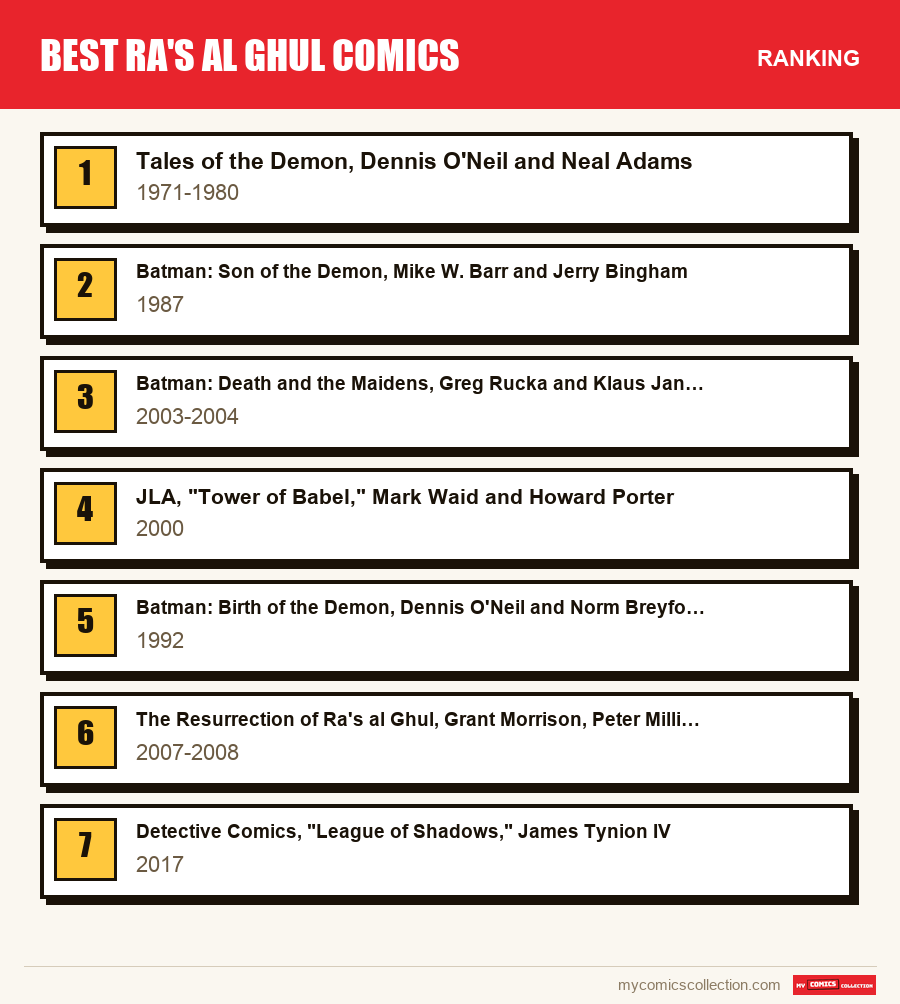
To find the best Ra's al Ghul comics, first read the collection Tales of the Demon, which gathers the 1970s stories by Dennis O'Neil and Neal Adams, then the album Batman: Son of the Demon (1987) by Mike W. Barr and Jerry Bingham. For a more recent read, add Batman: Death and the Maidens (2003-2004) by Greg Rucka and Klaus Janson. The character is born in Batman #232, cover-dated June 1971, his first appearance and the key issue to know.
Ra's al Ghul holds a place apart among Batman's adversaries: neither madman nor gangster, he presents himself as a man centuries old who wants to save the Earth by purging it, and who sees in Batman a possible successor. This ambition of world order gave Gotham an enemy on a planetary scale, and gave Bruce Wayne an adversarial family, the League of Assassins. The bibliography is rather scattered across single issues, albums and events; this guide picks seven reads and shows how to approach them.
As always in this guide, we only state verified facts (creators, issue numbers, dates); the analysis is our own, with no reproduction of protected pages or dialogue.
His first appearance
Ra's al Ghul enters the scene in Batman #232, cover-dated June 1971, with the story "Daughter of the Demon." Dennis O'Neil writes, Neal Adams draws, and Julius Schwartz runs the editing, to whom we owe the concept and the name. The story sets up an adversary who knows Batman's secret identity and treats him as an heir rather than an enemy. For the details of the issue, its cover and what to examine on a period copy, see our profile of this issue.
What to remember for reading: this issue launches a run of stories where Batman travels, investigates and confronts a conspiracy on a global scale, far from the alleys of Gotham. It is also why the reads that follow almost all start from this period: the character was conceived then and most of his founding stories refer back to it.
1: Tales of the Demon, Dennis O'Neil and Neal Adams (1971-1980)
This 1991 collection gathers the founding episodes: Batman #232, #235, #240 and #242 to #244, Detective Comics #411, #485 and #489-490, as well as DC Special Series #15. The releases span 1971 to 1980. The best-known turning point is in Batman #243, which introduces the Lazarus Pit, the bath that restores life and from which the character draws his reputation as an immortal. The collection is the best way to read this period without buying a pile of single issues.
It is for every reader, but especially for one who wants to see how the character was set. Neal Adams's art gives the stories the sweep of an adventure movie. Read it in the order of the volume, which follows the chronology of the releases, and keep the selection devoted to Neal Adams within reach to continue with the artist.
2: Batman: Son of the Demon, Mike W. Barr and Jerry Bingham (1987)
This album, released in 1987 by DC, is a complete story in graphic novel format, published in hardcover and softcover versions. Mike W. Barr writes, Jerry Bingham draws. Batman teams up there with Ra's al Ghul to counter a terrorist who hijacks a weather-control satellite, and the story focuses above all on the relationship between Bruce Wayne and Talia, Ra's's daughter. You also come across the early seeds of Damian Wayne, which makes the album a stop for anyone following Bruce Wayne's descendants.
It is perfect for anyone who wants a standalone story, more intimate than the Bronze Age clashes. A reading tip: its status in continuity has been debated and has no bearing on the pleasure of reading, but it is better taken as a story apart. Its sequel, Batman: Bride of the Demon (1990), is by Mike W. Barr and Tom Grindberg; the set, with Birth of the Demon, is collected in a three-album volume.
3: Batman: Death and the Maidens, Greg Rucka and Klaus Janson (2003-2004)
This nine-issue miniseries runs from October 2003 to August 2004, preceded by a prologue in Detective Comics #783. Greg Rucka writes, Klaus Janson draws. It deals with Ra's's relationships with his daughters and makes the League of Assassins a family affair. The volume that collects it includes the prologue.
This is the modern way in: a dense, thoughtful story that assumes almost no prior reading. It is for the crime-fiction reader who prefers dilemmas to fights, and it reads in a weekend. Take it in a collected edition rather than single issues, because the Detective Comics prologue is part of it.
4: JLA, "Tower of Babel," Mark Waid and Howard Porter (2000)
The "Tower of Babel" arc fills the JLA series in the second half of 2000: Mark Waid writes, Howard Porter draws, Steve Scott contributes. The contingency plans Batman had devised to neutralize his teammates are stolen by Talia al Ghul, then used by her father against the Justice League. A second phase targets language itself, with a tower that scrambles speech and writing.
This is where the conflict moves from Batman's turf to that of the whole team, and where distrust among heroes becomes the real stake. The arc will please the fan of superhero teams more than the Gotham fan; it reads outside any context, in its collection, and reminds us that Ra's al Ghul can be the engine of a League story without Batman at its center. The album is a good complement to the first two picks.
Do you collect this series?
Track what you own, what you are missing and what your collection is worth. 7-day trial.
Start my trial →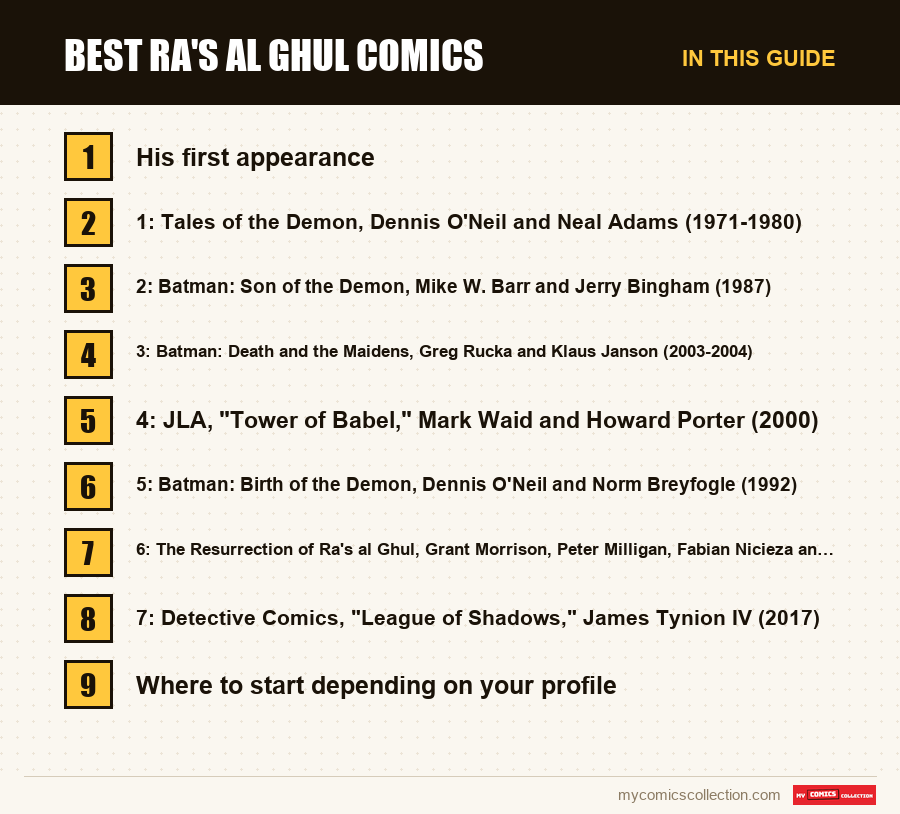
5: Batman: Birth of the Demon, Dennis O'Neil and Norm Breyfogle (1992)
Dennis O'Neil, who had created the character with Neal Adams, returns to his origins in this 1992 album drawn by Norm Breyfogle. It tells, in retrospect, how the man became Ra's al Ghul, and it closes the three-album cycle begun with Son of the Demon; the three are collected together.
This volume suits anyone who has already read Son of the Demon and is looking for the origin of Ra's al Ghul himself. It requires having read the foundational episodes, because it answers them, and it is more enjoyable with Tales of the Demon in mind. Norm Breyfogle's art, full of movement, suits a story that crosses the centuries. Fans of Norm Breyfogle will find one of Batman's great artists at work in a roomy format.
6: The Resurrection of Ra's al Ghul, Grant Morrison, Peter Milligan, Fabian Nicieza and Paul Dini (2007-2008)
This event stretches from late 2007 to early 2008 across several series: Batman #670-671, Detective Comics #838-839, Nightwing #138-139, Robin #168-169, Batman Annual #26 and Robin Annual #7. Several writers collaborate on it, including Grant Morrison, who writes the prologue in Batman #670, and Paul Dini. The collection released in 2008 gathers the whole.
The story is for the reader who follows the Batman family of the period and who knows Nightwing or Robin; it is not a starting point. Its value is in showing how Ra's al Ghul runs through the titles as a crossover event. To continue with the writer of the prologue, see the Grant Morrison page.
7: Detective Comics, "League of Shadows," James Tynion IV (2017)
This arc of the Rebirth-era Detective Comics series runs from issue #950 to #956 and appears in 2017. James Tynion IV writes, and the art is shared among Marcio Takara, Alvaro Martinez and Eddy Barrows. Issue #950 is a 48-page edition celebrating the 950 issues of the original series. The collection of this period carries the title League of Shadows.
It is the most recent entry in this selection, suited to the reader discovering the series of this period who wants to read an arc whose title points to Ra's al Ghul's organization. It demands more context than the first five; read it after at least one of Mike W. Barr's two albums. The writer's work is detailed on his dedicated page.
Where to start depending on your profile
If you are new to Batman, start with Tales of the Demon or Death and the Maidens: the first gives the foundations, the second the modern read. If you are coming from the movies, notably Batman Begins, read the 1970s stories then check our comparison of the movie with the comics to gauge what the film kept of the League.
If you prefer standalone albums, take Son of the Demon then Bride of the Demon, which follow the same story. If you like crossover events, turn to "Tower of Babel" or to The Resurrection of Ra's al Ghul. Readers of the Batman family will choose the 2007 event, which involves Robin and Nightwing, and those who want an arc to read alongside an ongoing series will choose the 2017 one.
The key issues to know
Eight landmarks mark out Ra's al Ghul's timeline, from the 1971 issue to the 2017 arc.
- Detective Comics #411 (May 1971): Talia, his daughter, arrives a month before her father, in a Dennis O'Neil story that sets the stage.
- Batman #232 (June 1971): the character's entrance, with "Daughter of the Demon."
- Batman #243: the Lazarus Pit is introduced in this episode of the O'Neil and Adams cycle.
- Batman: Son of the Demon (1987): album by Mike W. Barr and Jerry Bingham, where the future Damian Wayne appears.
- Batman #655 (2006): Grant Morrison opens his run and turns Talia's child into a full character, Damian, grandson of Ra's.
- Detective Comics #783: prologue to Death and the Maidens.
- Batman #670 (2007 prologue): launch of the resurrection, with Grant Morrison.
- Detective Comics #950 (2017): anniversary issue that opens the League of Shadows arc.
The first appearance is the collector's issue on the list; the other titles are read mostly in collections. For the 1971 copy, compare completed sales of the same issue in the same condition, then read what is printed on the cover before trusting the listing's title.
Frequently asked questions
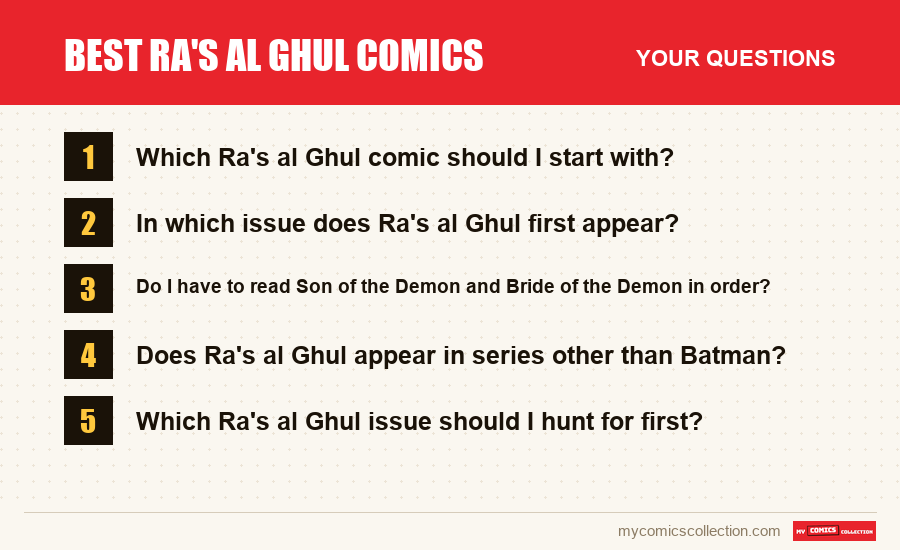
Start with the collection Tales of the Demon, which gathers the Dennis O'Neil and Neal Adams stories published between 1971 and 1980. If you prefer a modern, standalone read, choose Batman: Death and the Maidens by Greg Rucka and Klaus Janson (2003-2004).
In Batman #232, cover-dated June 1971, with the story "Daughter of the Demon." Dennis O'Neil writes, Neal Adams draws, and Julius Schwartz runs the editing. The Lazarus Pit, for its part, arrives in Batman #243.
Yes, it is preferable: Son of the Demon (1987) comes before Bride of the Demon (1990), both by Mike W. Barr. Birth of the Demon (1992) completes the set, and the three albums are collected in a single volume.
Yes. The "Tower of Babel" arc of JLA (2000), by Mark Waid and Howard Porter, pits him against the Justice League. The event The Resurrection of Ra's al Ghul (2007-2008) runs through Batman, Detective Comics, Nightwing and Robin.
To collect, Batman #232 (1971), his first appearance. To read, favor the modern collections over the original single issues. In every case, check the issue number, the edition and the condition before buying.
Do you own a 1970s Batman or a Ra's al Ghul album? Get the copy appraised before you resell it or have it graded.
Appraise my comic