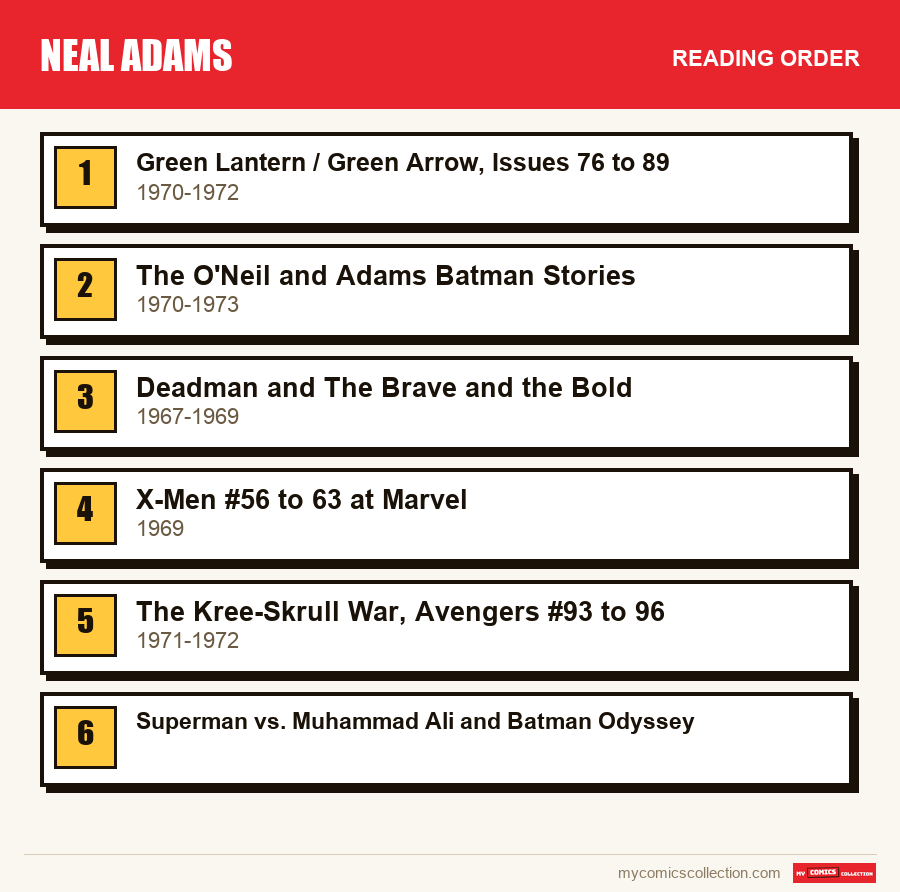
To read Neal Adams, start with Green Lantern #76 to 89, written by Denny O'Neil, then the Batman stories from the same team: Batman #232, Detective Comics #400 and Batman #251. Next come Deadman and The Brave and the Bold, X-Men #56 to 63 at Marvel, the Kree-Skrull War in Avengers, and finally Superman vs. Muhammad Ali and Batman Odyssey. Six steps, from the short stories to the most unusual projects.
Neal Adams's art changed the look of American comics at the turn of the 1970s: carefully built anatomy, bold framing, faces that age and grow tired. But reading Adams is not the same as following a single series. The work is scattered between DC and Marvel, between very different writers, between standalone issues and multi-part events. A route keeps you from spreading yourself too thin.
As always in this guide, only verified information (creators, issue numbers, dates) is stated as fact; the analysis is our own, with no reproduction of protected artwork or dialogue.
There is no biographical article on Adams on this site, and this guide does not try to stand in for one. It answers a different question: in what order should you read so that each step prepares the next? The natural starting point is an issue whose context we have already covered, Green Lantern #76 by O'Neil and Adams, which serves as the opener here. The rest of the path widens the circle toward Batman, toward lesser-known characters, and then toward Marvel.
Step 1: Green Lantern / Green Arrow, Issues 76 to 89 (1970-1972)
The series, in its early 1970s form, opens with issue #76, dated April 1970: Denny O'Neil writes, Adams draws most of what follows, and Julius Schwartz edits. Hal Jordan, the ring bearer, travels across the United States with Green Arrow and runs into subjects superhero comics avoided: urban poverty, intolerance, pollution. Issues #85 and #86, published in 1971, deal with drug addiction in Green Arrow's young partner and rank among the most cited episodes of the era.
Why start here? Because the reading is short and self-contained: each issue is a complete story, with no need for the previous one. Adams's close-ups on faces, his very vertical panels and realistic urban settings are enough to show why the artist left his mark on his time. The sometimes preachy tone of the writing is dated, but it is part of the object.
Effort level: low. Fourteen single issues, collected in one or two volumes. The context of the moment, and the frame of mind in which the series was born, are detailed in the study on the major Green Lantern artists.
Step 2: The O'Neil and Adams Batman Stories (1970-1973)
The second step stays with the same team but changes character. Between 1970 and 1973, Adams drew several Batman episodes that brought the hero back toward night and noir. Detective Comics #400, dated June 1970, introduces Man-Bat in a story written by Frank Robbins. Batman #232, from June 1971, introduces Ra's al Ghul: that issue is analyzed in our guide to the first appearance of Ra's al Ghul. Batman #251, from 1973, brings back the Joker in his murderous version.
These three episodes give an idea of Adams's range: gothic horror, international adventure, the Gotham thriller. They also serve as an introduction to the most lasting antagonists of the period, whom several decades of adaptations have made familiar. A reader coming from movies or TV will find well-known names here, in their starting version.
Effort level: low to medium. The three stories read in isolation; all you need is to know who Batman is. If you want to go further, the collections devoted to the Ra's al Ghul era gather several linked issues, in publication order.
Step 3: Deadman and The Brave and the Bold (1967-1969)
Let's go back a few years. Deadman was born in Strange Adventures #205, dated December 1967, written by Arnold Drake and penciled by Carmine Infantino. Adams took over the art starting with the next issue, and the character, a murdered trapeze artist who haunts the world of the living in search of his killer, became one of the most visual creations of the period. At the same time, Adams drew The Brave and the Bold starting with issue #79, on scripts by Bob Haney, in which Batman teams up with a different guest each episode.
This step is harder than the first two for a practical reason: Deadman has no character page on this site where you can find all the issues. The storytelling of the period, with its thought balloons and long-winded titles, takes some getting used to. But this is where you see Adams searching for his style, before the collaboration with O'Neil crystallized it.
Effort level: medium. Plan to read in collected editions: original single issues from this period are rare in good condition, and the point of the reading is not to own them. The shift from the Silver Age to the Bronze Age, which frames these stories, is explained in our piece on the ages of comics.
Step 4: X-Men #56 to 63 at Marvel (1969)
Adams also drew for Marvel. In 1969, the X-Men series, then close to cancellation, received his pencils on issues #56 to 63, with Roy Thomas on script. Alex Summers, introduced shortly before, takes the name and costume of Havok in issue #58, and the series strings together adventures that pass through the Savage Land. These single issues are brief, sometimes confusing, but the art contrasts sharply with the rest of Marvel's output at the time, which was more geometric and more static.
The interest of this step is twofold. First, seeing what Adams does with a character other artists have made famous. Second, understanding a period when the X-Men, in their first lineup, were dragging sales down and heading for an interruption. These issues are often presented as a last flash of brilliance before the series stopped, relaunched in 1975 by the Giant-Size X-Men team.
Where do these eight single issues fit among the landmarks of the series? The table of key X-Men issues places them. Effort level: medium. Eight issues, with subplots to follow, but writing that is more readable than the average of the era.
Do you collect this series?
Track what you own, what you're missing and what your collection is worth. 7-day trial.
Start my trial →
Step 5: The Kree-Skrull War, Avengers #93 to 96 (1971-1972)
The war between the Kree and the Skrulls, in Avengers, runs over several issues, from #89 to about #97, written by Roy Thomas. Adams draws the central chapters, #93 to 96, alongside other artists for the rest. The arc pits two alien empires against each other, with the Avengers caught between them, and involves a large part of the team.
This step is demanding for a structural reason: the story begins before Adams's issues and ends after them, so you have to read the whole thing to follow it, even if that means putting up with changes of artist. In return, Adams's pages here are among the most ambitious of his Marvel period, with large compositions where characters jostle each other in space.
Effort level: medium to high. Several single issues, a minimal knowledge of the Avengers of the time, and a taste for big serialized plots. The Avengers hub helps you locate the issues of this period.
Step 6: Superman vs. Muhammad Ali and Batman Odyssey
The last landmarks step outside the regular series. Superman vs. Muhammad Ali, published in 1978 in a large format, is a story scripted by Denny O'Neil and drawn by Adams, staging a boxing match between the hero and the champion. Much later, Batman Odyssey (2010) gives Adams the double role of writer and artist, in a deliberately baroque series that readers did not receive with one voice.
These two items are the most unusual on the path. They show an artist who follows his ideas all the way, with the visual successes and contested narrative choices that implies. You read them out of curiosity rather than for discovery: it is better to already have a taste for the creator before enjoying them.
Effort level: high, especially for Odyssey, whose story takes patience and a certain appetite for risk. The format of the first, a large album, deserves to be seen in its original edition or a faithful reprint so the art can breathe.
How to Read: Single Issues or Collected Editions
For 1967 to 1973, the collected edition is the royal road. Period single issues are fragile, their paper has aged, and the most in-demand ones are chased by buyers who do not read them. Omnibus- or Archives-type collections gather several issues in publication order, which matters for following the subplots. Our comparison of omnibus editions versus original single issues weighs these choices.
If you still want to own originals, concentrate on a few issues that truly matter: the first appearance of Ra's al Ghul, that of Man-Bat, the start of the Green Lantern / Green Arrow series. For the rest, it is better to read in collected editions and save your budget for a quality copy. The guide to the best Bronze Age comics helps you spot what holds up over time, and the one on comics signed by artists helps you decide whether a signature changes the picture.
One last habit: for an artist whose pages are the main attraction, reproduction quality matters. A collection with overdone recoloring or paper that is too glossy can betray Adams's line; compare the excerpts visible online before buying.
Summary: The Recommended Order
- Green Lantern / Green Arrow: #76 to 89, with O'Neil. Low effort.
- The O'Neil and Adams Batman stories: Detective Comics #400, Batman #232 and #251. Low to medium effort.
- Deadman and The Brave and the Bold: Strange Adventures from #206, Brave and the Bold from #79. Medium effort.
- X-Men #56 to 63: with Roy Thomas, Havok in #58. Medium effort.
- Kree-Skrull War: Avengers #93 to 96 for Adams's share. Medium to high effort.
- Superman vs. Muhammad Ali and Batman Odyssey: the curiosities. High effort.
If you could only choose two steps, keep the first and the second: they sum up the reason Adams is still talked about, in about thirty issues. If the line captivates you, continue in order through the sixth; if not, stop there without regret.
Frequently Asked Questions
Start with Green Lantern #76, the first issue of the collaboration with Denny O'Neil, then continue through #89. Each episode reads on its own, and Adams's art is fully on display. Follow with Batman #232 and Detective Comics #400 to see the same duo on another hero.
Mostly an artist. The famous Bronze Age stories are written by Denny O'Neil, Roy Thomas or Bob Haney. Adams handles both script and art in Batman Odyssey, in 2010, a late project that did not win everyone over and is best read after the rest of the path.
No. The fourteen issues, from #76 to #89, form a coherent whole, but most are independent. If you want a preview in few pages, read #76 and #85 and #86: they show both the ambition of the duo and the social register of the series.
Yes, out of curiosity: issues #56 to 63 from 1969 show art very different from what Marvel was producing at the time, and #58 gives Havok his name and costume. They are less accessible than Green Lantern, because the writing is dated and several storylines remain open.
To read, collected editions: the paper of the 1960s and 1970s is fragile and the important issues remain expensive in good condition. Keep originals for a few specific episodes, such as Batman #232, and check the cover details before buying so you do not mistake it for a reprint.
Do you own Batman, Green Lantern or X-Men issues drawn by Neal Adams? Get your single issues estimated for free before completing them or parting with them.
Estimate my comic