In short
Eight Batman issues carry the character: #357 (March 1983) for the debut, #408 (1987) for the new street-kid origin, #427 to #429 (autumn 1988) for the phone-vote death, then #635 and #638 (2005) for the Red Hood and his unmasking, and Annual #25 (2006) for the explanation of his return. Conway and Newton created him; Starlin and Aparo killed him; Winick and Mahnke revived him.
Few characters in the Batman line are collected as a sequence of separate moments. Jason Todd arrives as a boy, is rebuilt in 1987, dies in 1988, and returns as a masked adversary in 2005. Each moment sits in a different issue, by a different team, and each asks the buyer a different question. This ranking sorts those issues by what they mean on a shelf, then explains how to assemble them without paying twice for the same thing.
The credits, cover dates and vote figures below were checked against published reference material. The order of the ranking is our own judgment, and no panel, page or line of dialogue is reproduced.
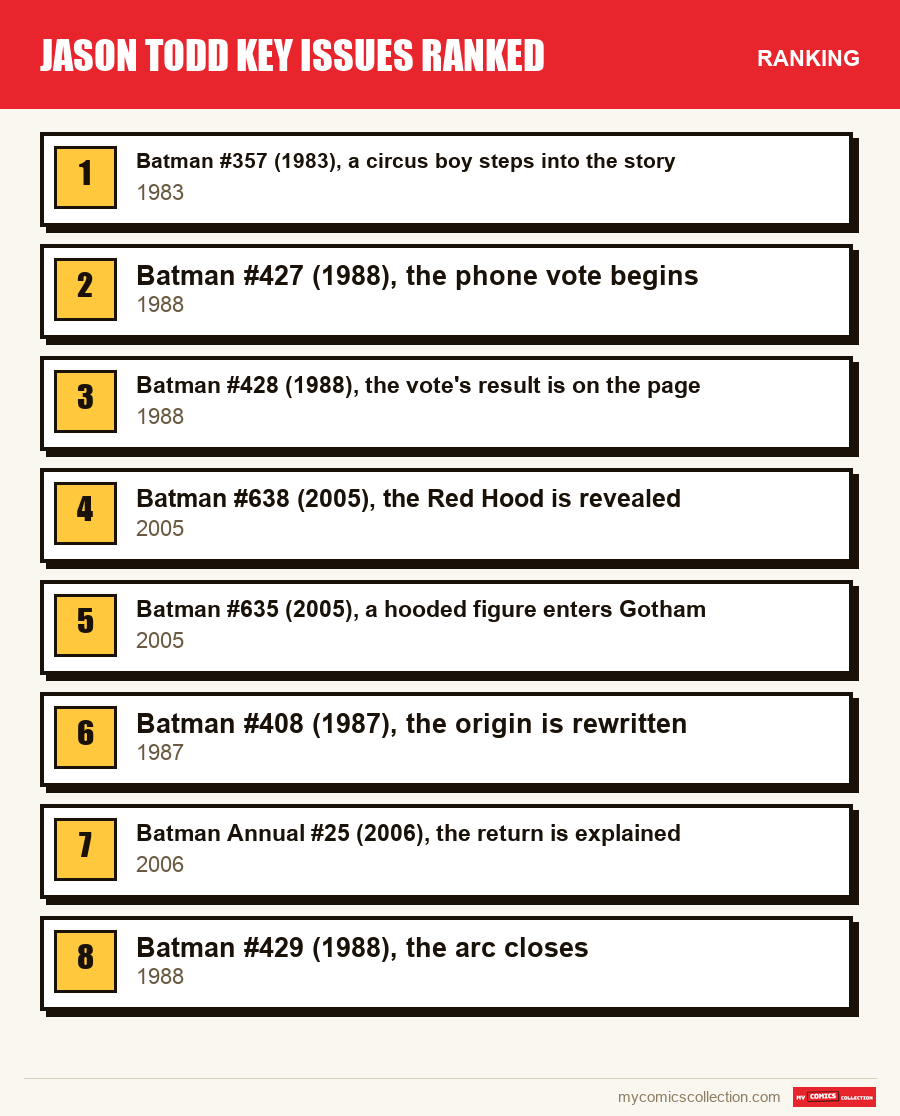
1: Batman #357 (1983), a circus boy steps into the story
The cover date is March 1983. Gerry Conway wrote the issue and Don Newton drew it, and the two are credited as the creators of Jason Todd. At this point the boy has no costume and no role as a partner: he is introduced as a young acrobat in a circus setting, with a design that mirrors the original Robin, the orphaned acrobat of the 1940 debut. The issue belongs on a Jason Todd list because it is the earliest appearance, but it is a quiet one.
The same issue holds a cameo of Killer Croc, the villain later tied to the death of Jason's circus parents in this first version of his origin. Jason's first full appearance is Detective Comics #525, cover-dated April 1983. For a collector this means that the debut issue serves two shelves, the Robin line and the rogues' gallery, and that an issue titled in a listing as a Killer Croc book may be sold to a different audience than the same copy sold as a Jason Todd book.
What to know before buying: the cover date is the identifying field, the debut is a cameo and not a story, and the two Detective Comics issues are separate numbers that should be filed separately. Our Batman #357 guide covers the issue page by page.
2: Batman #427 (1988), the phone vote begins
This is the issue that turned a monthly comic into a news item. The second chapter of A Death in the Family is Batman #427: Jim Starlin scripts it, Jim Aparo pencils it and Mike DeCarlo inks it, with John Costanza on letters and Adrienne Roy on colors. It ends with Jason beaten by the Joker and left to die in an explosion, and the back cover prints the two telephone numbers that readers could call to decide whether Robin lived or died.
The vote opened on September 15, 1988, at 9 a.m. Eastern, and the lines stayed open for about a day and a half. Of 10,614 votes, 5,343 favored death and 5,271 favored survival, a margin of 72. Dennis O'Neil, the editor, and the assistant editor Dan Raspler checked the tally every 90 minutes. That level of paperwork is why the margin is still quoted today.
What to know before buying: the object of interest is the printed page with the telephone numbers, so a copy with its back cover intact is the one to prefer. A cut or torn back cover changes what the copy is, and the cover date printed on the front should be noted in the record. The release date for the issue was September 6, 1988, which is useful if you cross-check a retailer's description.
3: Batman #428 (1988), the vote's result is on the page
Where #427 asks the question, Batman #428 answers it. The issue shows Batman finding Jason's body in the ruins of the warehouse and was released on October 18, 1988, with a cover by Mike Mignola, who drew the covers of the arc after the assistant editor Dan Raspler suggested him. Superman appears in the final two issues of the arc, this one and #429. The creative team continues from the previous issue: Jim Starlin as the writer, Jim Aparo as the penciller, Mike DeCarlo as the inker.
The reason this issue ranks so high is that the death itself became a cultural reference point. The issue is the printed result of a decision that readers made themselves. Collectors who care about the history of the medium often place this book beside the issue that preceded it.
What to know before buying: the cover is an artwork by Mike Mignola, so the book also belongs on a cover-artist shelf. The first three issues of the arc sold out, and the collected edition, shipped on December 5, 1988, exists because of that demand. If a listing shows a trade paperback and calls it the issue, it is a different object.
4: Batman #638 (2005), the Red Hood is revealed
Batman #638, published in 2005, is the issue in which the identity behind the red helmet is shown. Judd Winick writes the arc and Doug Mahnke is the main artist; Eric Battle and Shane Davis also contributed art to Under the Hood, which ran across Batman #635 to #641 and #645 to #650, plus Annual #25, between February 2005 and April 2006, with a break between the two halves.
For a collector, this is the second life of the character. The issue is the point where a mystery opened in #635 resolves, and it is also the number most often cited when someone says the Red Hood returned. The arc was adapted in 2010 as the animated film Batman: Under the Red Hood, with Bruce Greenwood as Batman and Jensen Ackles as the Red Hood, which is one reason new readers look for the source.
What to know before buying: the arc is spread over many issues, so decide whether you want the single key number or the run. For reading order, see the best Red Hood runs; for what the 2010 film changed from these pages, see the film against the comics.
5: Batman #635 (2005), a hooded figure enters Gotham
Batman #635, cover-dated February 2005, is listed as the debut of the Red Hood in the Under the Hood arc, by Judd Winick and Doug Mahnke. The reader of 2005 is not told who is behind the helmet. The issue works as a hook: a masked criminal reorganizes the underworld, and Batman senses a familiar presence.
The book ranks below the reveal because its meaning depends on the issues that follow. In the order in which a reader meets it, it is the first page of a mystery. In the order of a collection, it is the first page of the return, and collectors of the Red Hood line tend to want it for that reason.
What to know before buying: if you are building the line as a story, buy #635 with #638 and keep them together, because the first is incomplete without the second. If you are building it as a cameo and debut list, #635 is the entry that carries the helmet.
Do you collect this series?
Track what you own, what you are missing and what your collection is worth. 7-day trial.
Start my trial →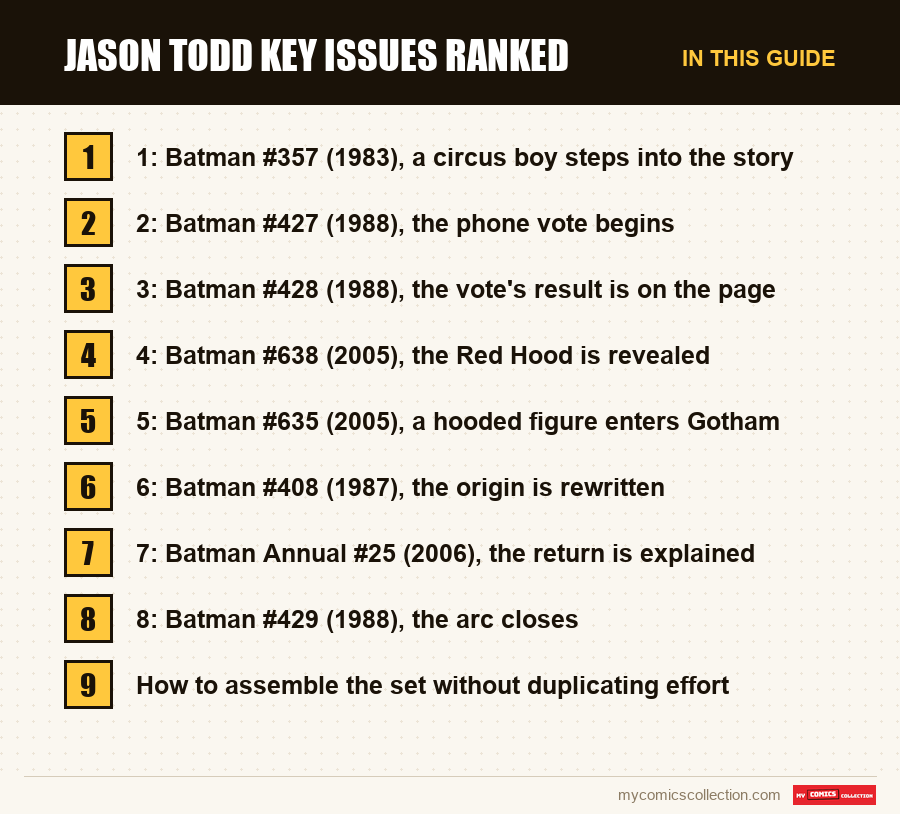
6: Batman #408 (1987), the origin is rewritten
With Batman #408, published in 1987, a four-issue story written by Max Allan Collins recast Jason as a street delinquent rather than the circus boy of 1983. The change is the reason Jason is remembered as a rebellious Robin instead of a copy of his predecessor. It reads as the preparation for what came a year later: a character with a temper and a history is easier to put in danger.
The wording of the reference is that #408 begins the story, and the later issues in the four-part run belong to the same arc. That is how a collector should file it: the first number is the entry point and the rest of the arc follows.
What to know before buying: this is a modest-profile issue in the middle of the 1980s Batman run, and the interest comes from the retcon rather than from the cover. It is a reasonable place to economize if the budget is limited, since the dramatic weight of the story sits in the 1988 issues.
7: Batman Annual #25 (2006), the return is explained
Batman Annual #25, dated March 2006, is the issue that explains how Jason came back, within the story of Under the Hood. It belongs to the same Judd Winick arc and is part of the continuity of Infinite Crisis. The annual also reused one of Jim Aparo's alternate pages from A Death in the Family, a detail that links the 2006 book to the 1988 one.
The explanation involves Superboy-Prime's alteration of reality, as the reference describes it, and that is the context in which an annual in a Batman line fits into a company-wide story. The issue ranks lower than the main run because its value is as an answer, not as an event.
What to know before buying: annuals are often overlooked, which is both a reason to look for them and a reason to check that you are buying the right number, since the series numbering and the annual numbering differ. Confirm the annual number and the date in the listing.
8: Batman #429 (1988), the arc closes
The conclusion of A Death in the Family is Batman #429, released on November 29, 1988. It is the last of the four parts, with Superman guest-starring and the same team of Jim Starlin and Jim Aparo behind it. Where #428 delivers the death, #429 handles the aftermath and the consequences for Batman.
It ranks last because its weight depends on the previous issues. But the arc is four issues, and a buyer who holds #427 and #428 without #429 owns an unfinished story. The opening part, #426, was released on August 23, 1988.
What to know before buying: the order of release is #426 on August 23, #427 on September 6, #428 on October 18 and #429 on November 29, 1988. Buy in that sequence if you want to read as you collect.
How to assemble the set without duplicating effort
A sensible order starts from the story you intend to read. If the goal is the 1988 arc, buy #427 and #428 first, then add #426 and #429 to complete the four parts. If the goal is the Red Hood return, buy #635 and #638 together and treat Annual #25 as the epilogue. The debut, #357, and the origin rewrite, #408, are best added when the middle of the set is secure, because they depend on the later issues for their meaning.
Three traps are worth naming. The first is mixing up the cameos: Killer Croc, Jason and the Red Hood each have a debut or cameo issue, and the cover dates differ by number, so read the date and not the seller's label. The second is the title: Batman's 2005 arc and the 2011 team series Red Hood and the Outlaws are separate runs, so a listing that blends them may send you to the wrong number. The third is the collected edition: the trade paperback of A Death in the Family and the later deluxe hardcover are different books from the four single issues, so the label on your record should say which one you hold.
Beyond the eight issues above, two later items extend the shelf: Red Hood: The Lost Days, a six-issue 2010 story written by Judd Winick that follows Jason's training abroad, and Red Hood and the Outlaws #1, cover-dated September 2011, by Scott Lobdell and Kenneth Rocafort, which launched the series. Neither belongs among the eight because the character's weight sits earlier, but both are logical stops for a collector who wants the line to continue after 2006.
A set of four 1988 issues, a 2005 pair and an annual already tells the whole arc of the character, from boy to victim to adversary. For the surrounding Robin line, the Robin key issues guide gives the earlier steps, and the Batman hub collects the rest of the line.
Frequently asked questions
Jason Todd debuts in Batman #357, cover-dated March 1983, created by writer Gerry Conway and artist Don Newton. His first full appearance is Detective Comics #525, cover-dated April 1983. In the debut issue he is a circus boy and has no costume yet.
Batman #428, released October 18, 1988, shows Batman finding his body, after Batman #427 ended with him left to die in an explosion. The storyline is titled A Death in the Family and ends with Batman #429, released November 29, 1988.
Readers cast 10,614 votes over about a day and a half. Death won 5,343 to 5,271, a margin of 72 votes. The numbers were printed on the back cover of Batman #427, and the editors checked the tally every 90 minutes during the vote.
It begins in Batman #635, cover-dated February 2005, by Judd Winick and Doug Mahnke. The identity behind the helmet is shown in Batman #638, published later in 2005. The full arc, Under the Hood, runs across Batman #635 to #641 and #645 to #650, plus Annual #25.
Yes. Batman: Under the Red Hood, released in 2010 with Bruce Greenwood as Batman and Jensen Ackles as the Red Hood, adapts the Under the Hood storyline with some changes for pacing. If you want the source, start with Batman #635 and the issues that follow.
Holding a Batman issue from the Jason Todd years, from the 1983 debut to the 2005 return? Check its number and cover date first.
Estimate my comic