The Bane comics history begins at DC with Batman: Vengeance of Bane #1, cover-dated January 1993. Chuck Dixon, Graham Nolan and Doug Moench are his creators, working from an idea by Dennis O'Neil. An inmate of the Peña Duro prison on the island of Santa Prisca and powered by Venom, he became famous by breaking Batman's back in Batman #497 (July 1993), at the heart of Knightfall. Since then he has gone from Gotham's rival to mercenary, to Secret Six teammate, and then to master of an entire city.
Bane is a textbook case: a character created for an event who then had to find a reason to exist once the event was over. The writers who picked him up have rarely treated him as simple brute force. This page follows his publishing life era by era, from 1993 to 2019, and leaves the reading selection to other guides.
As always in this guide, only verified information (creators, issues, dates) is stated as fact; the analysis is our own, with no reproduction of protected pages or dialogue.
His first appearance
In the early 1990s, DC was looking for an event on the scale of the one the publisher had just given Superman. The Batman group editor, Dennis O'Neil, floated the idea of an adversary able to beat the hero not through brute force, but through method. Chuck Dixon and Graham Nolan developed it and created the character, with Doug Moench also credited as co-creator.
The issue of his birth is Batman: Vengeance of Bane #1, dated January 1993. Dixon writes, Nolan draws. The story lays down the elements every later version reuses: Santa Prisca, a Caribbean island, the Peña Duro prison where the character grew up, and Venom, a drug that multiplies strength. It comes out shortly before the saga that will make Bane a star, and that is how it reads: an overture. Check the exact title on the listing: "Vengeance of Bane" covers several different items, including a sequel published in 1995.
Venom itself has an earlier history: O'Neil set it up in a story in Batman: Legends of the Dark Knight (#16 to 20). Bane therefore inherits a setting that was already drawn, and that is part of the character's solidity.
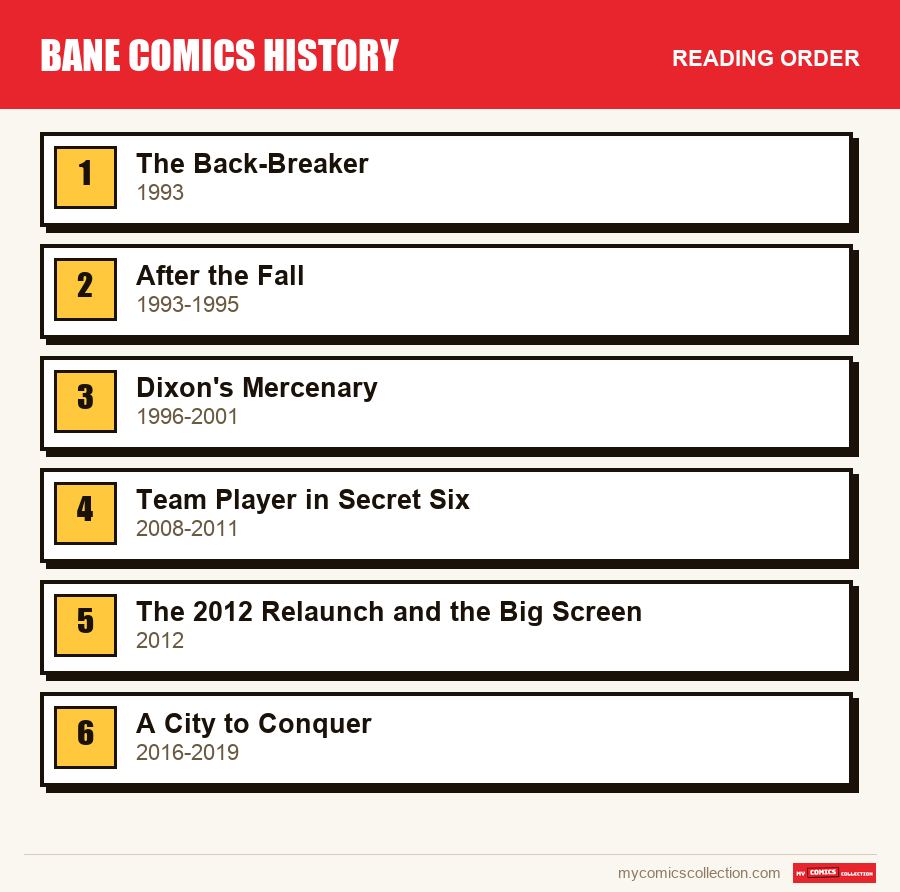
Era 1: The Back-Breaker (1993)
The Knightfall event fills the spring and summer of 1993, with Batman #492 to 500 and Detective Comics #659 to 666. Doug Moench and Chuck Dixon write in turns, alongside Alan Grant, Jo Duffy and Dennis O'Neil. The character's plan: empty Arkham Asylum so that Batman wears himself out chasing the escapees, before showing up to face him.
Warning, spoiler: in Batman #497, dated July 1993, Bane breaks Bruce Wayne's back. The cover is by Kelley Jones, and the page of the break is drawn by Jim Aparo, whose other issues are listed on the hub devoted to him. The replacement is named Jean-Paul Valley: Azrael, introduced in Batman: Sword of Azrael (O'Neil and Joe Quesada, October 1992 to January 1993), takes over the costume. In Batman #500, he is the one who beats Bane, who is sent to Blackgate.
The saga answers a simple question: can you beat Batman through planning rather than luck? What changes for Bane: within a few months he becomes a name every DC reader knows. It is also, and this is the trap of the era, a fame resting on one moment. The next appearance has to prove the character has more to offer. For the precise order of the single issues, see the guide dedicated to the saga.
Era 2: After the Fall (1993-1995)
After #500, Bane leaves center stage. Knightquest, which runs from October 1993 to June 1994, follows Batman's replacement, and Bane crosses paths with Selina Kyle in the first issues of the Catwoman series launched in 1993, in the wake of his defeat. The episode shows an adversary who hasn't disappeared, but whom no series yet wants to treat as a protagonist.
In 1995, his creators give him a comeback: Batman: Vengeance of Bane II, The Redemption, written by Chuck Dixon, drawn by Graham Nolan and inked by Eduardo Barreto. Bane gives up Venom there. The title already states the stakes: the question is what remains of a man whose reputation is made, but whose place has to be rebuilt. Best kept for readers already won over by Bane: the 1995 sequel is harder to track down than the saga.
What changes for Bane: he stops being the threat of the moment and becomes a character to reopen. The writers who take him up, starting with his creators, have to find him a role that doesn't boil down to the 1993 one.
Era 3: Dixon's Mercenary (1996-2001)
Bane's return comes from Chuck Dixon's pen. In Batman: Legacy, Bane faces Batman again, this time allied with Ra's al Ghul. The sixth chapter, in Detective Comics #701 (September 1996), sees Batman win in single combat; Dixon writes it, Nolan draws it, and Ra's al Ghul then dismisses his ally. Dixon then writes Batman: Bane (May 1997), drawn by Rick Burchett.
In 1997 too, the character moves to the screen in Batman & Robin, played by Robert Swenson, a version that the movie versus comics comparison sets against the page. In the comics, the cycle continues: Azrael #36 to 40 (December 1997 to April 1998) form the "Angel and the Bane" story, and the miniseries Batman: Bane of the Demon, launched in March 1998, reunites Dixon and Nolan to tell of Bane's meeting with Ra's al Ghul. For the latter's first appearance, first read our entry on Batman #232.
The period closes with Birds of Prey #26 (February 2001), "The Suiter," written by Dixon and drawn by Butch Guice. What changes for Bane: he becomes a networked character, tied to the Batman universe by several threads, and no longer to a single event. These years establish a trait the 1993 colossus didn't hint at: calculation.
Era 4: Team Player in Secret Six (2008-2011)
Bane finds a new setting with the third Secret Six series, launched in 2008 and written by Gail Simone. He joins a team of morally ambiguous criminals that includes Catman, Deadshot, Scandal Savage and Rag Doll. Nicola Scott draws the first issues. The series ends in 2011.
The change of role is radical: Bane is no longer a hero's adversary, he is a teammate with his own rules and limits. Simone also tackles a point that had stayed vague, the Venom dependency, in #6 and 7 (2009): Bane breaks his oath there to save Scandal Savage. For the reader, it is a chance to discover a Bane that no Batman series had had time to develop, and the series reads without knowing Batman in detail.
What changes for Bane: the character's humanity. This contrast with the 1993 colossus is the reason to read this series when you think you know the character.
Do you collect this series?
Track what you own, what you are missing and what your collection is worth. 7-day trial.
Start my trial →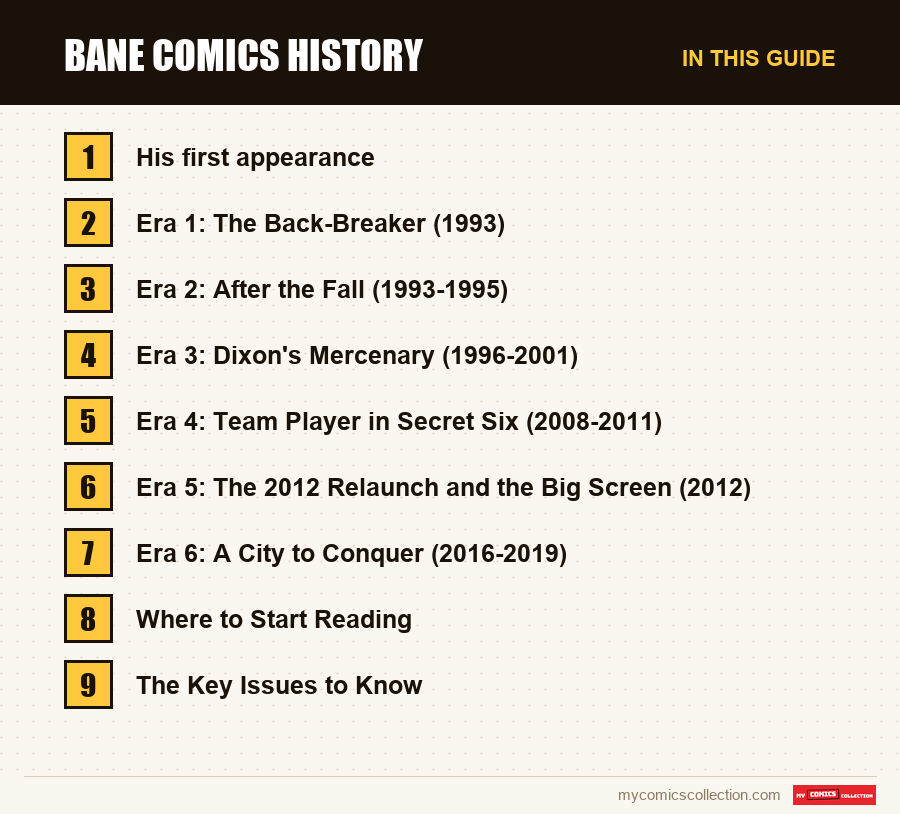
Era 5: The 2012 Relaunch and the Big Screen (2012)
The 2011 overhaul of the DC universe is the occasion to introduce the character to new readers. Batman: The Dark Knight (second series), by Paul Jenkins and David Finch, reintroduces Bane in issues #4 to 7, from February to May 2012.
The same year, The Dark Knight Rises (2012) gives Bane a central role in the movies, played by Tom Hardy. The film's script draws from elsewhere than the 1993 saga; the point-by-point confrontation is in our article on the film. For the collector, this screen presence makes Bane a name known beyond comics readers: one more reason to shelve his single issues by character rather than by series.
What changes for Bane: he becomes a pop-culture figure, and no longer just a Batman adversary. Readers who arrive through the film then find, in the comics, a character whose complexity predates the adaptation.
Era 6: A City to Conquer (2016-2019)
The 2016 Batman hands Tom King a body of work that culminates with Bane. The first arcs of this Batman follow one another this way: I Am Gotham, I Am Suicide, then I Am Bane, which gathers #16 to 20, #23 and 24 and Annual #1. King makes Bane a long-haul adversary, whom Batman can no longer treat as a passing enemy.
At the same time, Dixon and Nolan return to their creation in Bane: Conquest, twelve issues published from 2017 to 2018. There Bane, with his original gang (Bird, Trogg and Zombie), hunts mercenaries who smuggle nuclear weapons. He crosses paths with Bruce Wayne, with whom he escapes, and it is Batman who persuades him, in #8, to return the Kobra heir he has kidnapped.
City of Bane closes Tom King's time on the series, in Batman #75 to 85, in 2019. Bane's men take control of Gotham. Warning, spoiler: #77 contains the death of Alfred Pennyworth. Meanwhile, it is Thomas Wayne, the Batman of the Flashpoint world, who prowls the city in Bruce's place. Several artists follow one another on the arc, including Mikel Janín. To place the arc within the whole run, our guide Tom King: where to start gives the overview.
What changes for Bane: the ambition. His goal is no longer to take down one man but to take over Gotham. It is the logical conclusion for a character whose strength has always been method, and the loop with 1993 is deliberate: the balance of power set up by Knightfall is taken up on a wider scale.
Where to Start Reading
- Knightfall (1993), in a trade paperback: for the reader who wants the event. Seventeen single issues spread across two series: better to go through the three 2012 volumes or the 2017 and 2018 omnibus editions than through scattered issues.
- Batman: Vengeance of Bane #1, after Knightfall: for those who want to understand the character and not only the event. The effect works because the reader already knows what comes next.
- Gail Simone's Secret Six (2008): for the fan of morally ambiguous characters, who needs no prior knowledge.
- I Am Bane, then City of Bane (2016-2019): for the modern-series reader, as long as the start of Tom King's run is fresh in mind.
- Bane of the Demon (1998): for the reader who has read Batman #232 and wants to see Bane tied to Ra's al Ghul.
For a reasoned selection, see the ranking of Bane reads; the list above only follows chronology.
The Key Issues to Know
The hierarchy follows first appearances and turning points. Each marker is approached the same way: compare several listings of the same copy, note the stated condition, and choose a collected edition if only the story matters to you.
- Batman: Vengeance of Bane #1 (January 1993): the first appearance of Bane.
- Batman: Sword of Azrael #1 (October 1992): the introduction of Jean-Paul Valley, who will replace Bruce Wayne.
- Detective Comics #659: the opening of the Knightfall crossover, along with Batman #492.
- Batman #497 (July 1993): Batman's back is broken, cover by Kelley Jones.
- Batman #500 (October 1993): Jean-Paul Valley defeats Bane.
- Detective Comics #701 (September 1996): Batman wins in single combat.
- Secret Six, third series (2008): Bane becomes a teammate.
- Bane: Conquest #1 (May 2017) and Batman #77 (2019): the two recent markers, the second of which contains Alfred's death.
Before buying, check that the title and issue number match the listing, especially for the first appearance: Bane's presence in the movies has raised interest in all the 1993 single issues, which multiplies approximate listings. Then shelve the whole set by character: one dedicated shelf is enough to find every issue.
Frequently Asked Questions
In Batman: Vengeance of Bane #1, dated January 1993. Chuck Dixon writes, Graham Nolan draws, and Doug Moench is credited as co-creator. The issue comes a few months before the Knightfall saga: it is the one to look for as the first appearance, not Batman #497.
It is Batman #497, cover-dated July 1993, right in the middle of Knightfall. The cover is by Kelley Jones and the page of the break is drawn by Jim Aparo. Jean-Paul Valley then takes the costume, and defeats Bane in Batman #500, in October 1993.
Start with Knightfall, in a trade paperback, then Batman: Vengeance of Bane #1 to understand the character. If you prefer morally ambiguous characters, open Gail Simone's Secret Six, which reads without knowing Batman. Readers of modern series will head to Tom King's City of Bane.
No. In Gail Simone's Secret Six series (from 2008), he teams up with Catman, Deadshot, Scandal Savage and Rag Doll. In Bane: Conquest (2017-2018), he escapes alongside Bruce Wayne. He does remain the central adversary of City of Bane, in 2019.
The 2012 film gives the role to Tom Hardy. It keeps the name, the masked colossus look and the tie to Gotham, but the plot is not that of Knightfall. To tell borrowing from invention, read our article on the film, then open the 1993 comics.
A Batman #497 or a Batman: Vengeance of Bane #1 in your boxes: have its condition estimated before deciding where it fits in your set.
Estimate my comic