
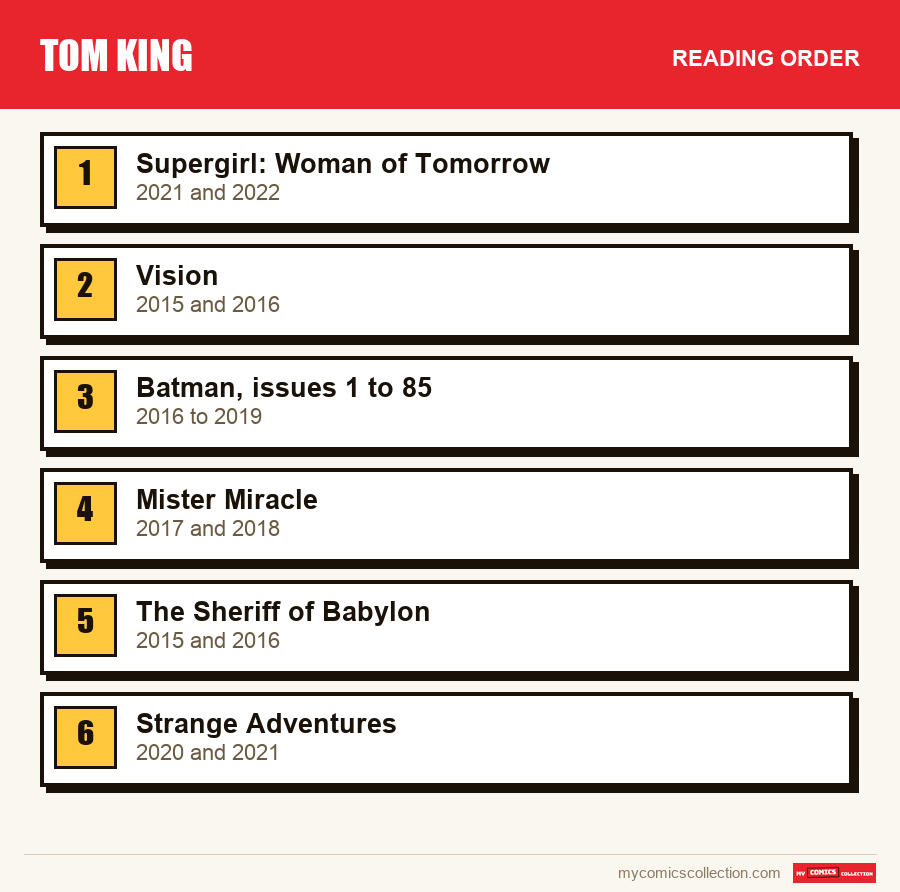
To read Tom King, start with Supergirl: Woman of Tomorrow (DC, 2021 and 2022, with Bilquis Evely) or with Vision (Marvel, 2015 and 2016, with Gabriel Hernández Walta). Then move on to King's Batman (issues 1 to 85, 2016 to 2019), followed by Mister Miracle (2017 and 2018, with Mitch Gerads). Save The Sheriff of Babylon and Strange Adventures, the most demanding of the lot, for last.
Tom King writes stories in which the action is a pretext for a bigger question: what do we do with exhaustion, with grief, with the lie we tell ourselves to keep going? A former CIA agent turned comics writer, King often works in twelve-issue limited series that read in one sitting. That makes getting in easy: almost none of King's major works requires knowledge of an entire universe. But order matters, because some of these books go very far into discomfort.
As always in this guide, only verified information (creators, issue numbers, dates) is stated as fact; the analysis is our own, with no reproduction of protected pages or dialogue.
What ties very different series together
Three writing habits come back from one title to the next. First, repetition: a phrase, a scene or a gesture returns slightly altered throughout a book, like a refrain that means something new each time. Second, closed-frame stories: a set number of issues, announced in advance, with an ending planned from the start. Finally, long-term artist partnerships: Mitch Gerads, Gabriel Hernández Walta, Mikel Janín and Bilquis Evely have each worked with King on several books, and their style counts as much as the text.
We are not retracing his career here. The site carries no complete biography of the writer: the author page simply lists the articles that mention him, and our feature on the Vision run explains where the 2015 series fits. The subject covered here is limited to the order in which to read.
Step 1: Supergirl: Woman of Tomorrow (2021 and 2022)
Eight issues, drawn by Bilquis Evely, telling the story of a trip through space between Kara Zor-El and a teenager from another planet who has come looking for an answer to a loss. It is the gentlest way in: a road story, a pair of characters, and an ending you can follow with no knowledge of the rest of the DC universe. The tone turns dark at times, but the book stays luminous, and color plays a leading role.
Why start here: the book shows King's style without the weight of the adult themes that come later. Who it suits: anyone who has never read the writer, or never read a superhero comic. As for reading format, the eight-issue run works equally well as a collected edition or in single issues. If Kara interests you as a character, our Supergirl reading guide places the series in the bigger picture.
Step 2: Vision (2015 and 2016)
Twelve issues, the first dated November 4, 2015, drawn by Gabriel Hernández Walta. Vision, the Avengers' android, moves into an American suburb with a family he built himself and tries to live like an ordinary neighbor. The book plays like a haunted-house story in which the danger comes from within: nothing that happens is spectacular, and all of it is heavy. Its subject is normality as an aspiration, and what it costs.
Why it sits here: after Supergirl, it is the most accessible book on the list, provided you accept a slow pace. It suits readers who enjoy family dramas and atmospheres that build gradually, and less so those who want action. To read it, a single volume holds everything. For collecting, these are recent, common single issues with no settled market price; our feature on the value of Vision comics lays out the method. The character's history helps you see what King borrows from earlier decades.
Step 3: Batman, issues 1 to 85 (2016 to 2019)
The writer's longest project: 85 issues of the third Batman series, between 2016 and 2019, with several artists including Mikel Janín, David Finch, Mitch Gerads, Lee Weeks, Joëlle Jones and Clay Mann. The cycle opens with the I Am Gotham arc (issues 1 to 6), continues with I Am Suicide (issues 9 to 15) and I Am Bane (16 to 20), runs through War of Jokes and Riddles (issues 25 to 32), and closes with City of Bane (75 to 85). In the middle, issue 50, built around the wedding of Batman and Catwoman, crystallizes a thread that runs through the whole cycle.
This is not the best way into King's work: the cycle is long, some arcs are uneven, and the last third assumes you have stayed with the story from the start. But it is the most widely read. A reader in a hurry can stop after the first 20 issues; a patient one will go all the way. To place this cycle among other runs, our ranking of modern Batman runs provides context.
For collectors, this is a modern run whose market value has yet to take shape; it will shift with the series' staying power, reprints, variant covers and the ratios of certain issues. In French, Urban Comics collections follow publication order.
Step 4: Mister Miracle (2017 and 2018)
Twelve issues, drawn by Mitch Gerads, taking up Scott Free, the escapee from the hell of Apokolips created by Jack Kirby in 1971, and Big Barda in the daily life of a couple. Gerads draws every page on a regular nine-panel grid, which gives the book a rigid frame around its characters. The subjects are depression, fatherhood, the endless war against Darkseid and doubt about what is real. It is probably King's finest achievement in terms of form.
Why fourth: the book is excellent, but disorienting if you know neither the character nor the Kirby works it descends from. It suits readers willing to read slowly and to reread. To grasp the legacy, the feature on Kirby's Fourth World gives the references without requiring you to read everything. The twelve-issue format makes the collected edition the natural choice.
Do you collect this series?
Track what you own, what you're missing and what your collection is worth. 7-day trial.
Start my trial →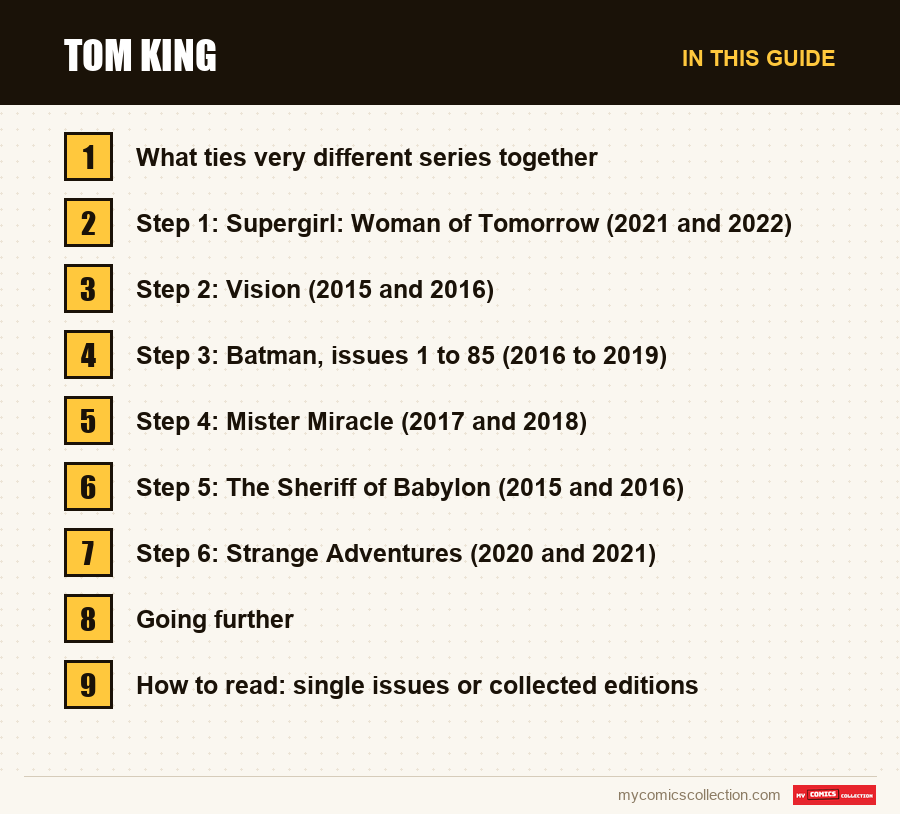
Step 5: The Sheriff of Babylon (2015 and 2016)
A twelve-issue series published by Vertigo and drawn by Mitch Gerads. It is set in Baghdad in 2004, after the American invasion, and follows a former cop turned Iraqi police trainer along with a group of characters caught up in a murder investigation. King puts a background in intelligence work to use, and it shows in the care given to details on the ground and to the moral ambiguity of the main characters.
Why late in the path: no superheroes, no fantastical escape route, and the pace of a documentary-style crime story. It suits readers who have already tasted the writer's style and want King's most realistic vein. For collecting, the series stands apart as a title from the old Vertigo line, and the single issues are not hard to find; the collected edition is the better choice for reading.
Step 6: Strange Adventures (2020 and 2021)
Twelve issues, drawn by Mitch Gerads and Evan "Doc" Shaner, revisiting Adam Strange, a hero of DC science fiction, through the lens of a trial: is the war hero really who the story says he is? The book alternates between two art styles, one for the present and one for memories, and pushes to the extreme King's taste for stories that challenge their own version of events.
It comes last on the list because it is the most demanding: it calls for sustained attention and a certain tolerance for ambiguity. It suits readers who have already read Mister Miracle and want to see how far the writer can go in the same direction. Here again, the collected edition is the ideal format.
Going further
A few titles round out this path without being part of it: Omega Men (2015 and 2016, with Barnaby Bagenda), Grayson (2014 to 2016, with Tim Seeley and Mikel Janín), Heroes in Crisis (2018 and 2019, with Clay Mann), Batman/Catwoman (2020 and 2021), Rorschach (2020, with Jorge Fornés) and Human Target (2021 and 2022, with Greg Smallwood). For Rorschach, our feature on the history of Rorschach puts the character back in his original context.
How to read: single issues or collected editions
King's series are books designed as closed sets: the collected edition is the natural format, and nothing forces you to go through single issues. For Vision, Mister Miracle, The Sheriff of Babylon or Strange Adventures, one volume, or two, covers the whole thing. For Batman, expect several volumes, to be read in the order the arcs were published.
If you go with single issues, keep in mind that these are recent releases with large print runs: nothing is scarce, and the price follows the cover you pick and the condition of the copy. On the French side, DC is published by Urban Comics and Marvel by Panini Comics: check which volumes are available in the catalog before buying, since formats and order vary. A King collection is built mostly around the first issues of the major series, which you follow issue by issue.
Recap: the recommended order
- Supergirl: Woman of Tomorrow (2021 and 2022): the gentlest way in, in eight issues.
- Vision (2015 and 2016): the android family, in twelve issues.
- Batman (issues 1 to 85, 2016 to 2019): the big cycle, to read by arcs.
- Mister Miracle (2017 and 2018): the finest formal achievement.
- The Sheriff of Babylon (2015 and 2016): the on-the-ground crime story, with no superheroes.
- Strange Adventures (2020 and 2021): the most demanding, to read last.
Frequently asked questions
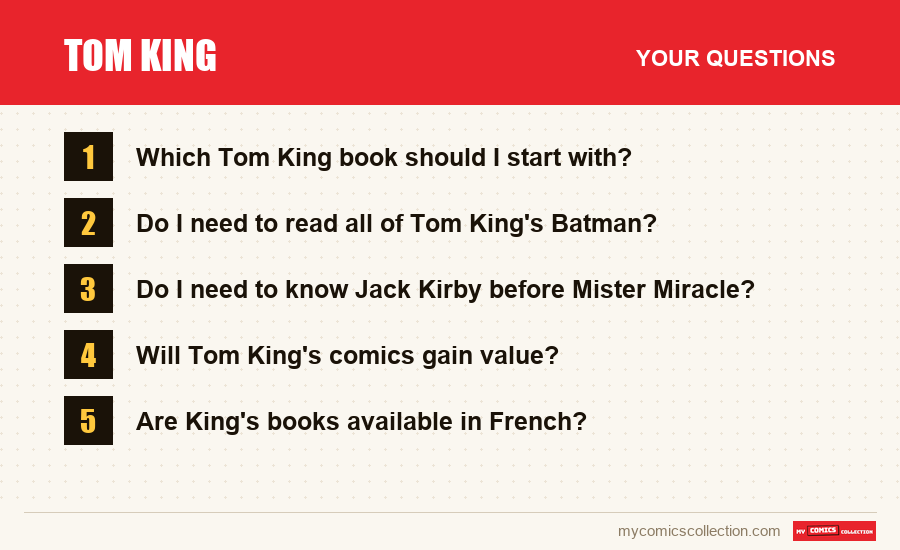
Start with Supergirl: Woman of Tomorrow, eight issues drawn by Bilquis Evely, or with Vision, twelve issues with Gabriel Hernández Walta. Both can be read with no prior knowledge, in a single sitting, and they show the writer's style without the harshness of his most demanding books.
No. The 85 issues from 2016 to 2019 form a long and uneven cycle. Many readers stop after the I Am Suicide and I Am Bane arcs, while others carry on to City of Bane. Reading by arcs rather than issue by issue lets you stop at the right moment.
It is not required, but it enriches the reading. Scott Free, Big Barda and Darkseid come from the Fourth World that Kirby created in the early 1970s. Our dedicated guide gives the useful references; you can read it before King's book, or after, to understand what the book takes up and shifts.
These are recent issues, and their market value has not settled. Everything will depend on the series' staying power, possible reprints, cover variants and reader appetite. The first issues of the major series are the most sought after; the rest remain common and affordable.
A large share of them are. DC titles are published in France by Urban Comics and Marvel titles by Panini Comics, generally as collected editions. Formats and volume order vary from title to title: check the catalog to see what exists before buying.
Do you own an issue of Batman, Vision or Mister Miracle signed by King? Get a starting point for its value.
Estimate my comic