In short
Ra's al Ghul debuted in Batman #232 (June 1971), created by editor Julius Schwartz, writer Dennis O'Neil and artist Neal Adams, a month after his daughter Talia appeared in Detective Comics #411. He grew from a globe-trotting conspirator into a legacy villain: the 1987 graphic novel Son of the Demon tied him to Damian Wayne, Death and the Maidens (2003-2004) ended his life, and the 2007-2008 resurrection story brought him back.
Most Batman villains belong to a street, an asylum or a rooftop. Ra's al Ghul belongs to a timeline, and that is the reason his comics history reads differently from the history of the Joker or the Penguin. His publishing record is a chain of returns, each one rewriting what the previous one meant.
Each credit, issue number and cover date for Ra's al Ghul in this timeline was checked against published credits and collection contents before it went in; the judgments about what each stage does to him, and the buying advice, are ours alone, and no pages or dialogue are quoted.
A villain assembled in the early 1970s
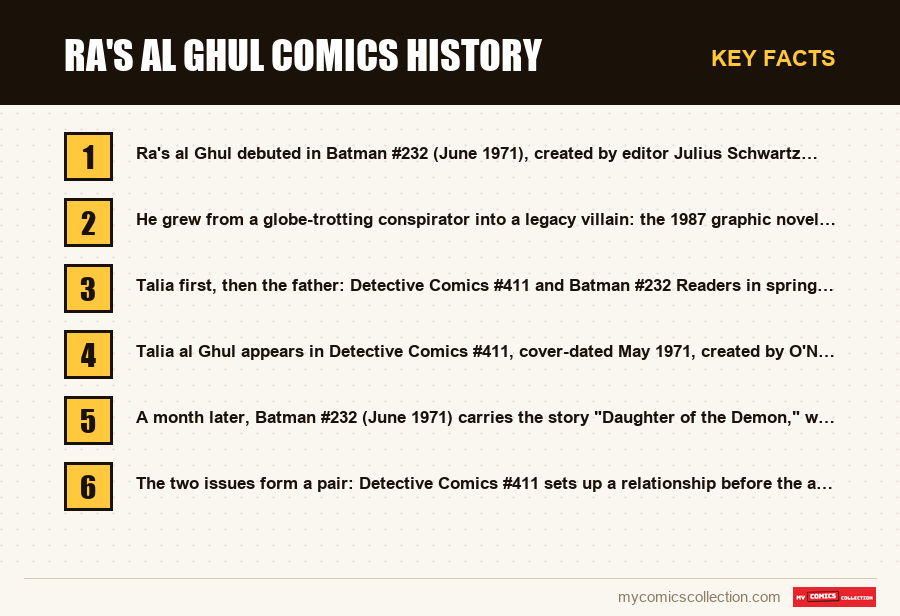
The credit that matters first is an editor's. Julius Schwartz supplied the concept and the name; Dennis O'Neil wrote the scripts and Neal Adams drew the pages that gave the idea a face, a cape and a manner of speaking to Batman as a near equal. That three-way split is the first thing to remember when a seller describes the character as "created by" one person.
The context is the rebuilding of Batman after the colorful television years. O'Neil and Adams had already pushed the series toward travel, conspiracy and night scenes, and an enemy with an international organization fit that direction better than another costumed gang leader. Ra's al Ghul was designed to take Batman out of Gotham, and to do it by treating the detective as a candidate rather than a target.
The character's early appeal is also structural. He arrives with a daughter, a private army, a claim to be centuries old and a plan that sounds almost reasonable when spoken calmly. That package gave later writers four separate handles: the family, the League, the immortality and the ideology.
Talia first, then the father: Detective Comics #411 and Batman #232
Readers in spring 1971 met the daughter before the father. Talia al Ghul appears in Detective Comics #411, cover-dated May 1971, created by O'Neil with artist Bob Brown. A month later, Batman #232 (June 1971) carries the story "Daughter of the Demon," written by O'Neil and drawn by Adams, with Julius Schwartz as editor. In that issue the father steps into the plot and shows that he knows who is under the cowl.
For anyone assembling a history of the character, this order is a gift. The two issues form a pair: Detective Comics #411 sets up a relationship before the audience knows its stakes, and Batman #232 turns the relationship into a conspiracy. Treating #232 as the only key issue misses half of the debut, and treating #411 as the father's debut gets the cover dates backward.
The detailed profile of the issue itself, including what to check on a period copy, lives in our Batman #232 guide. Here the point is narrower: this is the issue where Ra's al Ghul stops being a name and becomes a schedule of appearances.
The Lazarus Pit and the O'Neil and Adams years
The stories that followed in Batman kept the global scale. In 1991 those stories were gathered as Tales of the Demon. The book reaches back to Talia's Detective Comics #411, adds the Batman run from #232 to #244 with gaps, picks up Detective Comics #485 and #489 to #490 from later years, and closes with DC Special Series #15. The Lazarus Pit, the bath of chemicals that restores life, underlies his reputation for immortality.
That detail changes what kind of villain he is. A man who can recover from death cannot be defeated by a final panel, so the creators had no need to retire him between storylines. The Pit is both a plot device and a publishing strategy, and it explains why a character born in 1971 could be written out, buried and written back in without strain.
The gaps in that bibliography are worth noting. Tales of the Demon mixes two series and a special, and the Bronze Age stories were not written as a single novel. Read in collected order, they show a villain who is being tuned issue by issue, not planned from page one.
Son of the Demon and the second life of 1987
Through the early 1980s he stayed a recurring antagonist; then Batman: Son of the Demon (1987), a graphic novel from Mike W. Barr and Jerry Bingham, changed his function in the mythology. The story concentrates on Bruce Wayne and Talia, and in it an unnamed infant appears who is later understood as Damian. That single plot thread is the reason the 1987 book matters to collectors far beyond its own pages.
Barr followed it with Batman: Bride of the Demon (1990), drawn by Tom Grindberg, and the cycle closed with Batman: Birth of the Demon, written by Dennis O'Neil and drawn by Norm Breyfogle in 1992. O'Neil returning to his own creation, with Breyfogle on art, amounts to an origin biography written by the character's co-creator.
What changes for Ra's al Ghul in this period is his role in the family. In the 1970s he was a father who wanted a son-in-law; in 1987 he becomes a grandfather in waiting, and every later use of the character, from the Morrison era to the present, builds on that relocation.
Tower of Babel: the villain as threat to the whole League
In 2000, JLA #43 to #46, "Tower of Babel," moved him from Batman's corner to the whole Justice League. Mark Waid wrote, Howard Porter drew with Steve Scott, and the story sets Ra's al Ghul against the entire team.
The importance of the arc for a history is the demonstration that the character scales. A Gotham antagonist is limited by geography; Ra's al Ghul in a team book becomes a test of trust among heroes, and the stakes are different from any single-hero story. That is why the arc is often the entry point for readers who come from the team side of DC.
The same arc links to our longer reading advice in the best Ra's al Ghul comics page, which puts the collected volumes in a recommended order. Here the arc matters as a hinge: after 2000 nobody could treat him as a purely Batman problem.
Do you collect this series?
Track what you own, what you are missing and what your collection is worth. 7-day trial.
Start my trial →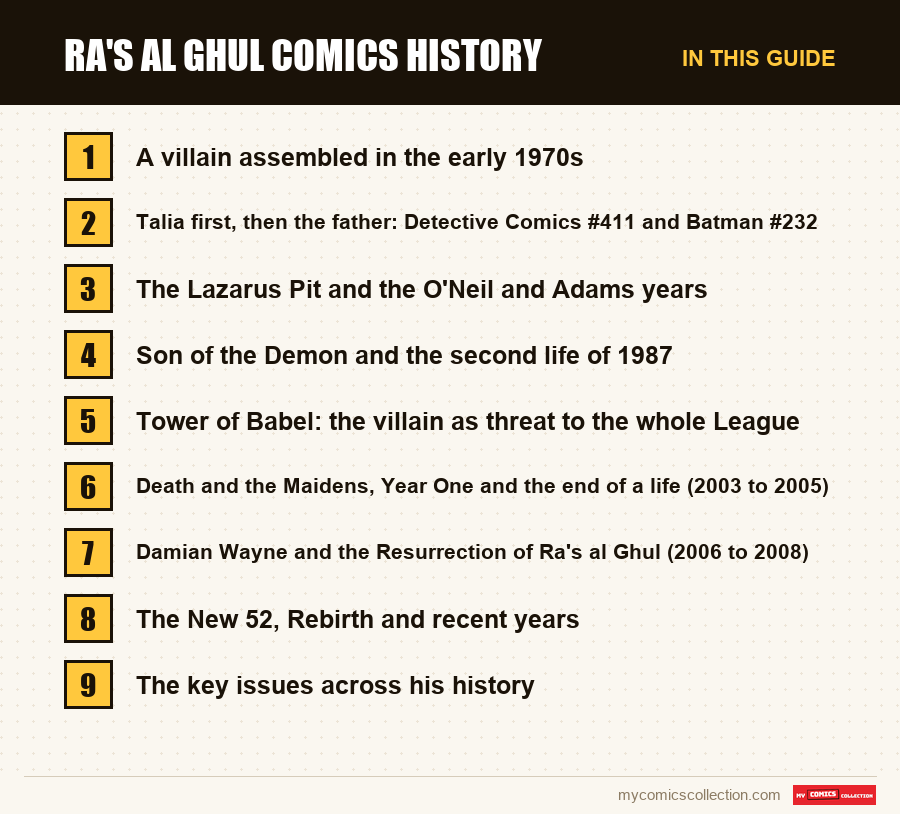
Death and the Maidens, Year One and the end of a life (2003 to 2005)
Greg Rucka and Klaus Janson's nine-issue Batman: Death and the Maidens appeared across 2003 and 2004 and gives the character his death.
That ending is a publishing event as much as a narrative one. A property that built its identity on resurrection chose, in 2004, to stage the one death it could not easily undo, and the aftermath of that choice shaped the next several years of Batman stories. The Lazarus Pit, once a convenience, becomes a question: what exactly comes back?
In 2005 a smaller series looked backward: Year One: Batman / Ra's al Ghul, by Devin Grayson and Paul Gulacy, two issues. The same year, Batman Begins carried the character to a mass audience, with Liam Neeson playing him under the name Henri Ducard; our guide to the film versus the comics lays out which elements came from the page.
Damian Wayne and the Resurrection of Ra's al Ghul (2006 to 2008)
In 2006 Grant Morrison and Andy Kubert introduced Damian Wayne in Batman #655, and the infant of 1987 became a character in his own right. The mechanism of the character's return follows. Batman Annual #26 (2007), by Peter Milligan and David López, belongs to the resurrection storyline, and the collection Batman: The Resurrection of Ra's al Ghul gathers Batman #670 and #671, Detective Comics #838 and #839, Nightwing #138 and #139, Robin #168 and #169, Batman Annual #26 and Robin Annual #7.
The creators span several hands: Grant Morrison, Peter Milligan, Fabian Nicieza and Paul Dini are among them. That crossover structure is itself informative. A cross-title event spreads one story over five series, which means the reading order and the checklist matter more than for any 1970s story, and Ra's al Ghul is the organizing principle of the whole event.
The reappearance also closes a loop. The death of 2004 and the return of 2007 to 2008 together show the character as a mechanism: a villain whose absence is a plot, not a state.
The New 52, Rebirth and recent years
After the 2011 reboot, the character kept appearing in the Bat-family books. Batman and Robin (volume 2) #23.3 (2013), by James Tynion IV and Jeremy Haun, retells his origin, and issue #30 follows his pursuit of Themyscira. Red Hood and the Outlaws #22 (2013), by James Tynion IV and Julius Gopez, adds the Well of Sins to his mythology, a sign that the creative teams were leaning toward the darker side of the figure.
Rebirth continued the line with Mara al Ghul, who debuted in Teen Titans (volume 6) in December 2016, created by Benjamin Percy and Jonboy Meyers, and with Detective Comics #951 to #956, "League of Shadows," published from April to July 2017. In 2019 a Batman Arkham: Ra's al Ghul anthology collected older stories, and in 2022 Chip Zdarsky's limited series Batman: The Knight featured the character.
Television also carried him: Matt Nable played the character in the third season of Arrow. For a collector, the later decades add titles but not the kind of key issue the 1970s produced; the new material is mostly a story of reinterpretation.
The key issues across his history
- Detective Comics #411 (1971): Talia al Ghul appears, created by Dennis O'Neil and Bob Brown, a month before her father.
- Batman #232 (1971): the debut of Ra's al Ghul in "Daughter of the Demon," by O'Neil and Neal Adams.
- Batman Annual #26 (2007): Peter Milligan and David López contribute a chapter to the resurrection storyline.
- Batman: Son of the Demon (1987): Mike W. Barr and Jerry Bingham give the character his family role and plant the seed of Damian.
- JLA #43 (2000): where "Tower of Babel" begins, by Mark Waid, Howard Porter and Steve Scott.
- Batman: Death and the Maidens (2003-2004): Greg Rucka and Klaus Janson end the character's life across nine issues.
- Batman #670 (2007): part of the resurrection storyline that brings the character back.
- Batman and Robin volume 2 #23.3 (2013): James Tynion IV and Jeremy Haun retell the origin.
How to follow Ra's al Ghul in a collection
Start with a decision about purpose. A reader who wants the founding stories should look for Tales of the Demon, because the single issues are scattered across Batman and Detective Comics and the collected order is the easiest way to see the Bronze Age arc. A reader who wants the family story should add Son of the Demon and its two follow-ups as a set.
The numbering traps are concentrated in the events. The resurrection story spreads over four series plus two annuals, so a checklist of the exact issues beats a guess by title. Collected editions of "Tower of Babel" and Death and the Maidens also include prologues or companion issues, which is worth confirming before buying the single issues.
For key-issue hunting, the pair of Detective Comics #411 and Batman #232 is the anchor, with the rest of Tales of the Demon as the natural third step. Everything after that is better collected as stories than as single issues. The blog index and the Batman hub help place each purchase in a reading order.
Frequently asked questions
Ra's al Ghul first appears in Batman #232, cover-dated June 1971, in the story "Daughter of the Demon" by Dennis O'Neil and Neal Adams, with Julius Schwartz as editor. His daughter Talia had already appeared in Detective Comics #411, cover-dated May 1971, so readers met her before her father.
The character was created by editor Julius Schwartz, who supplied the concept and the name, writer Dennis O'Neil and artist Neal Adams. Talia al Ghul was created by O'Neil with artist Bob Brown. Listings that credit only one person usually leave out part of that group, so check the full credit before repeating it.
The miniseries Batman: Death and the Maidens, written by Greg Rucka and drawn by Klaus Janson, ran nine issues across 2003 and 2004 and ends with his death. He returned in the resurrection storyline of 2007 to 2008, which crosses Batman, Detective Comics, Nightwing and Robin.
Damian is Ra's al Ghul's grandson, the son of Talia and Bruce Wayne. An unnamed infant appears in the 1987 graphic novel Son of the Demon, and Grant Morrison and Andy Kubert introduced Damian in Batman #655 in 2006, which connects the villain's history to the Robin line.
For the founding years, read Tales of the Demon (1991), which gathers the original 1970s stories by O'Neil and Adams along with their companions in Detective Comics and DC Special Series #15. For a self-contained story about the family, read Batman: Son of the Demon. For a modern entry that needs little background, read Batman: Death and the Maidens.
Holding a copy of Batman #232 or Detective Comics #411 and wondering about its place in a Ra's al Ghul run?
Estimate my comic