In short
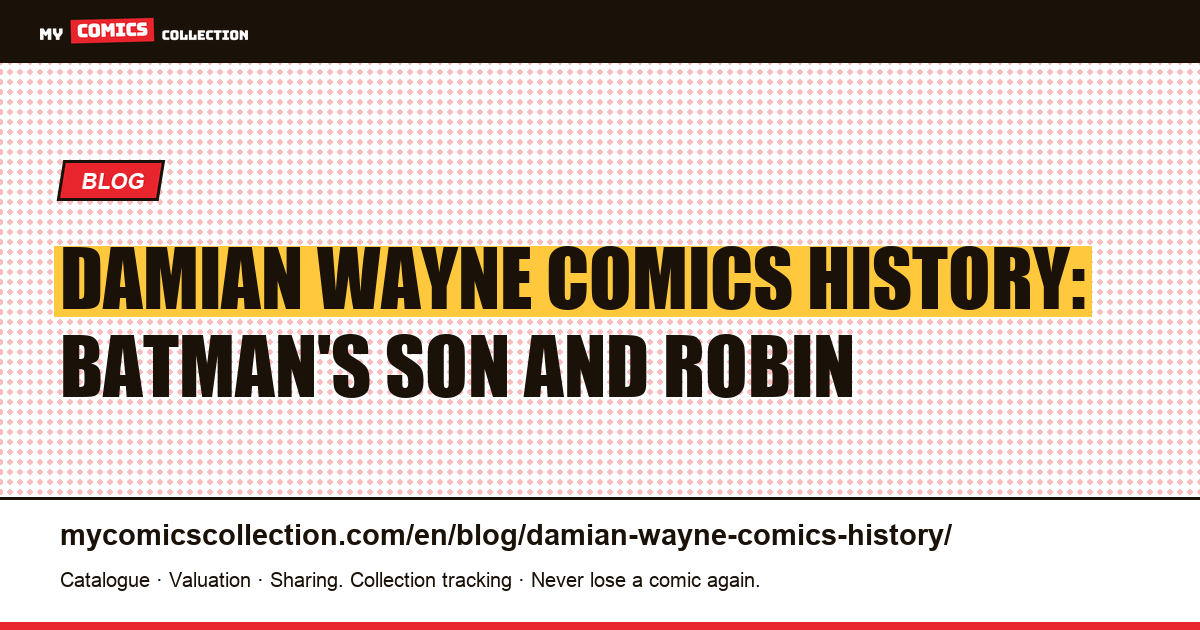
Before he had a name, Damian Wayne was a baby in a 1987 Bruce Wayne and Talia al Ghul story by Barr and Bingham. As a character he starts with Batman #655 (2006), by Grant Morrison and Andy Kubert. The turning points follow in order: Robin in the 2009 Batman and Robin, death in the second volume of Batman Incorporated (2013), a return under Tomasi and Gleason, then Super Sons and his own 2021 Robin series.
Most Robins arrive as sidekicks and grow out of the role. Damian Wayne arrives as a finished problem: ten years old, trained by the League of Assassins, and certain that he is the rightful heir to the cowl. That inversion, a child who already acts like a rival, is the engine behind nearly everything the character has done in print since 2006.
Every issue number, cover year and creator named in the sections below was matched to a publication history before it went in, and anything that did not match was dropped; the reading of what each period does to Damian is our own analysis.
A prototype in 1987: the child nobody named
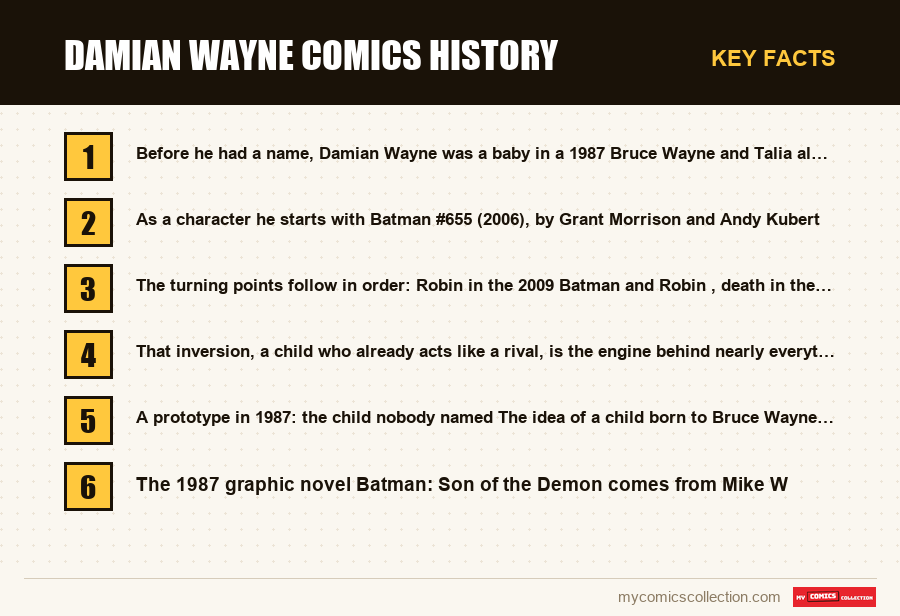
The idea of a child born to Bruce Wayne and Talia al Ghul predates Damian by almost two decades. The 1987 graphic novel Batman: Son of the Demon comes from Mike W. Barr as writer and Jerry Bingham as artist, and the child of Bruce Wayne and Talia al Ghul appears in it only as an unnamed infant. The baby has no name and no future in the story, which is why the book works as a prototype rather than a debut.
The graphic novel was not treated as part of the continuing Batman timeline when it came out, and that matters for the history that follows. Damian's later creators could borrow the premise without inheriting the book's events as settled fact. Collectors who want the whole arc of the character usually start here for the concept and move to 2006 for the person. The dedicated guide to Damian's two debuts covers the bookkeeping of that split; this page is about what happens after it.
Batman and Son: Morrison and Kubert introduce the heir (2006)
Batman #655, cover-dated September 2006, opens the arc Batman and Son and brings Damian Wayne into main continuity. Grant Morrison writes and Andy Kubert draws. The same issue opens Morrison's extended Batman storyline, so Damian and the writer's larger plan begin together. Damian is not introduced as a charming newcomer. He is a product of Talia's ambitions, raised to replace his father, and the early arc is built around Bruce Wayne learning that he has a son who has been shaped into a weapon.
The arc runs through #658 (December 2006), with Kubert on the art. For the character, the lasting decision is the premise of conflict: Damian's skills are real, his temper is real, and his loyalty is not yet anyone's. Everything later, the Robin costume, the partnership with Dick Grayson, the death, is a negotiation between what Talia built and what Bruce keeps offering him. A reader following Damian through time can treat 2006 as the point where the conflict is stated and the following years as the slow resolution.
Future glimpses and the fall of Batman (2007 to 2008)
Morrison does not rush Damian into a costume. Batman #666 (2007) shows a possible future in which a grown Damian carries the Batman identity, a glimpse that frames the boy's present as a question about what he will become. The device is characteristic of the period: the series keeps showing the endpoint of the character before the character has taken a single step toward it.
In 2008 Morrison's Batman R.I.P. begins with Batman #675 and leaves Bruce Wayne's place in the cowl in question. Around the start of the arc Damian senses a threat to his father, and the story's fallout is the hinge for everything in the next section. A reader who skips from 2006 to 2009 will notice that Damian goes from being the son of the man in the cowl to being the junior partner of a different man in it, and the 2007 and 2008 issues explain why that swap is plausible.
Robin at last: Batman and Robin (2009 to 2011)
When Batman and Robin launches in 2009, Dick Grayson wears the cowl and Damian is Robin. Grant Morrison writes the first sixteen issues, with Frank Quitely drawing #1 to #3, Philip Tan on #4 to #6 and Cameron Stewart on #7 to #9. The pairing is the point: the original Robin now plays the senior role, and the child who thinks he deserves the cowl has to take orders from him.
This is the period that gives Damian his public identity. The humor comes from the clash of temperaments, and the stakes come from the fact that Damian is still, in many scenes, a child doing dangerous work. After Morrison's sixteen issues the series passes through Paul Cornell (#17 to #19), Peter Tomasi (#20 to #22), Judd Winick (#23 to #25) and David Hine (#26), and the volume ends in 2011 at twenty-six issues. A collector building the Damian shelf can treat the Morrison stretch as the core and the later issues as a sampler of other writers' takes on the same duo.
The same years put Damian in other books. He appears in Blackest Night: Batman (2009) and in Teen Titans volume 3 from #88 (2010), which shows that the character can leave Gotham and still function. That second point is easy to underrate: a Robin who works in a team book is a Robin who can be sold as a character in his own right, not just as an accessory to the cowl.
Batman Incorporated and the Heretic (2010 to 2013)
Morrison's Batman Incorporated runs in two volumes. The first, from November 2010 to December 2011, is written by Morrison, with Yanick Paquette among its artists and Michel Lacombe among its inkers. The second volume, written by Morrison with art by Chris Burnham, begins in May 2012 and ends with #13 in July 2013. Bruce Wayne is back in the cowl by then, Damian is again Robin at his side, and Talia's organization is the enemy of the global network Bruce is building.
The second volume contains the turning point of the character's life. In the storyline collected as Gotham's Most Wanted (volume 2 #7 to #13), Damian is killed by the Heretic, his own artificially modified clone. The death is the logical end of the tension set up in 2006: the child raised as a weapon is killed by a copy of himself made inside Talia's organization. The storyline is the one most collectors name when they list the major events in the Damian timeline, and it is the hinge between the character's early life and his second.
Tomasi and Gleason: the other Batman and Robin (2011 to 2015)
While Morrison is closing his story in Batman Incorporated, DC's 2011 relaunch gives the father and son a second series. Batman and Robin volume 2 is written by Peter J. Tomasi with Patrick Gleason as penciller, and it runs from 2011 to 2015, with 45 issues counting #0 and the #23.1 to #23.4 specials. The tone is different from Morrison's: the series concentrates on the relationship between Bruce and Damian as father and son rather than on the machinery of a global plot.
Early in volume 2, Damian kills the villain Nobody in front of Bruce, one of the episodes that shows how far the League's training still shapes him, and father and son have to work through it. After the death in Batman Incorporated, the series becomes the book that carries Bruce's grief, and then the book that reverses the loss: in #37, Batman revives Damian with a Chaos Shard, in the same Robin Rises story that runs through the Robin Rises: Omega (2014) and Robin Rises: Alpha (2015) one-shots. Readers of Patrick Gleason's art will recognize this run as his long stretch with the character.
Do you collect this series?
Track what you own, what you are missing and what your collection is worth. 7-day trial.
Start my trial →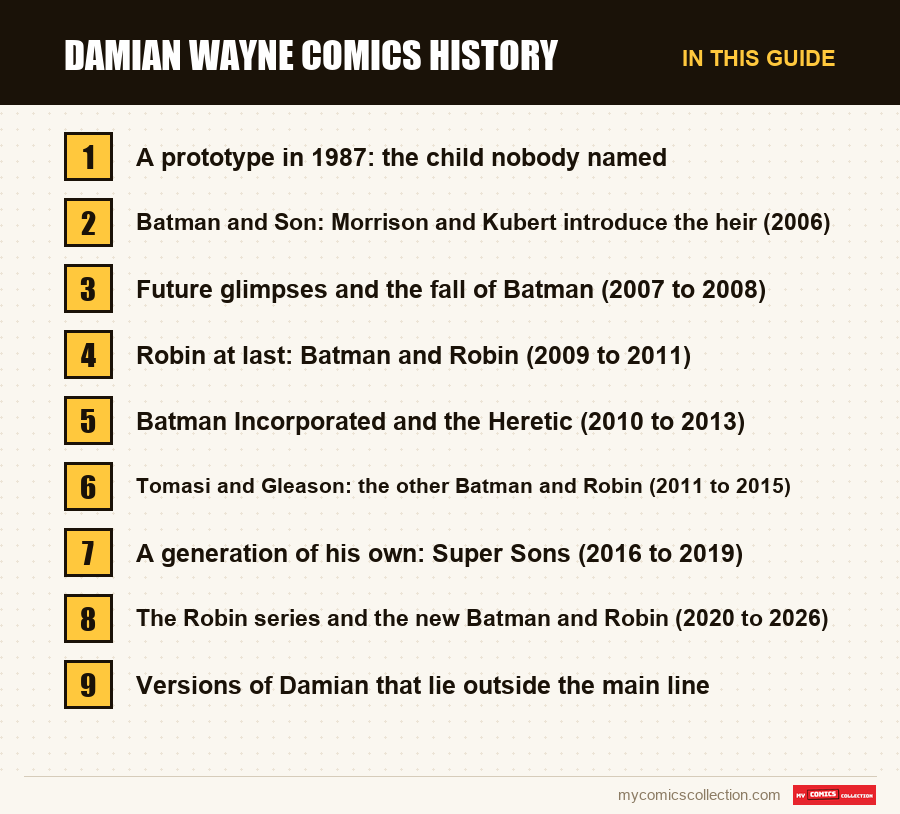
A generation of his own: Super Sons (2016 to 2019)
After the resurrection, Damian's career splits across several titles. Super Sons, announced as part of DC Rebirth in 2016, pairs him with Jon Kent, the son of Superman, in a series that launched in February 2017, ran sixteen issues plus an annual and ended in May 2018. Peter Tomasi later wrote the follow-up miniseries Adventures of the Super Sons, with art by Carlo Barberi and Art Thibert, a twelve-issue run from August 2018 to July 2019.
The effect on the character is to move him from a figure defined by a father to a figure defined by a peer group. He remains Bruce Wayne's son, but he is also the boy who has a best friend whose father is Superman. For a reader following the long arc, this is the section where Damian stops being only a product of his lineage and starts being a character with his own relationships.
The Robin series and the new Batman and Robin (2020 to 2026)
Damian gets his own Robin series in 2021, written by Joshua Williamson, after the storyline Demon or Detective. That title names the choice the character has faced since 2006: which half of his upbringing will win. In 2022 the character is part of Shadow War, with Robin #14 (May 2022) among the issues tied to that event.
In 2023 DC launches a third Batman and Robin volume. Joshua Williamson writes issues #1 to #13 and the 2024 annual, Simone Di Meo is the lead artist of the opening issues, and Phillip Kennedy Johnson writes #14 to #30. The first issue appears on September 12, 2023 and the run ends in February 2026. For a collector, this shows the current pattern: Damian has been Robin, Batman's partner and a team leader, and publishers continue to place him next to Bruce in a title that carries both names.
Versions of Damian that lie outside the main line
Several alternate Damians predate or surround the 2006 character, and they matter because they show how long the premise has been in circulation. The Brotherhood of the Bat (1995) introduces a variant named Tallant Wayne, and its sequel League of Batmen (2001) continues that line. Mark Waid and Alex Ross create a version called Ibn al Xu'ffasch in Kingdom Come #2 (June 1996), and Waid revisits that world in The Kingdom (1999).
The key distinction for a collector is that none of these versions is the 2006 character. They are variants, and a shelf that mixes them with the main-line issues will give a misleading picture of the character's timeline. A clean approach is to keep alternates in their own section and to read the main line first.
The key issues across his history
- Batman: Son of the Demon (1987): the unnamed infant prototype, written by Mike W. Barr and drawn by Jerry Bingham.
- Batman #655 (2006): Damian Wayne's main-continuity debut, opening Batman and Son from Grant Morrison and Andy Kubert.
- Kingdom Come #2 (1996): Mark Waid and Alex Ross create the alternate Ibn al Xu'ffasch.
- Batman and Robin #1 (2009): the launch of the Dick Grayson and Damian pairing, written by Grant Morrison with Frank Quitely.
- Batman and Robin volume 2 #1 (2011): the Peter J. Tomasi and Patrick Gleason relaunch of the father and son series.
- Batman Incorporated volume 2 #7 to #13 (2013): Gotham's Most Wanted, in which the Heretic kills Damian.
- Batman and Robin volume 2 #37 (2015): Batman revives Damian with a Chaos Shard.
- Super Sons #1 (2017): the launch of the Damian and Jon Kent series, which ran sixteen issues.
How to follow Damian in a collection
Start with the 2006 debut and decide how you want to treat the 1987 book. Buy Batman and Son in whatever form fits the way you read, then move to the 2009 Batman and Robin volume and the Morrison Batman Incorporated issues. The Tomasi and Gleason series is a separate shelf, because its numbering restarts with the 2011 relaunch.
Two numbering traps are worth knowing. The three Batman and Robin volumes share a title, so a listing that says only "Batman and Robin #1" is ambiguous. And Teen Titans has been relaunched several times, so the 2010 #88 that brings Damian onto the team belongs to the third volume and not to any later one. For a wider reading list, the guide to where to start with Damian ranks by reading order, while this page orders by publication.
Frequently asked questions
A nameless baby, child of Bruce Wayne and Talia, turns up in the 1987 book Son of the Demon. The boy called Damian arrives in Batman #655 (September 2006), with Grant Morrison writing and Andy Kubert drawing, and that issue is the one collectors call his first appearance.
The 1987 prototype comes from writer Mike W. Barr and artist Jerry Bingham in Son of the Demon. The named, canonical Damian is the work of Grant Morrison and Andy Kubert, who introduce him in Batman #655 in 2006 as the opening of Morrison's long Batman story.
Damian is killed by the Heretic, his own clone, in the second volume of Batman Incorporated, written by Grant Morrison with art by Chris Burnham. The storyline is collected as Gotham's Most Wanted (#7 to #13), and the series ends with #13 in July 2013.
In Batman and Robin volume 2 #37, written by Peter J. Tomasi, Batman revives Damian using a Chaos Shard. The resurrection belongs to the Robin Rises story, which also runs through two one-shots, and the character is then back in regular use across several DC titles.
For a publication-order shelf, take Batman #655 to #658, the 2009 Batman and Robin run by Morrison, the Tomasi and Gleason volume from 2011, Super Sons from 2017 and Joshua Williamson's Robin from 2021. Treat the alternate versions as a separate section.
If a Batman #655 or a Batman and Robin #1 sits in your collection, a quick valuation shows where it stands.
Estimate my comic