
In short
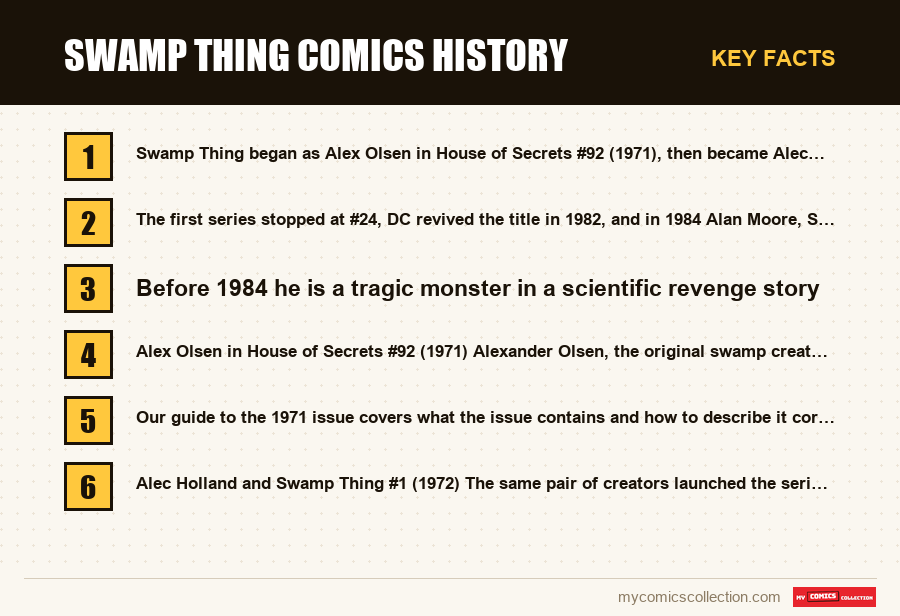
Swamp Thing began as Alex Olsen in House of Secrets #92 (1971), then became Alec Holland in Swamp Thing #1 (1972), both by Len Wein and Bernie Wrightson. The first series stopped at #24, DC revived the title in 1982, and in 1984 Alan Moore, Stephen Bissette and John Totleben used issue #21 of Saga of the Swamp Thing to show that he is a plant, not a man. Later runs by Rick Veitch, Brian K. Vaughan, Scott Snyder and Ram V followed.
Swamp Thing is a character with two lives that barely resemble each other. Before 1984 he is a tragic monster in a scientific revenge story; afterward he is the center of an elemental, adult horror universe. A history of the character has to explain both lives, and the many relaunches that connect them.
We checked each credit and issue number below, and printed a cover month only where it was confirmed for that issue; the reading of each period is ours. The interpretation of what each period changed, and the advice on building a run, is our own analysis.
Alex Olsen in House of Secrets #92 (1971)
Alexander Olsen, the original swamp creature, turns up in House of Secrets #92 with a July 1971 date. Len Wein and Bernie Wrightson are credited with the character. The story belongs to a horror anthology, one tale per issue: Olsen, a scientist, is murdered by his assistant, comes back as a plant creature, kills his killer, and is left to wander the swamps.
The detail that matters for collectors is that this is not the hero readers know. Olsen and Alec Holland share a swamp and a pair of creators, but they are different men, and a listing that blurs the two is confusing the buyer. Our guide to the 1971 issue covers what the issue contains and how to describe it correctly.
Alec Holland and Swamp Thing #1 (1972)
The same pair of creators launched the series the next year with Swamp Thing #1, dated October and November 1972, and this time the protagonist is Alec Holland. Holland and his wife Linda developed a bio-restorative formula. Thugs working for Nathan Ellery of the Conclave planted a bomb. He ran into the swamp, where the formula merged his consciousness and memories with the plant life around him.
Wein wrote the first 13 issues, and Wrightson drew the first 10. Nestor Redondo drew the next 13, and Fred Carrillo drew the last issue. After Wein left, David Michelinie and Gerry Conway finished the run. The series ended with issue #24, and a blurb announcing a #25 with Hawkman never led anywhere.
The supporting cast of this first volume is worth remembering because Moore later reworked every piece of it. Matthew Cable is a federal agent who first believes Swamp Thing killed Alec and Linda Holland. Anton Arcane becomes the monster's nemesis, although the two meet only twice in the first series. Abigail Arcane, Anton's niece, forms a close bond with the creature, and that relationship carries through every later era.
The 1982 revival and a title looking for a reason
DC revived the character in 1982 to coincide with Wes Craven's Swamp Thing film, with Dick Durock as the creature and Ray Wise as Alec Holland. The new series, The Saga of the Swamp Thing, began in May 1982 and was written by Martin Pasko with art by Tom Yeates, and its first annual adapted the film. This volume is the numbering that later collectors call the second series, and everything from Moore onward sits inside it.
Pasko's stretch ended at issue #19. Bissette and Totleben joined the book late in that period, replacing Yeates. The book had been revived as a film tie-in, which makes the next change of writer a notable gamble.
Alan Moore and "The Anatomy Lesson" (1984)
Len Wein, by then working as an editor, assigned the series to Alan Moore, and Karen Berger later gave him free rein. Moore's first issue is #20, and the story that changed the character is Saga of the Swamp Thing #21, dated February 1984, "The Anatomy Lesson." Moore reworked the origin: Swamp Thing is not Alec Holland transformed into a plant. He is a plant-based entity that absorbed duplicates of Holland's memories and believed itself to be the man.
That revelation does more than twist a backstory. It frees the character from the tragic quest to become human again, which had capped what the 1970s series could do. The art team of Stephen Bissette and John Totleben, with Totleben inking, gives the book a dense, organic look that the Jack Kirby Awards later recognized. Our Alan Moore key issues guide goes through the run issue by issue; here we place it in the character's longer arc.
American Gothic, Constantine and the Parliament of Trees (1985 to 1987)
Moore introduced John Constantine in issue #37, the opening of the "American Gothic" storyline, which runs from #37 to #50. The cycle sends the creature across a haunted America, and in it the Spectre loses to the Great Evil Beast. Moore also revealed that many Swamp Things had existed before, all serving the Parliament of Trees, which rules "the Green." The Spectre also appears in Swamp Thing Annual #2 by Moore, Bissette and Totleben; our guide to his debut introduces him from the other direction.
Under Moore the book became the first mainstream title to give up Comics Code approval altogether. Moore's last issue is #64, dated September 1987. Hellblazer began soon after #67 and crossed over with Swamp Thing during its first year under Jamie Delano, so Constantine's origin as a supporting character became a solo franchise.
Veitch, the censored issue and the 1990s (1987 to 1993)
Rick Veitch, credited as penciler from issue #65, then took over the scripting for 24 more issues. In 1989, DC refused to publish issue #88, which led to a public dispute and Veitch's departure. Doug Wheeler wrote the series afterward, including #88 and #90, with his run starting in September 1989.
Nancy A. Collins began with Swamp Thing Annual #6 in 1991 and wrote issues #110 to #138. Issue #129 was the first to carry the Vertigo logo, which placed Swamp Thing in the new imprint. The sequel film The Return of Swamp Thing arrived in 1989, again with Dick Durock in the lead.
Do you collect this series?
Track what you own, what you are missing and what your collection is worth. 7-day trial.
Start my trial →
Grant Morrison and Mark Millar close the first long run (1994 onward)
In March 1994, Grant Morrison began a four-issue arc with issue #140, co-written with Mark Millar. Millar took over at issue #144 and wrote through issue #171, the series finale. That ending ties off the second volume that began in 1982, and the numbering reaching #171 is what makes Moore-era issues easy to place: anything between #20 and #64 is Moore's, and the rest of the volume is a long tail of different voices.
For a reader, this long tail is a patchwork: Veitch's run stopped short of #88, Collins wrote 29 issues, and Morrison's arc lasted four. In our reading, none stayed long enough to define the book the way Moore did.
Vaughan, Diggle and the 2000s relaunches
The third volume arrived in 2001 with Brian K. Vaughan writing and art by Roger Petersen and Giuseppe Camuncoli. Volume four followed in 2004: Andy Diggle wrote #1 to #6, Will Pfeifer wrote #7 and #8, and Joshua Dysart wrote #9 to #29. The series ended at #29, canceled because of low sales.
These volumes matter mostly for completeness. They show DC trying twice to rebuild the character after the Millar finale, and they use the Moore revelation as a settled fact rather than a shock. If you collect by creator, Vaughan's volume is the one worth seeking out.
The New 52 and Rotworld (2011 to 2015)
Swamp Thing returned in the 2011 Brightest Day crossover, in issues #23 and #24 dated June 2011, and then through a three-issue miniseries, Brightest Day Aftermath: The Search for the Swamp Thing. That led to volume five, Swamp Thing #1, in September 2011, part of the New 52 relaunch. Scott Snyder wrote #1 to #18 and the annual, ending with the "Rotworld" storyline. Charles Soule wrote #19 to #40.
In our reading, Snyder's run, closing with "Rotworld," is the modern counterpart to Moore's cycle, and comparing the two shows how the mythology developed; our best runs guide ranks them against each other.
Wein's return, Ram V and the screen versions (2016 to today)
In March to August 2016, a six-issue miniseries by Len Wein with art by Kelley Jones brought the creator back to his character. A Tom King winter special in 2018 included Wein's last Swamp Thing issue. In March 2021, The Swamp Thing began as a 16-issue series by Ram V with art by Mike Perkins, planned at 10 issues and extended. It paused after issue #10 and returned in March 2022.
The character also moved to television. The 2019 series on DC Universe starred Derek Mears as the creature in costume and Andy Bean as Alec Holland, and it is a good case study in how an adaptation reshapes the comics; our comparison article goes through the differences.
The key issues across Swamp Thing's history
- House of Secrets #92 (1971): the murdered scientist Alex Olsen, in a short story credited to Len Wein and Bernie Wrightson.
- Swamp Thing #1 (1972): Alec Holland becomes the series hero, by Wein and Wrightson.
- Saga of the Swamp Thing #1 (1982): the revival, written by Martin Pasko with Tom Yeates art.
- Saga of the Swamp Thing #21 (1984), titled "The Anatomy Lesson": the issue where Moore and the art team of Bissette and Totleben redefine the monster as a plant.
- Swamp Thing #37 (Moore era): John Constantine appears and "American Gothic" begins.
- Swamp Thing #64 (1987): Alan Moore's last issue.
- Swamp Thing #129 (Nancy A. Collins era): the first issue to carry the Vertigo logo, during Nancy A. Collins's run.
- Swamp Thing volume 5 #1 (2011): Scott Snyder's New 52 launch.
How to follow Swamp Thing in a collection
Numbering is the main trap. Volume one ran #1 to #24; the 1982 series began with its own #1 and kept the same counter through the Moore era and beyond, reaching #171. The 2001, 2004, 2011 and 2021 series each restarted at #1. An "issue 20" can therefore be Moore's first, a 1970s issue, or a later relaunch, so always record the volume and the cover year.
For reading, start with Moore's issues #20 to #64, then Snyder's volume five. Treat the Wein and Wrightson issues as the foundation, and pick the 1971 anthology story as a separate item. Distinguish Olsen from Holland in your records, and keep annuals and crossover issues attached to the right volume so they do not get mixed with the main run.
Frequently asked questions
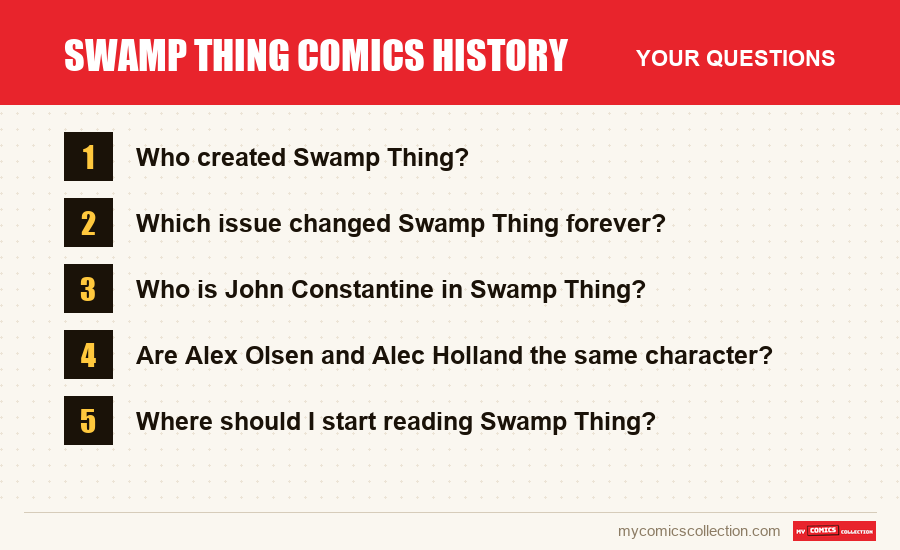
Len Wein and Bernie Wrightson are credited with Swamp Thing. The character debuted in House of Secrets #92 in 1971 as Alex Olsen, and Alec Holland, the hero most readers know, followed in Swamp Thing #1 in 1972, again by Wein and Wrightson.
Saga of the Swamp Thing #21, dated February 1984, titled "The Anatomy Lesson." Alan Moore revealed that Swamp Thing is a plant entity that absorbed copies of Alec Holland's memories rather than Holland transformed. Moore's run began with #20 and ended with #64 in September 1987.
Constantine was introduced by Alan Moore in Swamp Thing #37, at the opening of the "American Gothic" storyline, which runs from #37 to #50. He later headlined his own series, Hellblazer, which began soon after issue #67 and crossed over with Swamp Thing in its first year.
No. Alex Olsen is the scientist of House of Secrets #92 (1971), who is murdered and returns as a plant creature. Alec Holland is the scientist of Swamp Thing #1 (1972), whose formula merges with the swamp. They share creators and a setting, but they are different men.
Most readers start with Alan Moore's run in Saga of the Swamp Thing #20 to #64 (1984 to 1987), then continue with Scott Snyder's volume five from 2011. Readers who want the origins can add Len Wein and Bernie Wrightson's Swamp Thing #1 to #10 from 1972.
If you own early Wein and Wrightson issues or a run of Moore's Saga of the Swamp Thing, a quick estimate helps you decide what to keep together.
Estimate my comic