
In short
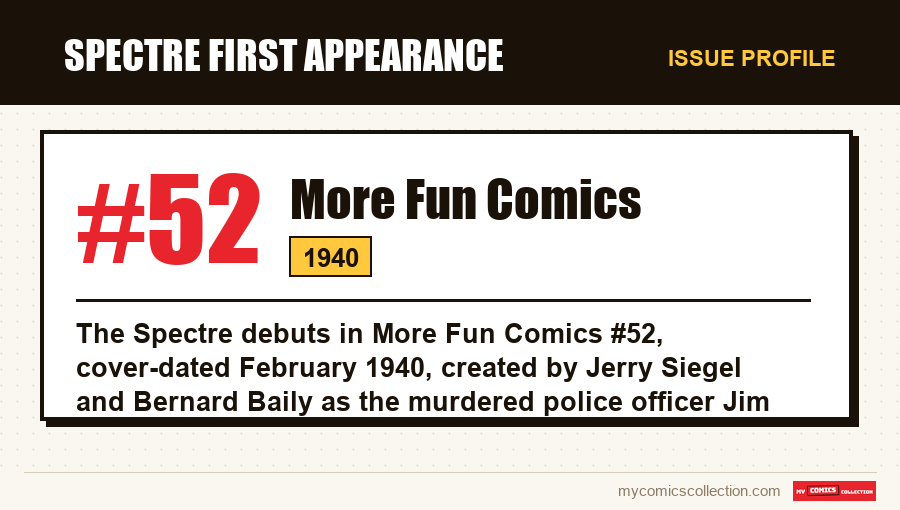
Jim Corrigan's ghostly alter ego makes his debut in More Fun Comics #52, dated February 1940 on the cover, from National Allied Publications, the firm that grew into DC Comics. Jerry Siegel and Bernard Baily are credited as creators. The issue introduces Jim Corrigan, a hard-boiled police officer who is murdered by thugs, then sent back to Earth by a heavenly figure called the Voice as an agent of divine justice. It launches a feature that ran in the title through issue #101.
Most Golden Age debuts are quiet affairs, a costume and a short origin tucked between other features. More Fun Comics #52 is different in tone: its lead character begins the story as a corpse sealed in a barrel of cement, and the rest of the feature is built on that grim premise. Collectors who type "Spectre first appearance" into a search box are usually trying to settle a handful of practical questions: which issue, which month, who made it, and whether the issue is worth chasing.
This page sticks to the points we checked in published histories of the title and the character: the cover date, the credited creators, the shape of the origin, and the later issues that built on it. The grading and buying notes further down are our own judgment, with no figures attached.
The issue at a glance: More Fun Comics #52
More Fun Comics began in February 1935 under the National Allied banner, and by the time issue #52 reached stands in early 1940 it had been running for five years as an anthology of adventure, humor and mystery strips. The cover date printed on #52 is February 1940. That cover date is the one to use when you list the book, because comics of the period were placed on sale ahead of the month printed on them.
The credits that matter are short. Jerry Siegel is credited as writer and Bernard Baily as artist, and the pair are the creators named for the character. Some accounts give Siegel alone as the originator and treat Baily as the artist assigned to realize the feature; collectors usually record both names when they catalog the issue, and it is sensible to do the same. No inker, letterer or colorist appears below for #52, since none could be confirmed, and a blank field in your records beats a guess.
The title was an anthology, so the Spectre did not occupy the whole book. He arrived as one feature among several, which is the usual format for debuts of the period and the reason a copy can look unremarkable on the cover while holding a character that mattered for decades. Inside the issue you are buying a short, self-contained origin rather than a full-length adventure.
How Jim Corrigan becomes the Spectre
The origin is compact and cruel. Jim Corrigan, a hard-boiled police officer, is murdered by criminals who force him into a barrel, pour cement over him and throw it into the water. As his soul approaches Heaven, a presence known as the Voice stops him and gives him a mission: he will return as an agent of divine justice. The Spectre emerges as a ghostly avenger who deals with the men who killed him in grisly, supernatural ways.
Two plot decisions in that opening shape everything that follows. First, the Spectre does not simply haunt the city; he takes over Corrigan's identity and his job as a police officer, which gives the series a procedural spine and a reason to keep returning to crime stories. Second, Corrigan breaks off his engagement to Clarice, his fiancée, because his new existence cannot be reconciled with an ordinary life. He also declines the offer of eternal rest until evil has been wiped out, which is the hook that lets the feature run indefinitely.
Creators and the editorial setting in 1940
Jerry Siegel was already known as the writer of Superman, and the character was already a publishing phenomenon. That context explains why the Spectre looks like a product of its moment: a masked or costumed champion who answers to a higher authority than the police, working in the same crime-ridden cities that early superhero comics favored. The Spectre was written for a market that had just discovered how hungry readers were for heroes with a distinctive hook, and his hook, a murdered man who cannot rest, was darker than most of what surrounded him.
Bernard Baily is the artist credited on the debut, and the look of the feature in its first installments rests on his work. The cement-barrel opening and the gloomy city settings all come from this period, and they set a visual tone that later artists inherited when they returned to the character.
The publisher matters too. More Fun Comics belonged to the National group, the company that became DC Comics. Doctor Fate appears in the title from issue #55 through issue #98, and Green Arrow and Aquaman both appear from issue #73 through issue #107, so a set of More Fun Comics issues is a small timeline of how National built its superhero line. See our guide to Green Arrow in More Fun Comics #73.
Why #52 is a key issue
An issue becomes "key" when a character or event inside it keeps mattering after the first printing. More Fun Comics #52 qualifies on several counts, and each can be stated without superlatives.
The first is longevity. The Spectre's own feature in More Fun Comics continued through issue #101, cover-dated February 1945. In the middle of that run, in issue #75 (January 1942), Corrigan was resurrected and the Spectre became a character who could separate from his body. The Spectre also held a charter seat on the Justice Society roster in All Star Comics; his last 1940s outing with that team is issue #23, dated winter 1944 to 1945. A debut that leads into a team book and a five-year solo feature is a debut worth owning.
The second is revival. DC returned to the character repeatedly: Showcase #60 in 1966, with Gardner Fox and Murphy Anderson, gave him far greater power; Adventure Comics #431 in 1974 launched a violent run by Michael Fleisher and Jim Aparo; and a long-running series by John Ostrander and Tom Mandrake began in 1992. Every one of those revivals pointed readers back to the original, and each one is a reason the 1940 issue stays on want lists.
The third is influence: a dead policeman turned into a spirit of vengeance gave DC one of its most unusual long-running characters, and the premise is established in this issue.
The fourth is the Justice Society link, which adds a second audience: people who assemble All Star Comics want the debut for completeness. Our guide to collecting Golden Age comics shows how such debuts fit a larger shelf.
Do you collect this series?
Track what you own, what you are missing and what your collection is worth. 7-day trial.
Start my trial →
Reprints, collected editions and issues people confuse with it
The 1940 story is not hard to read without owning the original. DC has collected Golden Age material in archive-style volumes over the years, and anyone who wants the text and artwork rather than the artifact should look in those first. We do not list specific collected volumes here because we did not confirm the contents of each, so check the contents page of any volume before buying it for this story.
Several different issues get mixed up in searches and listings, and it helps to keep them apart:
- More Fun Comics #52 (February 1940): the debut of Jim Corrigan as the Spectre.
- More Fun Comics #75 (January 1942): the issue in which Corrigan is resurrected and the Spectre becomes an independent character.
- Showcase #60 (1966): the Silver Age revival with Gardner Fox and Murphy Anderson, dated either January or February 1966 depending on the listing, so check the cover itself when you catalog it.
- Adventure Comics #431 (1974): the start of the Fleisher and Aparo run, which continued through issue #440 in 1975.
- The Ostrander and Mandrake series (from 1992): a modern ongoing series numbered as a third volume, which is a different book from the 1967 and 1987 titles.
A second confusion is the name itself. Jim Corrigan is the original host, and later stories gave the Spectre other hosts, so a listing that says only "Spectre first appearance" can mean the entity or a person who carried it. For this page, "first appearance" means the character introduced in 1940. If you are shopping from a seller's description, confirm the series title and the cover date printed on the cover rather than relying on a headline.
For a reading order that sorts these revivals by quality rather than by date, our guide to the best Spectre comics ranks them and explains where the 1940 issue sits in that sequence.
Inspecting a 1940 copy of #52
Anthology comics from 1940 were printed on cheap newsprint, handled roughly and rarely saved, so condition varies widely and the gap between an honest copy and a disguised one can be large. A methodical checklist protects you more than any single price point could.
- Verify the issue. Match the issue number and the cover date on the cover with the indicia on an interior page. Reproductions and later facsimile-style editions exist for many Golden Age books, so ask for scans of the cover, the indicia and the first page of the Spectre feature.
- Look for restoration. Color touch, spine reinforcement, added pieces on the corners, cleaned and pressed pages and replaced staples all appear on books of this age. Restoration is not a flaw in itself, but it changes how a copy should be compared, and an undisclosed repair is a reason to walk away.
- Read the certification label closely. If the copy has been graded, note the grade, the page-quality note and any restoration note. Compare like with like: a restored copy belongs in a different comparison group than an unrestored one.
- Inspect the interior. Brittle paper, tanned edges, tears near the staples and missing coupons or cut-outs are common. Open the book fully or have the seller do so on video if the copy is not sealed.
- Check the feature pages. The Spectre story is the point of the purchase, so confirm that its pages are intact and that nothing has been trimmed or replaced.
- Compare methodically. Pull a handful of recent sales of #52 at a similar grade and measure how your candidate sits against that spread, as a ratio. Single results can be skewed by a motivated bidder, so look at the spread.
The Spectre appearances that follow
When the 1940 book stays out of reach, these later Spectre issues carry most of the story. We have limited it to numbers we could confirm.
More Fun Comics #75 (1942). Corrigan is resurrected and the Spectre becomes an independent figure who can leave his body. It is the clearest structural change to the character in the 1940s run.
All Star Comics (1940s). The Spectre is a charter member of the Justice Society of America here, and he last appears with the team in this era in issue #23. If you collect the Justice Society, this is where his Golden Age team history sits; our look at the Justice Society and Karen Starr gives a sense of how that team's history is still used.
Showcase #60 (1966). Gardner Fox and Murphy Anderson revived the Spectre with greatly increased power, part of the wider Silver Age habit of bringing back Golden Age names. Readers of Gardner Fox's comics will recognize the writer from the same period's Justice League and Justice Society material.
Adventure Comics #431 to #440 (1974 to 1975). Michael Fleisher and Jim Aparo wrote and drew a notoriously violent run that remains controversial; if you want to see how far the character's vengeance premise can be pushed, this is the run. Jim Aparo's comics are collected by their own audience.
The Ostrander and Mandrake series (1992). A long-running modern series that gave the character a theological frame. It is where most modern readers meet the Spectre.
Frequently asked questions
Look for More Fun Comics #52 with a February 1940 cover date. It introduces Jim Corrigan, a police officer who is murdered and returns as an agent of divine justice. The credited creators are Jerry Siegel and Bernard Baily, and the feature ran in the title through issue #101.
Jerry Siegel and Bernard Baily are credited as the creators, with Siegel as writer and Baily as artist. Some accounts credit Siegel alone as the originator and describe Baily as the artist assigned to the feature, so catalog both names when you describe the issue in your own records.
No. The 1940 issue is the original appearance. The Silver Age revival is Showcase #60 in 1966, by Gardner Fox and Murphy Anderson, which brought the character back with much greater power. It is a separate key issue and should be cataloged under its own listing.
The same title carried Doctor Fate from issue #55 through issue #98, and Green Arrow and Aquaman from issue #73 through issue #107. That makes the series a useful anchor for a Golden Age National set, because several debuts and runs share one magazine over a few years.
Match the cover number and date to the indicia, request scans of the Spectre feature itself, and watch for color touch, spine repairs or added pieces on this newsprint book. On a slabbed copy, read the grade and any restoration line, then set it beside peers of the same kind only.
If you own a copy of More Fun Comics #52 or another Golden Age issue, an estimate helps you decide whether to grade, hold or sell it.
Estimate my comic