
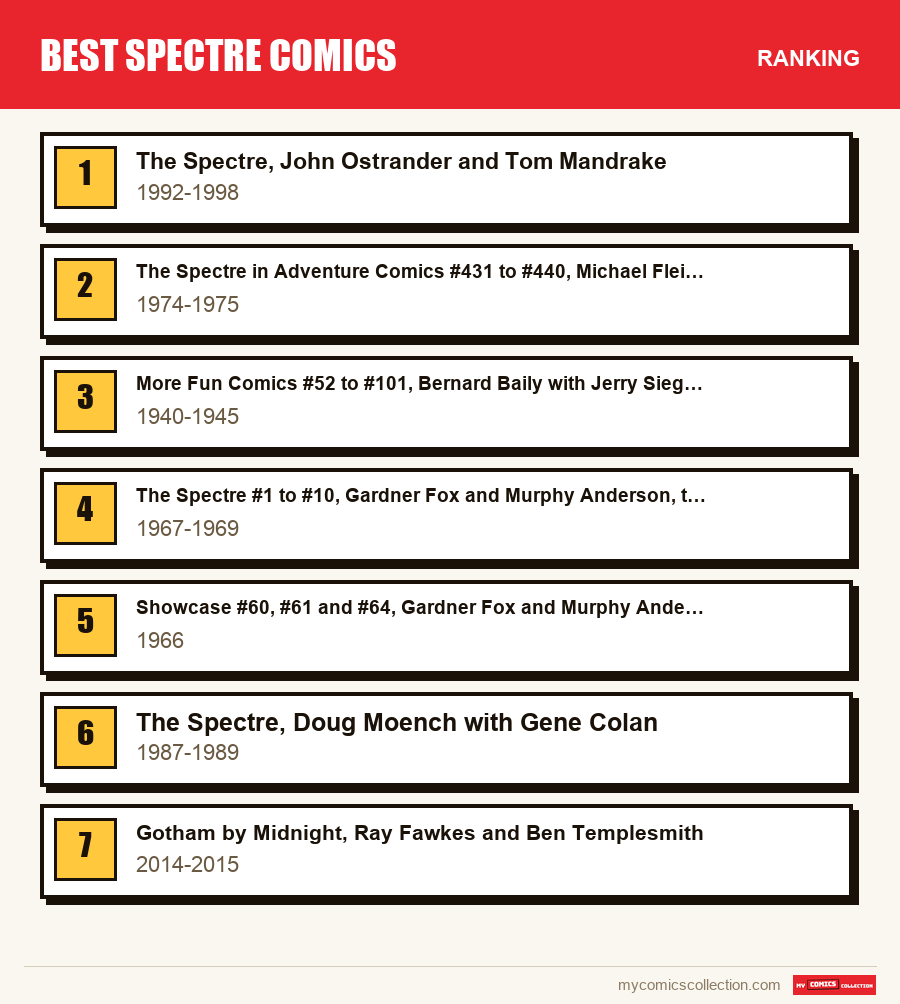
For the best Spectre comics, meaning Jim Corrigan, start with the The Spectre series by John Ostrander and Tom Mandrake (1992 to 1998), which gives the character his moral depth. Continue with Adventure Comics #431 to #440 by Michael Fleisher and Jim Aparo (1974-1975) for the most brutal version, then go back to More Fun Comics #52 (February 1940) for the origins. The 1967 and 1987 series come after.
The Spectre poses a rare problem for writers: how do you write an avenger nothing can threaten, since his host is already dead and the power inside him is that of divine wrath? Each era has answered in its own way, through horror, through theology, through police investigation or through supernatural crime fiction. This guide ranks the seven reads worth your time for Jim Corrigan, says in what order to approach them, then explains how to tell apart the hosts who bore the name after him.
As always in this guide, only verified information (creators, issues, dates) is stated as fact; the analysis is our own, with no reproduction of protected art or dialogue.
His first appearance
The Spectre is born in More Fun Comics #52, cover-dated February 1940, written by Jerry Siegel with art by Bernard Baily. Bernard Baily remains the artist for the entire original run. The character is already Jim Corrigan there, a murdered policeman who returns as a spectral avenger. His original run continues in that title through issue #101, in 1945.
For a reader today, this 1940 issue is above all a collecting milestone: it marks Corrigan's entry into comics. The read goes through Golden Age reprints rather than the single issue, and it serves as context rather than an entry point. The stories that follow explain better why the character lasted.
1: The Spectre, John Ostrander and Tom Mandrake (1992-1998)
The series launched in late 1992, whose issue #1 carries a December date, establishes the Spectre as a full-fledged character and not a mere crossover reinforcement. John Ostrander writes, Tom Mandrake draws most of the issues, with occasional fill-ins: Jim Aparo on #16, John Ridgeway on #20, Joe Phillips on #14. It ends with #62, in 1998.
What this series brings to the character comes down to one idea: the wrath of God needs a human witness, and Corrigan is that witness, torn between the entity's cold justice and what remains of his compassion. The opening arc pits Corrigan against the serial killer nicknamed the Reaver, while the psychic Madame Xanadu tells him that Amy Beitermann will die at the Reaver's hands. Corrigan then promises to protect her, and their relationship becomes the series' emotional thread. Issue #1 also shows Corrigan at the bedside of the man responsible for his death, fifty years earlier.
Who is it for? Readers who like stories of vengeance and guilt, and who accept a slow pace. How to read it: in order, without skipping issues, because the supporting characters, the policeman Nate Kane and Father Richard Craemer foremost, settle in over the course of the issues. It is the best starting point for understanding who Corrigan is.
2: The Spectre in Adventure Comics #431 to #440, Michael Fleisher and Jim Aparo (1974-1975)
Ten stories in which Fleisher and Aparo turn the Spectre into an executioner, with macabre punishments inflicted on criminals. The run opens in Adventure Comics #431, cover-dated early 1974, and stops with #440, in 1975. It was cut off abruptly: three Fleisher scripts were left without art and only appeared in 1988, in the miniseries The Wrath of the Spectre, whose fourth issue contains them.
What these issues bring to the character: a dark version, with no humor, that fixes the image of the implacable avenger. They are for Bronze Age horror fans and readers of Jim Aparo. How to read them: in one sitting, in issue order. The 1988 reprint in The Wrath of the Spectre collects the same stories, which makes access easier for anyone not hunting the original single issues. You will find the artist on his Jim Aparo page.
3: More Fun Comics #52 to #101, Bernard Baily with Jerry Siegel at launch (1940-1945)
The Spectre's Golden Age is the foundation everything rests on: a policeman killed by gangsters, then sent back to Earth by a power that wants him to punish crime. Bernard Baily holds the pencil throughout the original run, hence the interest of these single issues for Golden Age collectors.
What this period brings to the character: his basic principle, the policeman turned instrument of another authority. It is for readers of the medium's history and Golden Age collectors. How to read it: through reprint volumes, one of which collects the stories from #52 to #70 (1940-1941), rather than through the originals. For the context of the heroes of this period, the Hawkman guide sheds light on the other great figure of the Golden Age.
4: The Spectre #1 to #10, Gardner Fox and Murphy Anderson, then Neal Adams (1967-1969)
Ten issues, launched in December 1967: issue #1 is by Gardner Fox and Murphy Anderson, then Neal Adams draws issues #2 to #5. This is the Silver Age Spectre series, and it is worth it mostly for those Adams issues.
What it brings: a title of his own for the character, which picks up the work of the 1966 relaunch. Who is it for: Neal Adams fans and Silver Age readers. How to read it: starting with #2, if it is Adams's art that interests you.
5: Showcase #60, #61 and #64, Gardner Fox and Murphy Anderson (1966)
It is Showcase #60, in 1966, that puts Jim Corrigan back in circulation: Gardner Fox writes, Murphy Anderson draws. These issues of the tryout magazine precede the 1967 series.
What this relaunch brings to the character: his return to circulation after the Golden Age years. It is for Silver Age fans and collectors of relaunches. How to read it: before the 1967 series if you follow the chronology, after if you are after Adams's art first.
Do you collect this series?
Track what you own, what you are missing and what your collection is worth. 7-day trial.
Start my trial →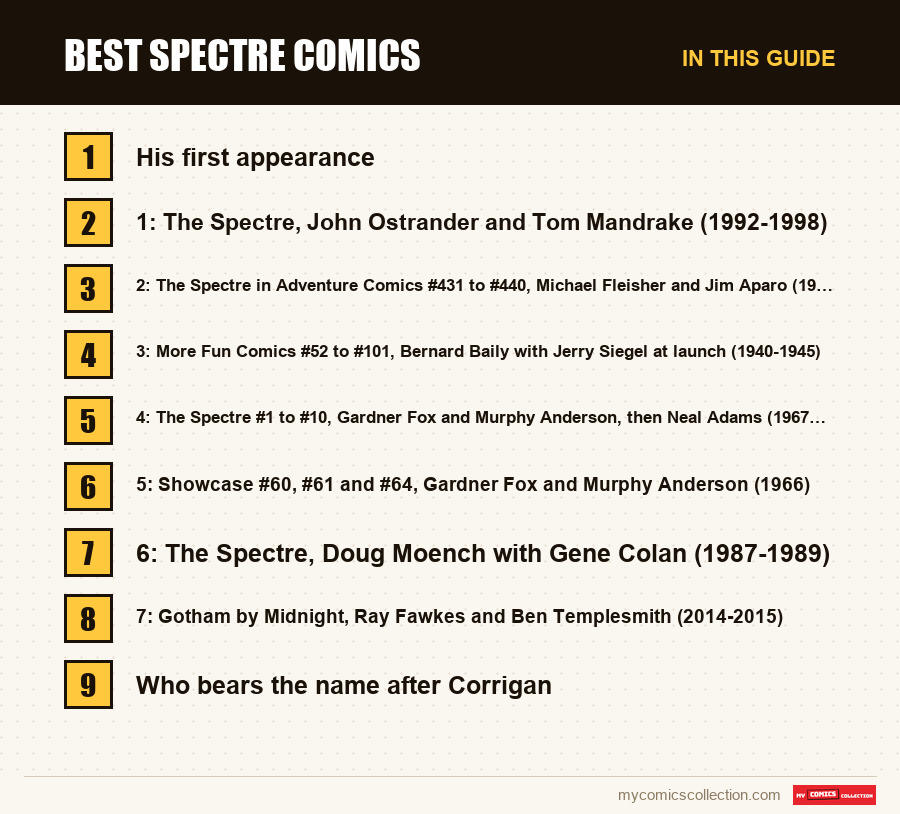
6: The Spectre, Doug Moench with Gene Colan (1987-1989)
The 1987 series runs 31 issues and ends in November 1989. Doug Moench writes it from start to finish; Gene Colan draws issues #1 to #6, then Cam Kennedy, Gray Morrow and other artists take over. Moench makes ample use of Madame Xanadu, created in 1978 by David Michelinie and Michael William Kaluta.
What this series brings to the character: a late-1980s Spectre, with Madame Xanadu as a recurring character. Target audience: Gene Colan fans, and those looking for the link between the Fleisher period and Ostrander's series. How to read it: the six Colan issues are enough if you are short on time.
7: Gotham by Midnight, Ray Fawkes and Ben Templesmith (2014-2015)
The series begins in late 2014 and runs twelve issues. Jim Corrigan belongs to the Gotham police there, in an investigation unit devoted to out-of-the-ordinary cases, with detective Lisa Drake as his partner. Templesmith's style, scratchy and misty, gives the series a film noir atmosphere that evokes horror more than superheroics.
What it brings: a modern version of Corrigan, a cop before being an entity. It is for readers who want a contained story that reads without knowing forty years of continuity. The opening trade paperback, We Do Not Sleep, collects issues #1 to #6.
Who bears the name after Corrigan
The Spectre is not always Jim Corrigan, and mixing up the hosts spoils a read. In the miniseries Day of Judgment (1999), five issues written by Geoff Johns with Matthew Dow Smith on pencils, Hal Jordan becomes the host of the power, after Corrigan has departed for heaven. The Sentinels of Magic, which include Zatanna, choose the host there.
Crispus Allen is born in Detective Comics #742, from March 2000, written by Greg Rucka with pencils by Shawn Martinbrough. He later becomes the host of the Spectre, and his story is at the heart of Final Crisis: Revelations, five issues published from October 2008 to January 2009, written by Greg Rucka with Philip Tan on art. Keep the rule in mind: a story belongs to Corrigan, to Hal Jordan or to Allen depending on the host it features, not on the title of the series.
Where to start based on your profile
- You are discovering the character: the Ostrander and Mandrake series, issues #1 to #6, then the rest if the tone suits you.
- You like horror and excess: Adventure Comics #431 to #440, or the reprint The Wrath of the Spectre.
- You prefer modern crime fiction: Gotham by Midnight, which reads with no prerequisites.
- You collect the Silver Age: Showcase #60 and the 1967 series, including the issues drawn by Neal Adams.
- You follow DC magic: the Doctor Fate guide and the Zatanna hub round out this path.
Key issues to know
For a collector, the method matters more than the list: first spot the character debuts, then the relaunches, finally the host changes. The following landmarks are verified.
- More Fun Comics #52 (February 1940): the first appearance of the Spectre.
- Showcase #60 (1966): the relaunch by Gardner Fox and Murphy Anderson.
- The Spectre #1 (December 1967): the start of the ten-issue series, with Neal Adams from #2.
- Adventure Comics #431 (1974): the opening of the Michael Fleisher and Jim Aparo run.
- The Spectre #1 (1987): the start of Doug Moench's series.
- The Spectre #1 (December 1992): the start of the Ostrander and Mandrake series.
- Day of Judgment #1 (1999): the host change to Hal Jordan, by Geoff Johns.
- Detective Comics #742 (March 2000): the first appearance of Crispus Allen.
- Gotham by Midnight #1 (late 2014): Corrigan's return as an investigator.
Two tips on method: tell apart the opening issue of a series from the one that introduces a new host, because they do not answer the same need; and favor reprints, like The Wrath of the Spectre, when you want to read without handling an old single issue. Whichever issue you target, compare its cover date to the actual year of release before closing the purchase.
If you are short on time, read the Reaver arc in the 1992 series, then the Fleisher and Aparo run in Adventure Comics, and finally Gotham by Midnight. You will have three visions of Corrigan, from three eras, without going through the transitional periods.
Frequently asked questions
The Spectre is a force of divine vengeance that takes form in a human host. The original host is Jim Corrigan, a murdered policeman, who appeared in More Fun Comics #52 in February 1940. Other hosts followed, including Hal Jordan in 1999 and Crispus Allen after his debut in 2000.
Open with The Spectre, written by John Ostrander and illustrated by Tom Mandrake from 1992 to 1998: Jim Corrigan is at his most readable there. It explores the character's morality, and its opening arc with the Reaver reads without any prior knowledge of the DC universe.
The ten stories of Adventure Comics #431 to #440, written by Michael Fleisher and drawn by Jim Aparo in 1974 and 1975, make up the darkest version of the character. Three scripts from this run were drawn later and published in 1988 in The Wrath of the Spectre.
No: the force is the same, the host changes. Jim Corrigan has housed it since 1940, then Hal Jordan becomes its host in the miniseries Day of Judgment in 1999, written by Geoff Johns. Crispus Allen, created in Detective Comics #742, bears it afterward. Check the host before buying an issue.
Yes. The Ostrander and Mandrake series, Adventure Comics #431 to #440 and Gotham by Midnight are self-contained. All you need to know is that Corrigan is a dead policeman returned as an avenger, host of a divine power; the rest is understood as you read, without knowing the teams of the DC universe.
Do you have an issue of More Fun Comics, Adventure Comics or the 1992 series in your collection? Get it estimated.
Estimate my comic