
In short
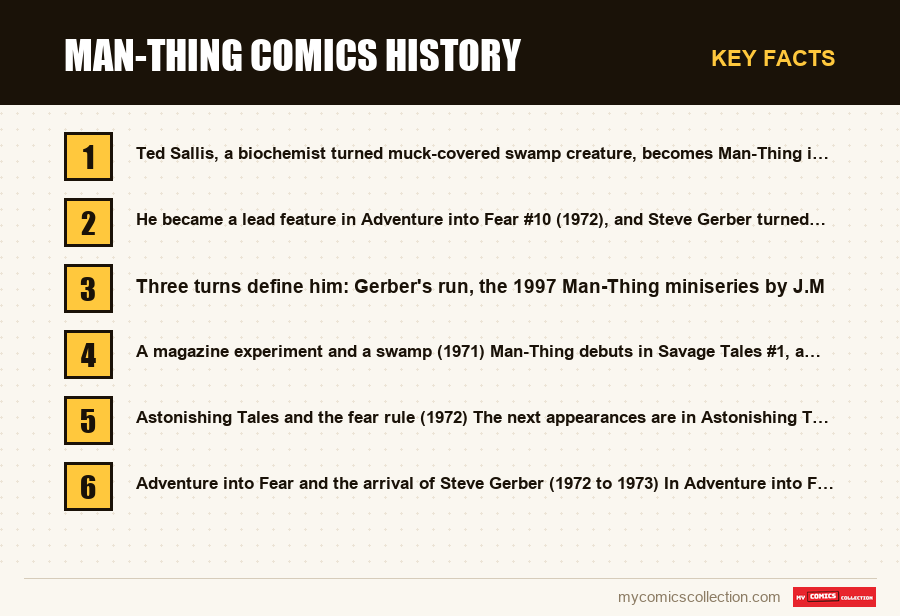
Ted Sallis, a biochemist turned muck-covered swamp creature, becomes Man-Thing in Savage Tales #1, a Marvel magazine cover-dated May 1971, built on a Stan Lee idea and credited to Roy Thomas, Gerry Conway and Gray Morrow. He became a lead feature in Adventure into Fear #10 (1972), and Steve Gerber turned him into a mute witness to human frailty across 22 issues of his own series. Three turns define him: Gerber's run, the 1997 Man-Thing miniseries by J.M. DeMatteis and Liam Sharp, and his stint as a team member in Thunderbolts.
Man-Thing is a difficult character to chart, because he has no speech, no plan and no archenemy worth the name. What changes from decade to decade is not the creature but the writer standing at the edge of the swamp, and each writer has used the same silent body for a different purpose. Following those hands in order gives a clearer picture than ranking his issues by scarcity.
Every credit and cover year here was checked against published references and doubtful items were dropped; the interpretation of what each era does to Ted Sallis is ours, and no art or dialogue is reproduced.
A magazine experiment and a swamp (1971)
Man-Thing debuts in Savage Tales #1, a magazine-format title dated May 1971. Stan Lee had the idea, and the story is credited to Roy Thomas, Gerry Conway and Gray Morrow. Its protagonist is Dr. Ted Sallis, a biochemist working in the Everglades on a version of the super-soldier serum under a project run by Wilma Calvin. When his lover Ellen Brandt, later written as his wife, sells the formula out from under him, Sallis injects himself with the one sample he has. His car goes off the road into the swamp, and the mixture of science and the swamp's own forces turns him into a hulking muck-covered creature. In that first story the creature kills the thugs Brandt hired and burns her face.
The black-and-white magazine format placed the book outside the comic-book distribution of the time, which explains both its adult tone and the fact that the character had to find a permanent home elsewhere. Our guide to the Man-Thing first appearance covers the issue itself, its contents and what to inspect. Here the question is what happens next, and the answer is that nothing happens at once. The creature goes quiet for a year.
Astonishing Tales and the fear rule (1972)
The next appearances are in Astonishing Tales #12 and #13, a two-part Ka-Zar story from mid-1972 written by Len Wein and drawn by Neal Adams. This is where the rule that would define the character is laid down: the creature burns those who feel fear. Wein's contribution is easy to overlook because the creature is a guest in someone else's book, yet it gives later writers the single mechanism they build everything on. Fear becomes the trigger, so every story can be turned into a test of what a person is afraid of.
For a collector tracing the character's life rather than his debut, these two issues mark the moment he stops being a one-off monster and becomes a usable concept. Neal Adams drawing him is also a reminder of how many major artists passed through the swamp before it settled into a rhythm.
Adventure into Fear and the arrival of Steve Gerber (1972 to 1973)
In Adventure into Fear #10, dated October 1972, Man-Thing becomes the lead feature. Gerry Conway writes the issue, with art by Gray Morrow and Howard Chaykin. The next issue, #11 from December 1972, brings in Steve Gerber, with art by Rich Buckler and Jim Mooney. Jim Starlin and Buckler draw issue #12, and from #13 in April 1973 Val Mayerik becomes the penciler, a role he keeps through the first four issues of the character's own series.
This stretch is the real founding of the character as readers know him. Gerber writes the creature as something close to a conscience: unable to speak, drawn to the emotions of whoever wanders into the swamp, and surrounded by people whose troubles are the actual subject of the story. Two supporting figures arrive in these pages. In Adventure into Fear #17 (October 1973), Jim Mooney joins as artist and Wundarr makes his debut. In issue #19 (December 1973), the last in which Man-Thing leads the book, the barbarian Korrek appears and so does a minor character who would go much further than anyone expected, Howard the Duck. Issue #20 hands the lead feature to Morbius.
The first series, written by Steve Gerber (1974 to 1975)
Man-Thing #1, dated January 1974, continues the story from Adventure into Fear with Gerber still writing and a cover by Frank Brunner. Issue #2 introduces Richard Rory, a recurring human point of view. Mike Ploog becomes the artist with issue #5 (May 1974) and stays through #11, giving the swamp a thick, damp look that readers still associate with the series. Gerber's stories range from the elegiac to the openly satirical; issue #12 carries the title "Song-Cry of the Living Dead Man," issues #13 and #14 bring in Captain Fate, and issue #16 begins a three-part Mad Viking arc.
The series ends with issue #22 in October 1975, a closing issue in which Gerber writes directly to his editor Len Wein. Gerber wrote all twenty-two issues. Alongside it, Giant-Size Man-Thing ran for five issues from August 1974 to August 1975, also written by Gerber. Its fourth issue carries Howard the Duck's first solo story, drawn by Brunner, and its second issue has the character's first story drawn by John Buscema. For the swamp creature's life as a publishing property, this twenty-two-issue run is the center of gravity; every later writer is answering it.
He also turns up outside his own books: in Marvel Premiere #28 (February 1976) he joins the Legion of Monsters alongside Manphibian and N'Kantu.
Guest spots and a second series (1976 to 1981)
After the first series ended, the creature drifted through other titles. He appears in The Incredible Hulk #197 and #198 (March and April 1976), in The Rampaging Hulk #7 (1978) in a story by Gerber and Starlin, and in Howard the Duck #22 and #23 (March and April 1978), where Val Mayerik draws a reunion of the old swamp cast.
A second ongoing series, Man-Thing vol. 2, starts with a number one dated November 1979, written by Michael Fleisher and penciled by Jim Mooney. Chris Claremont takes over the writing from issue #4 (May 1980), with Don Perlin on pencils, and Captain Fate returns in issue #7. The series ends with #11, written by Claremont, penciled by Val Mayerik and inked by Bob Wiacek. Eleven issues is a short life.
Anthology years and the DeMatteis revival (1980s to 1998)
Through the later 1980s and 1990s the creature is mostly a presence in anthologies. Marvel Comics Presents carries Gerber stories with art by Tom Sutton, a reminder that the original writer kept returning to his creation. Our Marvel Comics Presents omnibus guide explains how that anthology was collected.
The revival that matters comes at the end of 1997. Man-Thing vol. 3 runs eight issues from December 1997 to July 1998, written by J.M. DeMatteis and drawn by Liam Sharp. DeMatteis had written a backup story in the 1981 series, so the return is a continuation of a long personal association. A companion run of Strange Tales vol. 4, by the same pair, stopped at two issues in September and October 1998, because issues #3 and #4 were not published.
Do you collect this series?
Track what you own, what you are missing and what your collection is worth. 7-day trial.
Start my trial →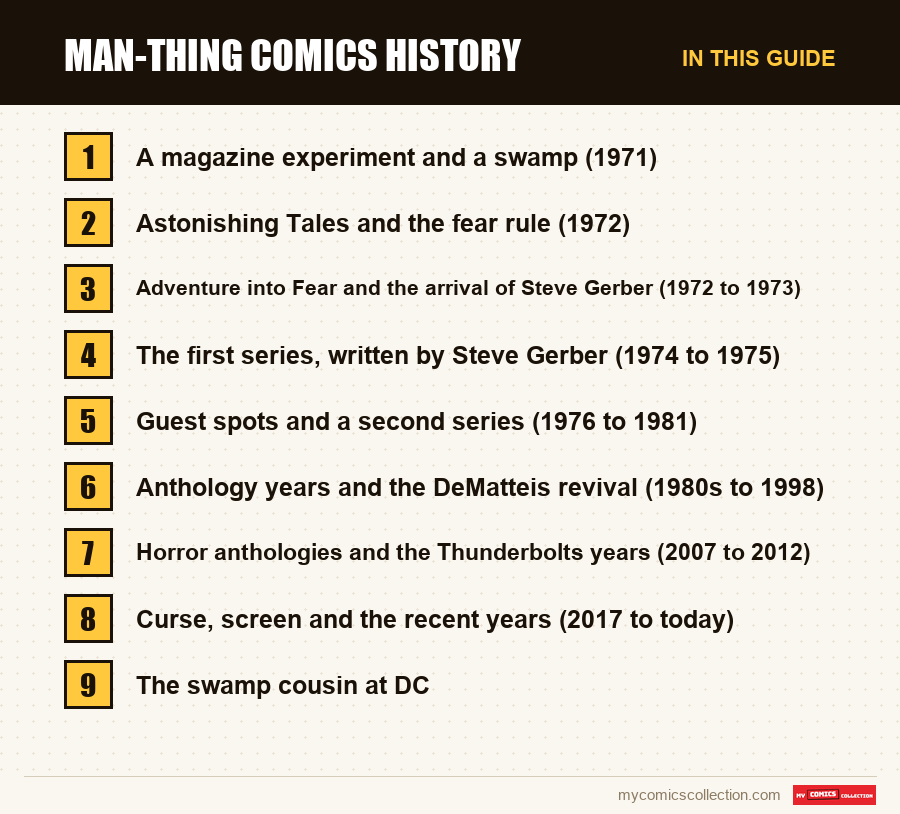
Horror anthologies and the Thunderbolts years (2007 to 2012)
The 2000s scatter the character across short projects. Legion of Monsters: Man-Thing #1 (May 2007) is written by Charlie Huston with art by Klaus Janson. Dead of Night featuring Man-Thing is a four-issue Marvel MAX miniseries from April to July 2008 by Roberto Aguirre-Sacasa.
The biggest change in status comes in Thunderbolts, where the creature becomes a regular member beginning with issue #144. The title is retitled Dark Avengers with issue #175, and he appears through #183. Moving a silent swamp elemental onto a government-sponsored team is a strange fit for the character Gerber built, and it shows how far a concept can travel once it is treated as a usable power set. For readers of the Avengers line, this is the closest the creature comes to being a team player.
In 2012 a three-issue Infernal Man-Thing, dated September and October, brings out a Gerber story posthumously, with art by Kevin Nowlan. It reads as a quiet coda, and it lets the creator's voice return to the swamp one more time.
Curse, screen and the recent years (2017 to today)
In 2017 Marvel published a five-issue Man-Thing series that marks the comics debut of R. L. Stine. In 2021 the line produced three one-shots under the banner Curse of the Man-Thing, in Avengers, Spider-Man and X-Men editions released in March, April and May. A Crypt of Shadows #1 appears in October 2022 with Adam Warren writing a story featuring X-23, and Uncanny X-Men #14 (May 2025), by Gail Simone and David Marquez, brings the creature back to a mainstream series.
The wider public met the character in the 2022 Werewolf by Night special, in which Carey Jones provided the motion capture. That exposure sits next to Marvel's October 2026 horror push, covered in our Marvel Midnight guide. He returns whenever a writer wants a silent witness.
The swamp cousin at DC
Over at DC, a rival swamp monster surfaces in House of Secrets #92 (July 1971), a story by Len Wein and Bernie Wrightson, months after Sallis took shape. Our page on House of Secrets #92 tells that side of the story, and the best Swamp Thing runs guide follows the DC creature's trajectory.
The key issues across his history
- Savage Tales #1 (1971): the magazine that carries the Ted Sallis origin, with Thomas, Conway and Morrow credited.
- Astonishing Tales #12 and #13 (1972): the Ka-Zar story by Len Wein and Neal Adams that sets the rule that fear burns.
- Adventure into Fear #10 (1972): Man-Thing takes over as the lead feature, with Gerry Conway writing.
- Adventure into Fear #11 (1972): Steve Gerber's first issue on the character, with art by Rich Buckler and Jim Mooney.
- Adventure into Fear #19 (1973): Howard the Duck and Korrek appear, in the last issue where Man-Thing leads the book.
- Man-Thing #1 (1974): the start of Gerber's own series, with a cover by Frank Brunner.
- Man-Thing #22 (1975): the final issue of the first series, which Gerber writes as a letter to his editor.
- Man-Thing vol. 3 #1 (1997): the DeMatteis and Sharp miniseries that revives the character.
How to follow Man-Thing in a collection
The simplest method is to separate the character into three layers. The debut is a single magazine issue and a historical object. The Gerber layer runs from Adventure into Fear #11 through Man-Thing #22, with Giant-Size Man-Thing alongside, and it is the part that most readers want to own in a readable form. Everything after is a series of scattered projects that are easier to chase by creator than by title.
Numbering traps are the main hazard. There are three different Man-Thing volumes, from 1974, 1979 and 1997, plus a 2017 series, so a listing that says just "Man-Thing #1" can mean any of them. Check the cover date before anything else. Run your Adventure into Fear searches by issue number and year rather than by title alone. The Strange Tales volume 4 run stopped at two issues, which matters if a seller lists it as a complete set. For the background on how reprints can mislead, our first edition versus reprint guide is a good companion, and the broader horror collecting guide places the character within the genre.
Because the early magazine is large, check the sleeve and board size before buying. For graded copies, compare the exact issue and label type, not a neighboring number.
Frequently asked questions
Man-Thing debuts in Savage Tales #1 (1971) in a story credited to Roy Thomas, Gerry Conway and Gray Morrow, from an idea by Stan Lee. Steve Gerber then defined the character's tone as the writer of Adventure into Fear and of the 1974 Man-Thing series, and he wrote all 22 issues of that first ongoing run.
Ted Sallis is a biochemist in the Everglades working on a super-soldier serum. After Ellen Brandt sells the formula, he injects himself with the one sample, crashes his car into the swamp and is transformed. The origin appears in Savage Tales #1, and later writers revisit it, notably in the 2008 Dead of Night miniseries, which retells it for a mature audience.
The rule is laid down in Astonishing Tales #12 and #13 (1972), a two-part Ka-Zar story written by Len Wein and drawn by Neal Adams. Later writers, Steve Gerber above all, built the character's stories around it, so those two issues are worth knowing even though Man-Thing is a guest in them.
Yes. Howard the Duck debuts in Adventure into Fear #19 (December 1973), the last issue in which Man-Thing leads the series, written by Steve Gerber. Howard's first solo story appears in Giant-Size Man-Thing #4 (1975), and the old swamp cast reunites in Howard the Duck #22 and #23 (1978).
Start with Steve Gerber's stretch, from Adventure into Fear #11 through Man-Thing #22, the core of the character. Then try the 1997 miniseries by J.M. DeMatteis and Liam Sharp, and the 2007 and 2008 horror projects if you want shorter, modern stories with the creature at the center.
Holding a Man-Thing issue from the 1970s? Check its exact title, volume and cover date, then estimate its value from real listings.
Estimate my comic