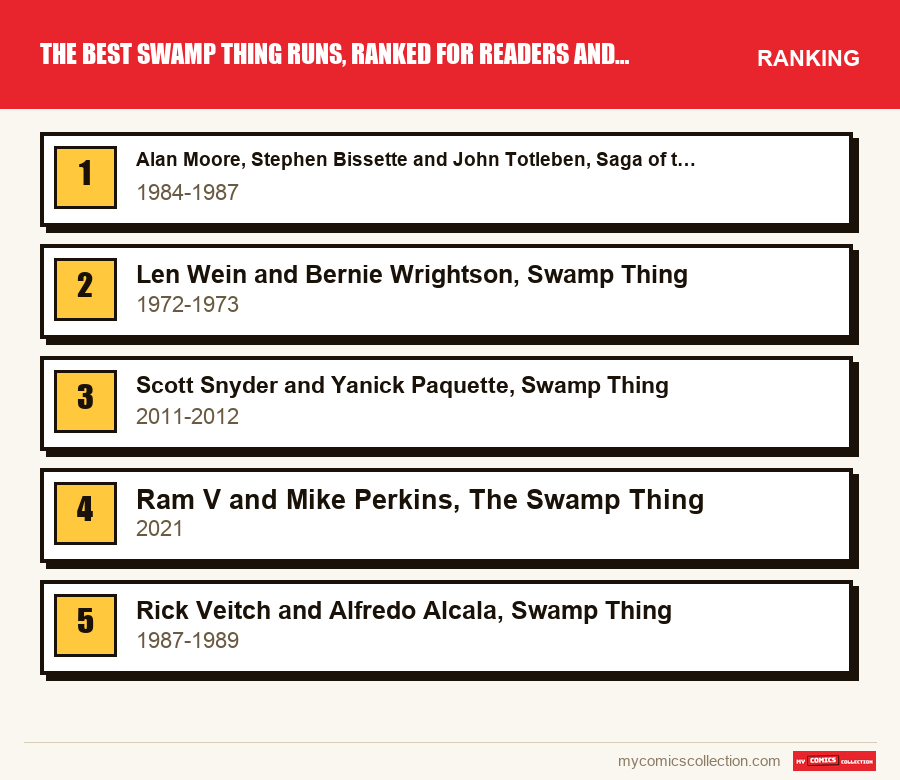
The best Swamp Thing run is Alan Moore's with Stephen Bissette and John Totleben, from issue 20 to issue 64 of Saga of the Swamp Thing (1984-1987), ahead of the creation by Len Wein and Bernie Wrightson (1972-1973) and the relaunch by Scott Snyder and Yanick Paquette (2011). Five sets are ranked, with the starting issues, the target reader and the recommended format between single issues and collected editions.
Few comic book heroes have had such a split existence. Before 1984, Swamp Thing is a swamp creature whose story fits within a scientific tragedy; afterward, he becomes the character through which DC learns to publish adult horror. Looking for the best runs therefore means deciding where to start from, and above all not letting yourself be pulled in by the 1984 peak alone.
As always on this guide, only verified information (creators, issue numbers, dates) is stated as fact; the analysis is our own, with no reproduction of protected pages or dialogue.
Our reading framework before the ranking
A title that has changed creative teams about ten times is poorly judged by length. For Swamp Thing, we weighed three things: what the run adds to the very nature of the character, whether it can be read without knowing the rest, and what it left behind in later relaunches. A brilliant but self-contained cycle ranks below a cycle that opened doors.
A chronology note avoids buying mistakes. A first swamp creature appears in House of Secrets #92 in 1971; Swamp Thing #1 only comes in late 1972. The original series stops in 1976 after twenty-four issues. A second series, titled Saga of the Swamp Thing, starts in 1982 on the occasion of the Wes Craven film; the 1984 run sits within that numbering. Later, the title goes back to Swamp Thing without changing its counter, then is relaunched from zero in 2011 and in 2021. An "issue 20" therefore means very different things depending on the year: always ask for the cover date.
Top 1: Alan Moore, Stephen Bissette and John Totleben, Saga of the Swamp Thing (1984-1987)
Alan Moore takes over the series at issue 20, dated January 1984, and writes it through issue 64 of September 1987. Stephen Bissette and John Totleben pencil and ink most of this period, joined near the end by Rick Veitch. The starting point resembles nothing that came before: the autopsy of the creature's body reveals that it never was Alec Holland, but a plant that absorbed his memories. Mourning for lost humanity stops being the engine of the story.
From there, Moore brings in Abby Arcane, the niece of Anton Arcane, in a love story that does not turn into melodrama, then opens the "American Gothic" cycle from issue 37, where the hero confronts reimagined horror figures. It is in this arc that John Constantine makes his first appearance. Issue 50 closes the set with an oversized volume, and issue 64 closes the loop.
This run dominates because it redefines what a superhero horror title can tell: ecology, desire, embodiment, with art that fits the plant matter. It reads without preparation and serves as an entry point to all of DC's adult output in the following years. Any adult can approach it, even without a taste for superheroes; the key issues of this run are covered in a separate article.
For collecting, two logics coexist. The single issues of numbers 20, 21, 34 and 37 are hunted one by one and their demand is concentrated. To read the whole, several bound volumes, including a large-format edition, reprint the period in order. Check the range of issues announced on the back before buying: a volume that stops in the middle of a cycle is a classic source of frustration.
Top 2: Len Wein and Bernie Wrightson, Swamp Thing (1972-1973)
Len Wein writes and Bernie Wrightson draws the first ten issues of Swamp Thing, starting in late 1972. The central character is Alec Holland, a researcher in Louisiana who sees his laboratory destroyed by an explosion and is reborn in plant form. Anton Arcane, an evil scientist, enters the scene as early as issue 2 and becomes the recurring adversary of the entire series. The tone oscillates between classic monster movies and gothic fantasy.
Why this place: everything that will be reinvented later is laid down here, the swamp, the tragedy, Arcane, the threat of a science without scruples. Wrightson's art, heavily inked and richly textured, is one of the reasons readers with no interest in DC seek out these issues. The story is more linear than what will follow: a mission, an enemy, a fall. It is readable, it is effective, but it does not shake up the genre.
This run is aimed at the Bronze Age collector, the reader drawn to Wrightson's art, and the one who wants to understand what Moore transforms. The original single issues are Bronze Age collector pieces, with highly variable condition and demand driven by issue 1; for reading, collected editions devoted to the creation and to Wrightson's work exist in several languages. Check that they really reprint issues 1 to 10 and not just a selection.
Top 3: Scott Snyder and Yanick Paquette, Swamp Thing (2011-2012)
The 2011 relaunch, under DC's new numbering, is entrusted to Scott Snyder on scripts and Yanick Paquette on art. The first issue appears in September 2011. Snyder puts Alec Holland back at the center: after accepting his status as a plant, he finds himself called back by the Parliament of Trees, which would like him to take up a role as guardian of the Green. Facing him, the Rot, a symmetrical and destructive force, finds a mouthpiece in Anton Arcane.
This run matters because it achieves what relaunches often fail to do: extend Moore's legacy without reciting it. Snyder sets up a mythology of the Green, the Red and the Rot that becomes the framework of later stories, and this framework carries into the joint cycle with Jeff Lemire's Animal Man series, titled "Rotworld". Paquette's pages, very architectural, treat forests like cathedrals.
This cycle appeals to anyone who prefers a contemporary, self-contained story, without going back through the 1980s. As for single issues, these 2011 numbers are too close to us to have an established value. Three things will make it evolve: reprints of the cycle, an adaptation only if confirmed, and the observed scarcity of the very first issues. The collected volumes, in French as in English, make reading simple. The hub devoted to Scott Snyder gathers the articles on other series by the same writer.
Top 4: Ram V and Mike Perkins, The Swamp Thing (2021)
The 2021 series is written by Ram V and drawn by Mike Perkins. It follows the opposite logic of Snyder's relaunch: the narration unfolds slowly, in layers, around a hero who is no longer really a man and who must understand what it means to protect something that does not resemble him. The swamp becomes a place of investigation more than of combat, and its outcome deserves to be discovered without being told here.
Why fourth place: this cycle proves that the title can still speak to a contemporary adult audience, in a tighter format, and that the theme of plant embodiment is not exhausted. It earns the critical recognition of a short, coherent series, rather than the momentum of a historic turning point. Ram V pursues a manner of writing that is distinct here; you will find the name in our hub devoted to Ram V.
It suits the reader who has already tasted Moore's Swamp Thing and wants to see what a writer of today does with it. For the collection, the single issues are too recent to fix a value; we put forward no ratio or print run. The short length and the quality of reception may favor steady demand, but only the observation of completed sales over several months will tell. The collected edition is the natural format.
Do you collect this series?
Track what you own, what you are missing and what your collection is worth. 7-day trial.
Start my trial →
Top 5: Rick Veitch and Alfredo Alcala, Swamp Thing (1987-1989)
Rick Veitch, who was already drawing issues under Moore, becomes the title's writer in the wake, with Alfredo Alcala on inks. Sources differ on the exact details of the start and end issues of this cycle; it opens around issue 65, dated late 1987, and ends after an editorial dispute over an episode that DC refuses to publish. This breaking point is better known than the story itself.
This run is worth the detour because it shows what happens when a hero rebuilt from the ground up must keep on existing: Veitch pushes the character toward more dreamlike, more historical and stranger terrain, at the price of a coherence that is sometimes uneven. It reads with pleasure for anyone who has finished Moore and wants more, less so for a newcomer.
It is therefore aimed at an already won-over reader, at the late 1980s collector and at the series completist. The single issues are affordable for the period and rarely sought one by one; some bound volumes in English reprint this cycle, though its presence in catalogs is not constant. Check the included issues before buying.
Which one to start with, depending on your profile
If you are discovering the character and gladly read in collected editions, start with the first volume of the Moore period: you will know within a few episodes whether the series speaks to you. If the gothic aesthetic attracts you more than narrative depth, go first through the ten issues by Wein and Wrightson, which are shorter, then come back to 1984 to measure the gap.
Do you prefer a recent story, with a beginning and an end? The Snyder and Paquette cycle, or the Ram V and Perkins series, offers that without prior knowledge. The Hellblazer reader will make the reverse trip: issues 37 to 50 of the 1984 series show how John Constantine was born.
For the single-issue collector, the hierarchy differs from that of reading. The milestones of Moore's run concentrate the demand, the creation by Wein and Wrightson attracts Bronze Age fans, and the rest is chosen for pleasure. Our profile of House of Secrets #92 avoids a frequent confusion between two characters with almost identical names.
What these runs are worth in a collection
These runs cannot be compared on a single scale. The gap between the key issues of Moore's cycle and the rest of the series is very pronounced: a small number of single issues carries the demand, while the rest trades at a fraction. This gap can be checked by taking several completed sales in the same condition, for issue 37 on one side and a mid-cycle issue on the other.
The creation by Wein and Wrightson follows another logic: the demand is narrower, but it is carried by the founding role of the series and by the illustrator's name. The 2011 and 2021 relaunches are not established on the market. A print run, an adaptation or a supposed scarcity never justifies a price; they can, however, explain a trend.
As a method, note for each purchase the actual condition, the presence or absence of the newsstand barcode and the cover date. Then build a range from recent closed sales, never from isolated listings. If you want to place a copy from your own library, the free estimate helps by starting from a comparison base. In every case, a well-chosen collected edition is worth more than a poorly understood single issue. Our comparison with the 2019 series also shows what an adaptation does not change.
How to build the collection in order
A coherent collection around Swamp Thing is built in three steps. First, a reading base: the collected editions of Moore's run. Then, a core of chosen single issues, for example numbers 21 and 37, depending on your budget and your taste for the period object. Finally, extras: the 1972 creation, the 2011 release and, if you feel like it, the 1971 episode that precedes the series.
Whatever the order, keep a purchase log: references, condition, source, date, publisher of the collected edition. A series that changes hands this often generates duplicates and issue-number confusion, and only an up-to-date inventory avoids them. The pillar article on the birth of the Vertigo imprint helps place DC's role in adult publishing, which is useful for this series.
Frequently asked questions
Alan Moore's, from Saga of the Swamp Thing #20 (1984) to #64 (1987), with Stephen Bissette and John Totleben. It changes the nature of the character from #21 and opens "American Gothic" at #37. It reads without prior knowledge, which also makes it the best entry point.
No. Each cycle works on its own. The simplest is to read Moore's run, then add the creation by Wein and Wrightson, then the 2011 and 2021 relaunches. Only the Snyder cycle benefits from being read alongside Jeff Lemire's Animal Man for "Rotworld".
It is the same title on the same numbering. The series launched in 1982 is called Saga of the Swamp Thing, then simply Swamp Thing from #39. The 2011 and 2021 relaunches start again from #1: always check the cover date before buying a single issue.
Not in the strict sense. A swamp creature, Alex Olsen, appears in House of Secrets #92 (1971). Alec Holland, the hero of the series, is born in Swamp Thing #1 in 1972. Both are by Len Wein and Bernie Wrightson; our dedicated profile details the nuance.
Collected editions for reading, single issues for owning. A few key issues (#21, #34, #37) justify buying one by one if you collect the period object. For everything else, the bound volumes, including in large format, offer a more comfortable read and a better-controlled price.
A Swamp Thing single issue in your box? Estimate it from its actual condition rather than its legend alone.
Estimate my comic