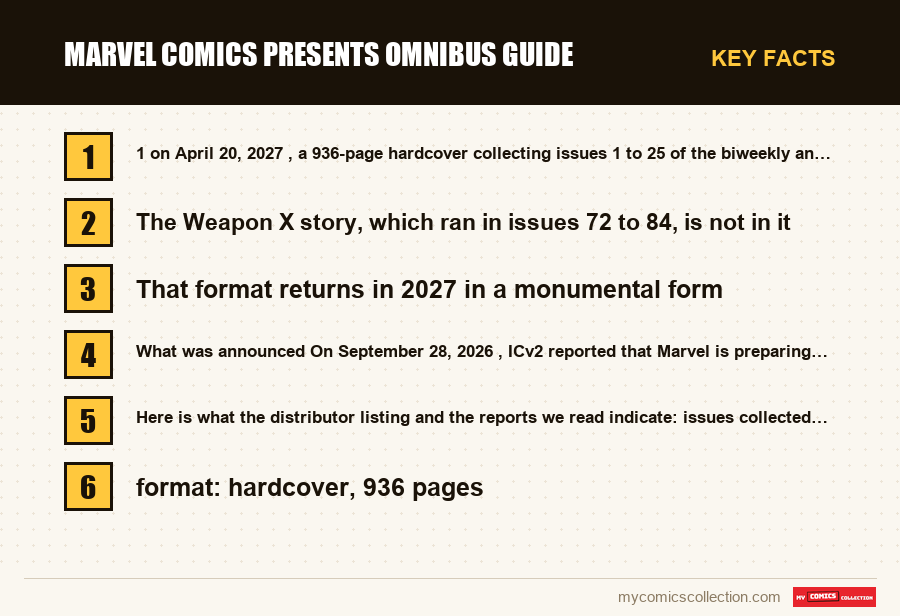
Marvel will publish the Marvel Comics Presents Omnibus Vol. 1 on April 20, 2027, a 936-page hardcover collecting issues 1 to 25 of the biweekly anthology launched in 1988 and ended in 1995, in this Marvel Comics Presents omnibus guide to the 1988 anthology. The publisher says it reprints every page, with Walter Simonson on the main cover and Marshall Rogers on the direct market cover. The Weapon X story, which ran in issues 72 to 84, is not in it.
A single issue could hold Wolverine, a Man-Thing adventure and a Shang-Chi tale: for seven years, Marvel Comics Presents worked as a short-story magazine, where you moved from one hero to the next page by page. That format returns in 2027 in a monumental form.
The volume's data comes from the Penguin Random House listing and from ICv2 and 13th Dimension articles; the Weapon X chronology relies on a reference page, and the buying advice is our own analysis.
What was announced
On September 28, 2026, ICv2 reported that Marvel is preparing a collection of the 1988 Marvel Comics Presents series "in its entirety," through a run of omnibuses. Volume 1 is the only one for which detailed contents have been published so far. Here is what the distributor listing and the reports we read indicate:
- issues collected: Marvel Comics Presents (1988) #1 to 25;
- format: hardcover, 936 pages;
- release date: April 20, 2027;
- covers: a main cover by Walter Simonson and a direct market cover by Marshall Rogers;
- ISBN of the Simonson cover edition: 9781302971328.
On the writing side, the listing names Chris Claremont, Steve Gerber, Doug Moench, Ann Nocenti, Don McGregor, Bob Harras and Howard Mackie, with Al Milgrom, John Byrne, Fabian Nicieza and others. On the art side: John Buscema, Tom Sutton, Tom Grindberg, Rick Leonardi, Gene Colan, Ron Lim and Rich Buckler, with Steve Ditko, Al Milgrom, Bob Layton, John Byrne, Mark Badger, Dave Cockrum and others.
The publisher's pitch highlights the Wolverine stories by Chris Claremont and John Buscema, Steve Gerber's Man-Thing, Doug Moench's Shang-Chi, Don McGregor's Black Panther, stories of Havok and Colossus, and rare pages by Steve Ditko and Dave Cockrum. Marvel states clearly that this volume reprints every single page of these twenty-five issues.
Point 1: A biweekly anthology born in 1988
Marvel Comics Presents started in 1988, as Marvel's fiftieth anniversary approached, and came out every two weeks. Its original series ended in 1995 after 175 issues, seven years of publication at a steady pace. In one issue, several short stories of different characters, each cut into installments of a handful of pages, followed one another on paper.
This mechanism explains why the series is hard to collect one issue at a time and hard to reread in a collected edition. A story begun in one issue continues a few issues later, often between two other tales; without an index, you lose the thread. An omnibus that reprints the pages in publication order restores the original experience, with its shifts in tone from one serial to the next.
The series did come back, by the way: a twelve-issue relaunch in 2007-2008, then another of nine issues in 2019. The 2027 volume concerns the 1988 series and covers nothing else.
Point 2: Wolverine, Man-Thing, Shang-Chi, Black Panther: a rotating lineup
The contents of the twenty-five issues read like an appointment book. Chris Claremont and John Buscema sign Wolverine stories there; Steve Gerber brings Man-Thing back; Doug Moench handles Shang-Chi; Don McGregor writes Black Panther. Each of these names opens a different reading path for the buyer, from swampy horror to martial arts tales.
The presence of Steve Ditko and Dave Cockrum, flagged as "rare" by the listing, particularly interests art fans. These two artists appear in the volume through pages that the listing presents as uncommon. The Havok and Colossus stories are a reminder that the X-Men's supporting characters found there a ground for short stories outside the regular series.
For a reader who knows Shang-Chi or Black Panther only from recent series, the anthology offers much older stories: a doorway into these characters as they existed in the late 1980s. Doug Moench's Shang-Chi stories are to be read as pieces of this rotating lineup.
Point 3: Weapon X, outside Volume 1
The story many readers associate with Marvel Comics Presents is not in this volume. Weapon X, written and drawn by Barry Windsor-Smith, ran in issues 72 to 84, in 1991. Volume 1 stops at issue 25, so it reprints none of its pages.
This story has already been collected several times: in a trade paperback in 2009 under the title Wolverine: Weapon X, which collects issues 72 to 84, in the Wolverine Omnibus Vol. 1 and in the fourth volume of the Wolverine Epic Collection, Escape from Weapon X. Barry Windsor-Smith handled the writing, pencils, inks, colors and lettering, and ICv2 reports that Dark Horse is preparing a black-and-white archive edition. For a reader waiting for the 2027 omnibus in the hope of finding Weapon X in it, the answer is therefore no: you will need a later volume of the collection, whose contents Marvel hasn't given, or one of the existing editions.
To place this story among the tales surrounding the Weapon X program, the "Weapon X: the program's key issues" page in the box above lists the landmarks and helps you decide what to buy before April.
Do you collect this series?
Track what you own, what you are missing and what your collection is worth. 7-day trial.
Start my trial →
Point 4: Why a complete reunion changes the reading
Marvel presents this book as the reunion of the series in its entirety, through successive volumes. For 175 issues, that implies several tomes; the trade press has floated numbers of volumes to come, but the publisher gave none in the announcement we read. A reader planning to buy everything should therefore think volume by volume, looking at each announcement rather than counting in advance.
The point of publishing in order is to restore a forgotten way of working: each issue offered a balance between several voices, and the stylistic variations from one creator to the next were part of the pleasure. Volume 1 covers the early days of this formula, when the anthology was looking for its stars. The list of creators, which mixes veterans of the 1970s with young writers of the moment, gives an idea.
Volume 1 is also a good test of the publisher's method: if the reception is favorable, the rest of the collection will come into focus, and that is when issues 72 to 84 will find their place in a schedule. Until then, no announcement we read allows us to date their return; better not to put off buying an edition of Weapon X that you need in order to wait for a volume whose date and contents are both unknown. To understand how original print runs are judged, our explanation of print runs and scarcity gives the useful benchmarks for single issues from this period.
What this changes for a collector
For a collector, two questions arise: which cover to choose and what to do with the single issues. The volume exists in two versions: the standard edition, with Walter Simonson's cover, which carries ISBN 9781302971328, and the Marshall Rogers cover edition, reserved for the direct market, that is, specialty comic shops. Before ordering, check carefully which one appears on the listing you are looking at: the reports we read note no difference in content between the two.
If you own single issues from 1988 to 1990, the volume doesn't replace them, but it fills a reading function. As with other big collections, our analysis of omnibus vs. original issues describes what each form brings. In this case, the every-two-weeks schedule made keeping up with each issue demanding; the omnibus gathers these stories with no gaps.
For single issues, the method stays classic: check the condition of the spine, the edge and the corners, and note the number and contents of each issue. An issue that is interesting for a Wolverine story by Claremont and Buscema isn't judged like an issue where you only care about the last page. To place your vintage Wolverine purchases, our guide to buying vintage Wolverine comics details the checkpoints. And to fit it all into a larger picture, the page on managing your Marvel comics collection lays the groundwork.
A 936-page volume is heavy, and its binding needs space and flat storage rather than standing upright over a long period. Store it flat, away from humidity, and avoid opening it to 180 degrees: at this thickness, the spine tires quickly. The choice of the direct market cover is better made before release, since these editions are distributed through a network of shops and not through every bookstore.
One concrete way to prepare the purchase is to draw up, before April, a list by star: note the Wolverine, Man-Thing, Shang-Chi and Black Panther stories you already own in single issues, then compare it with the creator list in the listing. You will quickly know whether the volume mostly brings you stories new to you, or whether it duplicates an already advanced collection. This method helps you avoid an impulse buy for a book of this size, and it costs nothing to do.
What remains to be confirmed
Everything above comes from Marvel's announcement as reported by ICv2 and the Penguin Random House listing; a release date can move. Still to be confirmed:
- the April 20, 2027 date, which may change;
- the number of volumes in the collection and the contents of Volume 2 and the following ones, of which Marvel has given no detail;
- when issues 72 to 84, and therefore Weapon X, will be collected in a later volume;
- whether alternate covers exist beyond those by Walter Simonson and Marshall Rogers.
Frequently asked questions
It gathers issues 1 to 25 of the 1988 series, in a 936-page hardcover announced for April 20, 2027. The contents include Wolverine stories by Chris Claremont and John Buscema, as well as Man-Thing, Shang-Chi, Black Panther, Havok and Colossus.
No, based on the announced issues. Barry Windsor-Smith's Weapon X ran in issues 72 to 84, in 1991, while Volume 1 stops at issue 25. The story remains available in earlier editions, including the Wolverine: Weapon X trade paperback and the Wolverine Omnibus Vol. 1.
The 1988 series has 175 issues, published every two weeks until 1995. It then had a twelve-issue relaunch in 2007-2008 and another of nine issues in 2019. The 2027 volume reprints issues 1 to 25 of the original series.
Two covers are announced: Walter Simonson's, for the standard edition, and Marshall Rogers's, reserved for the direct market of specialty shops. The contents are identical. The choice therefore depends on your taste and your buying channel, not on the pages' contents.
Marvel says it wants to collect the series in its entirety through a run of omnibuses, which implies more volumes. However, the publisher gave neither their number nor their contents in the announcement we read. Volume 1 is the one whose issues are specified, 1 through 25.
Are you holding on to single issues of Marvel Comics Presents with Wolverine or Man-Thing? Get them appraised before choosing your omnibus.
Estimate my comic