In short
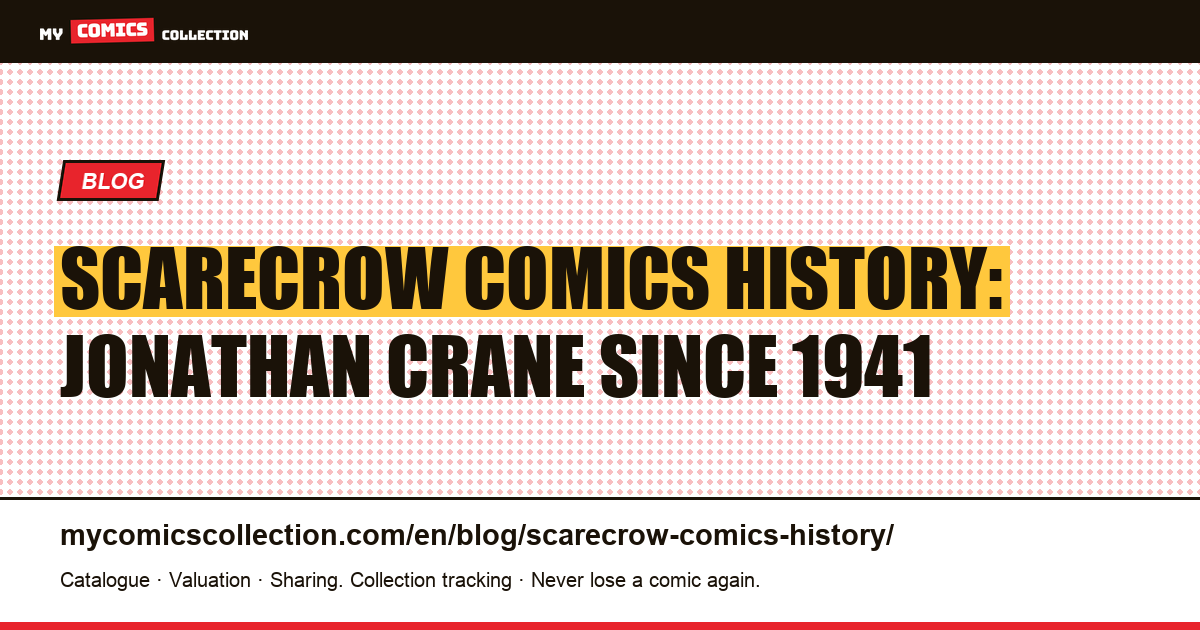
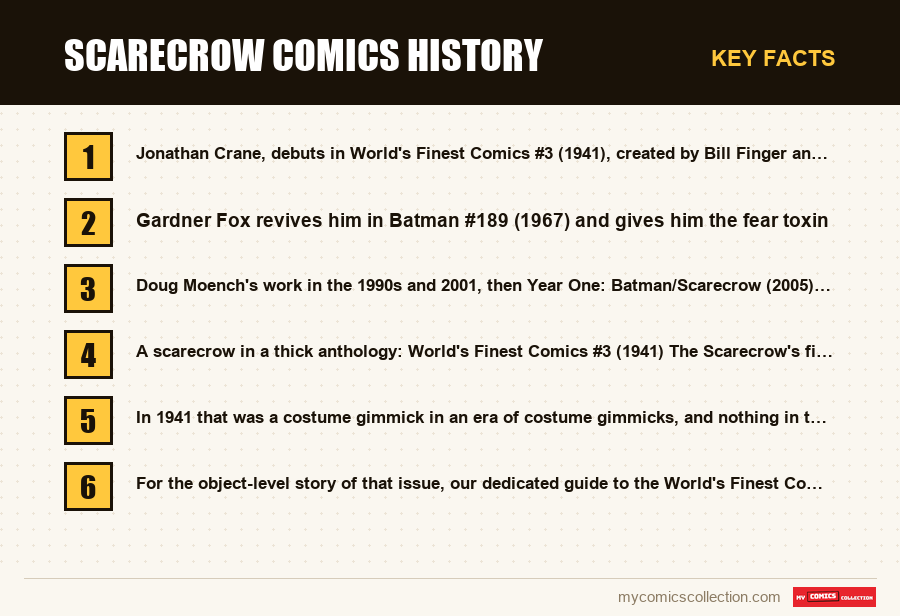
The Scarecrow, Dr. Jonathan Crane, debuts in World's Finest Comics #3 (1941), created by Bill Finger and Sheldon Moldoff, and appears only twice in the 1940s. Gardner Fox revives him in Batman #189 (1967) and gives him the fear toxin. Doug Moench's work in the 1990s and 2001, then Year One: Batman/Scarecrow (2005) and the New 52 relaunch, rebuild him from a gimmick villain into Gotham's specialist in terror.
Most Batman villains are defined by a weapon, a face or a crime. Jonathan Crane is defined by an effect, the moment someone else's fear takes over, and that is why his publishing history is worth following in order. He spent decades as a costume and a name before he became a method, and the comics that changed him are spread across eighty years of anthologies, annuals, miniseries and relaunches.
The credits and issue numbers below were checked against published records before they went in. Cover months appear only where they were confirmed against the books' records; elsewhere you get the year, and what each era does for Crane is our reading.
A scarecrow in a thick anthology: World's Finest Comics #3 (1941)
The Scarecrow's first page is World's Finest Comics #3, dated September 1941. Bill Finger and Sheldon Moldoff are credited as the character's creators, and the debut art is credited to Jerry Robinson. The title matters as much as the date. This is not a Batman monthly but an anthology, so the debut sits in a book where a collector would not think to look for a Gotham rogue.
The design borrows from American folklore. Washington Irving's Ichabod Crane in The Legend of Sleepy Hollow is the model for the lanky figure and for the name Jonathan Crane. In 1941 that was a costume gimmick in an era of costume gimmicks, and nothing in the issue number, the cover date or the credits suggests that the character would later anchor a whole line of psychological horror. For the object-level story of that issue, our dedicated guide to the World's Finest Comics #3 debut covers the book itself. This page follows what happened to the idea afterward.
Two appearances and a long silence (1940s to the mid 1960s)
The Golden Age Scarecrow makes only two appearances in the 1940s, the second being "The Scarecrow Returns" in Detective Comics #73 (1943), written by Don Cameron with pencils by Bob Kane. That is a thin record for a character who now headlines miniseries, and it frames everything that follows. Between the early 1940s and 1967, Crane is a name in the files and not a presence on the stands.
For a collector this gap is the first structural fact about the character. Because the original run is so short, the early history has no ongoing series to collect, no recurring supporting cast and no early arcs. The first era is two appearances; the second era starts with a different writer in a different decade. That discontinuity is also why the character reads as a revival more than a continuation, and why the 1967 relaunch carries so much weight in any timeline.
The fear toxin arrives: Batman #189 (1967)
Batman #189 is the issue that gives the Scarecrow his modern identity. Writer Gardner Fox revives him in "Fright of the Scarecrow," cover-dated February 1967, and introduces the fear toxin, shown at that point as a bag of dust.
The change is conceptual before it is visual. In 1941 the Scarecrow is something Batman fights. In 1967 he becomes someone who changes what the people around him experience. The toxin turns every later Scarecrow story into a question about what the victim sees, and that framing lets writers in later decades build horror sequences, hallucination chapters and psychological studies around a villain who started as a costume. Fox is the writer who put the device in place.
This is also the point where the Scarecrow becomes a character that other writers can pick up. A villain with a method is portable: he can be placed in a crossover, an asylum story or a team-up, and the logic of the toxin still holds. That portability explains the number of different creative teams that appear in the rest of this timeline.
Waiting for a writer: the 1970s and 1980s
The Bronze Age keeps the Scarecrow relatively unchanged. He is a recurring Batman foe, but no single issue from the 1970s stands out as a turning point, and that restraint is useful information. Between 1967 and the mid 1980s the toxin and the costume are the character; his psychology is mostly implied.
The picture sharpens in the late 1980s. Detective Comics #571 (February 1987) is a key issue of this period, with art by Alan Davis, inks by Paul Neary and colors by Adrienne Roy. It matters for the timeline because it shows the Scarecrow being drawn by a leading penciller of the moment, a sign that he had become a character worth putting on a Batman cover team's schedule. The book also arrives right after the 1985 to 1986 continuity reboot, which is when the origin story of Crane starts to expand.
A post-Crisis origin and Batman Annual #19 (1995)
After the reboot, the Scarecrow's background grows. Crane becomes a figure with a personal history, including a fear of bats that gives his relationship with Batman a mirror quality: the man who weaponizes fear is himself shaped by it. That reading is where later writers keep returning, and it is the main thing that separates the post-1986 character from the 1967 one.
Batman Annual #19 (1995), "Scarecrow: Masters of Fear," is the cleanest single-issue statement of that expanded origin. Doug Moench wrote it, Bret Blevins penciled it and Mike Manley inked it. An annual is a good format for this kind of background story, and this one does real work for a villain. If you want the person behind the toxin in one issue, it is one of the first books to look for.
In the same decade the Scarecrow is also drawn into the large crossovers, appearing in the Knightfall storyline alongside the Joker in a failed ransom plot. The crossover itself is not a Crane story, but it shows how far the character had come: in 1941 he was an anthology guest, and in the 1990s he was a figure that the company could trust inside a continuity-wide event.
Do you collect this series?
Track what you own, what you are missing and what your collection is worth. 7-day trial.
Start my trial →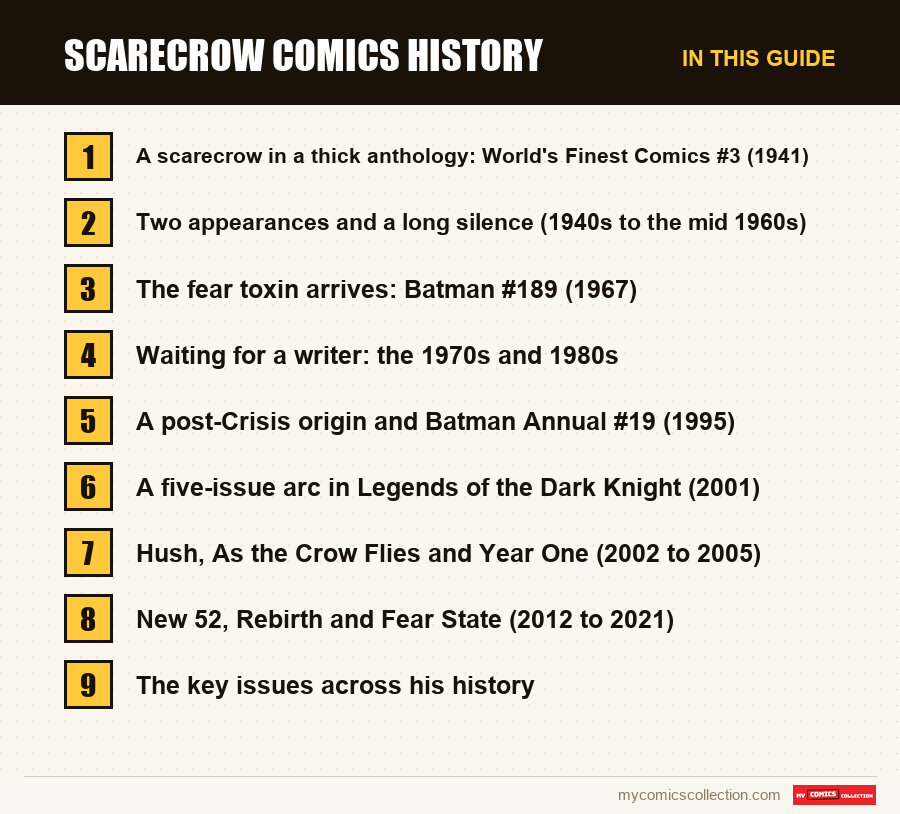
A five-issue arc in Legends of the Dark Knight (2001)
The next major step is a five-issue arc. Five consecutive numbers, Legends of the Dark Knight #137 through #141 (January to May 2001), tell "Terror," and Hugo Strange recruits Crane. Doug Moench wrote it, Paul Gulacy penciled it and Jimmy Palmiotti inked it. Moench is the writer of the 1995 annual as well, so these two books form a small, coherent Moench strand inside the Scarecrow's history.
Why does this arc belong in the timeline? Because it shows the Scarecrow sustaining a multi-issue narrative as the focus rather than a guest. The 1960s revival gave him a device, the 1995 annual gave him a past, and the 2001 arc shows that the combination can carry a serial story. It is also a useful case study for readers who like the character in long form: Legends of the Dark Knight was the book in which writers could tell self-contained Batman stories outside the main continuity flow, which suits a villain whose appeal is atmosphere.
Hush, As the Crow Flies and Year One (2002 to 2005)
In the Batman: Hush storyline the Scarecrow appears as one of the villains working with the Riddler and Hush, which places him in a team of Gotham's best known adversaries. The period is a useful reminder that the character is rarely a lone operator in the mainstream books; he is part of the ensemble of enemies that rotate through Gotham. The Riddler's own arc is traced in our Riddler comics history, and reading the two together shows how the same 2000s ensemble stories used different rogues for different jobs.
Batman #627, the "As the Crow Flies" story dated July 2004, is the stranger entry. In it the Penguin hires the Scarecrow under false pretenses, and Dr. Linda Friitawa mutates him into the Scarebeast. It is worth knowing as a transformation story in which the character's body, rather than just his toxin, is the weapon, and it sits apart from the more psychological issues around it.
Then, in July and August 2005, Year One: Batman/Scarecrow #1 and #2 (Bruce Jones as writer, Sean Murphy as artist) revisit Crane's early days and reveal his fear of bats. A Year One miniseries is a signal that a character has become important enough to receive an origin retelling of his own, and that signal is the real significance of the project in this timeline. The Penguin has a comparable path through the same decades, which you can compare in the Penguin comics history.
New 52, Rebirth and Fear State (2012 to 2021)
The 2011 relaunch rebuilds the origin again. In Batman: The Dark Knight volume 2, issue #4 of February 2012 marks his New 52 arrival, with David Finch and Paul Jenkins credited as writers, and #4 to #7 carry the retold origin through May. Issue #10 then opens a six-issue arc by Gregg Hurwitz. A reboot needs a fresh Crane on the shelf, and this series supplied one at once.
Crane turns up in the "Death of the Family" crossover through Batman volume 2 #16 (March 2013). The September 2013 issue Detective Comics volume 2 #23.3 is a villain-month tie-in under the title The Scarecrow #1. In the Rebirth period he shows up in Batman volume 3 Annual #1, Green Lanterns #16, Doomsday Clock #6 (July 2018) and Shazam! volume 3 #12, a spread that shows the character moving through lines far from Gotham.
The most recent step in the record is the Fear State crossover, where a redesigned Crane is the main foe, with Batman: Fear State: Alpha #1 as the entry point, and Infinite Frontier #0 (March 2021) shows him in art by Jorge Jiménez and Tomeu Morey. In the Absolute Batman line the Scarecrow is a scientist at Ark M with a flock of crows. Each of these is a new answer to the same question that Fox posed in 1967: what does a man who studies fear look like in the current decade?
The key issues across his history
- World's Finest Comics #3 (1941): the debut, by Bill Finger and Sheldon Moldoff.
- Batman #189 (1967): Gardner Fox revives the Scarecrow and introduces the fear toxin.
- Detective Comics #571 (1987): art by Alan Davis, Paul Neary and Adrienne Roy during the post-reboot rebuild.
- Batman Annual #19 (1995): "Scarecrow: Masters of Fear," by Doug Moench, Bret Blevins and Mike Manley.
- Issues 137 to 141 of Legends of the Dark Knight, published in 2001: the Moench-written "Terror" story, penciled by Gulacy.
- Batman #627 (2004): "As the Crow Flies," the Scarebeast story.
- Year One: Batman/Scarecrow #1 and #2 (2005): Bruce Jones and Sean Murphy.
- Batman: The Dark Knight volume 2 #4 (2012): the first New 52 appearance.
How to follow the Scarecrow as a collector
Start with the structure of the run. The 1941 debut sits in an anthology, so search the series name World's Finest Comics and not only the Batman titles. The 1967 revival is in Batman #189, which is a different catalog entry with a different market. Treat these as two separate collecting targets and do not assume that one covers the other.
For the modern character, assemble by creative thread rather than by calendar. The Moench thread is the 1995 annual and the 2001 Legends of the Dark Knight arc. The Year One thread is the 2005 miniseries. The New 52 thread begins with Batman: The Dark Knight volume 2. Because the Scarecrow often appears in volumes labeled "volume 2" or "volume 3," check volume numbers and cover years when you match your copy to a catalog entry, since the same issue number repeats across relaunches. Newcomers can pair this timeline with the reading order for the Scarecrow, and the Batman key issues list shows where his books sit among the rest of Gotham.
Finally, keep the difference between a villain-month tie-in and a main series straight. Detective Comics volume 2 #23.3 is numbered as a decimal issue and is labeled The Scarecrow #1 on its cover, which is a classic source of mismatched records. Note the series, the volume and the cover year together and the entry will survive any later renumbering.
Frequently asked questions
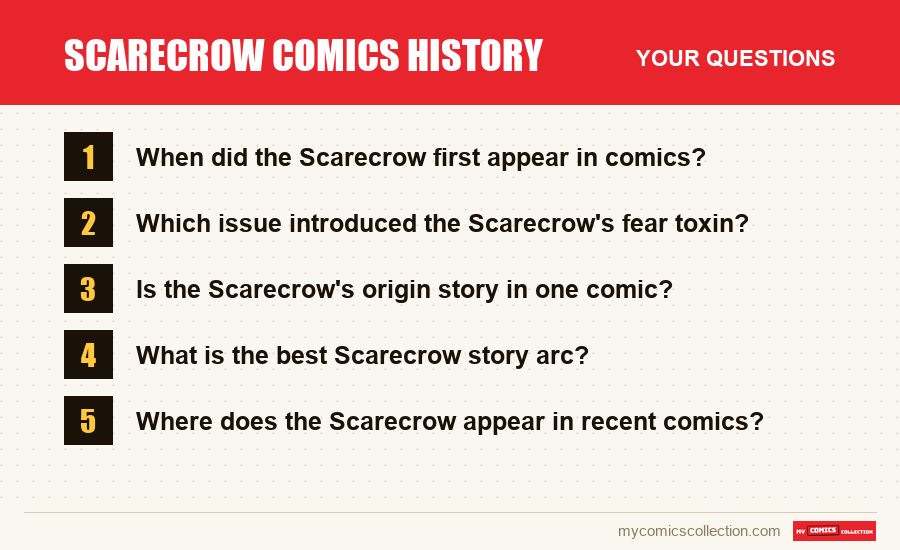
Crane's first page is World's Finest Comics #3, with a September 1941 date. Bill Finger and Sheldon Moldoff are credited as his creators, and the debut art is credited to Jerry Robinson. He makes only two appearances in the 1940s, so the modern character really dates from the 1967 revival.
In Batman #189 (1967), Gardner Fox writes the revival and brings in the fear toxin, drawn then as a bag of dust. It is the issue that turns him from a costume villain into the character defined by fear as a weapon.
Not in one place. The post-reboot origin grows over several books, and Batman Annual #19 (1995) by Doug Moench, Bret Blevins and Mike Manley is a strong single-issue statement of it. Year One: Batman/Scarecrow (2005) and the New 52 Batman: The Dark Knight volume 2 arc retell it again.
A self-contained pick is the five-part "Terror" arc from 2001 in Legends of the Dark Knight, issues #137 to #141, with Moench, Gulacy and Palmiotti on the creative team. For Crane's early days and his fear of bats, Year One: Batman/Scarecrow #1 and #2 (2005) is the dedicated miniseries.
A redesigned Crane is the main antagonist of the Fear State crossover, with Batman: Fear State: Alpha #1 as the entry point. Earlier, the New 52 gave him Batman: The Dark Knight volume 2 (2012) and a villain-month issue, Detective Comics volume 2 #23.3 (2013).
If you hold a Scarecrow issue from 1941 to today, check the series, volume and cover year before you estimate it.
Estimate my comic