
In short
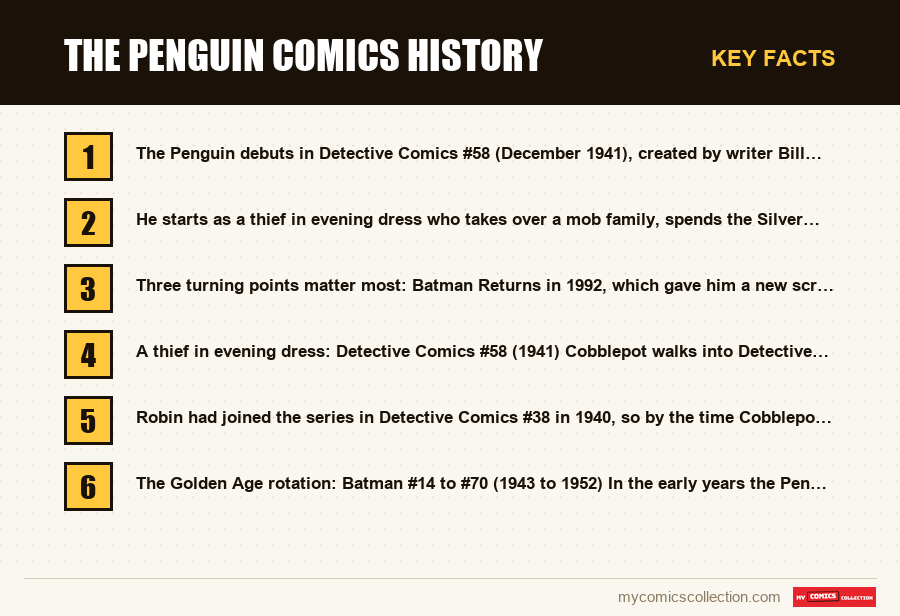
The Penguin debuts in Detective Comics #58 (December 1941), created by writer Bill Finger and artist Bob Kane. He starts as a thief in evening dress who takes over a mob family, spends the Silver Age as a gimmick villain, and is rebuilt after the 1985 reboot by Alan Grant and Norm Breyfogle. Three turning points matter most: Batman Returns in 1992, which gave him a new screen look, Gregg Hurwitz and Symon Kudranski's Pain and Prejudice (2011 to 2012), and Tom King's 2023 solo series.
Oswald Cobblepot is the Gotham villain who wants to be respected rather than feared. That ambition has kept him in print for more than eight decades, through eras that treated him as a gangster, a joke, a monster and a businessman. Following him in order is a useful way to see how a single character can be rewritten without ever losing his umbrella.
Each date and credit in this timeline was confirmed first, and an issue's creators are left out when they could not be confirmed. The reading of what every era does to Cobblepot is our own interpretation, with no panels or lines quoted.
A thief in evening dress: Detective Comics #58 (1941)
Cobblepot walks into Detective Comics #58 (December 1941) with Bill Finger as writer and Bob Kane credited as artist, the duo who launched Batman in 1939. Robin had joined the series in Detective Comics #38 in 1940, so by the time Cobblepot arrives the Dynamic Duo is an established team.
The debut story is built around a method of theft. Cobblepot steals paintings and hides the rolled canvases in the handle of his umbrella, which gives him a prop and a signature in the same stroke. The stolen goods buy him a place inside a mob family, the boss is killed, and Cobblepot takes over the mob. Batman ends up framed for the theft of a statue that Cobblepot already owned. He arrives, in short, as a climber who sees crime as a career.
The look came from two sources. Kane pointed to a cigarette brand's mascot, a penguin with a top hat and a cane; Finger pointed to formally dressed society men who put him in mind of emperor penguins. One account explains the silhouette and the other explains the idea of a man in white tie as a predator. Either way, the character is complete at birth, which is why the first-appearance guide treats the issue as a birth certificate rather than a rough draft.
The Golden Age rotation: Batman #14 to #70 (1943 to 1952)
In the early years the Penguin is a regular in the new Batman series. In Batman #14 (January 1943) Batman goes undercover as "Bad News Brewster" to investigate the Penguin's heists. In Batman #17 (July 1943) the villain turns to gimmick guns and fishing poles, and Batman defeats him with an umbrella. Batman #25 (October 1944) carries "Knights of Knavery," a Penguin and Joker team-up. In Batman #70 (April 1952) he is out on parole, runs an umbrella company and attempts an umbrella-themed theft on Oasis Beach Island.
What changes in this period is the tone of the crimes. The 1941 character is a skilled thief and mob planner; the stories that follow make him less violent and more fixated on birds and umbrellas. The gimmick becomes the point, a pattern shared by many Gotham rogues of the 1940s, and the Penguin's identity shifts from a ruthless mob boss to a crime-by-theme specialist whose weapons can be inspected like a toy catalog.
The team-up in Batman #25 is also an early sign of a habit that lasts: Gotham's villains are portrayed as a society with its own alliances, and the Penguin is a natural member of it. To see how other classic rogues were introduced in the same stretch of Detective Comics, the villain first-appearances guide places them side by side.
The Silver Age Penguin and the television effect (1956 to 1968)
Batman #99 (April 1956) is "The Golden Eggs," a separate Penguin story and not a retelling of the debut. Batman #155 (May 1963) is "The Return of the Penguin," followed by Batman #169 (February 1965). He also crosses into other titles, appearing in Justice League of America #40 (November 1965) and #61 (March 1968).
The 1960s Batman television series, with Burgess Meredith as the Penguin, brought the character to a mass audience, and the comics of the period reflect that popularity. The later Silver Age issues, among them Batman #190 (March 1967), "The Penguin Takes a Flyer into the Future," and Batman #191 (May 1967), "The Day Batman Sold Out," are the kind of colorful, high-concept stories that match the television tone.
The effect on the character is the thing to note. The television version fixed an image of the Penguin as a comic aristocrat, and every serious writer after the 1960s is, in some way, either keeping that image or arguing with it.
The Bronze Age: emperors, origins and a resurrection (1974 to 1986)
The 1970s bring a harder edge. Batman #257 (July to August 1974) carries "Hail Emperor Penguin," and Detective Comics #472 to #474 (1977) run "I am the Batman," "The Malay Penguin" and "The Deadshot Ricochet." The Detective Comics run is a good stretch to read if you want to see how the series of the late 1970s used a Penguin story as part of a larger arc.
Best of DC #10 (March 1981) carries "The Origin of the Penguin," which retells his background. It is not the 1941 debut, a distinction collectors should keep in mind, since listings that say "Penguin origin" can refer to several different books. The same period includes Detective Comics #526 (May 1983), Batman #374 (August 1984), the 1985 appearances in Crisis on Infinite Earths #5 and #9, and Batman #400 (October 1986), "Resurrection Night!"
What changes for the character is that the Penguin is given a past of his own. After forty years of costume and gimmick, a writer is finally asked to explain who Cobblepot was before the umbrella, and that question drives the next era.
Rebuilt after the reboot: Alan Grant and Norm Breyfogle (1989 to 1995)
After Crisis on Infinite Earths reorganized DC's continuity, writer Alan Grant and artist Norm Breyfogle brought the Penguin back as a more menacing figure. Grant had already written another origin treatment, "The Killing Peck," in Secret Origins Special #1 (August 1989), with a cover by Brian Bolland. The Mortimer Kadaver story runs in Detective Comics #610 to #611 (January to February 1990).
The decade's most lasting addition to the setting arrives in Detective Comics #683 (March 1995), where the Iceberg Lounge is introduced. A nightclub is the perfect symbol for the character. It gives Cobblepot a legitimate front, a place where Gotham's powerful people sit beside criminals, and a reason for Batman to visit him as a source rather than as a prisoner. From this point on the Penguin is as much a hub in Gotham's social map as a villain with a plan.
This is the version of the character that later writers inherit: a crime boss who owns a club, trades in information, and is dangerous in proportion to how polite he sounds.
Batman Returns, Penguin Triumphant and the two faces of Cobblepot (1992)
In 1992 Tim Burton's Batman Returns presents Danny DeVito's Penguin with flipper-like hands from syndactyly, which, combined with a beak-like nose, make him look like a cross between a penguin and a man. That is a long way from the gentleman thief in white tie of 1941 and from the comic aristocrat of the 1960s television series. The film's influence on the cartoon of the same decade is discussed on the page about Batman: The Animated Series versus the comics.
Also in 1992 comes the one-shot Batman: Penguin Triumphant, whose title alone points to the other side of the character: not the monster of the film but the climber who wants to win and be accepted, a version closer to the one in the original comics.
The result is a split that lasts. For readers, Cobblepot can be a grotesque outsider or a polished social climber, and the best later stories are the ones that hold both ideas at once.
Do you collect this series?
Track what you own, what you are missing and what your collection is worth. 7-day trial.
Start my trial →
From Gotham Underground to Pain and Prejudice (2008 to 2013)
In Gotham Underground #9 (August 2008) the Penguin fights a gang war against Tobias Whale, Intergang and the New Rogues, and Batman eventually persuades him to become an informant. It is a revealing role reversal: the villain becomes a resource instead of a target.
The most important character study of the period is Penguin: Pain and Prejudice, a five-issue limited series published monthly from December 2011 to April 2012, written by Gregg Hurwitz with art by Symon Kudranski, colors by John Kalisz and lettering by Rob Leigh. Its focus is Cobblepot the person more than Cobblepot the criminal, and Batman hovers at the edges.
The new continuity of the same years sends him in a different direction. In Detective Comics vol. 2 #15 (February 2013), part of "Death of the Family," Ignatius Ogilvy takes over as "Emperor Penguin." In issue #19 (June 2013) Cobblepot is acquitted, Forever Evil #1 (November 2013) has him join the Secret Society, and Detective Comics vol. 2 #23.3 (November 2013) makes him mayor of Gotham.
Their Dark Designs to the Tom King series (2020 to today)
In the Rebirth era the Penguin returns to Batman's own title in Batman vol. 3 #86 to #94 (March to September 2020), the storyline "Their Dark Designs." In Batman #125 to #127 (September to November 2022), "Failsafe," he fakes his own death and retires to Metropolis, a secret that Catwoman gradually uncovers. The One Bad Day line of one-shots, which gave the Riddler a revised origin in 2022, also includes Batman: One Bad Day: The Penguin.
The most recent step is a solo series announced by DC in March 2023 for its Dawn of DC initiative, written by Tom King with art by Rafael de Latorre. It arrives after "Failsafe" has left Cobblepot retired in Metropolis, and that situation reverses the old formula: the man who wanted to own Gotham has tried to leave it, and a title of his own lets a writer ask whether he can.
Alternate Penguins that matter
Several versions outside the main continuity are worth knowing. Batman: Earth One (July 2012) makes him the corrupt mayor of Gotham, who is killed by Alfred Pennyworth. Flashpoint: Batman, Knight of Vengeance #1 (June 2011) presents a security professional at Wayne Enterprises who is also an informant for Thomas Wayne. Batman: The Doom That Came to Gotham imagines a wealthy explorer who abandons his Antarctic expedition to live with penguins, and in Absolute Batman #12 (2025) he is a childhood friend of Bruce Wayne, deformed in an attack by Bane.
These alternates are useful as a test. Each one takes a single trait from the main character, ambition, informant status or wealth, and makes it the whole story, which shows what writers believe to be essential about Cobblepot.
The key issues across the Penguin's history
- Detective Comics #58 (1941): the debut by Bill Finger and Bob Kane, with the umbrella handle and the mob takeover.
- Batman #25 (1944): the "Knights of Knavery" team-up of the Penguin and the Joker.
- Batman #155 (1963): "The Return of the Penguin," a Silver Age revival.
- Best of DC #10 (1981): "The Origin of the Penguin," a retelling that is not the debut.
- Secret Origins Special #1 (1989): "The Killing Peck" by Alan Grant, with a Brian Bolland cover.
- Detective Comics #683 (1995): the Iceberg Lounge is introduced.
- Penguin: Pain and Prejudice #1 (2011): Gregg Hurwitz and Symon Kudranski begin the five-issue character study.
- The Penguin #1 (2023): Tom King and Rafael de Latorre open the solo series.
How to follow the Penguin in a collection
Start by separating the debut from the retellings. Most readers meet the fragile 1941 book through archive collections. Best of DC #10 and Secret Origins Special #1 look like debuts in a listing but are later retellings, so check the cover date and series title before buying.
After that, build around the stories that changed him: the Grant and Breyfogle run in Detective Comics, Penguin Triumphant as a single issue, Pain and Prejudice in its collected edition, and the 2023 series in single issues or collections. Watch the volume numbers: the 2011 relaunch of Detective Comics is a second volume with its own numbering, and the 2013 issues listed above belong to it. For the parent title's numbering, see the Detective Comics collecting guide.
Frequently asked questions
The debut of Oswald Cobblepot is Detective Comics #58, dated December 1941; the writer is Bill Finger and the credited artist is Bob Kane. Oswald Cobblepot enters as a thief who hides stolen paintings in his umbrella, joins a mob family and then takes it over.
Writer Bill Finger and artist Bob Kane created the Penguin in Detective Comics #58 (1941). Kane said the look came from a cigarette brand mascot, a penguin in a top hat. Finger recalled men in tuxedos looking like emperor penguins, and the two accounts together explain the character.
Tim Burton's 1992 film showed Danny DeVito's Penguin with flipper-like hands from syndactyly and a beak-like nose, so that he looks like a cross between a penguin and a man. It set a grotesque screen image beside the top-hat gentleman of 1941 and the comic aristocrat that Burgess Meredith played in the 1960s.
Penguin: Pain and Prejudice, a five-issue series from December 2011 to April 2012, is written by Gregg Hurwitz with art by Symon Kudranski. It follows Oswald Cobblepot's path with Batman mostly in the background, which makes it a self-contained starting point for new readers.
Yes. Tom King and Rafael de Latorre produced a Penguin solo series for DC's Dawn of DC initiative, announced in March 2023. It comes after the "Failsafe" arc of Batman vol. 3 #125 to #127 (2022), in which Oswald Cobblepot fakes his death and retires to Metropolis, so the series starts from a boss who has left Gotham behind.
Holding a Penguin key issue such as Detective Comics #58 or Batman #155? Get an estimate of your copy before you decide what to keep.
Estimate my comic