
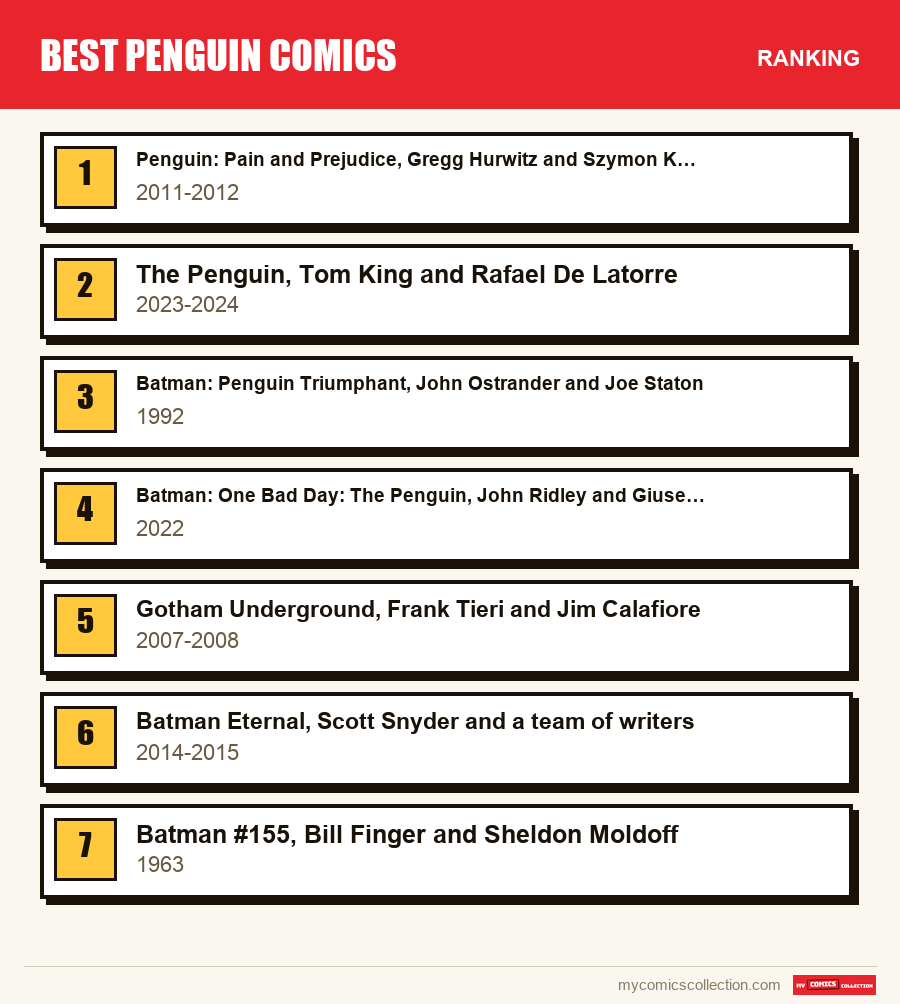
For the best Penguin comics and where to start, read Penguin: Pain and Prejudice (2011-2012) by Gregg Hurwitz and Szymon Kudranski first, the most complete portrait of Oswald Cobblepot in five issues. Follow it with Tom King and Rafael De Latorre's The Penguin series (2023-2024). The character is born in the key issue Detective Comics #58 (December 1941), by Bill Finger and Bob Kane.
The Penguin is one of Batman's hardest enemies to write. He does not want to destroy Gotham: he wants to own it, to frequent it, to be respected in it. The best stories about him therefore revolve around a man who dreams of belonging, who runs a club rather than an arsenal, and whose politeness covers an everyday violence.
As always in this guide, we only state verified facts (creators, issue numbers, dates); the analysis is our own, with no reproduction of protected art or dialogue.
His first appearance
The Penguin appears in Detective Comics #58, dated December 1941. According to reference sources, Bill Finger wrote the story and Bob Kane did the art; it is the team that created Batman in 1939. Oswald Cobblepot is already a gentleman of crime there: short, stout, wearing a top hat, armed with an umbrella that is not what it seems. That visual choice, an evil-doer in evening dress rather than a hulking figure in costume, sets him apart from the other adversaries of the time right away.
This issue belongs to the period when Detective Comics was piling up foundational first appearances, and it is better understood by placing it in the parent series: our Detective Comics collecting guide describes how to approach this series, issue by issue. For a reader mainly interested in the character, there is no need to hunt down the original copy: the story exists in an archive collection, and the stakes of the issue lie less in its plot than in its role as a birth certificate. Screen adaptations, notably the 1992 version covered in our page on Batman Returns versus the comics, later shifted the character's image, which explains why so many readers come to the comics with an idea far removed from the 1941 model.
1: Penguin: Pain and Prejudice, Gregg Hurwitz and Szymon Kudranski (2011-2012)
This five-issue miniseries is written by Gregg Hurwitz, with Szymon Kudranski on art, John Kalisz on colors and Rob Leigh on lettering. It revisits Oswald Cobblepot's path by focusing on the man rather than the criminal, and that is what makes it the best entry point: you understand what the character is looking for, and why he made cruelty into a language. Kudranski's line sets up a stifling atmosphere, far from the tone of the period stories.
Nothing to read beforehand: the story is self-contained, the city serves as a backdrop and Batman stays largely off-panel. The simplest way to read it is the collected edition, which gathers the five issues; sources indicate that it adds the one-shot Joker's Asylum: Penguin. Publication dates vary from one database to another, which is common for miniseries published over several months straddling two years.
2: The Penguin, Tom King and Rafael De Latorre (2023-2024)
This ongoing series, launched in August 2023, jumps several years into the character's future. Oswald Cobblepot lives in Metropolis, engaged to a veterinarian, and leads a quiet existence until an agent approaches him on behalf of Amanda Waller: he must rebuild his criminal empire for her, or pay the price. The creative team brings together Tom King on script, Rafael De Latorre on art, Marcel Maiolo on colors and Clayton Cowles on lettering.
It is the most recent series devoted to the Penguin, and the easiest to find right now. It suits readers who like carefully built stories and constrained antiheroes, and it is best read after Pain and Prejudice, whose idea of a man trapped in his own persona it extends. This writer's other series are gathered on the Tom King page. The single issues from August 2023 onward are easy to find; collected editions are the natural format for continuous reading.
3: Batman: Penguin Triumphant, John Ostrander and Joe Staton (1992)
This one-shot dated July 1992 is written by John Ostrander, drawn by Joe Staton and inked by Bob Smith. The Penguin decides to become a respectable businessman, sets his sights on Wall Street and takes on a rival of some stature: Bruce Wayne. Tim Burton's film Batman Returns comes out the same year: 1992 is thus a pivotal date for the character's image.
This issue is a read for people who already know Gotham. It gives the character his entrepreneur side, which most action stories neglect, and offers a confrontation played out in a boardroom rather than at the end of an alley. Its form, a single issue, makes for a quick read: plan on an evening. You can find it as a stand-alone single issue or in a collection devoted to Batman's enemies; flip through Joe Staton's art before deciding whether to give it a place.
4: Batman: One Bad Day: The Penguin, John Ridley and Giuseppe Camuncoli (2022)
In the One Bad Day one-shot line, each issue takes a major Batman adversary at the moment his day goes wrong. The Penguin's, released in October 2022, is written by John Ridley and drawn by Giuseppe Camuncoli, with finishes by Cam Smith. A former associate, the Umbrella Man, has seized the Penguin's empire and the Iceberg Lounge, and swept aside the rules his boss had imposed on the underworld. The weakened Penguin must cross a city that has become dangerous with a weapon and a single bullet to rebuild a crew.
It is a story of downfall and reconquest, dense, which reads in a single volume and without prior knowledge. It will please those who prefer an urban thriller to fantasy, and it shows the Penguin from a rare angle: that of a boss who has to win everything back by sheer effort. A single format, so no dilemma between single issue and collected edition: choose according to the object you want to own.
Do you collect this series?
Track what you own, what you are missing and what your collection is worth. 7-day trial.
Start my trial →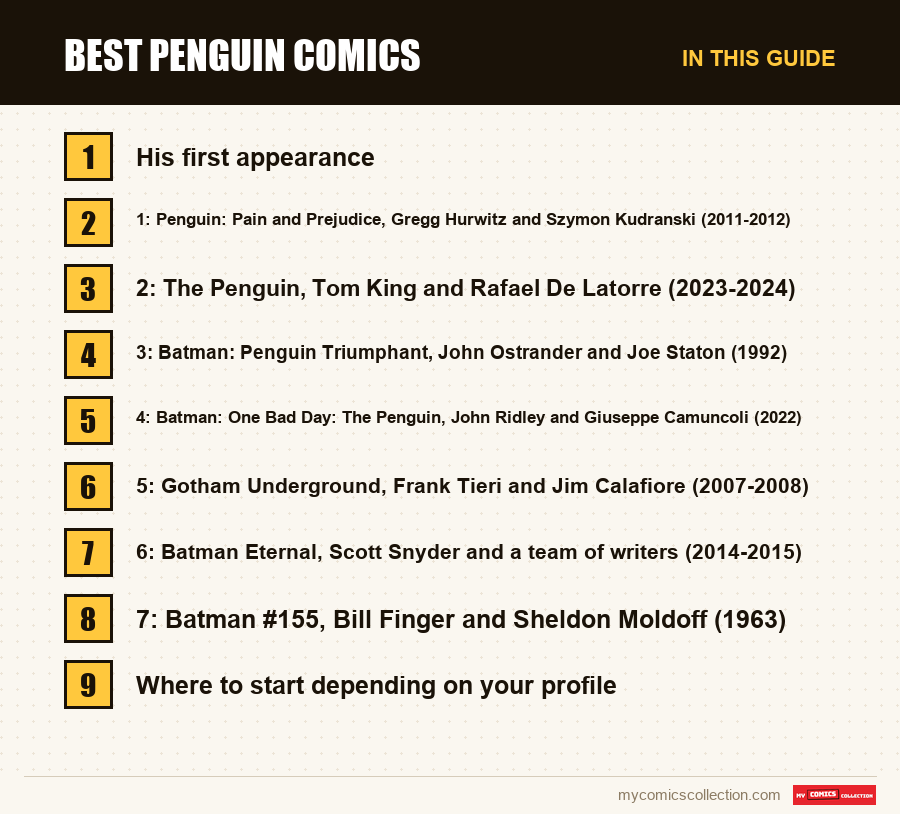
5: Gotham Underground, Frank Tieri and Jim Calafiore (2007-2008)
This miniseries, written by Frank Tieri and drawn by Jim Calafiore, inked by Jack Purcell, puts the Penguin at the center of a citywide power game. His club serves to steer supercriminals toward the Suicide Squad, which abducts them to send them to a labor camp on another planet, while Batman, largely in the background, investigates under the identity of Matches Malone. Intergang, Tobias Whale and the Riddler fight over the ground in a gang war.
The Penguin appears here as a broker more than a fighter, and that is the facet this entry illustrates best: a man whose power lies in his address book. The miniseries is aimed at a reader already comfortable with the DC universe, since it parades many characters; reader opinions are divided on this point. It reads in a collected edition, its issues following one another like an ensemble serial.
6: Batman Eternal, Scott Snyder and a team of writers (2014-2015)
A weekly of fifty-two issues, Batman Eternal runs from April 2014 to April 2015 for Batman's seventy-fifth anniversary. Scott Snyder is the "showrunner," with James Tynion IV, Ray Fawkes, Tim Seeley and other writers on script, and Jason Fabok on art at the start. The Penguin and the Iceberg Lounge feature in the main plot: in #7, Carmine Falcone blows up the club and sinks it into Gotham Bay, which ends, at least in appearance, the Penguin's empire; in #14, he goes after Falcone's hideout, but the operation fails.
To be honest, this is not a story centered on him, and the credits vary from one arc to the next. But it is the best illustration of what the Penguin becomes when he loses his setting, and it is an ideal read for anyone who wants to see how a supporting character fares in a large ensemble saga. Since the writers each wrote their own arcs, check the credits issue by issue if the detail matters to you. A multi-volume collected edition exists for continuous reading.
7: Batman #155, Bill Finger and Sheldon Moldoff (1963)
After several years' absence, the Penguin returns in Batman #155, dated May 1963, with the story "The Return of the Penguin." Reference indexes credit Bill Finger with the script and Sheldon Moldoff with the art, the latter then signing as Bob Kane; the editing is by Jack Schiff. It is the first appearance of the Silver Age Penguin, the one television would take up a few years later.
This entry is aimed first at historians of the medium and at single-issue collectors more than at readers looking for a great story. The read is pleasant but dated, with the tone of the adventures of the time. As with any older issue, read it first in an archive edition, then decide whether the original single issue is worth a search. To place this period of the hero, our page on Batman #404, Year One offers the counterpoint of the realistic Gotham of the 1980s.
Where to start depending on your profile
If you only know Oswald Cobblepot from the screen, for example from the 2022 film, start with Pain and Prejudice: it is the read that best explains the character without requiring other reading. If you are a longtime Batman reader, go straight to Tom King and Rafael De Latorre's The Penguin, then go back to Gotham Underground to measure what the character has become in the shadows.
For a short story, Penguin Triumphant and the One Bad Day one-shot each fit in a single issue, in two opposite registers: finance on one side, street survival on the other. For an ensemble saga, open Batman Eternal. Finally, if you are building a historical path, read Detective Comics #58 and Batman #155 in archive editions: you will have the two founding versions of the character, the 1941 one and the 1963 one.
The key issues to know
The first appearance, Detective Comics #58 (December 1941), is the obvious anchor point. It sits in a series whose reputation lifts every Golden Age issue: the copy is rare, and condition matters more than the mention of the year. The second landmark, Batman #155 (May 1963), is the character's return in the Silver Age, and it reads as his second birth. To appreciate these two keys, always check that the issue matches the story advertised and not a reprint.
Next come reading landmarks more than rarity ones: the one-shot Penguin Triumphant (July 1992), the first issue of Penguin: Pain and Prejudice, the one of The Penguin (August 2023) and #7 of Batman Eternal, where the Iceberg Lounge disappears into the bay. These recent single issues are easy to find; their interest lies first in the reading. Our method stays the same: identify what the issue brings to the character, check whether several covers or printings exist, then compare copies in the same condition.
A collector building a themed set around the Penguin can put together a simple path: an archive collection for the 1941 and 1963 beginnings, a 1990s single issue for the period of the film, a 2010s miniseries and the most recent series. That set covers more than eighty years of publication without any exceptional purchase and tells the story of a character who went from eccentric gentleman to boss of an underground empire. If one of your copies intrigues you, our free valuation tool can give you a first read on it.
Frequently asked questions
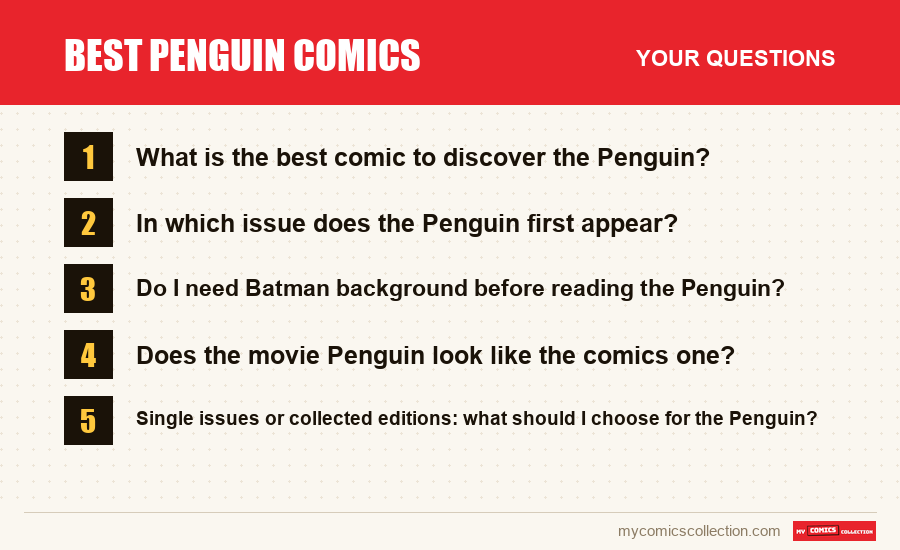
Penguin: Pain and Prejudice (2011-2012), written by Gregg Hurwitz and drawn by Szymon Kudranski, is the most accessible: five self-contained issues centered on Oswald Cobblepot himself. For a more recent take, Tom King and Rafael De Latorre's The Penguin series (2023-2024) follows on naturally.
In Detective Comics #58, dated December 1941, credited to Bill Finger and Bob Kane. The character is already a gentleman of crime with a booby-trapped umbrella. The story is available in an archive collection, far more affordable than the period single issue, which is rare and fragile.
Not always. Pain and Prejudice and the One Bad Day one-shot read on their own. Gotham Underground and Batman Eternal are best approached with a few Batman reads under your belt, since they parade many characters and assume a minimum of familiarity with Gotham.
Only in part. The 1992 film imposed a deformed version raised in the sewers, absent from the original character, who is a gentleman of crime. To find the comics Penguin, turn to Pain and Prejudice or to Tom King's series, which are more faithful to his social side.
For reading, collected editions are almost always enough: Pain and Prejudice, Gotham Underground and Batman Eternal exist in volumes. On the collecting side, the single issue is mainly justified for Detective Comics #58 and Batman #155, two issues where the condition of the copy decides the purchase.
Do you own an older Detective Comics or an issue of Batman featuring the Penguin? Get a first read on its condition and its interest.
Value my comic