In short
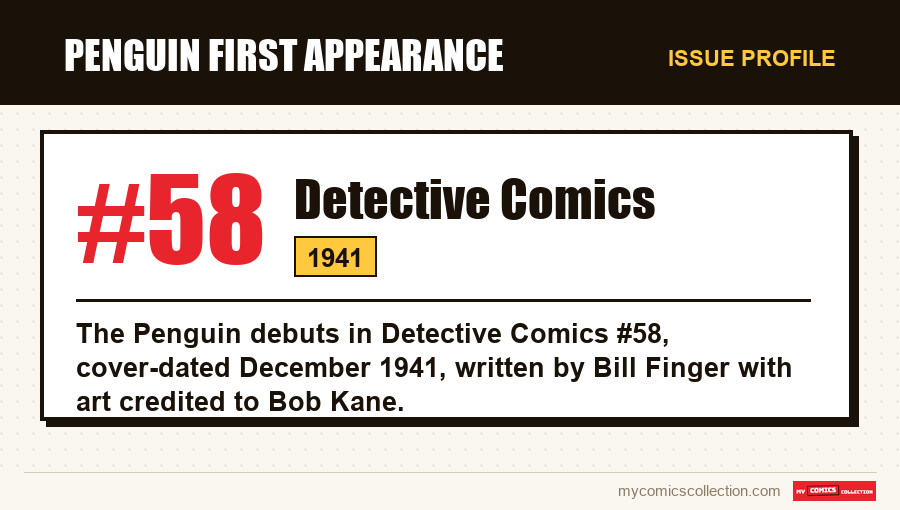
The Penguin debuts in Detective Comics #58, cover-dated December 1941. Writer Bill Finger and credited artist Bob Kane, the pairing behind Batman's 1939 debut, produced the story. In this issue Oswald Cobblepot is a thief in evening dress who hides stolen canvases in an umbrella handle, joins a mob family, then takes it over. The issue sits in the middle of a run of Golden Age Batman debuts, and it is the origin point for one of Gotham's most durable crime bosses.
A villain debut can be easy to describe and hard to hold, and that is the case with Detective Comics #58. The cover date is simple, the creators are named, the character is instantly recognizable, and yet a copy of the issue is a Golden Age book that most collectors will meet only in photographs, in auction listings or in archive volumes.
Finger and Kane's credits, the December 1941 date and each later Penguin story listed here were confirmed in published sources, while the advice on shelving and inspecting a Golden Age copy is ours, with no pages quoted.
Detective Comics #58 at a glance: the issue behind the cover date
Detective Comics #58 carries a December 1941 cover date. The series had begun in March 1937 and was a monthly title through its first several hundred issues, so a book dated December 1941 reached readers a little earlier in the calendar than the date printed on its cover suggests. That habit of forward-dating is why collectors quote the cover date, not a presumed release month, whenever they identify an issue.
The credits that matter for this debut are straightforward. Bill Finger is the writer. Bob Kane is credited as artist. That is the same writer and the same credited artist associated with Batman's own debut in Detective Comics #27 in 1939, which gives issue #58 a kind of continuity: the person who shaped Batman's early voice was still at the typewriter when Gotham's next great criminal arrived. No inker, letterer or colorist is named here for #58, since the sources consulted give none for this 1941 book.
Two other facts help you place the issue. Robin had arrived in Detective Comics #38, dated April 1940, so by the time of #58 Batman was working with Robin as a matter of course. And the series was by then more than four years old, with a settled format: a Batman lead story surrounded by other features from the same publisher. Issue #58 is therefore a Golden Age Batman comic at full cruising speed, not an experimental one.
How Oswald Cobblepot enters Gotham in this issue
The character is introduced by a deed, not by a speech. He appears in Gotham as a skilled thief, and the story describes him as originally known only by his alias. The heist that defines him takes place at an art museum: two priceless paintings are stolen with the canvases rolled up and hidden in the handle of his umbrella. The method matters because it establishes the prop that would follow him for decades.
The stolen goods then serve as a calling card. They buy him a place inside a local mob boss's crime family. He does not stay a junior member for long: the boss is killed and the Penguin takes over the mob. In the same sequence he arranges for Batman and Robin to be framed over a statue that he already owned. That outline, a social climber who treats crime as a business ladder, is the template that later writers kept returning to, from the 1950s through to the modern The Penguin series covered in our best Penguin comics guide.
For a collector, the useful observation is how much of the character is already present. The tailoring, the umbrella with a concealed purpose, the instinct to own a city's institutions rather than burn them: all of it is in the debut, which is why the issue reads as a birth certificate and not as a rough draft.
Where the umbrella and the top hat came from
The origin of the look is documented in two versions that sit comfortably together. Bob Kane said the design was inspired by the mascot of a 1940s cigarette brand: a penguin wearing a top hat and carrying a cane. Bill Finger described a different spark, saying that the sight of high-society gentlemen in tuxedos reminded him of emperor penguins. One account explains the silhouette; the other explains the idea that a man in white tie could be a predator.
There is also a comic-strip comparison on record. The Penguin has been noted as resembling Broadway Bates, a villain from the Dick Tracy strip who was introduced in 1932. It is a useful reminder that Golden Age villains were assembled from a crowded popular culture of newspaper strips, advertising mascots and gangster films, and that the Penguin's originality lies in how the pieces were combined for Batman's world.
For a buyer, this context affects how to describe a copy. Listings sometimes attach grand claims to the issue; the safe description is the factual one. It is the debut of the Penguin, cover-dated December 1941, written by Finger and credited to Kane for the art. Anything beyond that, such as a particular cover artist, a studio assistant's name or a story title, should be treated as an extra that needs its own source before you repeat it.
Why issue #58 became a landmark of Batman's rogues gallery
The importance of the issue is a matter of what followed. Within the same period, Detective Comics was producing a steady supply of Batman antagonists, and the Penguin was one of the few who stayed in the rotation across eras. He was still being written in the 1950s, and he was in the stories of the 1970s and 1980s, each time with a slightly different emphasis. That longevity is a more reliable sign of a key issue than any single sale.
There is a second reason the issue matters, which concerns the shape of Batman collecting. A collector building a Batman run in order usually reaches a fork at the early Detective Comics numbers: some chase the hero's own debut and the arrival of Robin, others follow the villains. Issue #58 belongs to the second path, together with the other Golden Age debuts in our villain first appearances guide. The Penguin has a very clear identity: a single prop, the umbrella, is enough to name him.
It also helps to separate the character from the screen. Film and television versions have given readers an idea of the Penguin that has little to do with the 1941 pages. A collector who buys because of an adaptation should still read the actual debut story, because the issue shows a human criminal with an ordinary ambition, not a grotesque, and that is the version the later best comics build upon.
Do you collect this series?
Track what you own, what you are missing and what your collection is worth. 7-day trial.
Start my trial →
Reprints and the issues people mix up
Reading the Penguin's debut does not require the original comic. Golden Age Batman material has been gathered in archive-style collections many times. The better question for a collector is which later issues retell the Penguin's origin, because these are the books most often confused with the debut.
- Best of DC #10, cover-dated March 1981, contains a story titled "The Origin of the Penguin". It retells his background; it is not the 1941 debut.
- Secret Origins Special #1, cover-dated August 1989, includes "The Killing Peck", another origin treatment from a later generation of writers.
- Batman #99, dated April 1956, features "The Golden Eggs" and is a separate Penguin story, not a retelling of the debut.
The practical advice is to read the cover date and the series title before you pay. A listing that says "Penguin origin" can refer to any of these books. Detective Comics #58, December 1941, is the debut of the character. Our Detective Comics key issues page shows how the same rule applies across the series: always anchor the claim to the issue number.
Inspecting a Detective Comics #58 copy before paying
A Golden Age issue is a physical object first and a historical document second. Start with the completeness of the book: front and back covers attached, the centerfold present, no missing pieces along the edges, and no pages trimmed. Many surviving copies of 1940s comics have been repaired over the years, so ask directly whether a copy has any restoration, and ask the seller to describe it in plain words.
The common forms of restoration are well known. Tears can be sealed, missing corners can be replaced, color can be touched up, spine splits can be glued and the whole book can be pressed or cleaned. Each of these can be acceptable if disclosed and reflected in the price, and each is a problem if concealed. The label color on a professionally graded holder is the quickest signal: a grading company uses a distinct label to flag restoration, so check which label is on the case and read the notes on the certificate.
Next, think about paper. The cheap newsprint of the period darkens and becomes brittle with age, so the description of paper quality is more informative than the number alone. A copy with off-white pages and a flat cover is a different object from one with tanned pages and a rolled spine, even if both are graded. Look at the staples for rust and at the spine for stress lines, and ask for photos of the inside covers and the opening page.
Finally, verify the identity of the book. Because the Penguin has many later origin retellings, confirm the series title, the issue number and the cover date, then compare the cover with a published image. For a high-value Golden Age purchase, a third-party grade with a verified certificate number is a sensible filter, and the choice between a raw copy and a graded one is a matter of your risk tolerance and your ability to assess condition. Use a valuation tool for the comparison with recent sales and keep every amount out of the listing text you save: a number written once goes stale quickly.
Later Penguin appearances worth tracking
When the 1941 book is beyond your reach, these dated stories trace Cobblepot across four decades and are easier to hold:
- Batman #99 (April 1956), "The Golden Eggs": a 1950s Penguin story.
- Batman #257 (July-August 1974), "Hail Emperor Penguin": a 1970s appearance with its own title and tone.
- Detective Comics #473 (November 1977), "The Malay Penguin": a late 1970s story in the series that introduced him.
- Best of DC #10 (March 1981), "The Origin of the Penguin": the retelling mentioned above.
- Batman #400 (October 1986), "Resurrection Night!": a mid-1980s appearance in a milestone-numbered issue.
These are good targets because they are tied to specific titles and dates, so they can be searched and compared without confusion. They also let you see how the creative teams revisited the same idea, a gentleman criminal with an umbrella, over four decades. For the reading order that suits a newcomer, go back to our Penguin reading guide, and for the series as a whole, the Detective Comics collecting guide.
A short plan for a Penguin collection
A sensible plan has three layers. The first is the anchor: the debut, Detective Comics #58, either as a long-term target or as a reading copy in an archive edition. The second is the set of dated later stories above, which cost less and show the character at different points in time. The third is the modern material, which gives the best entry to the character as a person and not only as a collectible.
Whatever route you choose, record each book with its series, issue number, cover date, creators and condition notes. That habit makes it easy to spot duplicates and to avoid buying a retelling when you meant to buy the debut. A catalog entry that says "Penguin origin" tells you very little; one that says Detective Comics #58, December 1941, Finger and Kane, tells you what you own.
Frequently asked questions
It is Detective Comics #58, cover-dated December 1941. Finger is the writer and Kane the credited artist. The issue introduces Oswald Cobblepot as a thief who hides stolen paintings in an umbrella handle before taking over a mob family.
Bill Finger and Bob Kane, the pairing behind Batman's own debut. Kane pointed to a cigarette brand's penguin mascot in a top hat as an inspiration, while Finger said that men in tuxedos reminded him of emperor penguins. Both accounts shaped the final look.
No. Best of DC #10, dated March 1981, contains "The Origin of the Penguin", a retelling of his background. The debut remains Detective Comics #58 from December 1941. The same caution applies to Secret Origins Special #1 from 1989, which holds "The Killing Peck".
Golden Age Batman stories have been gathered in archive-style collections, so a reading copy is easy to find. Check that the volume lists Detective Comics #58 in its contents before you buy, and treat the original comic as a separate, condition-driven collectible.
Confirm that both covers are attached and the centerfold is present, ask about any restoration such as sealed tears, replaced corners or color touch-up, and inspect the staples and spine. On a graded copy, read the label color and the certificate notes, then compare the grade with recent sales.
Own a Golden Age Batman book or a later Penguin story? Get a free estimate based on its issue, cover date and condition.
Estimate my comic