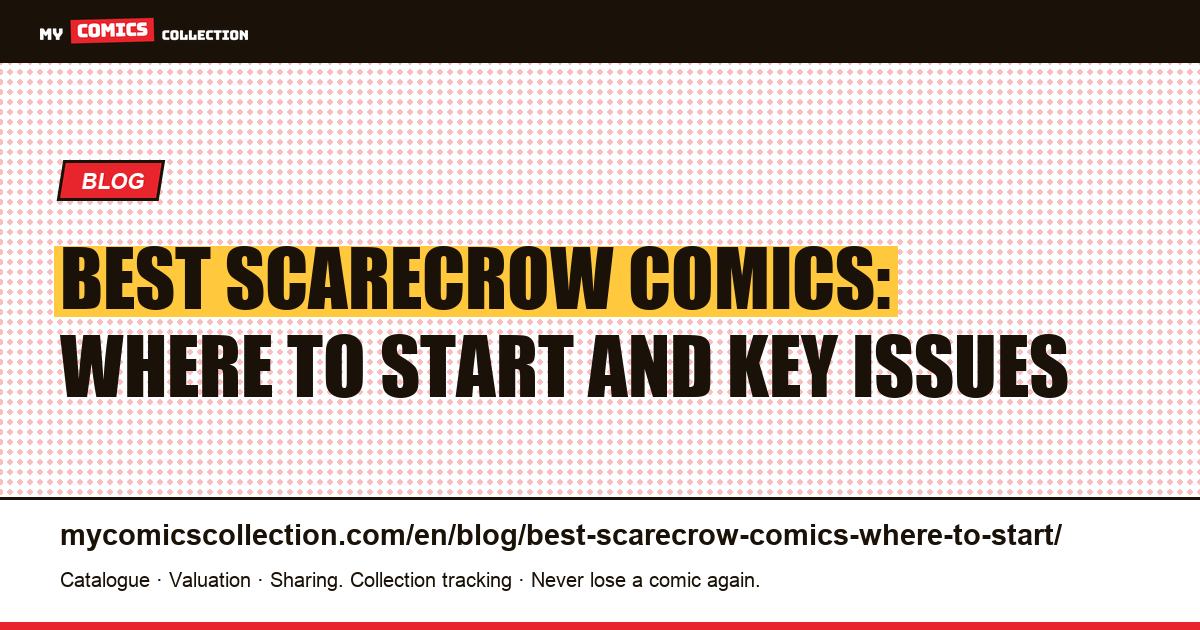
To find the best Scarecrow comics, open Fears (1993) by Jeph Loeb and Tim Sale, then read Year One: Batman/Scarecrow (2005) by Bruce Jones and Sean Murphy for his origin, and James Tynion IV's Fear State (2021) for his most ambitious version. To go back to the source, the character is born in World's Finest Comics #3, in 1941, and his fear toxin appears in Batman #189 (February 1967). Those are the key issues and where to start.
Dr. Jonathan Crane has neither Bane's physical stature nor the Joker's charisma, and that is precisely what makes him singular: he attacks the mind before the body. A psychiatrist who puts his science of phobia at the service of crime, a costume of burlap and rope, a gas that turns everyone's terror against themselves. The good Scarecrow stories are not measured by the number of blows exchanged but by what they make the reader and Batman feel.
As always in this guide, we only state verified facts (creators, issue numbers, dates); the analysis is our own, with no reproduction of protected pages or dialogue.
His first appearance
The Scarecrow makes his debut in World's Finest Comics #3, a 1941 issue published by DC Comics, in a Batman story titled "The Riddle of the Human Scarecrow." Bill Finger wrote the script and the art is credited to Bob Kane. The character is then called Professor Jonathan Crane, a teacher whose taste for fear pushes him outside the university setting. The gangly look, the surname and the first name all recall Washington Irving's Ichabod Crane from the short story, a lineage that historians of the character regularly point out.
For collectors, this World's Finest belongs to the most demanding corner of the Golden Age: brittle period paper, worn covers, coveted copies. For reading, nobody needs to buy it: the story appears in archive collections. The character does not really make himself memorable at this time, since he returns only once in the 1940s. It is another era that gives him his modern identity, that of the 1960s and then the 1990s.
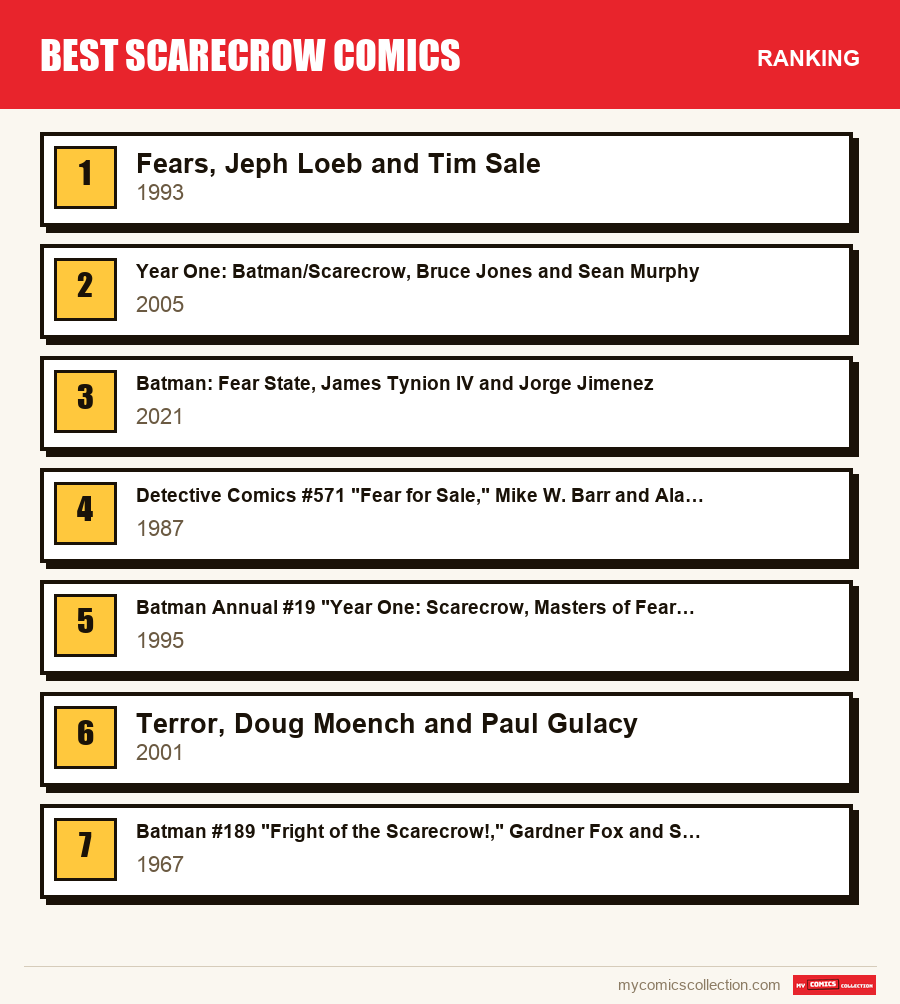
1: Fears, Jeph Loeb and Tim Sale (1993)
The first of the three Halloween specials of Batman: Legends of the Dark Knight comes out in December 1993. Jeph Loeb writes, Tim Sale draws and does the cover. The story puts the Scarecrow on Gotham's trail and forces the Dark Knight into a game of cat and mouse where every shadow can hide a hallucination. The volume is later collected in Batman: Haunted Knight (1996), with the next two installments, devoted to the Mad Hatter (1994) and then a ghost story (1995).
It is the best way in because it is short, self-contained and drawn with a very strong personality: Tim Sale's angular silhouettes give Crane the look of an emaciated specter that has remained a visual reference. It is for anyone who has read no Batman and wants to feel the character without committing to a series. Read it in one sitting, preferably at nightfall, then move on to the second entry to understand where such a man comes from. To continue with the same creators, see our comparison of The Long Halloween with its animated adaptation.
2: Year One: Batman/Scarecrow, Bruce Jones and Sean Murphy (2005)
This two-issue miniseries belongs to the Year One line that DC launched in summer 2005, when the movie Batman Begins came out. Bruce Jones, who was then making his debut at DC after his work on Hulk, writes the story, and Sean Murphy, then a young artist, illustrates it. The story goes back to Jonathan Crane's birth and follows his path up to his first meeting with Batman and Robin.
This is the read that explains the man. It suits anyone who prefers to understand an adversary before seeing him act, and the short format lends itself to a same-evening read. These two issues are collected with the miniseries Two-Face: Year One in a shared volume; if you like the logic of origins, also see our selection devoted to Two-Face. Do not read it first: it is better preceded by Fears, which settles the character in the reader's imagination.
3: Batman: Fear State, James Tynion IV and Jorge Jimenez (2021)
The Fear State crossover runs from August to December 2021. Its core is the arc of the Batman series (third volume), issues #112 to #117, published from September to November 2021: James Tynion IV writes, Jorge Jimenez draws. The prologue, Batman: Fear State - Alpha #1 (August 2021), is drawn by Riccardo Federici, and the epilogue, Omega #1, comes out in December. Several series of the Batman family take part, from Nightwing to Catwoman. The whole is gathered in Batman: Fear State Saga, a hardcover collection released in April 2022.
The Scarecrow becomes the architect of a theory: a society can evolve if it is exposed to extreme fear. This is the most ambitious version of Crane, that of a strategist aiming at the whole city and no longer at a single adversary. It is for the reader who wants a recent, dense, spectacular read and who is willing to commit to a large-scale event. If you have followed the writer's work, see the page devoted to James Tynion IV. Go in the order of the collection rather than that of the single issues, because the tie-ins are spread across many series.
4: Detective Comics #571 "Fear for Sale," Mike W. Barr and Alan Davis (1987)
This February 1987 issue is a short story. Mike W. Barr writes, Alan Davis draws, Paul Neary inks. The starting point is a new formula: Crane's gas strips his victims of the inhibitions of fear, and he uses it to capture Robin, then to put Batman, himself exposed, in trouble.
What makes the story interesting is Alan Davis's elegant line, which gives fear a clean, legible shape. It reads on its own, with no prior knowledge, and it appeals to the fan of modern-age art more than to the prestige hunter. Hold on to it if you like stories where the danger resolves in twenty pages and where fear lodges in a simple mechanism.
Do you collect this series?
Track what you own, what you are missing and what your collection is worth. 7-day trial.
Start my trial →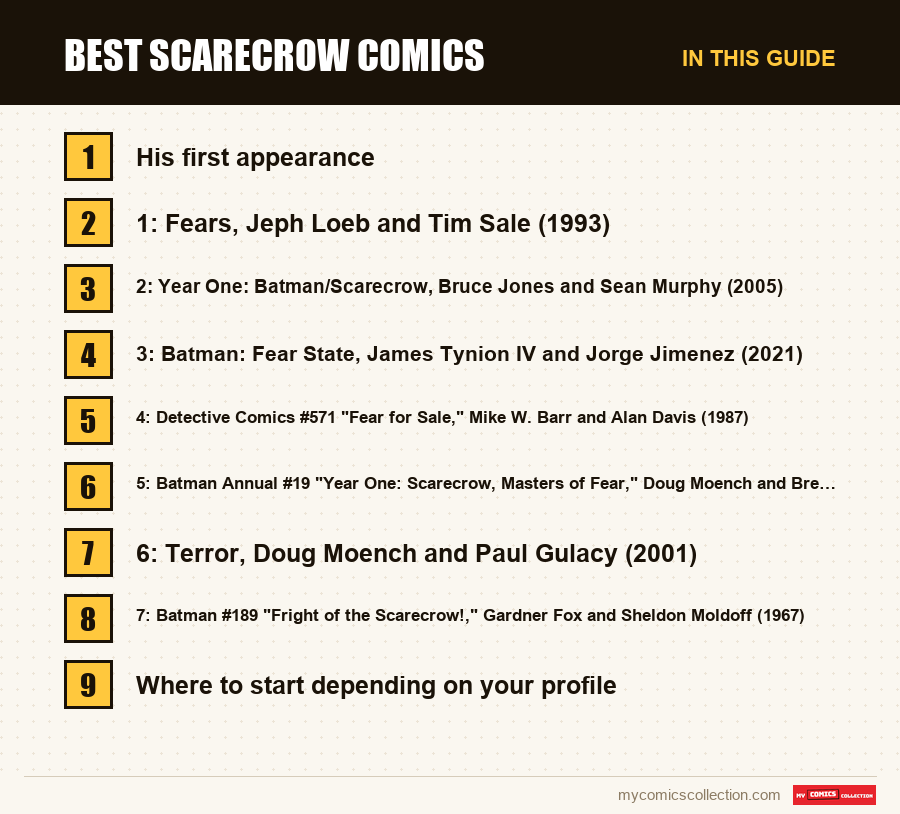
5: Batman Annual #19 "Year One: Scarecrow, Masters of Fear," Doug Moench and Bret Blevins (1995)
This September 1995 annual rereads the first meeting between Batman and the master of fear. Doug Moench writes, Bret Blevins pencils and does the cover, Mike Manley inks, and Stu Chaifetz does the colors. It is part of that year's series of annuals devoted to the beginnings of Batman's adversaries, and it extends Crane's origin.
The format is that of an annual: a thick, standalone issue that you do not find in the regular series. It is for the reader who has already tasted Fears and wants a more classic, more detailed version of the genesis, before comparing with Bruce Jones's version. It can be found in the collection Batman Arkham: Scarecrow, which gathers stories of the character; look for that volume before the original issue.
6: Terror, Doug Moench and Paul Gulacy (2001)
This arc appears in Batman: Legends of the Dark Knight #137 to #141, from January to May 2001. Doug Moench writes, Paul Gulacy draws, Jimmy Palmiotti inks. The Scarecrow teams up with Hugo Strange, who returns for revenge, and the two men hatch a plan based on terror. The story is the sequel to Prey, an earlier arc of the same series, and it is collected under the title Batman: Terror.
Here, the pleasure comes from pairing two deviant psychiatrists, which the collection of these five issues condenses better than reading them in isolation. The arc is for the reader who already knows Strange or who wants to read the two stories back to back; otherwise, it is not essential. Read Prey first if you want to grasp the relationship between the two adversaries, then continue.
7: Batman #189 "Fright of the Scarecrow!," Gardner Fox and Sheldon Moldoff (1967)
Cover-dated February 1967, this issue resurrects the character after two appearances in the 1940s. Gardner Fox writes, Sheldon Moldoff draws. This is where the fear toxin makes its entrance: it is not yet named that, it comes out as a spray and smoke, but it is the weapon that will become Crane's signature.
This story speaks less to the reader looking for fun than to the character's historian, because its tone is very light, a break from modern anxiety. It is for anyone who wants to understand how a minor villain became a classic: the 1967 smoke prepares the gas of the 1980s. Do not put it in your first pile, but keep it as a milestone.
Where to start depending on your profile
If you have never read Batman, take Fears then Year One: Batman/Scarecrow: two short, self-contained reads. If you are coming from the movies, especially Batman Begins, read the 2005 miniseries first, which dates from the same season, then compare with our analysis of the movie vs. the comics. If you follow current Batman news, Fear State is the event to read, in its collection.
If you like psychological crime stories, Terror and Fear for Sale offer two opposite tones, one dark and serialized, the other elegant and compact. If you are curious about the character's history, start in 1941, pass through 1967, then come back down to 1987. And if you want to place these stories within the big Gotham sagas of the 1990s, first browse the key issues of Knightfall, which set the scene for the era.
The key issues to know
Seven landmarks are enough to organize a collection around Jonathan Crane, from 1941 to 2021.
- World's Finest Comics #3 (1941): first appearance of the Scarecrow, script by Bill Finger.
- Batman #189 (February 1967): the character's return and the birth of his fear toxin.
- Detective Comics #571 (February 1987): "Fear for Sale," by Mike W. Barr and Alan Davis.
- Batman: Legends of the Dark Knight Halloween Special #1 (December 1993): the Loeb and Sale story.
- Batman Annual #19 (September 1995): detailed origin by Doug Moench.
- Batman: Legends of the Dark Knight #137 (January 2001): start of the Terror arc.
- Batman: Fear State - Alpha #1 (August 2021): prologue of the event.
For each one, compare completed sales of the same issue in the same condition, set aside bundled lots, then reread the copyright page of the copy on offer. Scarecrow stories read very well in collections; the original issue mainly serves those who want to own the piece.
Frequently asked questions
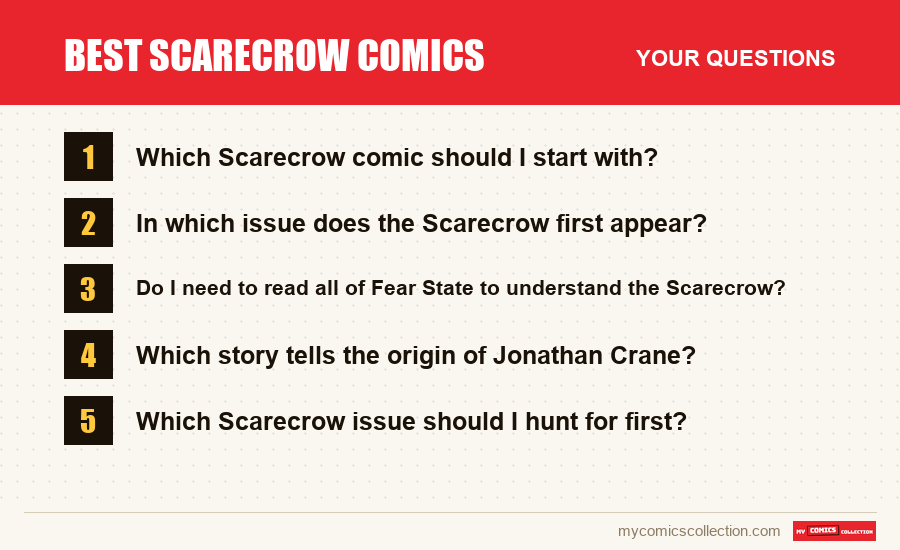
Start with Fears, the Jeph Loeb and Tim Sale story published in December 1993 in the first Halloween special of Legends of the Dark Knight. It is short, self-contained and found in the Haunted Knight collection. Then continue with Year One: Batman/Scarecrow for the origin.
In World's Finest Comics #3, in 1941, with the story "The Riddle of the Human Scarecrow." Bill Finger writes, the art is credited to Bob Kane. The character is Professor Jonathan Crane there. The fear toxin only arrives much later, in Batman #189 (February 1967).
No, it is a recent, large-scale read, not a prerequisite. The core is in Batman #112 to #117 (2021), by James Tynion IV and Jorge Jimenez, with the Alpha prologue and the Omega epilogue. Read it in the collection, under the title Fear State Saga, rather than following the tie-ins.
Two stories develop it: the miniseries Year One: Batman/Scarecrow (2005, Bruce Jones and Sean Murphy, two issues) and Batman Annual #19 (September 1995, Doug Moench and Bret Blevins). The second is more classic, the first more recent, and you can read them in whichever order you prefer.
It depends on your goal. World's Finest Comics #3 is the first appearance, but it is a Golden Age issue, fragile and contested. Batman #189 (1967) marks the birth of the toxin. To read rather than collect, favor the collections of the modern stories.
Do you have a Scarecrow issue in a stack, from Detective Comics #571 to a 1995 annual? Get its condition and its place in the market appraised.
Appraise my comic