In short
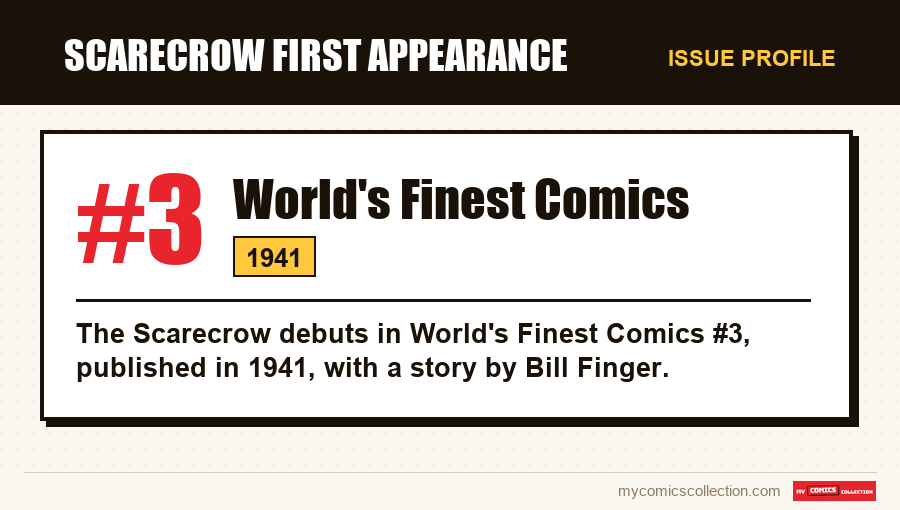
The Scarecrow debuts in World's Finest Comics #3, published in 1941, as a new adversary for Batman. Bill Finger is credited as writer, and the art is associated with Jerry Robinson and Sheldon Moldoff, two artists from the Batman team of the period. His alter ego, Jonathan Crane, and his lanky look draw on Ichabod Crane from The Legend of Sleepy Hollow. He appears twice in the 1940s, then returns in Batman #189 (1967) with a fear toxin.
Searches for the Scarecrow's debut usually land on the wrong comic: Detective Comics is the series people expect for a Batman villain, yet this one begins in an anthology that was barely under way. That detail alone changes how you shop for the book.
Every credit, date and issue number below comes from published sources; the view on why the Scarecrow's debut matters and how to shop for it is our own, and no page or line of dialogue is reproduced.
World's Finest Comics #3: the book behind the cover date
World's Finest Comics #3 is the third quarterly issue, published later in 1941. The series itself is a useful part of the story. Its opening number was titled World's Best Comics, and issue #2, dated Summer 1941, switched to World's Finest Comics. Historian Michael E. Uslan has speculated that the change followed a cease-and-desist letter from Better Publications, which had published a title called Best Comics since November 1939. So issue #3 is the second book to carry the name we use today.
The format was a 96-page quarterly anthology. It carried several DC characters, always including Superman and Batman, but in separate stories; the two did not share a story until issue #71 in July 1954. Robin, who had joined Batman in Detective Comics #38 in April 1940, was also part of the early issues. A buyer should therefore picture issue #3 as a thick, quarterly package of mixed features in which a Batman story is one component, not as a Batman comic in the narrow sense.
That packaging explains a collecting quirk. A Detective Comics debut is surrounded by decades of guides and census discussion. A World's Finest debut tends to be listed under the character's name and the series, and it can be missed by a collector who only scans the Batman titles. If you are building a Scarecrow set, add this series to your search from the start.
Credits and the artists of 1941
For this issue, the credits we can state are these. Bill Finger is credited as the writer of the Scarecrow's debut. For the art, the names attached to the character's creation are Jerry Robinson and Sheldon Moldoff, both of whom worked in the orbit of Bob Kane's Batman operation during these years. We do not assign an inker, a letterer or a colorist to the story, because the sources we read do not give those credits for a 1941 issue, and we do not name a cover artist for the same reason.
This matters when you write a listing or a catalog entry for your own copy. Golden Age credits are layered: one name might appear on a signature while another did the pencils, and studio practice blurred the lines. The honest short form is the one used above, a Finger story with art from the Batman team of the period. It is accurate, it is searchable, and it avoids a precision the record does not support.
If you follow the later history of the character, you will notice that the creative lineage splits into two threads. The 1940s thread is the Finger and artist-team thread. The modern thread starts in 1967 with Batman #189, a later story by a different creative team, and it is that issue which gives the Scarecrow the weapon readers now associate with him.
What the debut sets up: a gaunt figure borrowed from folklore
The Scarecrow is introduced as a new villain facing Batman. His name and look are rooted in American literature: Ichabod Crane, the protagonist of Washington Irving's The Legend of Sleepy Hollow, inspired both the lanky appearance and the alter ego, Jonathan Crane. The surname is the clue, and once you see it you cannot miss the deliberate echo.
We do not summarize the plot of the debut story in detail, because the point for a buyer is the identity of the book and not a spoiler. What is worth noting is the character design choice. A Gotham rogue built from a rural figure, a scarecrow, is an odd fit for a dense city, and that contrast is part of what made the figure distinctive among the other Golden Age adversaries.
The debut did not turn the Scarecrow into a regular. He made two appearances in the 1940s, and the second is Detective Comics #73, dated March 1943, in a story called "The Scarecrow Returns". After that he went quiet for more than two decades, so the debut waited for a later author to give it a payoff.
Why it is a key issue even though the character disappeared
A key issue is not defined by a continuous publishing record. It is defined by the importance of what it introduces. The Scarecrow's modern identity was assembled afterward: Batman #189, dated February 1967, revived him and introduced his fear toxin, depicted at the time as a bag of dust. From there the character became a recurring figure, and later stories deepened his background.
Those later pieces are specific. Batman Annual #19 (1995) and the two-issue Year One: Batman/Scarecrow (2005) expanded his origin. "Terror" ran in Batman: Legends of the Dark Knight #137 to #141 (2001), and "As the Crow Flies" appeared in Batman #627, dated July 2004. In the New 52 era he was in Batman: The Dark Knight volume 2 #4 (February 2012), and the villain-focused tie-in Detective Comics volume 2 #23.3 (September 2013) was titled The Scarecrow #1. Each of those is a point where the character's meaning shifted.
For a collector, the logical conclusion is that the 1941 issue is the foundation and the 1967 issue is the identity. The first gives you the name and the look; the second gives you the toxin and the fear-driven role. A balanced collection wants both, in whatever condition is affordable, and our Scarecrow reading guide shows which modern stories to read in between.
Do you collect this series?
Track what you own, what you are missing and what your collection is worth. 7-day trial.
Start my trial →
Numbers that are easy to confuse
Three mistakes recur in listings. The first is mixing up the 1941 debut with the 1943 return: Detective Comics #73 is the Scarecrow's second 1940s appearance, so it is a worthwhile book but not the debut. The second is treating Batman #189 as the debut because it is the issue that made him famous. It is an important revival, and the cover date is February 1967, but the character was already in print decades earlier. The third comes from the renaming: World's Best Comics #1 belongs to the same run as World's Finest, yet the Scarecrow is not in it.
Modern reprints add another layer. Archive-style collections gather Golden Age Batman stories, and a reader can follow the debut without buying the comic. When a seller describes a "Scarecrow origin" book, ask which origin is meant: the 1941 debut, the 1995 annual or the 2005 miniseries. They are different books with different dates and different creative teams.
It also helps to keep a simple rule for yourself: the series title, the number and the cover date must all appear together in any claim you accept. For example, World's Finest Comics #3, 1941. If one of the three is missing from a listing, the claim is not yet verified. Our guide to villain first appearances applies the same discipline to the wider Batman rogues gallery.
Inspecting a World's Finest #3 before paying
Condition is the main variable on a 1941 anthology. Start with attachment: confirm that both covers are present and joined to the staples, and that no interior pages are missing or trimmed. A thick quarterly with ninety-six pages has more places to fail than a thinner monthly.
Next, restoration. Ask whether the copy has color touch-up, sealed tears, replaced corners, spine repairs or a pressing treatment, and ask to see photographs of the covers under raking light, where retouching is easier to spot. On a professionally graded copy, the label color tells you whether the grader flagged restoration, and the certificate notes list what was found. Restoration that is disclosed and priced in can still make a reasonable purchase; just record such a copy as restored in your own notes.
Then paper and staples. Golden Age newsprint tans and becomes brittle, so a description of the paper tone is as informative as the numeric grade. Look for rusted staples, corner chips, and the spine roll that develops in thick comics stored on their sides. Finally, compare the cover with a published image so that you know you are looking at World's Finest #3 and not an adjacent number. A third-party grade is a useful filter for a book of this age, and the sensible next step is to compare recent sales through a valuation tool while keeping prices out of your own notes, because they date quickly.
Later Scarecrow appearances that deserve a place on the shelf
Should the 1941 book stay out of reach, these dated issues follow Crane through nearly seven decades:
- Detective Comics #73 (March 1943), "The Scarecrow Returns": the second Golden Age appearance.
- Batman #189 (February 1967): the 1967 revival and the arrival of the fear toxin.
- Batman: Legends of the Dark Knight #137 to #141 (2001), "Terror": a major storyline.
- Batman #627 (July 2004), "As the Crow Flies": a mid-2000s appearance.
- Year One: Batman/Scarecrow #1 and #2 (2005): an origin treatment in two parts.
These dated entries let you see the character move from a one-off 1940s adversary to a psychological threat. They also provide a practical order for acquisitions: buy the books that match your budget, read the stories in publication order, and keep the debut as a long-term target. For the series that surrounds the character's early years, our Detective Comics key issues list is the natural neighbor.
Cataloging your copy
When you record the book, write the series, number, cover date, writer, artists named and the condition notes in separate fields. Add a note on restoration and on the grade certificate, if there is one. A well-kept record turns a rare comic into a documented one, and it spares you from the vague wording that circulates around Golden Age debuts. If you own several Batman villain debuts, group them by series so that the anthology issues are not lost among the Detective Comics titles.
Frequently asked questions
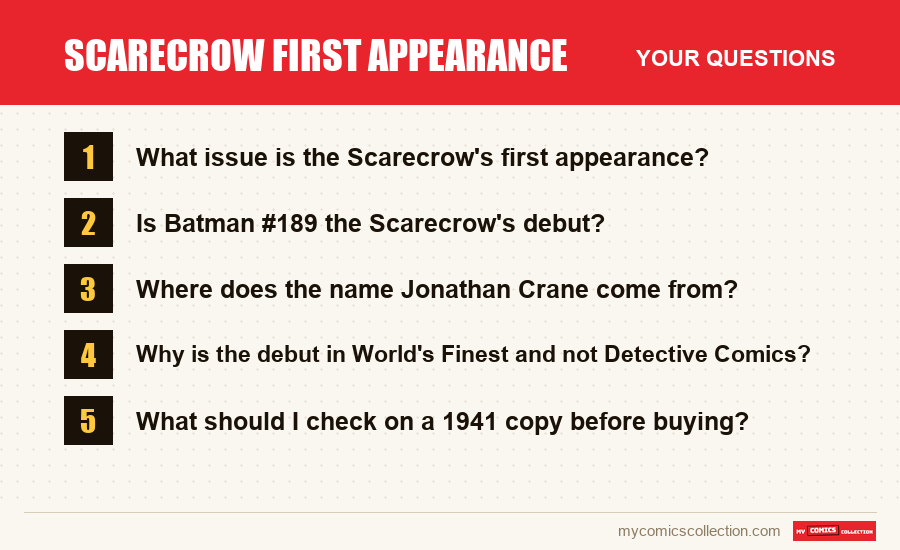
It is World's Finest Comics #3, published in 1941. Bill Finger is credited as writer, with art associated with Jerry Robinson and Sheldon Moldoff. The character is introduced as a new adversary for Batman in a quarterly anthology that also featured Superman.
No. Batman #189, dated February 1967, is the 1967 revival that introduced the fear toxin, depicted as a bag of dust. The character had already appeared in 1941 and again in Detective Comics #73 in March 1943.
The character's lanky appearance and his alter ego draw on Ichabod Crane, the protagonist of Washington Irving's The Legend of Sleepy Hollow. The shared surname is the visible link, and it has been noted by historians of the character.
World's Finest Comics was a quarterly anthology that always included Batman and Superman in separate stories. Its opening issue was titled World's Best Comics, and issue #2 changed the name. Batman villains could debut there as well as in his own series.
Confirm that both covers and all pages are present, then ask about restoration: color touch-up, sealed tears, replaced corners or spine repairs. Inspect the staples and the paper tone, read the grading label and certificate notes if the copy is graded, and compare the cover with a published image.
Holding a Golden Age Batman anthology or a Scarecrow story from Batman #189? Get a free estimate based on its number, date and condition.
Estimate my comic