In short
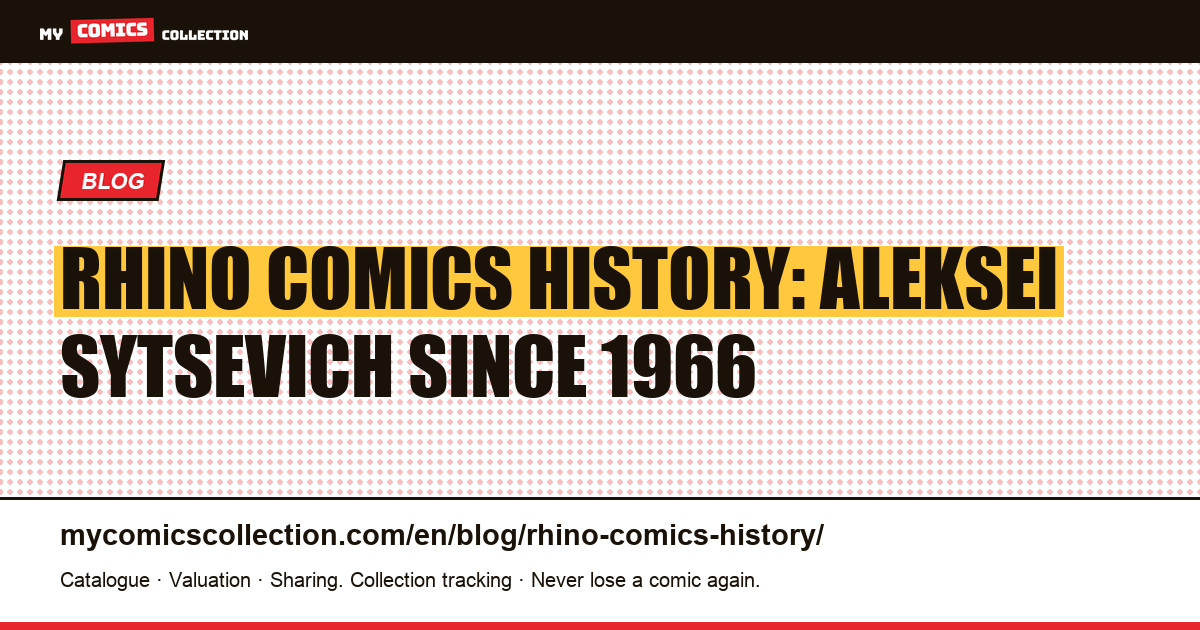
Aleksei Sytsevich, the Rhino, arrives with The Amazing Spider-Man #41 (October 1966), a Stan Lee and John Romita Sr. creation. He began as a hired brute in an armored suit, drifted through Hulk, Defenders and Avengers stories, and became a Spider-Man regular in the 1980s and 1990s. The 2001 story "Flowers for Rhino" and the 2010 Gauntlet arc in #617 and #625 turned him into a tragic figure, before the Slott years and the 2020s pulled him back toward crime.
Few Spider-Man villains have changed purpose as often as the Rhino while keeping the same silhouette. Over six decades Aleksei Sytsevich has been a Cold War hired hand, a Hulk opponent, a punchline, a prisoner, a widower and a Thunderbolt. This page follows that trajectory in order, era by era.
Numbers, cover dates and credits in the Sytsevich timeline below were cross-checked, and doubtful credits were dropped. Judgments about what each stage means for him are opinion, and no pages are quoted.
1966: a hired brute arrives in three issues
Issue #41 of Amazing Spider-Man carries an October 1966 date and opens a story that closes in #42 and #43, dated November and December. Lee scripted and Romita Sr. drew, which makes the Rhino one of the early villains designed under the new look that Romita gave the title after Steve Ditko left. Our companion guide to the #41 debut covers the issue itself in detail.
The original concept is simple. Aleksei Mikhailovich Sytsevich is a low-ranking member of the Russian mafia who undergoes treatments that give him superhuman strength. He turns on the Eastern Bloc agents who made him, is hired to kidnap Colonel John Jameson, and loses to Spider-Man. For a collector, the useful point is that the three-part arc is a unit: #41 is the debut, but #42 and #43 finish the story, and the Rhino spends the whole arc as a figure of pure force with no inner life.
That blankness is the starting condition for everything that follows. Writers who return to him decades later are, in effect, answering a question the 1966 story never asked: what is going on inside the suit?
1968 to 1977: the Hulk years and the Leader
The Rhino's next appearances are not in a Spider-Man book. In The Incredible Hulk (vol. 2) #104 (June 1968) he returns with gamma-radiation augmentation and a tougher suit, is sent to kidnap Bruce Banner, and the Hulk beats him into a coma. In #124 (February 1970) the Leader revives him to disrupt Banner's wedding to Betty Ross; the Rhino turns on the Leader, attacks Banner and falls back into a coma. He is back for a three-part Hulk story, #157 to #159, dated November 1972 to January 1973. It ends with the Leader's rocket crashing on arrival, and from then on his costume can no longer be separated from his body.
For a history of the character, this stretch matters because it shows how the Rhino was used in the early 1970s: as a loaner. A villain with a recognizable look and no complicated motive is easy to hand to another series. The Incredible Hulk #218 (December 1977), where he appears alongside Doc Samson, is another example. A collector who only follows Spider-Man titles will miss this entire run, and that is the reason it is worth listing on its own.
In the same decade he turns up in Defenders #42 and #43 (December 1976 and January 1977), where he fights the team. He is, by then, a fixture of the shared Marvel universe rather than a property of one hero.
1983 to 1985: Project Pegasus and the suit that will not come off
The costume fused in that crash becomes the subject of the next stage. Doc Samson takes him to Project Pegasus, and in Avengers #236 and #237 (October and November 1983) he is part of a failed prison break there. From the crash onward the suit is no longer a tool he can take off. That single change shapes every later story that deals with his freedom, his health or his hope of a normal life.
Thing #24 (June 1985), where Miracle Man tries to free him during a transfer and the Rhino helps the Thing stop him, keeps him in the wider Marvel orbit. The point to retain is the pattern: the 1980s Rhino is a character whose body, not his criminal ambition, is the problem. After treatments fail to restore him, he later asks Justin Hammer for a removable suit, which gives writers an in-universe reason to put him back in the field.
1986 to 1995: a regular in Spider-Man's rogues' gallery
The Amazing Spider-Man #280 and #281 (September and October 1986) bring him back to the title that created him. He escapes Project Pegasus and joins the Sinister Syndicate, fighting Spider-Man on several occasions. The four-issue miniseries Deadly Foes of Spider-Man (May to August 1991) is the clearest sign of his promotion to a headliner among the villains, with #4 carrying the kidnapping plot described below.
The Kingpin hires him in this period to raise money for surgery, and in Deadly Foes of Spider-Man #4 he kidnaps a scientist's child to force a suit-removal procedure. That plot is a good example of the character's logic: the violence is real, but the goal is a wish to be released from the thing that makes him dangerous. The Incredible Hulk #435 (November 1995) sets him against the Hulk once more in a baseball-themed story, a reminder that the Hulk connection never fully disappears.
The alternate-universe version in Tales from the Age of Apocalypse #1 (December 1996) shows how readily the design transfers. Even outside the main continuity, a hulking horned brute is recognizable at a glance.
2001: "Flowers for Rhino"
A new angle arrives in 2001 with "Flowers for Rhino," a two-part story in the anthology Spider-Man's Tangled Web (#5 and #6, October and November 2001) from Peter Milligan and Duncan Fegredo. Spider-Man's Tangled Web was a 22-issue anthology (June 2001 to March 2003), so this story sits in a series that is easy to overlook if you collect by title run.
What makes it a turning point is the premise. The Rhino becomes smarter to impress the daughter of a Russian mobster, then misses his old, simpler life, which inverts the 1966 setup: the same man who was a blank instrument is given an inner life. After 2001, a writer who uses the Rhino has a template for a sympathetic version, and later sympathetic treatments build on that choice rather than on the 1966 original. In collecting terms, #5 and #6 are the pair to look for, and they are unusual among Spider-Man villain keys because their appeal is the writing rather than a first appearance.
Do you collect this series?
Track what you own, what you are missing and what your collection is worth. 7-day trial.
Start my trial →
2008 to 2010: the Punisher, the Gauntlet and Oksana
The next major shift starts outside Spider-Man's own title. In Punisher War Journal (vol. 2) #13 to #15 (January to March 2008), the Rhino accidentally kills a security guard, the Punisher humiliates him, and Alyosha Kravinoff captures him. The Punisher frees him, and he begins to make amends. Kravinoff is the family name that links this story to the hunters of the Kraven line.
The Gauntlet storyline then reorients him. In the arc that runs through The Amazing Spider-Man #617 ("Rage of the Rhino," 2010), Aleksei Sytsevich has already surrendered, S.H.I.E.L.D. has removed his suit, and after an early release from Ryker's Island he lives with his wife Oksana. Sasha Kravinoff tells a new villain in a Rhino suit that he can gain honor by killing Aleksei. Spider-Man fights the new Rhino to protect him and is defeated, and at Spider-Man's persuasion Aleksei refuses to fight.
The payoff is The Amazing Spider-Man #625 ("Endangered Species," March 2010). The new Rhino attacks the vehicle taking Aleksei and Oksana to a safehouse, and Oksana is killed. Aleksei puts his old suit back on and kills the new Rhino. This is the character's most emotional turn, and it works precisely because the 1966 design is still intact: a mountain of armor, now grieving.
The Gauntlet covers The Amazing Spider-Man #611 to #633, with Grim Hunt (#634 to #637) following directly and Web of Spider-Man (vol. 2) #2 to #7 carrying origin stories, #3 among them for the Rhino, from November 2009 to July 2010, so the Rhino issues are one thread inside a much larger event.
2011 to 2018: Sinister Six, Ends of the Earth and the Clone Conspiracy
Under Dan Slott, the Rhino is put to work as a team player. The Amazing Spider-Man #648 brings him into Doctor Octopus's Sinister Six, and in the Ends of the Earth arc (#687) he pins Silver Sable in a flooding corridor and is presumed drowned. Slott is credited as the writer of The Amazing Spider-Man #700, which includes an afterlife scene that reuses the character. For a history of the villain, the Slott run shows how a figure shaped by a tragic story can still be redeployed as a heavy.
The Clone Conspiracy storyline (#4 and #5) uses the grief from #625 directly. The Jackal persuades the Rhino to work for him by promising to revive Oksana. When the clones decay and Oksana turns to dust, he goes on a rampage, and Spider-Man is the one who calms him. It is a rare case of a long-running supporting villain whose motivation can be traced through a single loss across several years of publication.
2020s: Kraven's captives, the Thunderbolts and Devil's Reign
In the current era the Rhino keeps appearing in event tie-ins. The Amazing Spider-Man (vol. 5) #16 shows him among Kraven's captives as part of the Savage Six. He then turns up as a Thunderbolt in King in Black: Thunderbolts #1 and in Devil's Reign #1 and #2 to #4. The pattern is a return to the loaner role of the 1970s, now as a reliable muscle presence inside team books rather than a solo threat.
Alternate versions continue to show the design's reach. The Rhino appears in Ultimate Spider-Man #28, in Amazing Spider-Man: Renew Your Vows #1, in Spider-Verse Team-Up #2 and in Marvel Mangaverse Spider-Man #1. These are optional reading, but they confirm that the horned silhouette from 1966 never needed a redesign.
The key issues across his history
- The Amazing Spider-Man #41 (1966): the debut of the Rhino, by Stan Lee and John Romita Sr.
- The Amazing Spider-Man #42 and #43 (1966): the conclusion of the debut arc, best collected as a set with #41.
- The Incredible Hulk #104 (1968): the Rhino's return, beaten into a coma by the Hulk.
- Avengers #236 and #237 (1983): the failed Project Pegasus prison break.
- A four-part 1991 miniseries titled Deadly Foes of Spider-Man gathers Sytsevich with other rogues.
- Spider-Man's Tangled Web #5 and #6 (2001): "Flowers for Rhino," by Peter Milligan and Duncan Fegredo.
- The Amazing Spider-Man #617 (2010): "Rage of the Rhino," the new Rhino hunts Aleksei.
- The Amazing Spider-Man #625 (March 2010): "Endangered Species," Oksana's death and the new Rhino's end.
How to follow the Rhino in a collection
Open the shopping list with the 1966 debut arc, The Amazing Spider-Man #41 to #43, and treat it as one three-issue set. From there, the character moves in two different directions. If you collect by character, add the Hulk issues from 1968 to 1977, the 1983 Avengers pair and the 1991 miniseries. If you collect by story quality, jump to Spider-Man's Tangled Web #5 and #6 and then the Gauntlet issues, #617 and #625.
Two numbering points are worth knowing before you buy. Because the title was renumbered more than once, "vol. 5 #16" and the original "#625" belong to separate runs, and a want list must name the volume. Anthologies such as Spider-Man's Tangled Web are easy to miss in a run-based checklist, so they need their own line. Our where-to-start guide ranks reading order, while this page follows chronology, and the editorial history of Amazing Spider-Man places the relaunches in context.
Frequently asked questions
His debut sits in The Amazing Spider-Man #41 (cover date October 1966), with the arc finishing in #42 and #43; Lee wrote and Romita Sr. drew. He is introduced as a thug for hire sent after Colonel John Jameson.
The main Rhino is Aleksei Mikhailovich Sytsevich, a low-ranking Russian mafia member who undergoes treatments for superhuman strength. Other people have worn Rhino-style suits, including a new Rhino created by Doctor Tramma in the 2010 Gauntlet arc, who dies in The Amazing Spider-Man #625.
It is an anthology story from 2001, issues #5 and #6 of Spider-Man's Tangled Web, by Peter Milligan and Duncan Fegredo. The Rhino grows smarter to impress a Russian mobster's daughter, then misses his old, simpler life, which gives him an inner life the 1966 debut never had.
Oksana, the Rhino's wife, is killed in The Amazing Spider-Man #625 (2010), when a new Rhino attacks the vehicle taking her and Aleksei to a safehouse. Aleksei puts his suit back on and kills the new Rhino. Her loss drives his later arc, including the Clone Conspiracy storyline.
Yes. He appears in The Incredible Hulk #104 (1968), #124 (1970), #157 to #159 (1972 to 1973) and #435 (1995), in Defenders #42 and #43, in Avengers #236 and #237, and as a Thunderbolt in King in Black: Thunderbolts #1 and Devil's Reign.
If you own a Rhino debut run or a Gauntlet issue, a quick valuation shows where your copy stands.
Estimate my comic