
In short
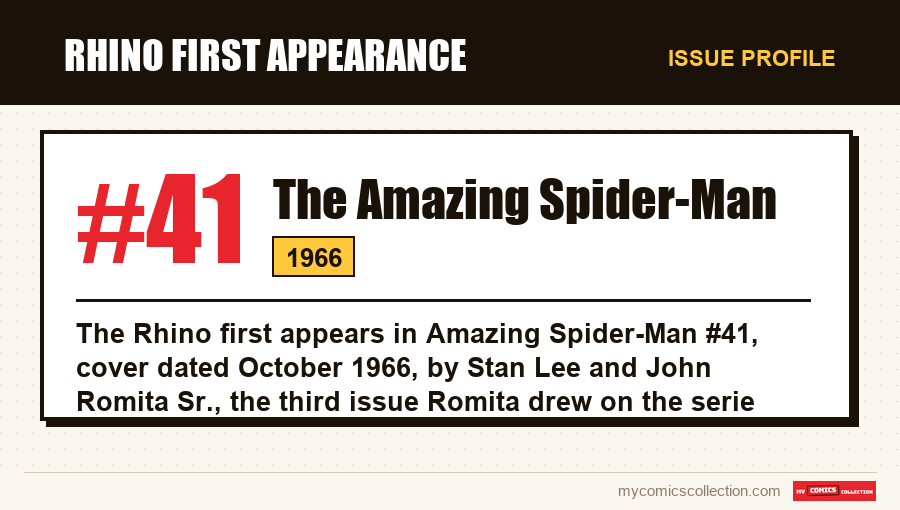
The armored brute arrives in The Amazing Spider-Man #41 (October 1966), under the title "The Horns of the Rhino!", written by Stan Lee with John Romita Sr. on pencils and cover. The Rhino, a hired brute in a rhinoceros-themed armored suit, reaches New York to seize astronaut John Jameson, and Spider-Man knocks him out. The story continues in #42 and #43, and the issue is the third drawn by Romita after Steve Ditko's exit.
Issue #41 asks a different question from most debut pages: it is both the arrival of a villain and the third number drawn by a new artist on a series that had just lost the person who defined its look. A collector who wants the Rhino also gets a snapshot of the title in transition.
The dates, story titles and credits for #41 to #43, and the Hulk and Defenders issues listed near the end, come from published reference listings. How the three numbers fit together and what to look for on a copy are our own judgment, and no artwork or dialogue is reproduced.
What #41 is on paper: date, title and credits
The Amazing Spider-Man #41 carries an October 1966 cover date. The lead story is "The Horns of the Rhino!", credited to Stan Lee as writer and editor, with John Romita Sr. as penciler and cover artist. The inking is credited to Mike Esposito under the name Mickey Demeo, the pen name he used for the first three issues of the Romita era.
The inker note is worth keeping in mind. Unlike the following two issues, where Romita is credited with pencils, inks and cover, #41 has an outside inker, and a listing that says "all Romita" is simplifying. Letterer and colorist are left out of this page, since the listings we read disagree on them.
Some dealer listings print "John Romita Jr." on the cover credit. The artist is the father, John Romita Sr., and the son is not part of this issue. If you want to filter by creator when you search, use the Sr. name and the 1966 date together.
A series in transition: Ditko's exit and Romita's arrival
Reference material states that Steve Ditko drew the first thirty-eight issues, ending with #38 of July 1966, and that John Romita Sr. took over as penciler with #39 of August 1966. That makes #41 the third Romita issue. Ditko's departure was announced in the Bullpen Bulletins of comics cover-dated July 1966, and published accounts of the period describe disagreements behind it, with details that remain uncertain.
What a collector can state with confidence is the sequence of the numbers. The Rhino arrives while Romita is still new to the series, and the design reflects his style. The rhinoceros suit is bulky and graphic, a silhouette that reads at newsstand distance. A mountain of armor with horns suits a cover composition built around a single massive figure, which is how #41 uses it.
That timing is the reason the number sits next to the Ditko debuts in many collections. If you are building the creator side of the series, our Silver Age guide follows the title issue by issue through this change of hands, and the author page for John Romita Sr. lists the rest of his coverage.
How the Rhino is introduced in #41
The Rhino is presented as a hired thug acting for an Eastern Bloc country. In the debut he arrives in New York with a single assignment. Reference material describes the origin of the character as an experiment in which a polymer suit is bonded to his skin, giving him large amounts of strength and speed. The costume is part of the body, which is why the issue treats removing it as a problem and not as a change of clothes.
His target is John Jameson, the astronaut son of J. Jonah Jameson, who has returned from a space mission carrying extraterrestrial spores. The Rhino is hired to kidnap John and obtain the spores, which is how the issue signals that he works for someone else. Spider-Man intervenes, and the fight ends with the Rhino beaten and in custody.
The Peter Parker subplot is lighter. Peter buys a motorcycle, and the issue closes with Peter riding home and a teaser for Mary Jane Watson. In other words, #41 is a debut that still reads as an issue of the series, with the soap opera of the period running beside the battle.
The three-issue story: #41, #42 and #43
The Rhino's introduction is spread over three numbers, and a collector should treat them as one. The numbers and dates are #41 of October 1966, #42 of November 1966 and #43 of December 1966.
Issue #42, "The Birth of a Super-Hero!", gives the Rhino a short appearance. He is shown in custody while the authorities struggle with the armored hide that cannot simply be taken off. The main story of that issue involves John Jameson, who gains super-strength from the spores and is encouraged by his father to hunt Spider-Man. The issue is also the one where Mary Jane Watson's face is shown for the first time in the series. A collector who wants #42 for that reason gets the Rhino's brief appearance in the bargain.
Issue #43, "Rhino on the Rampage!", returns him to the center. He breaks out of custody and rampages through the city to draw out Spider-Man. Spider-Man and Dr. Curt Connors work on a chemical that dissolves the armored hide, and the Rhino is subdued and captured. Lee writes and edits both numbers, and Romita draws them.
The trio is why many readers think of the debut as a mini-arc and not as a single number. A fair way to hold it is to buy #41 for the debut and to add #42 and #43 as the continuation, with the understanding that the Rhino's own spotlight is in the first and third issues.
Reference material credits the Rhino to writer Stan Lee and artist John Romita Sr. The credit on the issue is plain: the writer-editor wrote, the artist drew and drew the cover, and the combination is the one reference works repeat.
The creators built a character who is mostly power and little else. A later description in a reference work calls him a monstrous behemoth trapped in a durable rhinoceros suit, and that is fair as a summary of the 1966 intent. The Rhino is a problem that cannot be punched in the usual way, which is why #43 solves it with chemistry. For readers who want his later arcs ranked by quality, the best Rhino comics page covers them; this page stays with the number.
Do you collect this series?
Track what you own, what you are missing and what your collection is worth. 7-day trial.
Start my trial →
Why #41 is a key issue
The number matters for reasons that do not depend on a market. It introduces a villain who appears in the series for decades and who is identified in reference material as Aleksei Mikhailovich Sytsevich. It is the third Romita-drawn issue, so it documents the new look at the moment it replaced the old one. And it begins a three-part story, which gives a collector a clean target: one issue for the debut, two for the follow-through.
It also has company in the same collecting category. If you are comparing villain debuts across the Marvel line, the guide to villain first appearances sets this number beside other debuts, and the Sinister Six reading guide is useful for the wider group of Spider-Man foes.
The appearances that matter after #41
The Rhino is not confined to Spider-Man's own book. The list below was checked against reference material for issue numbers and dates.
- The Incredible Hulk #104, June 1968: the Rhino fights the Hulk and apparently dies at the end of the story.
- The Incredible Hulk #124, February 1970: he returns, revived.
- November 1972 to January 1973, The Incredible Hulk #157 to #159: a storyline involving the Leader brings the Rhino back to the Hulk's series for three numbers.
- The Defenders #42 and #43, December 1976 and January 1977: the Defenders and Doctor Strange defeat him.
- The Amazing Spider-Man #280 and #281, September and October 1986: a two-part story in which the Rhino fights Spider-Man as part of the Sinister Syndicate.
For a collector, the early publishing life of this villain passes through the Hulk's series, so a Rhino shelf doubles as a small Hulk shelf. The 1986 pair is the bridge back to Spider-Man's own series. These numbers are good second purchases, but #41 remains the debut.
Reprints, collected editions and numbers people confuse
Collected volumes of the 1966 stories exist, so a reader can follow the Rhino from #41 to #43 without owning a single newsstand copy. That is a reading route, and the original-copy question stays separate: a reprint has its own cover and indicia.
The common confusions are small but frequent. Sellers sometimes tag #42 or #43 as the debut simply because the character fills the story; the debut is #41. A listing may give a later Hulk number as the "Rhino debut" because of its cover; the debut is still #41. And a copy of the later 1986 numbers may be sold as "Rhino" when the cover puts the whole Sinister Syndicate forward.
Name spellings are a final trap. The reference spelling of the character's name is Aleksei Sytsevich, and later stories use the alias Alex O'Hirn. A listing built on one spelling may not surface a copy listed under the other.
Examining a copy of #41 before you buy
Use the list below as a routine for any copy from 1966; it contains no prices.
- Verify the number 41 and the October 1966 date on the cover, not just in the description.
- Get crisp images of both covers, the spine and the staples, and look at the large colored areas of the front for fading or touch-ups.
- Check the corners, the edges and the paper tone for glue, fill or trimming. Those are the usual signs of restoration, and a seller who is open about restoration will provide a written note.
- For a slabbed book, read the label's grade and notes, then check the serial number against the grading company's own database.
- For a raw book, ask for interior photographs too, since pages loose near the staples, tape or cuts do not always show from the front.
- Decide whether you want #41 alone or the full story of #41 to #43, and keep a separate condition note for each issue.
The dependable habit is side-by-side comparison of several #41 copies. Light striking the cover at a low angle shows creases a flat photograph can hide.
For a collector working through the 1966 run, #41 comes after the first Romita numbers and before the stretch that brings in the larger supporting cast. It is a natural stopping point if you collect by artist: a Ditko set ends at #38, and a Romita set begins at #39.
For a collector who prefers characters, the Rhino is a compact project: the three-issue debut, the Hulk appearances of 1968 to 1973, the Defenders pair, and the 1986 pair. The whole project fits on a short list that a simple spreadsheet can track. When you know exactly which numbers you own, the free valuation page linked below can help with an estimate.

Frequently asked questions
The debut sits in The Amazing Spider-Man #41 (October 1966), story "The Horns of the Rhino!", by Stan Lee and John Romita Sr. The story continues in #42 of November 1966 and #43 of December 1966, so many collectors treat the three numbers as a set.
John Romita Sr. is credited with the pencils and the cover. Mike Esposito, credited as Mickey Demeo, is credited with the inks. Romita had taken over from Steve Ditko with #39 of August 1966, which makes #41 the third issue of the Romita era.
No. The debut is The Amazing Spider-Man #41 of October 1966. The Rhino fights the Hulk later, in The Incredible Hulk #104 of June 1968, returns in #124 of February 1970 and appears again in #157 to #159. Those are strong second purchases, not the debut.
It depends on the goal. #41 is the debut. #42 shows the Rhino briefly, in custody, and #43 returns him to the center and ends the story. A collector of the character often wants all three, and a collector of the debut alone can stop at #41.
Read the number 41 and the October 1966 date off the cover first. Then gather images of the spine, staples, corners and interior, and check for any sign of restoration. For a book already encapsulated, compare the label with the grader's public records.
Holding a copy of #41, #42 or #43 and wondering what to check next? Run it through the free valuation tool.
Estimate my comic