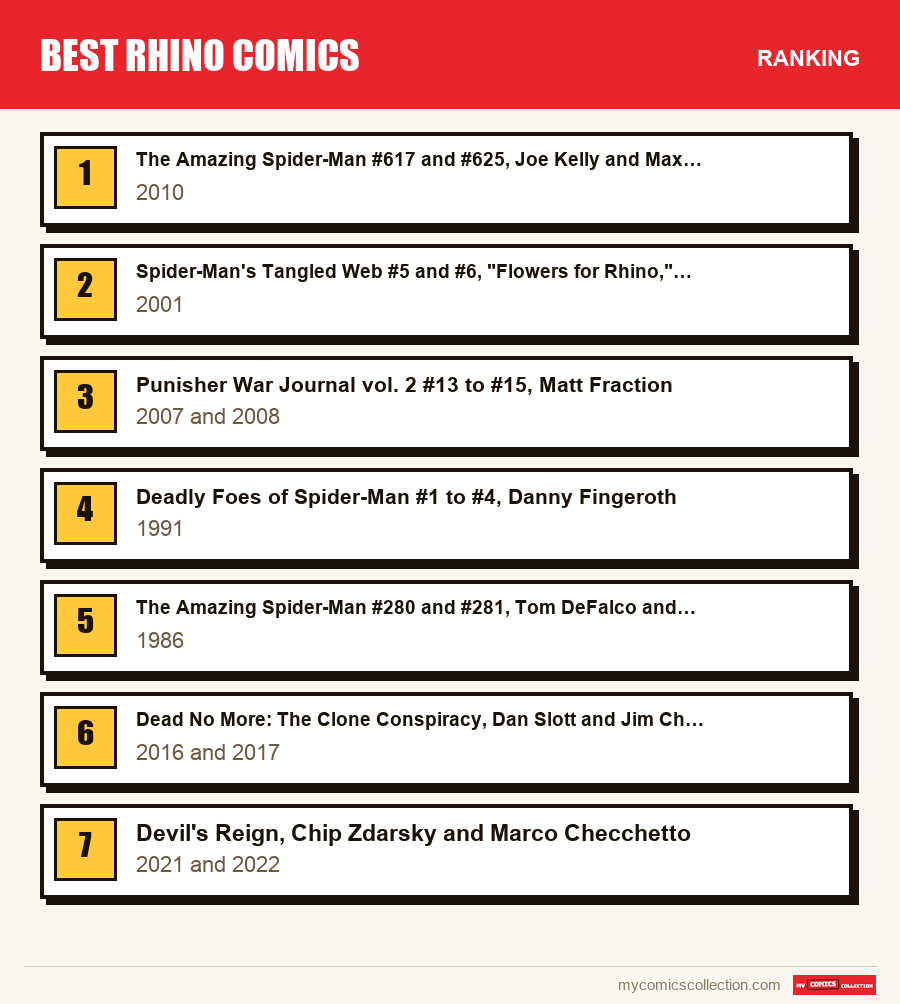
For the best Rhino comics, start with his debut in The Amazing Spider-Man #41 to #43 (October to December 1966), by Stan Lee and John Romita Sr. For the best stories, read #617 and #625 (2010) by Joe Kelly and Max Fiumara first, where Aleksei Sytsevich tries to change his life, then Flowers for Rhino (2001) by Peter Milligan and Duncan Fegredo. The rest of the ranking runs from 1986 to 2022.
The Rhino is a mountain of muscle in an armor bonded to his skin, an unstoppable force with a brain the character does not pretend to have. That contrast is precisely what makes his best stories moving: a brute who looks, from time to time, for a way out. This guide ranks seven reads to get into his story, from the character's early days to his recent returns.
As always in this guide, we only state verified information (creators, issue numbers, dates); the analysis is our own, with no reproduction of protected art or dialogue.
His first appearance
The Rhino is born in The Amazing Spider-Man #41, cover-dated October 1966, from an idea by Stan Lee on script and John Romita Sr. on art. The story continues in #42 and #43 (November and December 1966). He is presented as a hired thug recruited by an Eastern Bloc country, who agrees to go through an experiment: a polymer suit bonds to his skin and gives him enormous strength. The three issues form a whole, and that is how you should hunt for them.
This debut arrives at a pivotal moment for the series: John Romita Sr. had taken over the art, and the Rhino was designed in that more readable style. The 1966 run fits into a broader collection, covered in the guide to the title's Silver Age. Before paying for a #41, #42 or #43, examine the spine, corners, edges and paper, ask for sharp photos of the cover and the interior pages, and look for signs of restoration.
The Rhino later turns up in other heroes' books. In The Incredible Hulk #104 (June 1968), he fights Hulk and seems to die; he is back in #124 (February 1970), then in #157 to #159 (November 1972 to January 1973). That detail matters for your reading: the character is not only a Spider-Man adversary, and these issues interest the collector who also follows the green hero.
1: The Amazing Spider-Man #617 and #625, Joe Kelly and Max Fiumara (2010)
This is the story most readers cite first for the Rhino, and it deserves the spot. In #617, dated February 2010, Aleksei Sytsevich turns himself in; he refuses to fight a new Rhino built by Dr. Tramma, after being persuaded by Spider-Man. Issue #625, from May 2010, closes the loop: the death of Oksana, his partner, breaks the promise made to Spider-Man, and Aleksei faces his replacement. Both issues are written by Joe Kelly, with Max Fiumara on art.
What it brings to the character: lasting dramatic depth, and a lasting relationship with Peter Parker, who ends up protecting a criminal. It is for everyone who wants to understand why the Rhino can make you laugh and cry in equal measure. These two issues are part of The Gauntlet, but they read on their own: pick up #617, then move on to #625, and you will not have missed anything essential for the Rhino. Max Fiumara's angular, nervy art gives the brawl a brutality that suits the subject.
2: Spider-Man's Tangled Web #5 and #6, "Flowers for Rhino," Peter Milligan and Duncan Fegredo (2001)
Published in October and November 2001, this two-parter is written by Peter Milligan and drawn by Duncan Fegredo. It draws on the novel Flowers for Algernon: the Rhino undergoes an operation that multiplies his intelligence, with consequences he had not foreseen. The story takes the point of view of the character himself, which changes everything: the reader is no longer on Spider-Man's side, but on that of the giant discovering what it means to think.
It is the ideal entry point for a reader who wants Rhino without knowing the thirty years of continuity that precede it. The story is self-contained, it fits in two issues, and Duncan Fegredo's linework gives it a distinct visual identity. It appears in volume 1 of the Spider-Man's Tangled Web trade paperbacks, which makes it easy to read without going through the single issues.
3: Punisher War Journal vol. 2 #13 to #15, Matt Fraction (2007 and 2008)
This arc, written by Matt Fraction, mixes the Rhino, the Punisher and Spider-Man. In #13, a crew of robbers that includes the Rhino finds itself facing the Punisher, whom Spider-Man tries to stop from killing the giant; during their quarrel, Kraven's son steps in and carries the Rhino off. The following issues show him locked in a menagerie of criminals, among them the Vulture, before the story pushes him to start making amends.
What this story brings: the Rhino is no longer just an obstacle, he is a victim, and a man who is beginning to feel regret. It is for the reader who already knows a bit of the Punisher and wants to see Aleksei in a darker register. It serves as a preface to his 2010 turn: read before #617 and #625, it gives a reason for the character's weariness.
4: Deadly Foes of Spider-Man #1 to #4, Danny Fingeroth (1991)
This four-issue miniseries, published from May to August 1991, is written by Danny Fingeroth. It brings together five Spider-Man adversaries, among them the Rhino, Boomerang, the Beetle, Speed Demon and Hydro-Man. As a read, it is a group adventure where the Rhino shares the spotlight rather than a solo portrait.
It interests mostly those who like the villain teams of the early 1990s: you will find the gang dynamic that settled in during the 1980s. For a reader in a hurry, it stays secondary to the earlier stories, but it is worth the effort if you are completing a collection of Spider-Man miniseries. The art credits vary from issue to issue; check them on the indicia of each copy before buying.
5: The Amazing Spider-Man #280 and #281, Tom DeFalco and Ron Frenz (1986)
Issue #280 (September 1986) introduces the Sinister Syndicate, a group of mercenaries the Rhino joins, facing Spider-Man and Silver Sable. The adventure continues in #281 (October 1986), with the help of the Sandman. Tom DeFalco writes, Ron Frenz draws.
This read shows the Rhino as part of a team, before the more personal stories of 2001 and 2010. It is for those who want to see what a gang fight looked like in the DeFalco and Frenz era, with the dynamic of five villains jockeying to be the strongest. It reads in two issues and requires no preparation.
Do you collect this series?
Track what you own, what you are missing and what your collection is worth. 7-day trial.
Start my trial →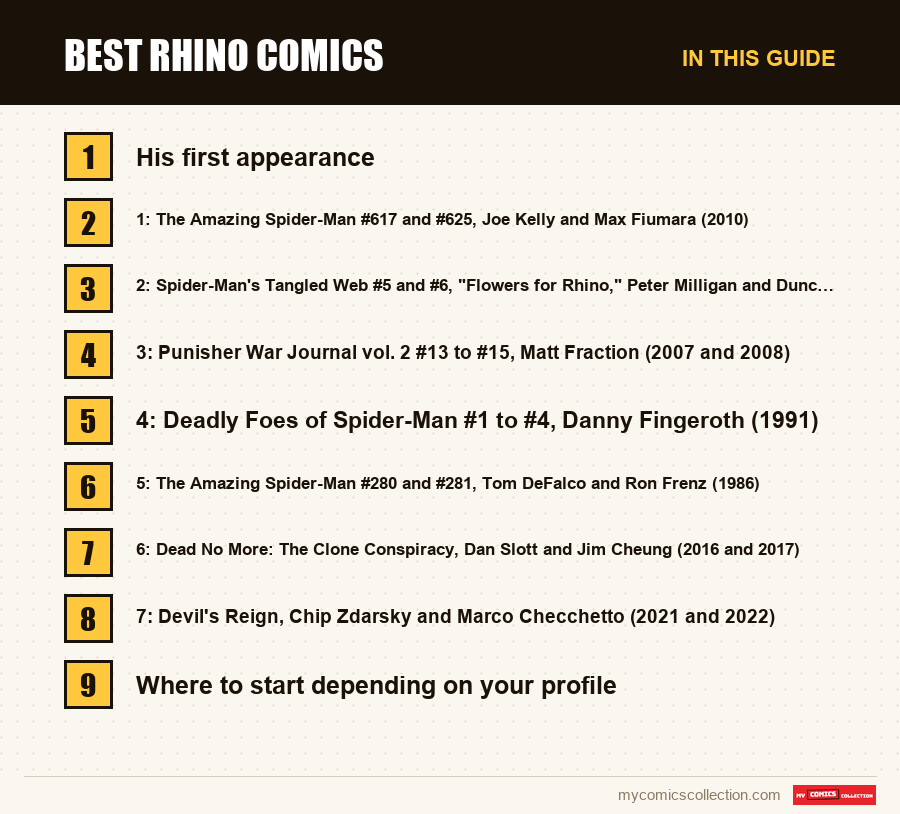
6: Dead No More: The Clone Conspiracy, Dan Slott and Jim Cheung (2016 and 2017)
An event written by Dan Slott with Jim Cheung on art, The Clone Conspiracy brings Oksana, the Rhino's partner, back to life. The Rhino appears in #4 and #5 of the miniseries; Oksana crumbles to dust and Aleksei goes on a rampage, then Spider-Man calms him down in Clone Conspiracy: Omega #1 (March 2017). In Amazing Spider-Man vol. 4 #2, it is the Jackal who promises to resurrect Oksana.
You need to have read #617 and #625 to gauge what Oksana's return means. The story is therefore for the reader who has already followed Aleksei over several years. Critics found it uneven, notably in how Oksana's loss is handled, but the file is useful for completing the character's trajectory. For an overview of the writer, see our guide Dan Slott: where to start.
7: Devil's Reign, Chip Zdarsky and Marco Checchetto (2021 and 2022)
In this event written by Chip Zdarsky and drawn by Marco Checchetto, Wilson Fisk assembles a new Thunderbolts team that includes the Rhino, alongside Crossbones, Taskmaster and others. The Rhino first serves Fisk's interests, then refuses to fight the Champions and saves them from the Octobots, taking their side.
This return shows a Rhino who, after years, keeps his giant's fiber but acts with a conscience: he chooses to switch sides at the moment it counts. The story is for a current reader looking for recent Marvel, with Fisk at the center. It reads best after entries 1 and 2, which give the key to Aleksei's character. To find more of Chip Zdarsky's work, see his author page.
Where to start depending on your profile
You want a self-contained story. Start with Flowers for Rhino (Spider-Man's Tangled Web #5 and #6). Two issues by the same writer, no continuity to know.
You want the best of the character. Take The Amazing Spider-Man #617 and #625, by Joe Kelly and Max Fiumara. Count on two single issues; the Gauntlet trade paperbacks contain them too.
You love the Silver Age. Aim for Amazing Spider-Man #41 to #43 (1966). These are the debut issues, by Stan Lee and John Romita Sr.
You prefer recent comics. Read Devil's Reign (2021 and 2022), then work backward to entries 1 and 2 to understand what the character has been through.
You collect Spider-Man's adversaries. Fill in with the 1991 Deadly Foes and the 1986 Sinister Syndicate encounter, then compare with the path of other adversaries.
The key issues to know
For a collector, the method matters more than the list: first spot the debut issues, then the turning points, and always cross-check several completed sales before settling on a figure. Here are the Rhino's landmarks.
- The Amazing Spider-Man #41 (October 1966): first appearance, with #42 and #43 for the complete arc;
- The Incredible Hulk #104 (June 1968): the Rhino fights Hulk, a milestone for readers of the green hero;
- The Amazing Spider-Man #280 (September 1986): debut of the Sinister Syndicate;
- Spider-Man's Tangled Web #5 (October 2001): start of Flowers for Rhino;
- The Amazing Spider-Man #617 (February 2010) and #625 (May 2010): the character's dramatic turning point;
- Clone Conspiracy: Omega #1 (March 2017): epilogue to Oksana's return.
On the price side, do not rely on a single figure: compare the median of several completed sales and check the exact condition before deciding. A 1966 copy and a 2010 single issue are not judged by the same criteria.
How to organize a complete read
To follow Aleksei Sytsevich across nearly sixty years, go by the cover-date calendar: the 1966 debut, the 1986 Sinister Syndicate, the 1991 Deadly Foes, Flowers for Rhino in 2001, the Punisher arc in 2007 and 2008, then #617 and #625 from 2010. The returns of 2016 and 2021 come next. This order highlights a common thread: from a thoughtless enforcer, the character becomes a man capable of regret, which explains the sympathy he draws today.
Watch out for relaunches: the "vol. 4" or "vol. 5" labels in this guide designate successive volumes of the title, each restarting at #1, sometimes with a second number on the cover for the historical count. When two numbers coexist, go with the one that accompanies the month and year of publication.
Frequently asked questions
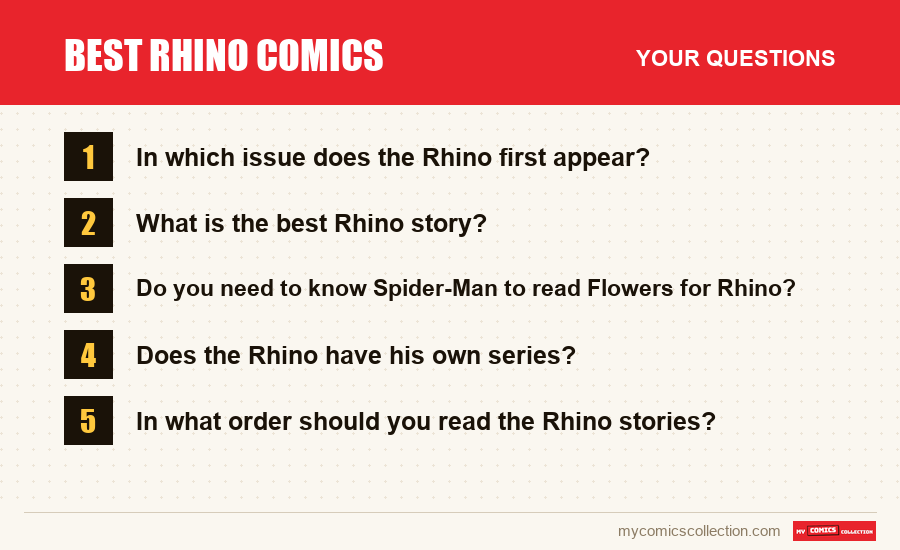
October 1966: issue #41 of the series opens the file, with Stan Lee writing and John Romita Sr. on pencils for this first meeting with the armored brute. The story continues in #42 and #43. Before buying a copy, check the number and date printed on the cover.
Many readers cite The Amazing Spider-Man #617 and #625 (2010), by Joe Kelly and Max Fiumara, for its dramatic weight. If you prefer a self-contained and stranger story, Flowers for Rhino (2001) by Peter Milligan and Duncan Fegredo is an equally solid choice.
No. The two-parter in Spider-Man's Tangled Web #5 and #6 reads without preparation. The story follows the Rhino's own perspective, and its starting idea, borrowed from the novel Flowers for Algernon, can be appreciated without knowing anything about the hero's continuity: a comfortable doorway for a curious reader.
The miniseries Deadly Foes of Spider-Man (four issues, 1991) puts him front and center with other adversaries of the hero, but it rests on a group rather than a solo portrait. His best stories are found mostly in Amazing Spider-Man and in Spider-Man's Tangled Web.
Cover-date order works well: 1966 for the debut, 1986 for the Sinister Syndicate, 1991 for Deadly Foes, 2001 for Flowers for Rhino, 2007 and 2008 for the Punisher, then 2010 for #617 and #625. The returns of 2016 and 2021 round out the path.
Did you find a copy of Amazing Spider-Man #41 to #43 or #617 and #625 in a box? Get it appraised before selling it or having it graded.
Estimate my comic