The Kraven the Hunter comics history starts with a Russian big-game hunter, Sergei Kravinoff, who was born under Steve Ditko's pencil and in a script by Stan Lee in The Amazing Spider-Man #15, August 1964. An original member of the Sinister Six, he became a tragic figure with J. M. DeMatteis and Mike Zeck's Kraven's Last Hunt (1987). His name has since been carried by several members of his family, which makes him a legacy as much as an adversary.
Among Spider-Man's enemies, Kraven is the one whose nature has changed the most. A big-game hunter at the start, he became over the decades a portrait of obsession, then a name handed down from generation to generation. Tracing his history therefore means telling the man, Sergei, apart from those who took up his title.
As always on this guide, only verified information (creators, issue numbers, dates) is stated as fact; the analysis is our own, with no reproduction of protected art or dialogue.
His first appearance
The meeting takes place in August 1964, in The Amazing Spider-Man #15: Stan Lee holds the pen, Steve Ditko the pencil. The title arrives at a moment when the series is building its rogues' gallery at a brisk pace: nearly every issue brings an adversary who challenges Spider-Man in his own way. Kraven presents himself as a hunter from Russia whose goal is to capture the hardest prey there is, a hero who climbs walls. His civilian identity, Sergei Nikolaevich Kravinoff, supplies a family name that writers would exploit decades later.
The character's strength, from the very first appearance, lies in his logic: he does not hate Spider-Man, he stalks him like a trophy. That difference in motivation sets him apart from revenge-driven villains such as Doctor Octopus. It gives writers plenty to dig into, because a hunter chasing the ultimate catch may one day wonder what he will do with his victory. Our page on Spider-Man key issues places this issue within the whole series, and the page devoted to Steve Ditko collects his work.
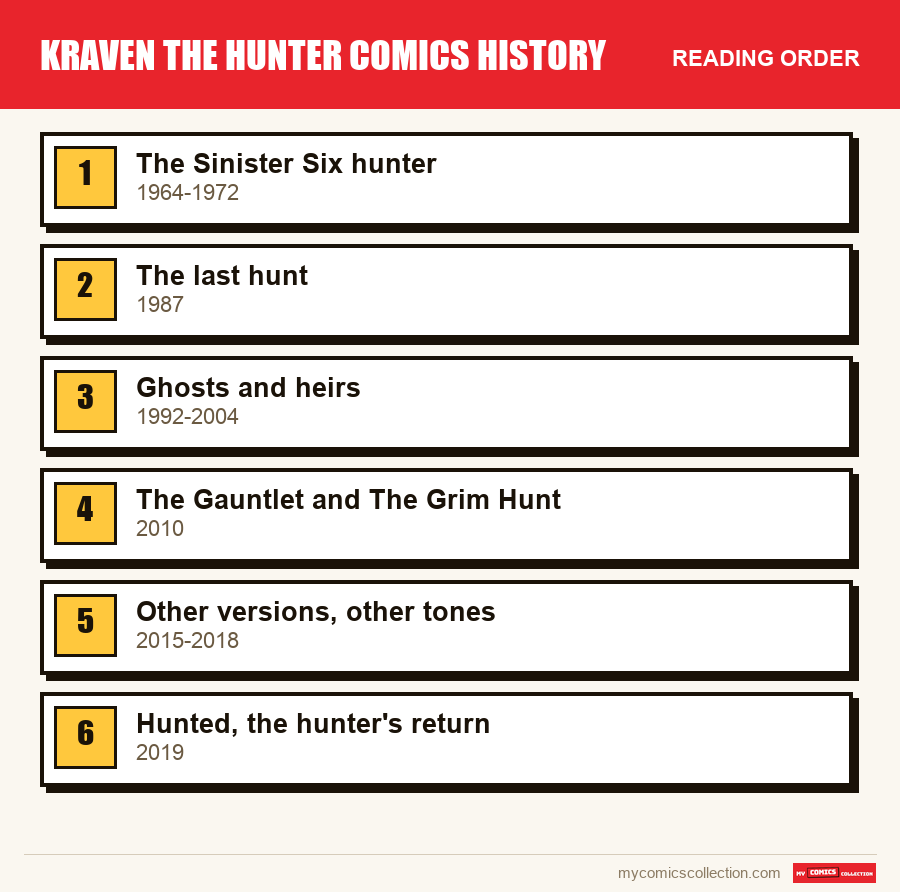
Era 1: The Sinister Six hunter (1964-1972)
Kraven's first cycle is written with Stan Lee and Steve Ditko. In October 1964, The Amazing Spider-Man Annual #1 brings together the Sinister Six for the first time, created by Lee and Ditko. Doctor Octopus gathers Spider-Man's known enemies, and Kraven is one of the six original members, alongside Mysterio, the Vulture, Sandman and Electro. There the hunter finds a bigger stage than his solo chases: Doctor Octopus's plan involves kidnapping Aunt May and Betty Brant. Our selection of the best Sinister Six comics details the group's other incarnations.
In The Amazing Spider-Man #47 (April 1967), the character returns on a John Romita Sr. cover, a sign that the hunter stays in the series' repertoire after Ditko's departure. Later, the hunter is back with The Amazing Spider-Man #103 (December 1971, a story by Roy Thomas illustrated by Gil Kane) and then #104 (January 1972), which set him in the Savage Land, a prehistoric jungle setting where a hunter feels at home.
What stands out from this first period is a character both faithful to his founding idea and trapped by it: Kraven comes back when the series wants a physical, spectacular adversary, but he does not change. That stability will become the raw material for the great reversal of 1987.
Era 2: The last hunt (1987)
Spoiler warning: this section describes the complete end of the original hunter.
The saga spans two months, October and November 1987, with two chapters per title: Web of Spider-Man #31 and #32, The Amazing Spider-Man #293 and #294, Peter Parker, the Spectacular Spider-Man #131 and #132. J. M. DeMatteis writes, Mike Zeck pencils, Bob McLeod inks, Janet Jackson, Bob Sharen and Mike Zeck color, Rick Parker letters and Jim Salicrup edits. The covers simply announce "a 6-part story": the famous title came later.
The aging, bitter hunter shoots Spider-Man with a tranquilizer and buries him alive. He then puts on his costume, brutally attacks criminals and captures Vermin. Spider-Man escapes the grave, finds Mary Jane Watson, then confronts Kraven. Kraven refuses to fight, frees Vermin and declares his hunts are over. He then takes his own life with his rifle, leaving a confession with photographic evidence that clears Spider-Man. The last scene reveals that the grave dug throughout the story was his own.
The event transformed how the character is read: from an exotic hunter, Kraven becomes the figure of a man who has moved past his obsession. To go further, the guide devoted to this story details the reading, and the one on French editions helps you choose a format. The reference English-language editions are the 1989 collection Fearful Symmetry: Kraven's Last Hunt, a 2008 edition, the 2017 Epic Collection and the 2018 Deluxe edition.
Era 3: Ghosts and heirs (1992-2004)
After the hunter's death, writers keep using his name. In 1992, The Amazing Spider-Man: Soul of the Hunter #1, by J. M. DeMatteis, Mike Zeck and Bob McLeod, brings him back as a ghost: the Kraven's Last Hunt team returns for an epilogue. In 1996, The Sensational Spider-Man Annual '96 offers "Kraven's First Hunt," again by DeMatteis, which rewrites the hunter's past by showing him violent toward the Chameleon, his half-brother.
The family then takes over. Alyosha Kravinoff, half-brother of Ana and Vladimir, takes up the Kraven title, in a story tied to Calypso in The Spectacular Spider-Man #243 (1997). The six issues of Spider-Man's Get Kraven (2002-2003) send him to Hollywood. This period shows a series logic: a name this striking does not vanish with its bearer, it passes to others.
In the Ultimate universe, the miniseries Ultimate Six (seven issues, 2003-2004) offers an alternate version of the hunter, to be read apart from the main story. For a collection, this period is the character's most scattered: annuals, miniseries and issues of parallel series, rarely gathered in a convenient collected edition.
Era 4: The Gauntlet and The Grim Hunt (2010)
Spoiler warning: this section details Sergei's return and the deaths of several Kravinoffs.
In 2010, The Amazing Spider-Man lines up two linked arcs, The Gauntlet (starting with issue #631) and then The Grim Hunt. In issue #634, Sasha sacrifices Mattie Franklin to resurrect Vladimir as a lion-like creature. The Grim Hunt then runs from issue #635 to issue #637, from June to July 2010. Joe Kelly writes its chapters, with several artists.
Sergei is resurrected through a ritual, and the hunter who returns blames his comeback on the corrupted blood Sasha used and calls his condition a "non-life." In the Savage Land, he kills Sasha and Vladimir, while Ana kills Alyosha. The arc thus closes the Kravinoff line in a bloodbath, with a Sergei whose status is very different from 1987.
For anyone following the family, this arc is the chapter to read after Kraven's Last Hunt: it measures the consequences, twenty-three years later, and shows what becomes of a character whose fate had been sealed. Issue #634 is a good entry point to pick up as a lot with the next three issues.
Do you collect this series?
Track what you own, what you are missing and what your collection is worth. 7-day trial.
Start my trial →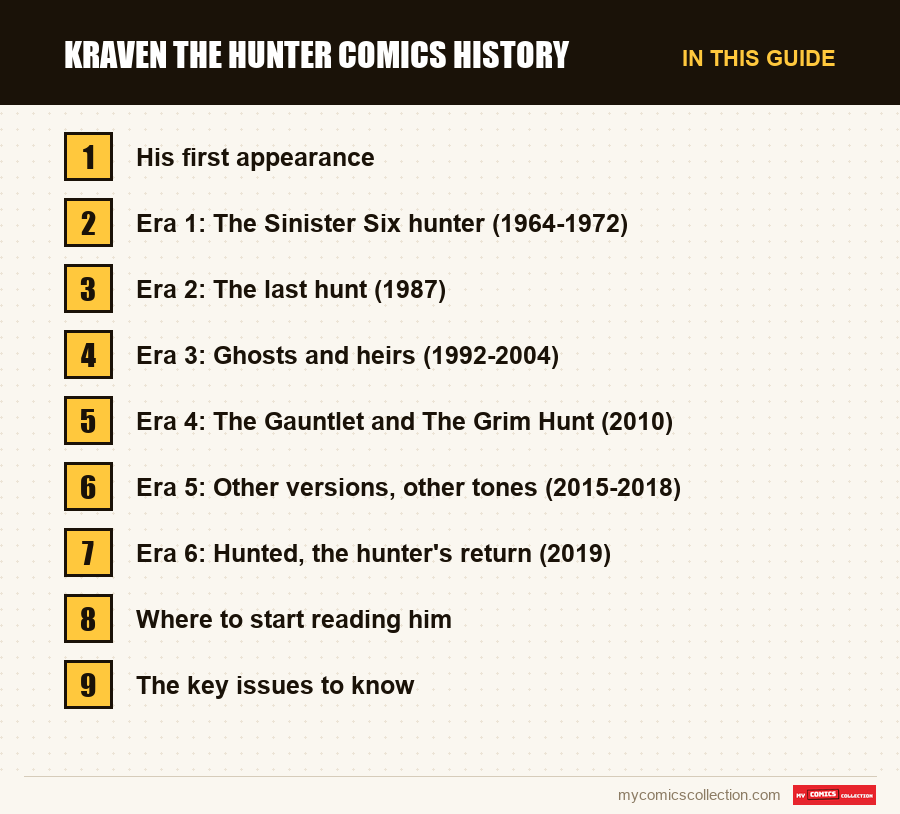
Era 5: Other versions, other tones (2015-2018)
Part of the following decade changes the register. The Unbeatable Squirrel Girl volume 1 #1 (January 7, 2015), by Ryan North and Erica Henderson, pits Kraven against Squirrel Girl. In volume 2, issues #32 to #35 (2018) make him an ally of the heroine. In Amazing Spider-Man: Renew Your Vows (2015), by Dan Slott and Adam Kubert, an alternate version of the hunter sits in Regent's Sinister Six, in issues #2 to #4. Our Dan Slott page collects this writer's other work.
These series show that the character can handle comedy as well as drama: the same name serves a light story or a parallel version. The reader looking for the main path can skip them, but the curious collector will find issues far from the historical core, best acquired last.
Era 6: Hunted, the hunter's return (2019)
Spoiler warning: this section describes Sergei's death.
Hunted runs from February to June 2019 in The Amazing Spider-Man volume 5, issues #16 to #23. Nick Spencer writes, with several artists including Humberto Ramos. The arc openly converses with Kraven's Last Hunt. Sergei has had eighty-seven clones made: these are the Sons of Kraven, trained to hunt each other. He also captures animal-themed criminals to make them the quarry of a grand hunt.
In the climax, Kraven puts on Spider-Man's black costume, and his cloned son, the Last Son of Kraven, kills him by mistake. This clone is the survivor of the eighty-seven; after Sergei's death, he takes the name Kraven the Hunter. This ending closes a cycle: the man dies a second time, but the title lives on.
The character has also had an on-screen continuation: the feature film Kraven the Hunter (2024), produced in Sony's Spider-Man universe, casts Aaron Taylor-Johnson in the role. Our film and comics page compares the two.
Where to start reading him
- The reader in a hurry: Kraven's Last Hunt (1987), six issues, the character's peak and a self-contained story.
- The reader going back to the roots: The Amazing Spider-Man #15 (1964) and Annual #1, to see the hunter and the Sinister Six born.
- The family saga reader: The Gauntlet then The Grim Hunt (2010), to follow the fate of the Kravinoffs.
- The modern reader: Hunted (2019), in eight issues, which echoes the 1987 story.
- The reader looking for something lighter: The Unbeatable Squirrel Girl (2015), for a comedic version of the character.
The key issues to know
Three tiers structure a Kraven collection. First the foundations: The Amazing Spider-Man #15 (August 1964), the first appearance, and Annual #1 (October 1964), the first gathering of the Sinister Six. Then the 1987 turning point: Web of Spider-Man #31, The Amazing Spider-Man #293 and #294, and Peter Parker, the Spectacular Spider-Man #131, which form the backbone of the story. Finally the milestones of the bloodline: The Amazing Spider-Man #634 and #637 for 2010, and The Amazing Spider-Man volume 5 #16 and #23 for 2019.
For each issue, the method is to compare several listings of the same copy, identify the edition clearly and read the condition description before buying. If the 1987 story interests you mainly for reading, a trade paperback is easier to assemble than six single issues; if you want the collectible object, it is the period single issues that count, especially issue #294, which closes the arc.
Frequently asked questions
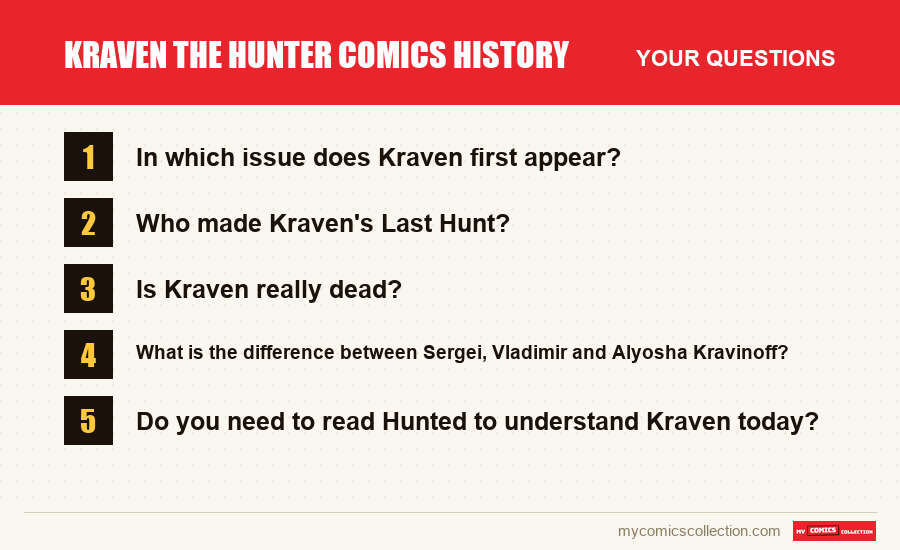
It is The Amazing Spider-Man #15, from August 1964, by Stan Lee and Steve Ditko. There he is a Russian hunter who wants to capture Spider-Man as a trophy. A few months later, Annual #1 puts him among the six original members of the Sinister Six.
J. M. DeMatteis writes, Mike Zeck draws and Bob McLeod inks. The six chapters are split across three series in the fall of 1987. Jim Salicrup, the editor, makes it a crossover of the three series.
Spoiler warning: Sergei takes his own life at the end of Kraven's Last Hunt in 1987, returns in 2010 in The Grim Hunt and dies again in 2019 in Hunted, killed by mistake by his clone. Another character has carried the Kraven name since.
Sergei is the original Kraven, who first appeared in 1964. Vladimir is his son, the Grim Hunter, and Alyosha is a half-brother of Ana and Vladimir who takes up the title in the late 1990s. The Last Son of Kraven, a clone who appeared in 2019, in turn carries the name.
Not for the essentials: Kraven's Last Hunt is enough to grasp the character. Hunted (2019, Nick Spencer with Humberto Ramos, among others) extends that story and explains the identity of the current Kraven. It reads in eight issues of The Amazing Spider-Man volume 5, #16 to #23.
Did you get your hands on The Amazing Spider-Man #15 or an issue of Kraven's Last Hunt? Get your copy appraised before you sell it.
Appraise my comic