The Millennium (1988) reading order is simple: read the eight issues of DC's weekly event in order, then add the tie-ins that appeal to you. Millennium is an eight-issue DC miniseries released weekly in 1988, written by Steve Englehart and drawn by Joe Staton, with Ian Gibson on inks. The two issues of Green Lantern Corps and those of Justice League International are the most natural tie-ins. The direct sequel is the twelve-issue series The New Guardians.
In 1988, DC tried something that was rarely done in the American market: a weekly miniseries, eight weeks in a row, whose plot spilled over into more than twenty of the company's titles. The project bears the mark of Steve Englehart, who mixes Guardians of the Universe, Manhunters, and heroes from around the world. For the collector, the difficulty lies less in the compact central series than in the forest of tie-ins surrounding it.
As always on this guide, we only state verified information (creators, issue numbers, dates); the analysis is our own, with no reproduction of protected panels or dialogue.
What to read first
The central series requires no formal prerequisites: it presents its stakes from the first issue. But its setting rests on a context that readers do well to know. The Guardians of the Universe have left Earth's dimension with their companions the Zamarons, and two of their emissaries, Herupa Hando Hu and Nadia Safir, return to announce the choice of ten humans destined to become new Guardians.
Two other pieces of background prove useful. First, the Manhunters, robot enemies of the Guardians, get their hands on Harbinger's sphere, which contains data gathered after Crisis on Infinite Earths: read our page on the series and the comics of Crisis on Infinite Earths if that passage is unfamiliar. Second, the central role of the Guardians of the Universe, who founded the Green Lantern Corps, justifies a look at the Green Lantern reading guide.
Our recommendation fits in one sentence: if you have an evening ahead of you, open Millennium #1 directly, and save the background reading for later.
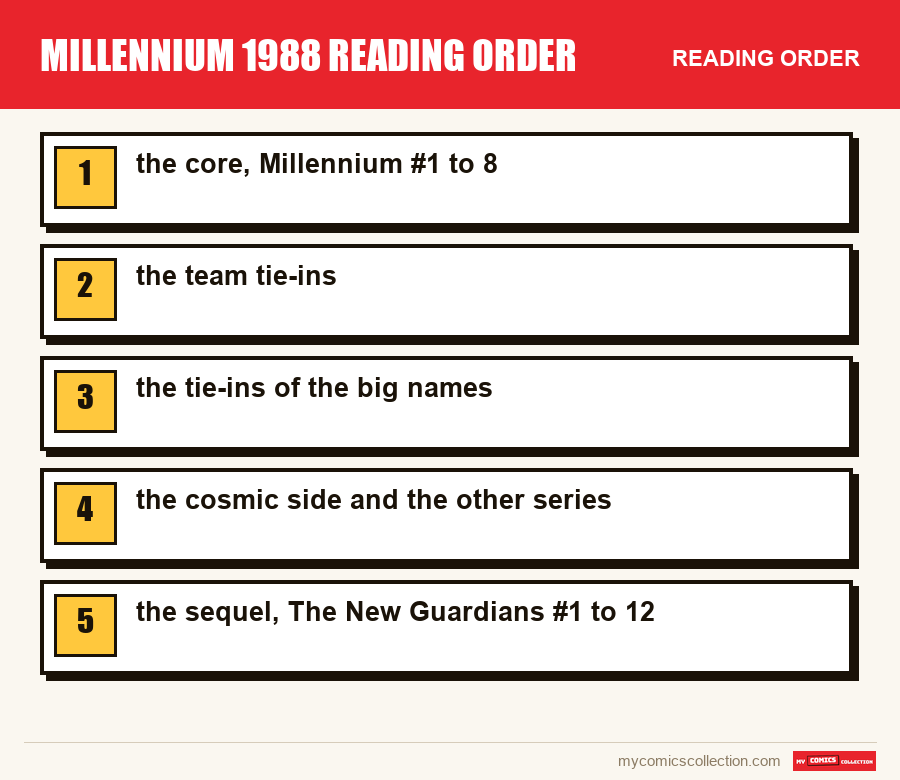
Phase 1: the core, Millennium #1 to 8
The core of the event is these eight weekly issues, all written by Steve Englehart and drawn by Joe Staton, with Ian Gibson on inks. Bob Lappan handles the lettering, Carl Gafford the coloring, and Andy Helfer the editing. The team is therefore small, which gives the story a unity of tone that the tie-ins don't always share.
The plot follows two parallel movements. On one side, heroes travel the world to gather the Chosen, among them Thomas Kalmaku and Floronic Man. On the other, the Manhunters, who learned the heroes' secret identities thanks to Harbinger's sphere, place agents near each of them and go on the attack when they learn of the search for the Chosen.
Spoiler warning: two of the Chosen are missing, including Terra of the Teen Titans, who is already dead. The sacrifice of the Guardian and the Zamaron then activates the latent powers of the remaining Chosen, who become the New Guardians. If you would rather discover these moments on the page, skip straight to the next phase.
As for reading pace, the weekly format invites a quick read: the eight issues can be read in one or two sittings. Our advice is to read them in one go, without interrupting for tie-ins, and then pick those up in small groups.
Phase 2: the team tie-ins
The central series is surrounded by single issues published by the company's team titles. The ones that connect to it are:
- Justice League International #9 and 10
- The Outsiders #27 and 28
- Infinity, Inc. #46 and 47
- Teen Titans Spotlight #18 and 19
- Young All-Stars #8 and 9
- Legion of Super-Heroes (vol. 3) #42 and 43
The team titles act as relays: they show how the search for the Chosen affects the groups that already exist in the DC universe. If you only have time for one pair, Justice League International #9 and 10 is the most accessible, because the series brings an entire team together around the stakes.
For each pair, count on a standalone read: each tells its part of the event without requiring you to read the previous one. You can therefore move from one series to another without following a strict order, as long as you have finished Millennium #8 beforehand.
Phase 3: the tie-ins of the big names
The company's three pillars, Superman, Batman, and Wonder Woman, also take part in the event. The issues listed are:
- Superman (vol. 2) #13 and 14
- Adventures of Superman #436 and 437
- Action Comics #596
- Batman #415
- Detective Comics #582
- Wonder Woman (vol. 2) #12 and 13
- The Flash (vol. 2) #8 and 9
These issues mostly interest readers who follow one of these series: they show each figure's place in the event. For a character-driven read, lean on our Superman reading guide or the one for Batman, which place these series within their overall journey.
The case of Batman #415 and Detective Comics #582 deserves a note: these are isolated issues, so they are easy to add without changing your reading plan, but they don't form an arc on their own.
Phase 4: the cosmic side and the other series
Several tie-ins extend the event into other series of the company, including the Green Lantern one:
- Green Lantern Corps #220 and 221
- The Spectre (vol. 2) #10 and 11
- Firestorm (vol. 2) #67 and 68
- Captain Atom (vol. 2) #11
- Blue Beetle (vol. 6) #20 and 21
- Booster Gold #24 and 25
- Suicide Squad #9
- Secret Origins (vol. 2) #22 and 23
Green Lantern Corps #220 and 221 are the most logical for a Green Lantern reader, since the series belongs to the universe directly concerned by the Guardians. Our page on Green Lantern crossovers places them in the character's broader history. The other titles are aimed mostly at readers of their home series.
A note on method: the list is long and the issues are short, two per series in most cases. A reader who already follows one of these series for the long haul will see a natural extension of their reading; a reader discovering the event will do better to choose only two or three titles, not all of them.
Do you collect this series?
Track what you own, what you are missing and what your collection is worth. 7-day trial.
Start my trial →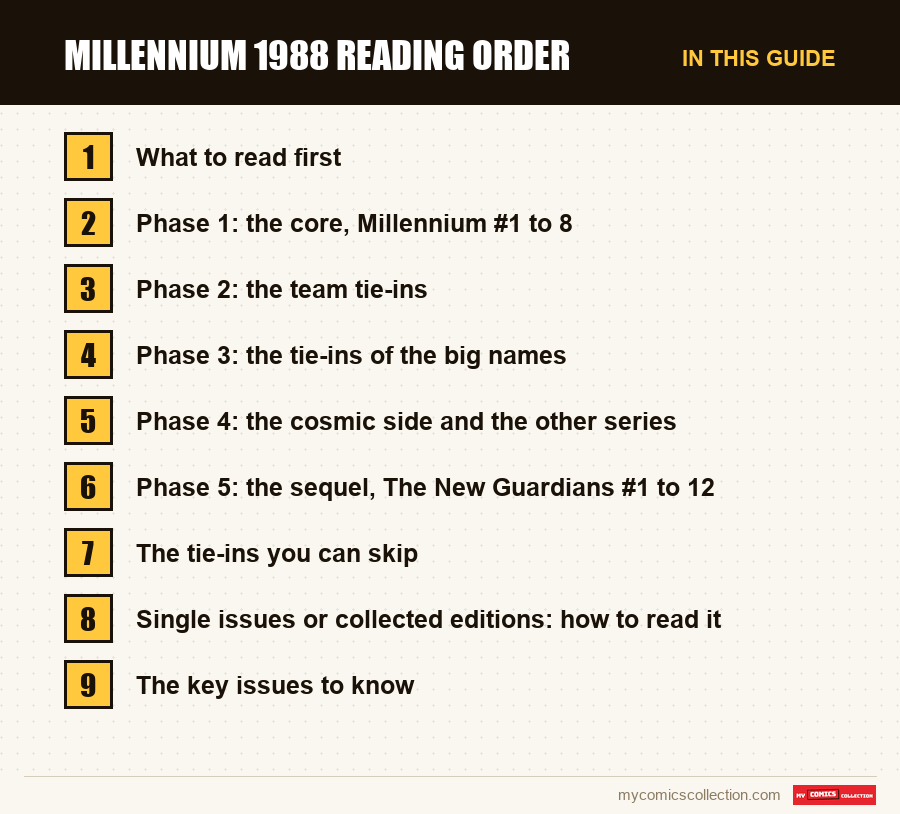
Phase 5: the sequel, The New Guardians #1 to 12
The event's heirs have their own series: The New Guardians, twelve issues, by Steve Englehart and Joe Staton, the same creators as the miniseries. It serves as the sequel: the New Guardians continue their adventure there before going their separate ways.
Spoiler warning: the spirits of Herupa Hando Hu and Nadia Safir later return to announce the existence of backup plans, according to which the true Chosen would be the creations of Janwillem Kroef, the white supremacist who had left the group. If you want to discover it on the page, read the series without consulting a summary.
The series suits readers who enjoyed the tone of the miniseries and want to stay with its characters. Others can stop at the eighth issue of Millennium without feeling the story is unfinished, because the main story wraps up.
The tie-ins you can skip
Almost all the tie-ins belong in this category, and that isn't a criticism. Each issue tells how the Millennium plot crosses an ongoing series, without the central series depending on it. Skipping Suicide Squad #9, Captain Atom #11, or Secret Origins #22 and 23 costs you nothing of the main story.
One relative exception: The New Guardians is not a tie-in in the strict sense, but a sequel. Skipping it is possible, at the price of not knowing the fate of the New Guardians, who split up at the end of their twelve issues.
The series Swamp Thing (vol. 2) #65 and 66 is a special case: these issues are listed as an unofficial tie-in. They interest the loyal reader of the series, but have no place in a path centered on the event.
Single issues or collected editions: how to read it
Released in 1988, at a rate of one issue per week, Millennium is a particular collectible: eight issues that form a compact block, easy to store in a single box. In single issues, you can gather the central series and the tie-ins that interest you, filing them by series so you can easily find each issue.
For a collected-edition read, the method is to check the table of contents before buying: note the Millennium issues included (from #1 to 8) and any tie-ins added. We don't cite a specific edition, because contents vary from one volume to another. If you read in French, also check which tie-ins appear in the translated version, because not all the series are available in the same language.
The choice between the two formats comes down to how you use them: single issues respect the original weekly rhythm and let you mix titles, while the collected edition gives a continuous, compact read. For an eight-issue event, both hold up.
The key issues to know
An older event offers the collector several benchmarks, which should be approached with method rather than with numbers:
- Millennium #1: the opening issue, the natural entry point of the series.
- Millennium #8: the last issue, which closes the series.
- The New Guardians #1: the start of the spin-off series, by the same creators.
- Justice League International #9 and 10: the most accessible team tie-ins for a reader discovering the event.
- Green Lantern Corps #220 and 221: the tie-ins that speak to Green Lantern collectors.
Before paying for a 1988 single issue, look at the spine, the corners, and the tint of the pages: paper from that era yellows at very different speeds from one print run to another. Always compare several sold listings of the same issue in comparable condition. A copy of Millennium already in your longboxes can be valued through the free estimate.
Recap: the complete order
- Millennium #1 to 8 (1988), read in one go
- Green Lantern Corps #220 and 221
- Justice League International #9 and 10
- The Outsiders #27 and 28, Infinity, Inc. #46 and 47, Teen Titans Spotlight #18 and 19, Young All-Stars #8 and 9, Legion of Super-Heroes #42 and 43
- Superman #13 and 14, Adventures of Superman #436 and 437, Action Comics #596
- Batman #415, Detective Comics #582, Wonder Woman #12 and 13, The Flash #8 and 9
- The Spectre #10 and 11, Firestorm #67 and 68, Captain Atom #11, Blue Beetle #20 and 21, Booster Gold #24 and 25, Suicide Squad #9, Secret Origins #22 and 23
- The New Guardians #1 to 12
Frequently asked questions
The miniseries has eight issues, published weekly in 1988, which was unusual for an American series. Steve Englehart writes it, Joe Staton draws it, and Ian Gibson inks it. The spin-off series The New Guardians adds twelve more issues.
No: the central series reads on its own and wraps up in eight issues. The tie-ins show how the event touches other series of the company. The most natural ones for a Green Lantern reader are Green Lantern Corps #220 and 221, and for the teams Justice League International #9 and 10.
The direct sequel is the series The New Guardians, twelve issues written by Steve Englehart and drawn by Joe Staton. It follows the New Guardians who emerged from the event until they split up. It remains optional for anyone who only wants the miniseries.
The link is indirect: the Manhunters seize Harbinger's sphere, which contains data gathered after Crisis on Infinite Earths. Reading Crisis first isn't necessary, but it gives meaning to that plot detail.
Finish Millennium #8 first, then read the tie-ins by series, each pair of issues forming an independent block. Choose the ones that match your favorite series: the order between series doesn't matter, because each tells its part without depending on the others.
You own single issues from the 1988 weekly event: get the condition of your copies appraised before you file them away.
Appraise my comic