
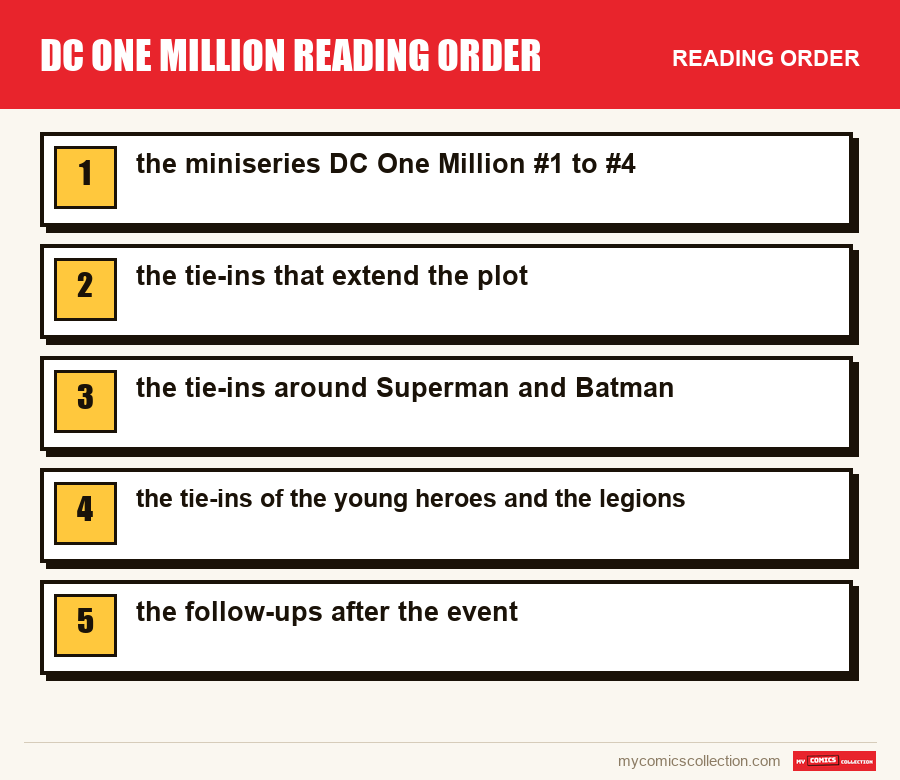
The DC One Million reading order starts with a four-issue miniseries dated 1998, written by Grant Morrison with Val Semeiks on pencils. It comes with "#1,000,000" issues published in about thirty other DC series. Read the four miniseries issues first, then the tie-ins that extend the plot: JLA, Starman, Green Lantern and Resurrection Man. The rest is a bonus.
Few DC events rest on a numbering idea as simple as this one: the 853rd century, when Action Comics would reach issue number one million at a rate of one issue per month. This article gives you the order to read DC One Million without getting lost in the mass of tie-ins: a short backbone, a few useful milestones, then a list of issues you read for the fun of seeing eras meet.
As always in this guide, we only state verified facts (creators, issues, dates); the analysis is our own, with no reproduction of protected pages or dialogue.
What to read before
Good news: DC One Million demands no heavy prerequisites. Two teams come together: the JLA of our era and the Justice Legion Alpha of the year 85,000 and change. DC's usual figures, from Superman to Aquaman by way of Flash and Green Lantern, all play a part. If this cast is familiar to you, you can open #1 directly.
Three reference points still make the reading easier:
- the JLA by Grant Morrison and Howard Porter, whose #1,000,000 issue is one of the tie-ins: reading a few issues of that series helps you grasp the team Morrison puts on stage;
- the Legion of Super-Heroes as a whole, the source of inspiration for the Justice Legions of the future; the page on Legion of Super-Heroes between screen and comics gives the context for these heroes of the 30th century;
- a quick overview of the team, which our reading page devoted to the Justice League provides if you have never opened the series.
If you only remember one thing: the event is about continuity, legacy and the future. The more familiar you are with the characters, the better the nods work, but nothing stops you from coming in out of curiosity.
Phase 1: the miniseries DC One Million #1 to #4
The main series has four issues, released in November 1998 at the same time as the tie-ins. Grant Morrison writes; Val Semeiks draws, with Prentis Rollins, Jeff Albrecht and Del Barras on inks and Pat Garrahy on colors. It is a short story, where the chosen setting serves inventiveness more than a string of fights: today's team meets the one from the year 85,201 to 85,300, and you have to accept entering a world populated by future variants of the heroes you know.
The starting point of the plot is a scheme by Vandal Savage and Solaris, a stellar computer, against which the two teams join forces. The Justice Legions of the future are numerous, each built on a hero or a family of heroes: Legion Alpha includes future counterparts of Wonder Woman, Hourman, Starman, Aquaman, Flash and Batman; others draw on the Titans, the Legion of Super-Heroes, the Superboy clones, Young Justice or the Super-Pets. This catalog of teams is the richness of the event and the reason it reads better as a single block.
Tip: read the four issues in one go, without interleaving tie-ins on a first read. You will get the architecture of the story, and then you can choose what to add.
Phase 2: the tie-ins that extend the plot
Among the thirty or so "#1,000,000" issues, some touch more directly on what the miniseries tells. Spoiler warning: the following lines mention elements of the conclusion.
- JLA #1,000,000: Grant Morrison writes, Howard Porter draws, John Dell inks. It is the natural tie-in for catching up with the 20th-century team under the pen of the event's writer.
- Starman #1,000,000: James Robinson on script, Peter Snejbjerg on art, Wade Von Grawbadger on inks. The character plays a part in the conclusion of the miniseries.
- Green Lantern #1,000,000: Ron Marz on script, Bryan Hitch on art, with Andy Lanning and Paul Neary on inks. Kyle Rayner steps in at the end of the story.
- Resurrection Man #1,000,000: Dan Abnett and Andy Lanning on script, Jackson Guice on art. The character matters in the outcome of Vandal Savage's plan, with Chronos: also read Chronos #1,000,000 if you follow that thread.
As for method: read these four issues after miniseries #4 rather than between chapters. They read like echoes of the ending, which avoids breaking the rhythm of the main story.
Phase 3: the tie-ins around Superman and Batman
The two most represented families of characters are those of Superman and Batman. On the Superman side, the list starts with Action Comics and Adventures of Superman, goes through Superman (vol. 2) and Superman: The Man of Steel, then extends to Superboy, Supergirl and Superman: The Man of Tomorrow. Superman: The Man of Tomorrow #1,000,000 is written by Mark Schultz and drawn by Georges Jeanty, with Dennis Janke and Denis Rodier on inks.
For Batman: Batman, Batman: Shadow of the Bat, Detective Comics, Nightwing, Robin, Azrael and Catwoman. Detective Comics #1,000,000 is written by Chuck Dixon and drawn by Greg Land, with Drew Geraci on inks. These issues provide a "family" side of the event: you see the heroes of the Bat-family and the Super-family projecting themselves into the future.
Reading them is not essential to follow the miniseries. It is worth it if you collect one of these characters and want to see their 853rd-century version. If you follow Batman's adventures as a collector, the Batman reading guide helps place these series.
Phase 4: the tie-ins of the young heroes and the legions
Another group of issues gathers the series with a younger or more collective tone: Young Justice, Impulse, Legionnaires, Legion of Super-Heroes and The Power of Shazam!. The Justice Legions described by the miniseries lean on these universes: Legion T draws on Young Justice and includes Robin the Toy Wonder and Impulse; Legion L builds on the Legion of Super-Heroes.
If you have read the miniseries, you will recognize these echoes immediately. Read these issues according to your affinity with the original series: the point is to find, in each title, its own atmosphere, adapted to the shared futuristic setting.
The other series involved are more disparate: Flash, Wonder Woman, Aquaman, Martian Manhunter, Green Arrow, Chase, Creeper, Hourman, Lobo, Booster Gold, Hitman and Young Heroes in Love. Hitman #1,000,000 parodies the whole story, which makes it a read apart, funnier if you already know the main narrative.
Do you collect this series?
Track what you own, what you are missing and what your collection is worth. 7-day trial.
Start my trial →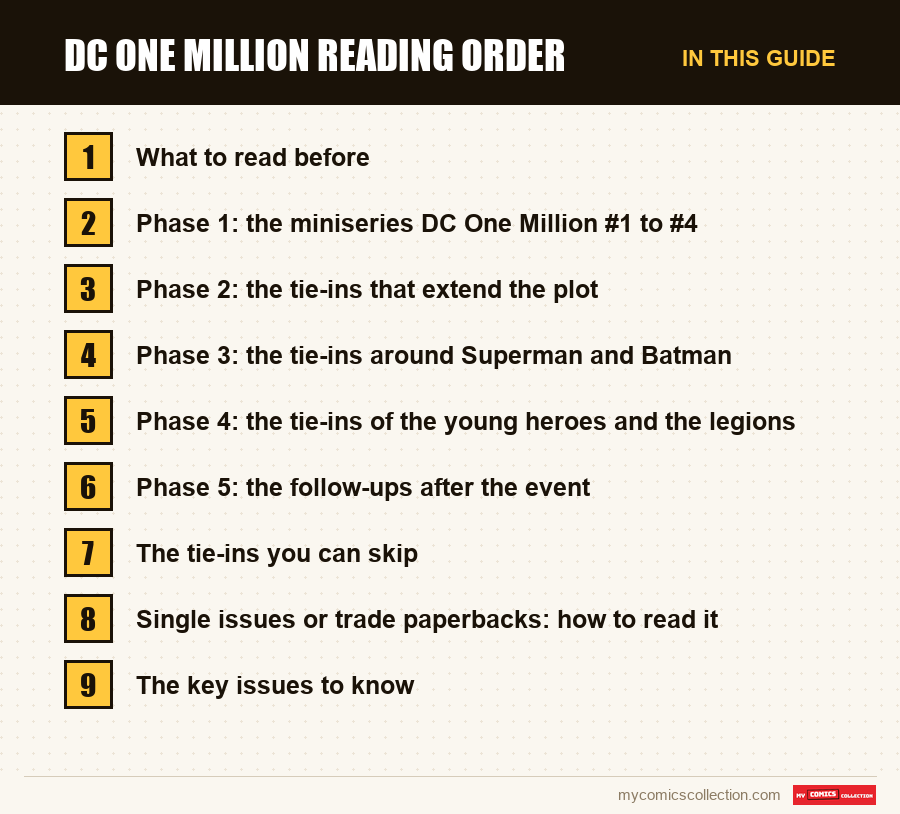
Phase 5: the follow-ups after the event
Several publications pick up or extend the event after the fact. Read them in this order, according to your curiosity:
- DC One Million 80-Page Giant #1,000,000 (1999): a one-shot that tells other adventures of the heroes of the future.
- Superman/Batman #79 and #80: the One Million versions of Batman, Robin and Superman reappear in a story where Epoch faces Batmen and Supermen from several eras.
- Batman #700: Grant Morrison's episode briefly brings back the One Million Batman and Robin the Toy Wonder.
- All-Star Superman: Morrison's series ends with a Superman turned into a being of energy settled in the Sun, a direct echo of the original Superman of DC One Million, and Solaris appears in it. The page All-Star Superman: the film versus the comics gives another angle on this series.
- Booster Gold #1,000,000 (2008): billed as an official tie-in, it introduces Peter Platinum, the Booster Gold of the 853rd century. The duo described in Blue Beetle and Booster Gold helps place this character.
These titles are not urgent reading. They serve rather to gauge the event's influence on Morrison's later work, and they suit readers who want to extend the experience without rereading the miniseries.
The tie-ins you can skip
Almost all of them. The miniseries is designed to stand on its own: each "#1,000,000" issue tells an episode within its own series, with its own creators, and stays readable without the others. Choosing among them is a matter of taste, not of comprehension.
In practice, you can set aside the series you do not usually follow: not reading Chase, Creeper or Young Heroes in Love deprives you of no element of the main plot. They have their value, but they mostly interest those who collect these series, or those who want to complete all thirty-four issues to the end.
For the hurried reader, a simple rule: miniseries, then JLA, then the three other milestones of Phase 2. After that, add what you like.
Single issues or trade paperbacks: how to read it
In single issues, the challenge is to gather about thirty issues from different series, some of which may not interest you. If you do it, build the miniseries first, then add the tie-ins at your own pace.
In a trade paperback, the DC One Million volume, released in 1999 (208 pages), also circulates under the title JLA: One Million; DC reprinted it in June 2004. A DC One Million Omnibus edition (October 2013, 1,080 pages) also exists.
The 1999 collection gathers the miniseries and six tie-ins: JLA, Starman, Green Lantern, Resurrection Man, Superman: The Man of Tomorrow and Detective Comics #1,000,000. The omnibus collects the miniseries, the 1998 tie-ins except Young Heroes in Love, as well as Booster Gold #1,000,000, the 80-Page Giant and Superman/Batman #79 and #80.
Our method: if you simply want to read the story, take the 1999 collection, whose contents overlap almost exactly with our Phase 2; if you want the complete collection, the omnibus covers most of it and only Young Heroes in Love #1,000,000 remains to be hunted down as a single issue.
The key issues to know
- DC One Million #1: the opening of the miniseries, the reference issue of the event.
- JLA #1,000,000: the Grant Morrison and Howard Porter tie-in, for readers of that run.
- Booster Gold #1,000,000 (2008): the first appearance of Peter Platinum, the Booster Gold of the 853rd century.
- DC One Million 80-Page Giant #1,000,000 (1999): the extension of the event as a one-shot.
- Superman/Batman #79 and #80: the return of the One Million versions of Batman, Robin and Superman.
The method for valuing these issues remains simple: favor condition and the completeness of a series over the supposed effect of scarcity. A #1,000,000 issue sells first as an issue of its original series; what changes is the buyer's interest in the event. Compare several completed sales before setting a price.
Summary: the complete order
- DC One Million #1 to #4 (1998): the miniseries by Grant Morrison and Val Semeiks.
- JLA #1,000,000 (Grant Morrison, Howard Porter).
- Starman #1,000,000 (James Robinson, Peter Snejbjerg).
- Green Lantern #1,000,000 (Ron Marz, Bryan Hitch).
- Resurrection Man #1,000,000 (Dan Abnett, Andy Lanning, Jackson Guice), with Chronos #1,000,000.
- The Superman and Batman tie-ins, your choice, including Superman: The Man of Tomorrow and Detective Comics.
- The tie-ins of the young heroes and the legions: Young Justice, Impulse, Legionnaires, Legion of Super-Heroes.
- DC One Million 80-Page Giant #1,000,000 (1999).
- Follow-ups: Superman/Batman #79 and #80, Batman #700, Booster Gold #1,000,000 (2008).
Frequently asked questions
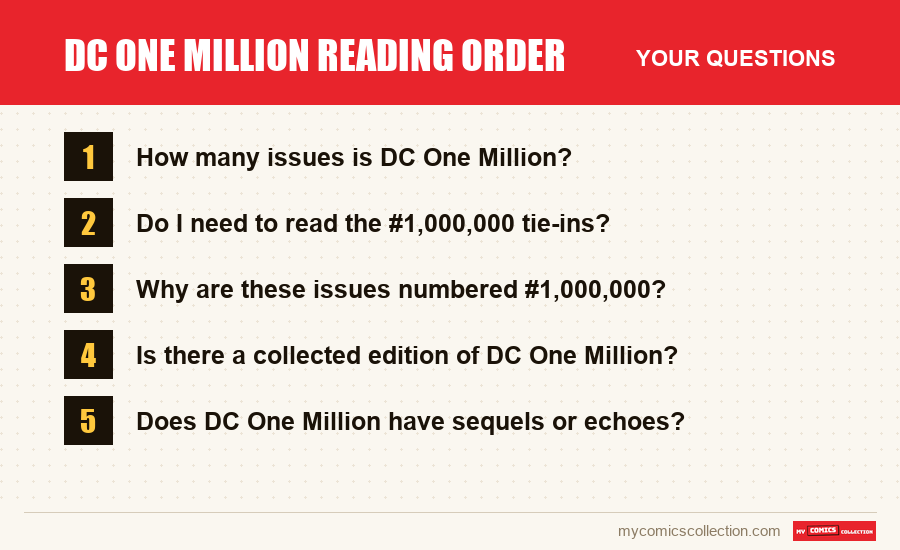
The main miniseries has four issues, written by Grant Morrison and drawn by Val Semeiks, published in 1998. It comes with "#1,000,000" issues published in about thirty other DC series, which makes for an extended collection if you want to read everything.
No, the miniseries stands on its own. The tie-ins are episodes within each original series. If you only read a few, choose JLA, Starman, Green Lantern and Resurrection Man, which touch more closely on the main plot.
The event is set in the 853rd century, a period chosen because that is when Action Comics would reach issue number one million at one issue per month. The series involved therefore carry this symbolic number for their futuristic episode.
Yes. A volume was released in 1999 (208 pages); it also circulates under the title JLA: One Million. It collects the miniseries and six tie-ins, including JLA and Starman. A 1,080-page DC One Million Omnibus edition, released in October 2013, gathers almost all of the #1,000,000 issues.
Several. DC One Million 80-Page Giant (1999) extends the adventure, Booster Gold #1,000,000 (2008) introduces Peter Platinum, and Grant Morrison echoes it in All-Star Superman, where Solaris reappears, then briefly shows the One Million Batman in Batman #700.
Do you have #1,000,000 issues filed with your DC series? Estimate their condition and value before you sort them away.
Estimate my comic