The duo formed by Ted Kord and Booster Gold is one of the most beloved friendships in American comics, and it is based on a simple principle: they are two mediocre people in the middle of legends. One is a powerless inventor, the other an opportunist who came from the future for glory. Together, they set up businesses that failed, contracted debts and supported each other against general opinion. Their comedy comes from the gap: they are ordinary in an environment that is not.
It is this duo, much more than their respective solo series, which made these two secondary characters figures that readers still defend thirty years later: to the point that their separation, when it occurred, was received as a personal loss by part of the readership.
This article explains how it works, why it has stood the test of time, what its dissolution produced, and how to approach it today.
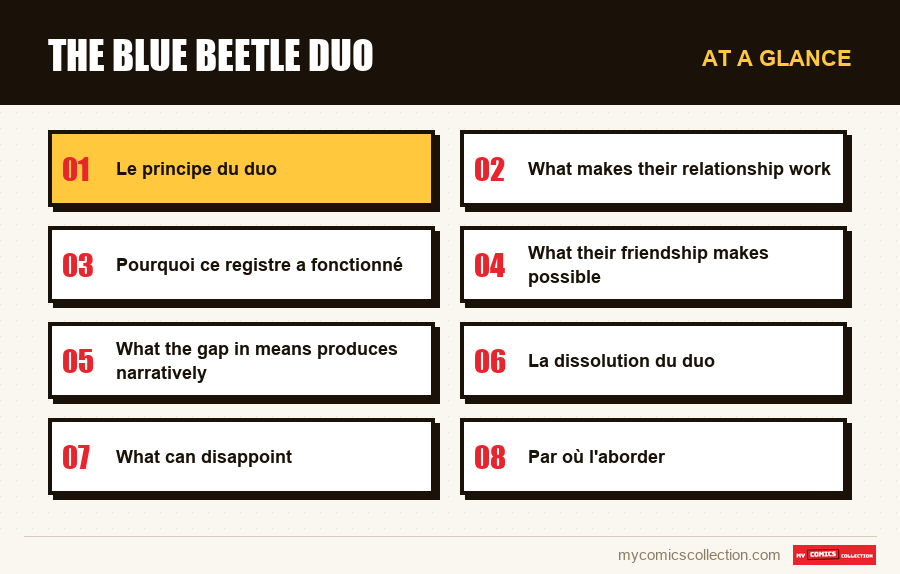
Le principe du duo
Two secondary characters placed in a team of first-tier heroes, and whose inadequacy becomes the subject rather than the problem.
One has no power and compensates with machines he makes himself. The other has equipment brought from the future, but uses it mainly to get noticed and set up commercial operations.
Neither is truly incompetent in the strict sense of the term. They are simply located below room level, stuck among people capable of moving mountains, and fully lucid about the distance that separates them.
It is this consciousness that does everything. A mediocre character who ignores himself is a gag; two mediocre characters who know exactly where they stand and carry on anyway become endearing.
What makes their relationship work
A complementarity of faults
One is cautious and handy, the other impulsive and smooth-talking. Their respective weaknesses trigger each other, ensuring that nothing ever goes as planned.
It's not a complementarity of forces: that would be an effective team, therefore without comic interest.
Des projets commerciaux
Their most constant motive: starting a business that will enrich them. They all fail, and they start again with the same enthusiasm.
Une loyauté disproportionnée
They support each other well beyond reason, even when everyone around them advises them the opposite. This is what makes comedy touching.
A relationship that evolves
This is not a gag repeated over twenty years. They get angry, reconcile, disappoint each other, and this development transforms a comic duo into a written friendship.
Pourquoi ce registre a fonctionné
Comedy in a superhero story fails more often than it succeeds. Three choices explain why it held.
The issues remain real. The world around them does not become a joke: the threats are serious, as are the consequences. The comedy comes from how these two get through serious situations, not from a general weakening.
They are competent when necessary. This is the most important and most often missed point. When it’s time to act, they act: sometimes brilliantly. A comedy duo that would never measure up would quickly cease to be lovable, and the team around them would keep them for the wrong reasons.
The story doesn't make fun of them. He laughs with them. The difference is tenuous and decisive: a text which exhibits the incompetence of its characters from the outside produces contempt, not attachment.
What their friendship makes possible
Beyond the comic, this duo provides the team-up series with something its other members can't.
A team of first-rate heroes is an institution: we speak to each other with a certain formality, we debate strategy, we resolve differences. None of this feels like friendship.
These two introduce the private register in a place that did not have one. They argue with each other, confide in each other, argue with each other for stupid reasons. The headquarters ceases to be an office and becomes a place where people come together.
This shift left a deep mark. After them, we stopped treating teams as constituted bodies to show them as they really would be: colleagues who tolerate each other more or less well and whose power does not resolve any domestic question.
The paradox of their popularity. These two characters are, individually, of second rank. Together, they became one of the reasons why we reread this team series thirty years later.
Neither carries a memorable solo series. Their value lies entirely in who they are to each other, which is rare in a medium where individual characters are first constructed.
What the gap in means produces narratively
One construction detail is worth isolating, because it explains why this particular duo works where other comedic attempts fail.
The two characters are not mediocre in the same way, and this asymmetry is what fuels their scenes. One lacks means but compensates with ingenuity: he makes, he tinkers, he finds. The other has superior equipment but uses it poorly, because his priorities are not the right ones.
This results in a dynamic where each one is right against the other in turn. The handyman blames his friend for wasting his advantages; the opportunist reproaches him for being content with little. Neither is wrong, which prevents the story from pointing out anyone at fault.
It's very different from a classic duo where one would be the voice of reason and the other the troublemaker. This configuration quickly exhausts itself, because the reader knows in advance who will be right in the end.
No one here holds the sane position. Both are wrong, alternately and for different reasons, which allows their arguments to be repeated for years without the process wearing out.
La dissolution du duo
One of the two was killed in 2005, at the end of a story where he alone discovered a conspiracy and continued his investigation without being taken seriously.
Death itself is nothing exceptional in this medium. What stood out was what she did to the surviving character: deprived of his only anchor point, he becomes a much more serious figure, carried by a mourning which redefines his entire subsequent journey.
This is an effect that the authors could not have achieved directly. You can't write twenty years of friendship in one chapter; you have to have built it, then remove it. The weight comes from the buildup, not the scene.
For a reader who discovers these characters today, the consequence is clear: reading death before comedy produces nothing at all. Order matters more here than in almost any other story of the genre.
Collecting this series?
Track what you own, what you are missing and what your collection is worth. 7 day trial.
Start my trial →What can disappoint
Un humour d'époque
Certain jokes and situations clearly belong to the 1980s. The whole thing holds up, but some chapters have frankly aged.
Crossings that interrupt
Large transversal operations periodically appear in the series, with pieces of intrigue published in other titles. Following the duo then becomes frankly uncomfortable.
A tone that divides
For a section of the readership, making a vigilante laugh amounts to diminishing him. The objection dates from the origins of the genre and it is not absurd.
Une reconstitution malcommode
The duo's best scenes are scattered across several series with changing titles. Putting them together requires knowing what to look for.
Par où l'aborder
Three recommendations, the first of which avoids most of the disappointments.
By the training of 1987, and in collections. Their association was born there and will never be better served there. The bound format puts the chapters in sequence and neutralizes a large part of the references to other titles.
Without looking for solo series. Neither has an individual narrative that matches what they do together. This is a case where the duo is definitely worth more than the sum of its parts.
La mort en dernier. The 2005 story only produces its effect after the comedy. Read backwards, it tells of the disappearance of a character we don't know.
Côté marché
The following figures come from a count of offers opened in the United States on August 28, 2026, after removing packets and subsequent drawings.
The booklet which launches this training is displayed around huit dollars nus, with nearly one hundred and forty-one simultaneous offers. Nothing related to this character is cheaper or more available.
Its certified market is almost non-existent:six annonces, at a median of $148, a figure to be handled with caution since it describes the intention of six sellers rather than a market.
The contrast with the character's old issues is clear: his first appearance in the 1960s fetched $20 gross and had 29 certified ads. The most popular period is therefore the least expensive, because a major publisher's circulation in 1987 remains abundant forty years later.
Ce qu'il faut enregistrer
In a duo whose best scenes are scattered, two fields stand out from the ordinary.
The actual title of the booklet. The numbers that count bear the name of a team, with titles that change over the years. Saving “Blue Beetle” on a copy whose cover says something else makes it impossible to find in one’s own collection.
L'année de parution. Teams with almost identical titles followed one another a few years apart: the number of the booklet alone therefore does not allow us to locate any period.
For those who build a collection around the duo rather than around a character, a third field becomes useful: the effective presence of both in the number. Many issues in this series do not feature them together, and nothing on the cover indicates this.
It is a way of collecting by relationship rather than by character, and no standard classification provides for it: hence the need to note it yourself.
Questions fréquentes
Because it is based on two ordinary characters among people who are not, and who are perfectly aware of it. A mediocre character who ignores himself is a gag; two who know exactly where they stand and carry on anyway become endearing.
It does not weaken them because they remain competent when acting: this is the point most often missed. A comedy duo who never measure up would quickly cease to be likeable, and the team around them would keep them around for the wrong reasons. The story laughs with them rather than at them.
It's not necessary, and it's even disappointing. Neither has an individual narrative that matches what they produce together: it's a case where the duo is significantly more than the sum of its members, which is rare in a medium built on individual characters.
Yes, but last. The 2005 story only produces its effect after the comedy: read backwards, it recounts the disappearance of a character we do not know. The weight of this scene comes from twenty years accumulated, not from its writing: you can't write twenty years of friendship in one chapter.
When looking for the title of the team series and the year, never the name of the characters: their numbers do not have it. You should also know that many booklets in this series do not feature them together, without anything on the cover indicating this.
Collect a relationship, not a character
No standard classification provides for this field: the effective presence of both in the number.