Three people have had the name Blue Beetle, and they have almost nothing in common. Dan Garrett is an archaeologist from the 1930s whose powers come from a mystical scarab. Ted Kord, created by Steve Ditko in 1966, has no power: he is an inventor who compensates with machines and humor. Jaime Reyes, who appeared in 2006, is a teenager from El Paso whose spine is grafted by the beetle, and it turns out to be alien technology. A reader who doesn't know which one he's looking for is wasting a lot of time.
The confusion is all the easier since all three had exactly the same name, under two different publishing houses, with series that all start again at number one and covers that never specify who it is.
This article introduces each carrier, explains what connects and separates them, and where to start depending on what you're looking for.
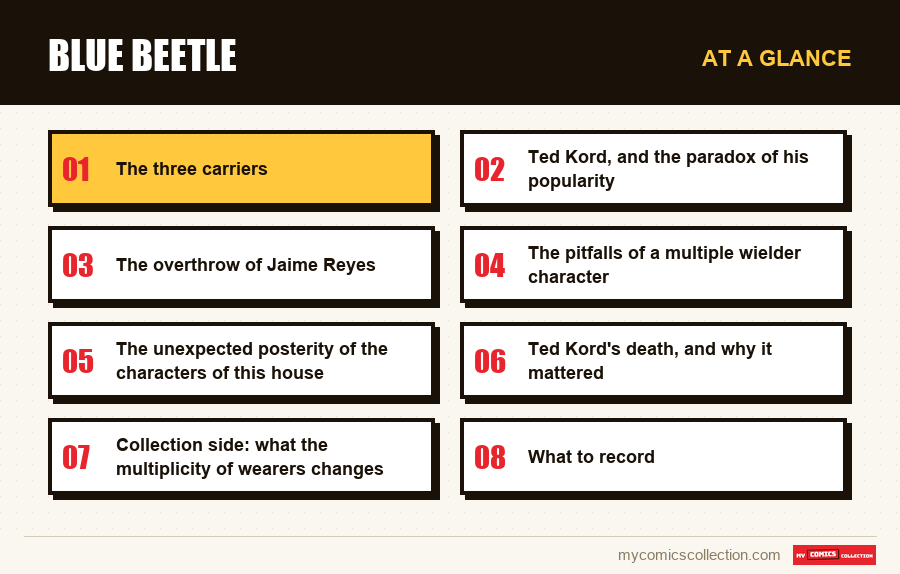
The three carriers
Dan Garrett: the original
Created in the late 1930s, then reinvented in 1964 under another publishing house. He is an archaeologist who gets his powers from a scarab discovered in an Egyptian tomb.
Frankly dated register, exotic adventure and shoddy mysticism. We read it today to understand the character's story, rarely for the pleasure of reading itself.
Ted Kord: readers' favorite
Created by Steve Ditko in 1966. A student of Garrett, he cannot activate the beetle and decides to do without magic: he makes his tools.
He's the only one of the three without power, and by far the most endearing. His most beloved period is not his solo series but his time in a team, twenty years later.
Jaime Reyes: the current porter
Appeared in 2006. A high school student from El Paso finds the beetle, which grafts itself to his spine and refuses to leave.
The story reverses the situation: the scarab is not mystical but an alien weapon, and it has plans that are not those of its bearer.
What connects them
An object, transmitted from one to another, whose nature changes with each era: magical relic, then inspiration, then hostile technology.
This is the only truly continuous thread between the three: the costume is not transmitted, the beetle is.
Ted Kord, and the paradox of his popularity
One thing is surprising when we look at this character closely: his most celebrated period is not the one that bears his name.
His 1960s solo series, drawn by Ditko, was brief and never achieved much success. What made him a beloved character was his integration into a team twenty years later, in a register of comedy that nothing suggested.
There, he becomes one half of a comedy duo with another minor hero, and the lifeblood of the series rests on their failed schemes, debts, and relative incompetence. They are funny because they are mediocre among people who are not.
This period lastingly defined the character. A reader who discovers Ted Kord through his solo series will find a fairly conventional B-movie vigilante; anyone who discovers it through the team will understand why his death, in 2005, was received as a betrayal by part of the readership.
The overthrow of Jaime Reyes
The Third Wearer doesn't just repeat the costume: his series retroactively reconfigures everything that came before.
The scarab that gave the first wielder its powers was not an Egyptian relic. It is an extraterrestrial device, designed by a civilization which places it on the planets it intends to annex: the object must prepare the ground by linking itself to an inhabitant.
This completely changes the meaning of inheritance. Where the first two bearers received a power, this one receives a weapon that has its own intentions and who speaks to him. The essence of the story lies in the negotiation between the adolescent and the object grafted to his back.
The series adds a second shift, less spectacular but just as clear: Jaime has a family who knows. No double life, no secrets to protect: his parents, his sister and his friends are in the know from the first chapters, which removes the most worn dramatic mechanism of the genre.
Where to start, depending on what you're looking for. For humor and characters, go straight to Ted Kord's team period: it's also the most financially accessible.
For a modern, complete and self-contained story, take Jaime Reyes' series from 2006. For the character's story and Ditko's drawing, the series from the 1960s. Dan Garrett is only of interest to completionists.
The pitfalls of a multiple wielder character
Many series start at one
Each carrier has had its own number one, under different publishers and forty years apart. “Blue Beetle #1” means nothing without the year.
Two publishing houses
The old titles were published by a publisher since purchased. Subsequent reissues bear another brand, although the cover does not always indicate this.
The name is not enough to search
A “Blue Beetle” ad can refer to three characters. You must look in the name of the bearer, or that of the title bearing the apparition.
Appearances outside the title series
Ted Kord's most important moments occur in team series that don't bear his name. Searching for “Blue Beetle” misses them entirely.
The unexpected posterity of the characters of this house
A detail of editorial history is worth knowing, because it explains why these characters matter beyond their own success.
When the big publisher bought the catalog of the small house that published Blue Beetle, an author proposed using them for a story that would have destroyed them all. We preferred characters invented for the occasion, in order to preserve those we had just acquired.
This story has become one of the most read graphic novels in the history of the medium, and its protagonists are direct transfers of the characters of this house. The powerless inventor with an insect-shaped ship has an immediately recognizable equivalent.
For a reader, this provides an unexpected gateway: those who know this classic already know, without knowing it, the structure of Blue Beetle's group. For a collector, this adds a reason to be interested in original titles, whose lineage goes far beyond notoriety.
Collecting this series?
Track what you own, what you are missing and what your collection is worth. 7 day trial.
Start my trial →Ted Kord's death, and why it mattered
An event from 2005 is worth explaining, because it constantly comes up in discussions about this character and is rarely placed in context.
The second bearer is killed at the end of a story where he alone discovers a conspiracy, alerts the major heroes who do not take him seriously, and continues his investigation despite everything. He dies refusing an offer that would have saved his life.
What shocked part of the readership was not death itself, the genre uses it extensively, but what it meant. A character established as comic is granted, at the moment of disappearing, a courage that serious heroes did not have. Its end rehabilitates it by removing it, which is an ambivalent way of paying homage.
The episode lastingly structured the perception of the character. For many readers, Ted Kord is now defined by two things in tension: a decade of comedy and a serious release. It is this tension that explains attachment, and the resentment that accompanies it.
Collection side: what the multiplicity of wearers changes
A three-wielder character is not collectable as a single character, and the most common mistake is to treat the set as a single item.
Each carrier has its own market, with its own key numbers and its own buyers. A collector interested in the inventor of the 1960s is not looking for the same issues as someone interested in the recent film, and the two are not in competition.
This has a pleasant consequence: you can collect one carrier without the others, without the collection appearing incomplete. A coherent whole around just one of the three is perfectly defensible, and it costs three times less than an attempt at completeness.
The difficulty lies elsewhere. A carrier's defining moments often occur in series that don't bear his name: a team, an event, a title dedicated to someone else. A collection organized by title therefore systematically misses part of what matters.
The solution consists of keeping the list by character rather than by series, and to record the real title of each issue. It takes longer to grasp at the moment, and it is the only way to find, years later, the number of a team series where a decisive scene is played out, the existence of which is no longer indicated by anything in the ranking.
What to record
Three fields, and the first has no equivalent on any single wielder character.
What a carrier. It is the information that structures everything else. Without it, a list of issues mixes three characters who have neither the same era, nor the same publisher, nor the same audience.
Year and publisher. Several series have the same title and start at the same number. The year separates them, and the publishing house confirms.
The actual title of the booklet. On this character, a significant portion of the numbers that count bear the name of a team or another hero. Saving "Blue Beetle" where the cover says something else renders the copy unobtainable in one's own collection.
An inventory with these three fields immediately answers the question we ask ourselves when looking at a box: which Blue Beetle is this, and at what point in its history?
Frequently asked questions
The question has no single answer, and that is precisely the interest of the character. The first is the original, the second is the one that longtime readers prefer, and the third is the current carrier and the one that the general public is discovering. Everyone has their audience, and they hardly overlap.
This is not necessary, as each carrier has its own standalone series. The modern series only assumes knowing that there were predecessors, information which it itself provides. Starting with the most recent period does not spoil anything from the previous ones.
Because he cannot activate the scarab from which his predecessor derived his abilities. His creator made him an inventor who compensates with machines, which brings him closer to a more down-to-earth register, and which partly explains the lasting affection that readers have for him.
Both, depending on the era. Presented as a mystical Egyptian relic for decades, it was reinterpreted in 2006 as an extraterrestrial device deposited by a conquering civilization. This retroactive revision gives the object its own intention, and it is at the heart of the modern series.
Absolutely, and it's even the most reasonable approach. Each carrier constitutes a coherent whole with its own key numbers, and there is no obligation to cover all three. A collection focused on one of them costs significantly less than an attempt at completeness, without appearing incomplete.
Three carriers, three markets, one name
Without the "which carrier" field, an issue list mixes three characters and two editors.