To read Marvels in French today, Panini's Marvel Must-Have collection (August 2021) is the simplest choice: it contains the miniseries and the 2019 epilogue. The annotated edition of November 2024, at 504 pages, is for those who want the commentary. Fans of the first French edition will look for the 1994 Semic album or the two Le Téméraire volumes from 1997.
Marvels tells the golden age of superheroes from the point of view of a photographer, and its publishing history in France is no less winding: a Semic album, two hardcover volumes, several Panini collections, an epilogue that arrived twenty-five years after the series. These are objects that look little alike once set side by side.
As always in this guide, only verified information (creators, issue numbers, dates) is stated as fact; the analysis is our own, with no reproduction of protected art or dialogue.
The original edition in brief
Marvels was published by Marvel Comics in four issues, from January to April 1994. Kurt Busiek writes, Alex Ross paints every page. An issue 0, published as a complement, contains preparatory work by Ross. The series received three Eisner Awards, including the one for best limited series in 1994, and five Harvey Awards.
The common thread is Phil Sheldon, a photojournalist who passes through the first decades of the Marvel universe as a simple witness: the appearance of the original Human Torch, the arrival of the X-Men, the death of Gwen Stacy, the coming of Galactus. The story is therefore not a story of heroes, but a story of gazes, and that is what made it popular with readers who do not collect monthly series. You can place some of these events in our Galactus hub or in the X-Men one.
Two late additions matter for the French editions. In 2019, a quarter century after the series, Busiek and Ross reunited for Marvels Epilogue: sixteen pages, a single issue. The same year, Marvels Annotated was published in the United States, in four issues, accompanying the story with notes and anecdotes; Steve Darnall wrote the annotations.
The French editions, in order of release
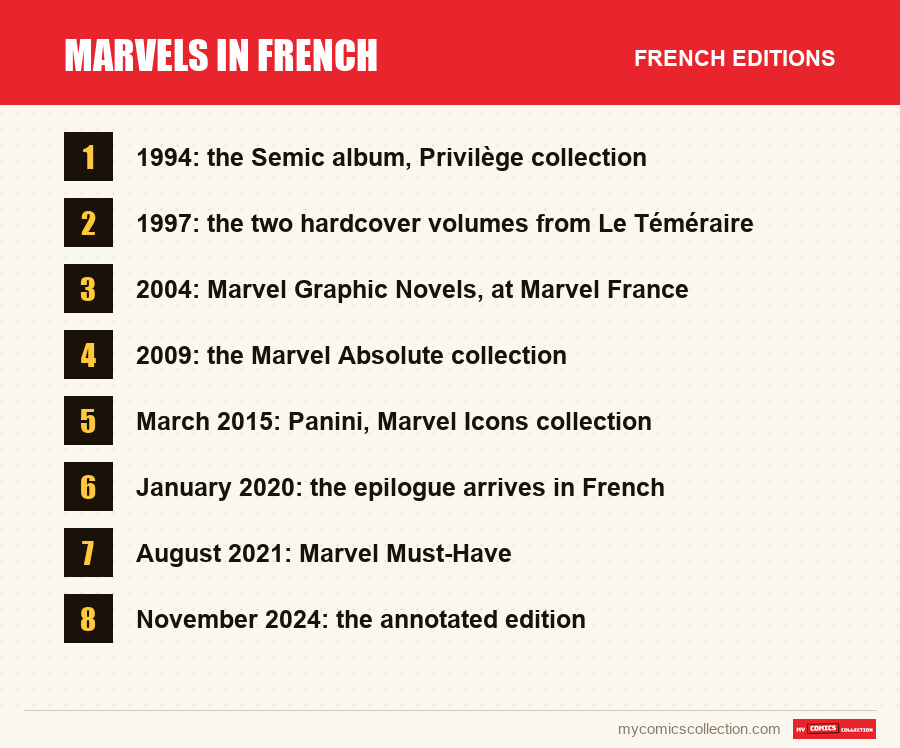
1994: the Semic album, Privilège collection
The first French edition is a Semic album, shelved in the Privilège collection and dated 1994. It is Marvels' first appearance in France, well before Panini's collections. To understand how a publisher of this period numbered and bound its albums, see our article on Lug and Semic bindings.
1997: the two hardcover volumes from Le Téméraire
The publisher Le Téméraire took up the work in 1997 as two hardcover volumes: Marvels, tome 1, Genèse (volume 1, "Genesis"), and Marvels, tome 2, Le Jugement dernier (volume 2, "The Last Judgment"). This split into two volumes is a French peculiarity: any reader who owns both volumes has the complete 1994 work, but neither is enough alone.
2004: Marvel Graphic Novels, at Marvel France
In 2004, Marvel France, Panini's label, published Marvels in its Marvel Graphic Novels collection. This album, like the one in the 2009 Marvel Absolute collection, is among the earlier releases whose issues the 2015 edition reprises.
2009: the Marvel Absolute collection
The same label released Marvels in 2009 in the Marvel Absolute collection. It collects the same issues as the 2004 album and the 2015 edition that succeeds it. Before buying a copy, check its page count and any slipcase directly on the object.
March 2015: Panini, Marvel Icons collection
On March 4, 2015, Panini published Marvels in the Marvel Icons collection. The volume runs around 400 pages, gathers American issues 0 to 4 and adds behind-the-scenes material on the creation. It does not contain the 2019 epilogue, which did not yet exist. It is a reference edition for those who want the raw 1994 material in a large format.
January 2020: the epilogue arrives in French
On January 2, 2020, Panini released a new edition adding the 2019 epilogue, unpublished in French, to issues 0 to 4. For the collection and page count of this edition, sources disagree: rely on the date, the epilogue and the ISBN readable on the copy.
August 2021: Marvel Must-Have
On August 11, 2021, Panini's Marvel Must-Have collection welcomed Marvels. The volume is a hardcover, in a 27 by 18 centimeter format, and contains American issues 0 to 4 as well as Marvels Epilogue. On its page count, sources disagree. This edition, shelved in a collection designed to offer classics, is the most accessible today.
November 2024: the annotated edition
On November 6, 2024, Marvels, Édition annotée (the annotated edition) was released in Panini's Marvel Hors Collection. It has 504 pages and contains the French translations of Marvels Annotated 1 to 4 and of Marvels Epilogue. Panini presents it as an ultimate edition with many bonuses. It is designed for the reader who has already read the story and now wants to understand its references.
Original / French edition correspondence
| French edition | Date | Original issues collected |
|---|---|---|
| Panini, Marvel Icons | March 4, 2015 | Marvels 0 to 4 |
| Panini, new edition with epilogue | January 2, 2020 | Marvels 0 to 4, Marvels Epilogue 1 |
| Panini, Marvel Must-Have | August 11, 2021 | Marvels 0 to 4, Marvels Epilogue 1 |
| Panini, Édition annotée | November 6, 2024 | Marvels Annotated 1 to 4, Marvels Epilogue 1 |
Do you collect this series?
Track what you own, what you are missing and what your collection is worth. 7-day trial.
Start my trial →
Which edition to choose for your profile
To read the complete story, with the epilogue, at the best balance between object and use: the 2021 Must-Have. It is a hardcover, in a format that shelves effortlessly, and it does not force you to buy a second volume or a heavy tome.
For the reader who wants to understand what they see, the 2024 annotated edition: the Marvels Annotated notes shed light on secondary characters and the events cited, and the epilogue is included too. It assumes you enjoy reading with a heavy volume on your lap.
For the fan of the first French edition, look to Semic (1994) then Le Téméraire (1997). These are two very different ways of owning the same series: a single album on one side, two hardcover volumes on the other. If you like the painted editions of that era, our guide to Kingdom Come in French, another painted work by Alex Ross, shows how the same publisher successively took up this type of book.
Pitfalls and points to watch
First pitfall: the epilogue. The 2004, 2009 and 2015 editions do not contain it, since it dates from 2019. If you want it, you need the 2020 edition, the 2021 one or the annotated one. Conversely, buying a single Le Téméraire volume gives you only half the series.
Second pitfall: page counts that vary from one description to another. For the same edition, the announced figures differ by a few pages depending on catalogs. Do not refuse a copy for that reason: compare the date, the ISBN and the list of issues instead.
Third pitfall: collections. Marvel Icons, Marvel Hors Collection, Marvel Must-Have, Best of Marvel: labels change depending on catalogs, and the same edition can end up shelved under another name in a shop. Content takes precedence over the label.
Fourth pitfall: the "annotated" suffix. It is not the same as the 1994 series augmented by a few pages: the volume translates Marvels Annotated, a separate 2019 publication. If you simply want to read the story, it is heavier than necessary. The French-edition collector's glossary clarifies the vocabulary of editions (omnibus, deluxe, hors collection) so you can find your way.
What these editions are worth to collectors
Values are judged by copy scarcity, not by the reputation of the work. The older releases, Semic 1994 and the two Le Téméraire volumes, now exist only secondhand: their price depends on condition, the possible presence of a dust jacket and, for Le Téméraire, the possibility of reuniting the two volumes. To know whether a complete lot sells at a different level than two separate purchases, compare completed sales rather than listings.
Panini's editions are compared differently: take the catalog price of the time, then look at the ratio between that price and those of completed sales. A ratio below one signals a saturated market; a ratio above one, a sold-out, sought-after volume. For the 2009 album, replaced six years later by the Marvel Icons collection, do not presume scarcity: check it against completed sales.
Finally, do not confuse the value of a book with that of the American single issues: they follow a distinct market, sensitive to grading. For a work praised mainly for its painting, the condition of the album, that is, the spine, the corners and the brightness of the colors, weighs more than the print run.
One last methodological tip for this work: draw up your shopping list before searching. Note the targeted edition, the presence of the epilogue, the expected condition of the spine and corners, then compare three completed sales of the same edition only. Since Marvels exists as two volumes, as an album and as a large volume, a price noted for one has no value for another. If you are building a themed collection around Alex Ross, shelve the painted albums together: their format and paper look alike, and the absence of a volume quickly stands out.
If you already own an older edition and hesitate to replace it, ask yourself a single question: are you looking to read the epilogue or the notes? If so, a recent edition is a must. Otherwise, the copy you have is already complete for the 1994 series, and keeping it avoids an expense with no reading benefit.
Two simple habits complete this method. Keep a photo of the credits page of each album, with the printing date: it is what separates an original printing from a late reprint, even more than the cover, and it proves what you hold at resale. For the two Le Téméraire volumes, photograph both together. And keep the painted volumes out of the light, because Alex Ross's large flat areas of color fade more visibly on an exposed spine than a line drawing does.
One last benchmark on the original side: Marvels has four issues published in 1994, in prestige format, with acetate overlay covers. The photographer Phil Sheldon serves as the common thread of the four chapters, from the golden age to the death of Gwen Stacy. A French edition that advertises the complete story must cover these four issues.
Frequently asked questions
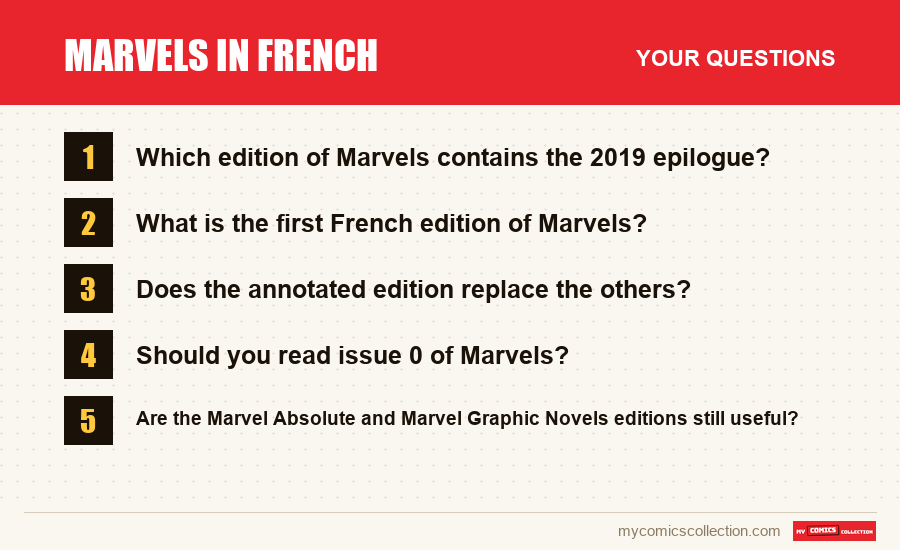
The 16-page epilogue appears in the Panini edition of January 2, 2020, in the Marvel Must-Have of August 11, 2021 and in the annotated edition of November 6, 2024. Editions prior to 2019, including the 2015 Marvel Icons, do not contain it.
It is a Semic album dated 1994, shelved in the Privilège collection. It was followed in 1997 by two hardcover volumes from Le Téméraire, Genèse then Le Jugement dernier.
No. It translates Marvels Annotated 1 to 4 and the epilogue, with bonuses, over 504 pages. It suits those who already know the story and want the commentary. For a first reading, the 2021 Marvel Must-Have contains issues 0 to 4 and the epilogue in a lighter volume.
Issue 0 contains preparatory work by Alex Ross, published as a complement to the four 1994 issues. It mainly interests those attached to how the image was made. The Panini editions of 2015, 2020 and 2021 advertise issues 0 to 4.
They were superseded by the 2015 Marvel Icons edition, which gathers the same issues with creation backstage material. They therefore keep collector interest, not reading interest: their appeal lies in the object, its era and its original label.
Do you own a Semic album, a Le Téméraire volume or a Panini edition of Marvels? Give the edition and its condition to learn its value.
Appraise my comic