Since 1984, Marvel has made crossovers an institution. Every year or so, an "event" mobilizes a large part of the Marvel universe, forces readers to buy dozens of parallel series, and generates key issues that sometimes soar to considerable prices.
Since 1984, Marvel has made crossovers an institution. Every year or so, an "event" mobilizes a large part of the Marvel universe, forces readers to buy dozens of parallel series, and generates key issues that sometimes soar to considerable prices. But behind the commercial mechanics, some Marvel crossovers are genuine narrative works that changed the industry. Others are marketing exercises whose existence is quickly forgotten.
This guide ranks the most important Marvel crossovers, from absolute must-haves to historically significant events, and explains how to approach a crossover as a collector without breaking the bank or getting lost in hundreds of tie-ins.
Definition: A Marvel crossover (or "event") is a story that unfolds simultaneously across multiple series, linked by a central mini-series. "Tie-ins" are the regular-series issues that take place during the event. The crossover proper is the main mini-series: the rest is optional.
Marvel crossovers ranked by importance
Secret Wars
The first true crossover in modern comic history. The Beyonder gathers the most powerful Marvel heroes and villains on a patchwork planet to pit them against each other. Jim Shooter's Secret Wars #1-12 remains readable and entertaining today, but its historical importance exceeds its intrinsic quality.
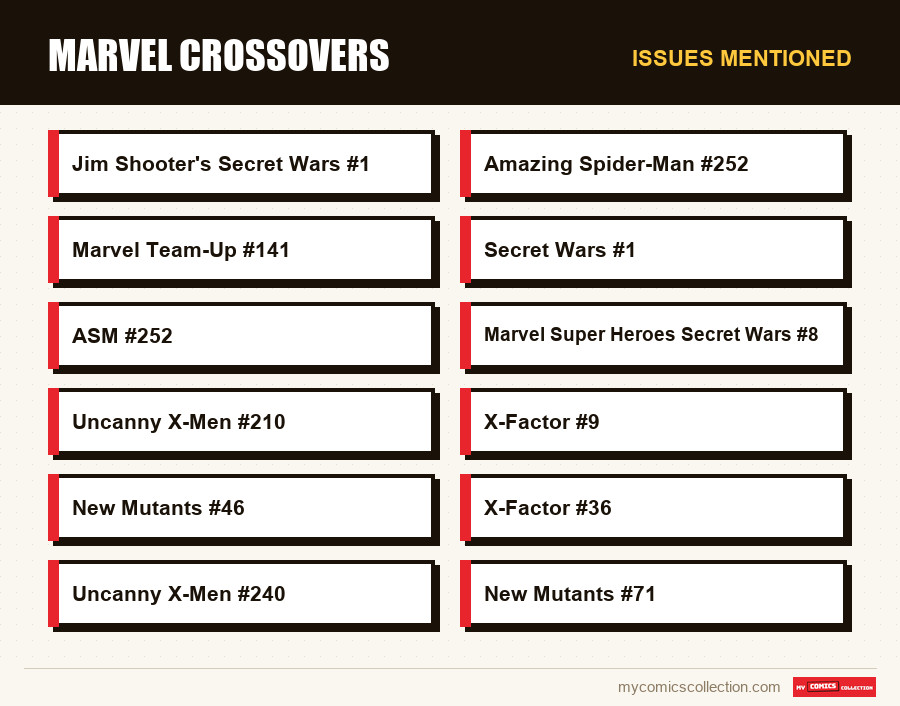
For collectors, Secret Wars is best known for the issue that introduces Spider-Man's black costume (actually an alien entity that will become Venom). Amazing Spider-Man #252 and Marvel Team-Up #141 are the key issues from this period. She-Hulk also joins the Fantastic Four during this event.
Mutant Massacre
Less a narratively constructed crossover than a brutality demonstration: the Marauders, mutant mercenaries in Mister Sinister's employ, massacre the Morlocks in their underground tunnels. The event spans X-Men, X-Factor, New Mutants, Thor, and Power Pack. Angel loses his wings during this event, leading to his transformation into Archangel in X-Factor.
Mutant Massacre is significant because it establishes that characters can suffer permanent consequences in Marvel comics: a break from perpetual-status-quo logic.
Inferno
New York is literally invaded by demons. The crossover finds its strength in the character of Madelyne Pryor, Jean Grey's clone married to Cyclops, who sinks into madness and becomes the Goblin Queen. Inferno is a dense X-Men crossover that resolves several years of complex narrative threads around Jean Grey's clone and Nathan Christopher Summers.
Acts of Vengeance
Loki orchestrates an opponent swap: Marvel villains face heroes they've never met before. Electro vs. Thor, Mandarin vs. Captain America, Red Skull vs. X-Factor. The event is especially memorable for giving Spider-Man cosmic powers (Captain Universe) for several issues, and for seeing Magneto join the Acts of Vengeance before betraying his allies.
Onslaught
The entity Onslaught, born from the merged consciousnesses of Professor X and Magneto, threatens the entire Marvel universe. The event is best known for leading to the Heroes Reborn saga: the Avengers and Fantastic Four appear to die saving the world, before being "relaunched" in a pocket reality created by Franklin Richards. Onslaught Marvel Universe (the concluding one-shot) is the key issue of this event.
Civil War
The Superhero Registration Act forces all heroes to reveal their secret identities to the government and work under official supervision. Iron Man leads the pro-registration camp; Captain America leads the resistance. Civil War is the Marvel crossover that has aged best and resonates most in today's world: its questions about individual freedom vs. collective security haven't wrinkled.
For collectors, Civil War #1-7 by Mark Millar and Steve McNiven is the absolute reference. Issue #1 remains affordable, but very-good-condition or CGC copies have appreciated. Tie-ins include: Amazing Spider-Man (Peter Parker reveals his identity), Thunderbolts (villains working for the government), and Civil War: Frontline, which follows journalists.
Secret Invasion
The Skrulls, an alien race of shapeshifters, have infiltrated humanity for years: some superheroes could be imposters without knowing it. The paranoia generated by this premise is Secret Invasion's best asset. Secret Invasion #1 with its "Who do you trust?" cover is a sought-after key issue. The event lays the groundwork for Dark Reign: Norman Osborn emerges from the crisis as a public hero.
Dark Reign / Siege
Direct consequence of Secret Invasion: Norman Osborn now runs S.H.I.E.L.D. renamed H.A.M.M.E.R. and creates the Dark Avengers, a team of villains disguised as heroes. Dark Reign isn't a crossover per se but a narrative period spanning several series. Siege (4 issues) is its explosive conclusion, with the assault on Asgard.
Fear Itself
The Serpent, god of fear and Odin's brother, releases cosmic hammers that transform several heroes and villains into chaos agents. Fear Itself is a Thor-centric event, visually spectacular but narratively hollow per critics. Its importance for collectors lies in Bucky Barnes / Captain America's temporary death and some hammer-related key issues.
Avengers vs X-Men
The Phoenix Force heads for Earth. The Avengers want to destroy it to protect the planet; the X-Men want to channel it to resurrect the mutant race. The conflict between Cap and Cyclops erupts. AvX is important because it marks Cyclops's fall, who becomes a mutant revolutionary and involuntarily kills Charles Xavier under Phoenix influence. It also sets up the Marvel Now that follows.
Infinity (Jonathan Hickman)
Jonathan Hickman orchestrates a cosmic saga of rare ambition: while the Avengers face the Builders at galaxy's edge, Thanos attacks Earth to find his hidden son. Infinity is the centerpiece of a 3-year saga Hickman weaves through New Avengers and Avengers: the Illuminati, Infinity Stones, Incursions between universes. A masterpiece of narrative construction.
Key issue: Infinity #1 and New Avengers #1 (start of Hickman's Illuminati) are the entry points. Black Bolt is definitively established as a major tragic character. The event leads directly to Secret Wars 2015.
House of X / Powers of X
Jonathan Hickman's X-Men revolution. In six issues each, published alternately, House of X and Powers of X entirely redefine the X-Men: Krakoa, a sovereign mutant island-nation; an economy based on mutant drugs; a resurrection system allowing any mutant to return from the dead. Characters dead for years (Magneto, Banshee, reinvented Moira MacTaggert) regain central roles.
HoX/PoX is the crossover that most surprised the industry since Watchmen. House of X #1 is a certain key issue: it has already appreciated and its popularity hasn't faded.
Collecting this series?
Track what you own, what you are missing and what your collection is worth. 7 day trial.
Start my trial →How to approach a crossover without breaking the bank
The temptation is great to "collect everything" during a major crossover, but tie-ins can quickly represent dozens of extra issues, for a very high total cost. Here's a pragmatic approach:
Main mini-series only
For Civil War, read Civil War #1-7. For HoX/PoX, read House of X #1-6 and Powers of X #1-6. For Infinity, read Infinity #1-6. The central mini-series is always designed to be understandable without tie-ins. It's the most economical and often most narratively satisfying strategy.
Mini-series + tie-ins from series you already follow
If you're a fan of Amazing Spider-Man and Civil War is connected there, read the corresponding issues. But don't start buying series you don't normally read just because they carry a "tie-in" logo. You'll end up with orphan issues without context.
Buying everything "just in case"
The "I'll take everything so I don't miss anything" strategy is the costliest and least satisfying. Civil War officially counts over 100 tie-ins. Even enthusiasts haven't read everything. Be selective: it's the approach of every experienced collector.
The 5 Marvel crossovers to absolutely have
- Secret Wars #1-12 (1984), the first, historic
- Civil War #1-7 (2006-07), the biggest narratively and commercially
- Infinity #1-6 + Hickman's New Avengers run (2013), the best cosmic saga
- House of X / Powers of X (2019), the X-Men revolution
- Secret Invasion #1-8 (2008), for the paranoid atmosphere and key issue #1
FAQ: Marvel crossovers
Manage your crossover runs with My Comics Collection
Track every issue of your Marvel crossovers, mini-series, and tie-ins in a clear interface. Instantly identify missing issues to complete your event runs.
🚀 Free 7-day trial, no commitment