
In short
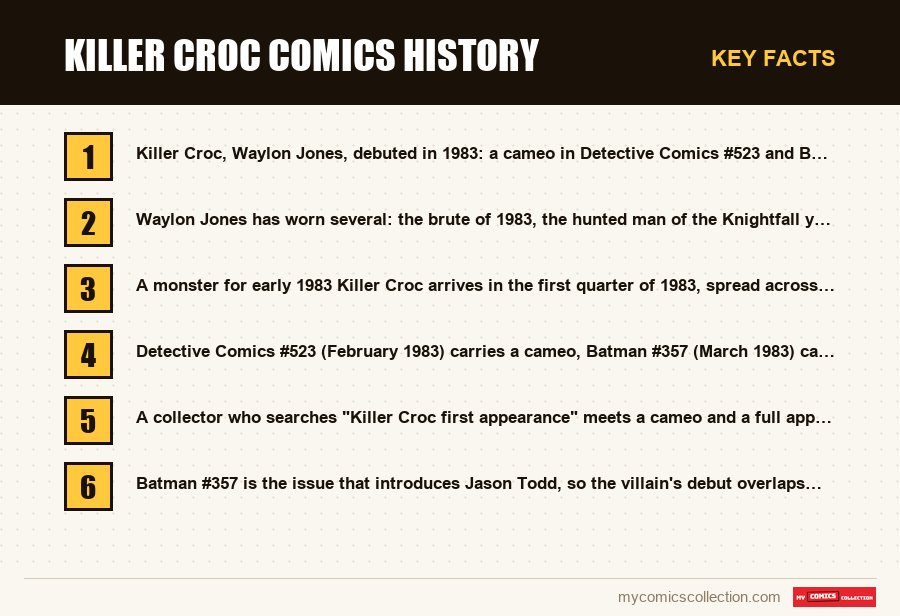
Killer Croc, Waylon Jones, debuted in 1983: a cameo in Detective Comics #523 and Batman #357, then a full appearance in Detective Comics #524, created by writer Gerry Conway with artists Gene Colan and Don Newton. He began as a reptilian criminal tangled in Jason Todd's origin, then became a sewer outcast, an Arkham patient, a Suicide Squad anti-hero in DC Rebirth and, in the All In era, an uneasy ally of Batman.
Most Batman villains keep one face. Waylon Jones has worn several: the brute of 1983, the hunted man of the Knightfall years, the creature drifting toward the animal, the schemer's muscle, the soldier with a squad badge. Reading his history in order shows a character that writers keep repositioning, and that repositioning is what a collector needs to understand before chasing any single issue.
Each issue number and cover date below was matched to a credited creator or a collected volume before it went in; where a year is missing, the date was left out on purpose. What each stage does to the character, and the advice at the end, is analysis, and no panels or dialogue are quoted.
A monster for early 1983
Killer Croc arrives in the first quarter of 1983, spread across three issues. Detective Comics #523 (February 1983) carries a cameo, Batman #357 (March 1983) carries another, and Detective Comics #524 (March 1983) gives the character his full first appearance. Gerry Conway is the writer who stands behind the creation, with Gene Colan and Don Newton credited as artists on the character's debut.
The spread matters because it explains the confusion that still shadows the character on listings. A collector who searches "Killer Croc first appearance" meets a cameo and a full appearance that share the March 1983 cover date. Anyone building a line around Waylon Jones should decide early whether the target is the cameo, the full debut, or the three issues as a set.
The timing is also worth noting. Batman #357 is the issue that introduces Jason Todd, so the villain's debut overlaps with a sidekick's. For the buying side of that overlap, our guide to Batman #357 goes through what the issue contains; here the question is narrower, which is what the character was at birth.
The pre-Crisis Waylon Jones: atavism and an aunt
In his earliest version, Waylon Jones is born with a rare atavism that gives him reptilian traits, and his birth costs his mother her life. An abusive, alcoholic aunt raises him; he later kills her, turns to crime in Gotham and commits several murders. The comics present him as a former sideshow wrestler, which is how a villain with a scaled body finds work among crooks who want a tough man on the payroll.
He also appeared differently from the version most readers picture today. His scales were green but his face was basically human, so the first Croc is a man with a skin condition turned weapon, not yet a creature. That is a useful detail for anyone comparing early copies with later cover art, because the character on the 1983 pages is not the long-snouted figure of later decades.
At the start he is shown killing Jason Todd's parents, a detail later changed so that Two-Face was responsible. The consequence of the first version is that Croc and the second Robin are tied together in the character's opening chapter: he fights Batman and the new Robin, and he loses. The retcon is a reminder that a villain's earliest story can be rewritten without the issues changing a word, which is why the numbers matter more than the plot summaries on a listing.
After the Crisis: the sewers and the Knightfall years
The post-Crisis Croc is a different person on the page. He escapes, hides in the sewers and falls in with an unhoused community living there. Batman finds the group and is nearly killed by Croc in a primal rage, and Croc seemingly sacrifices himself holding back a rush of water, a turn that gives a brute a protective instinct. That sewer story is told in Batman #489.
In Batman #471 a rampage ends in a shopping mall, where Jean-Paul Valley, wearing the Batman costume, is distracted by a glimpse of Bane. Bane tests his strength against Croc's and breaks both of his arms, and Croc returns to Arkham. In the Knightfall storyline Croc is among the inmates who escape Arkham, and Dick Grayson, acting as Batman, catches Croc in a fishing trawl for the police. The ladder is clear: Croc goes from menace to casualty, a body used to show how dangerous the larger players are.
For a collector this is the period where Croc stops being a one-issue name and becomes connective tissue in a bigger event. The issues are not first appearances, so the interest is completionist: the monster's role in the Bane saga, seen in Bane's comics history, and the reading order laid out in the Knightfall key issues.
The Louisiana swamp: Batman #521 and #522
A two-part story in Batman #521 and #522 sends the character to the Louisiana swamps, where Swamp Thing offers him a home. The shift in setting is the point. Gotham's docks and alleys frame him as a criminal, while a bayou frames him as a creature, and the offer of a place to live treats his body as something other than a curse.
This is the stretch that pushes the character from thug toward tragedy. It does not erase the violence, but it supplies the template that later writers reuse: Croc as a man whose body has decided what society will do with him. If your interest is in how a villain gets a second dimension without losing menace, these two issues are the cleanest example in his run.
Arkham on the page: Living Hell and Hush
The six-issue miniseries Arkham Asylum: Living Hell (2003) pairs writer Dan Slott with artist Ryan Sook, and Eric Powell paints the covers. Croc is not the lead, but the series is cited for the fate of Arkham guard Aaron Cash, whose hand Croc bit off, which gives the character a lasting scar on another person's story. It is a good example of a rogue serving as a piece of the setting.
In Hush the physical side of the character darkens again. A virus accelerates his devolution, and he helps with a kidnapping before Batman defeats him. If you track the Hush-era key issues for other reasons, our note on Batman: Hush will show where Croc sits in that story. What the sequence adds to the history is a direction of travel: the more the stories use his body as a gauge, the less human the character looks.
One Year Later to Brightest Day: a villain passed from event to event
Between the mid-2000s and the early 2010s, Croc is used almost like a unit of measurement. When a cure attempt fails, he eats the doctor and vows revenge on Batman and Black Mask (Detective Comics #810, 2005). In Infinite Crisis he joins Alexander Luthor Jr.'s Secret Society of Super Villains. In the One Year Later period, Detective Comics #819 shows him feeding on the corpse of Orca, and in Countdown #50 he tries to kill Jimmy Olsen before being subdued.
He also turns up in Salvation Run and in Final Crisis, where he joins Libra's society and is later made a Justifier (DC Universe #0 and Final Crisis #4). During Brightest Day, he is let out of his cell by a guard during Deathstroke's raid on Arkham, a guard Osiris then kills (Titans vol. 2 #28).
The pattern here is useful to a collector who wants to separate the signal from the noise. These are appearances rather than milestones: each one deepens the monster, but no single issue reshapes him. They fit best into a themed run built around the character, not into a hunt for one expensive key.
Do you collect this series?
Track what you own, what you are missing and what your collection is worth. 7-day trial.
Start my trial →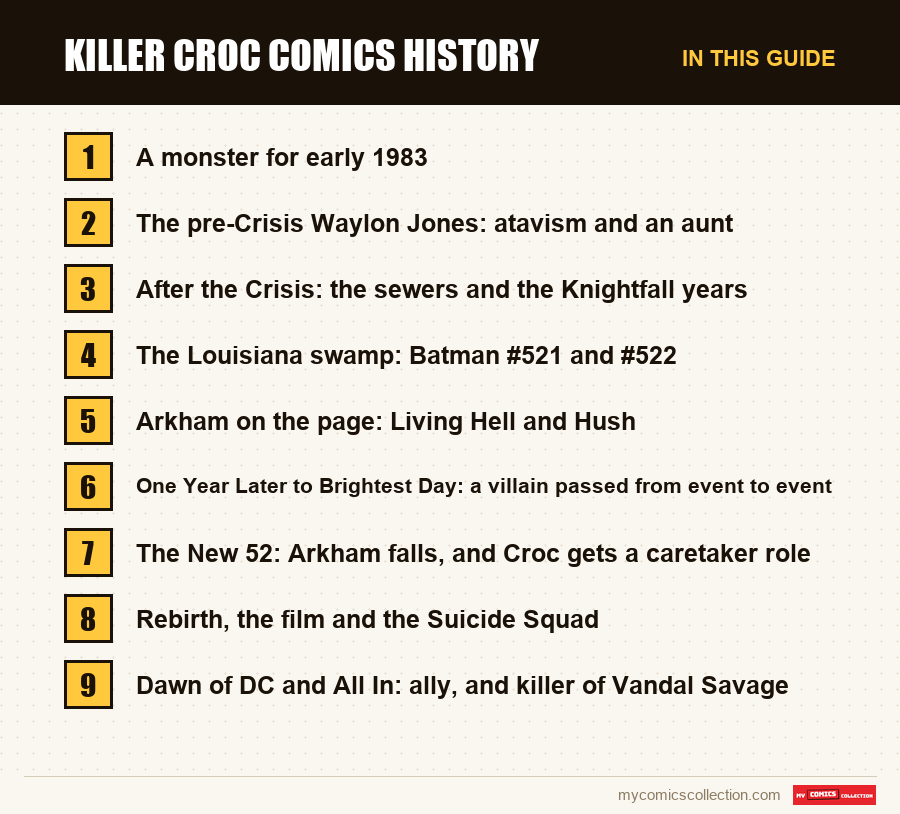
The New 52: Arkham falls, and Croc gets a caretaker role
The 2011 reboot gives the character an unexpected tenderness. A flashback in Red Hood and the Outlaws #3 shows him fighting Roy Harper in Hell's Kitchen, and in #4 he is said to have sponsored Harper's recovery from alcoholism. In Gotham Academy #6 he is in Arkham with Sybil Silverlock, and he promises to look after her daughter Olive if he gets out. When Arkham is destroyed in Batman Eternal #29, Croc escapes and watches over Olive at the school.
That arc matters because it inverts the original brief. The 1983 character was built to menace a boy; the New 52 character protects a girl. The shift comes from three different series, each adding a single piece.
Rebirth, the film and the Suicide Squad
In DC Rebirth Croc becomes an anti-hero in the Suicide Squad and forms a relationship with June Moone, the woman who hosts the Enchantress. After her apparent death he breaks down in tears, and he later leaves the Squad. The 2016 Suicide Squad film, in which Adewale Akinnuoye-Agbaje plays him, put the character in front of a mass audience; if the movie is your way in, our Suicide Squad key issues shows the issues that matter around the team.
Before the film, the animated side had already given the character a profile. Aron Kincaid and Brooks Gardner voiced him in Batman: The Animated Series and The New Batman Adventures, and an android version of Croc appears in Batman Beyond. These are not comics, but they explain why a villain with a modest early bibliography has a recognition level that outruns his shelf of key issues.
Dawn of DC and All In: ally, and killer of Vandal Savage
The recent run keeps the contradictions. In Batman and Robin vol. 3 #1 and #2, Croc, Man-Bat, Orca and the Terrible Trio kidnap a doctor at Gotham Zoo, and he later helps Poison Ivy and fights Solomon Grundy. In the "Bad Seeds" storyline of the All In period, he rescues Batman, then reveals a poison he developed to kill Poison Ivy, and later helps Batman against Vandal Savage, whom he kills in battle.
Taken together, the arc from 1983 to the present is not a straight line from villain to hero. It is a pendulum: menace, casualty, tragic figure, ally, menace again. A reader who wants to understand why Croc can plausibly appear in a Batman book, a Suicide Squad book or a school story needs that pendulum in mind. The character has no fixed role, a body and a past that writers can aim anywhere.
The key issues across his history
- Detective Comics #523 (February 1983): the cameo that opens the character's run of appearances.
- Batman #357 (March 1983): a second cameo, in the issue that also introduces Jason Todd.
- Detective Comics #524 (March 1983): the full first appearance of Killer Croc.
- Batman #521 and #522: the Louisiana swamp story where Swamp Thing offers him a home.
- Arkham Asylum: Living Hell #4 (October 2003): the series cited for Aaron Cash losing his hand to Croc.
- Detective Comics #810 (2005): the failed cure and the doctor's fate.
- Gotham Academy #6: the issue that sets up his promise to look after Olive Silverlock.
- Batman Eternal #29: Arkham's destruction and Croc's escape.
How to follow Killer Croc in a collection
Start with the debut set, three issues from early 1983, and decide whether you want the cameos as well as the full appearance. Then add the swamp two-parter in Batman #521 and #522, and a single volume of the 2003 Arkham Asylum: Living Hell series, which reads on its own. The Knightfall-era appearances are best bought as part of a Knightfall reading order rather than singly.
The numbering trap is the cameo. Listings mix the three 1983 issues, and a seller who writes "first Killer Croc" on a copy of Batman #357 is describing a cameo. Check the issue number against the full appearance in Detective Comics #524 before paying for the label. For a longer shopping path, our guide to the best Killer Croc comics ranks the reads, and the best Batman runs tells you what to pair them with.
Frequently asked questions
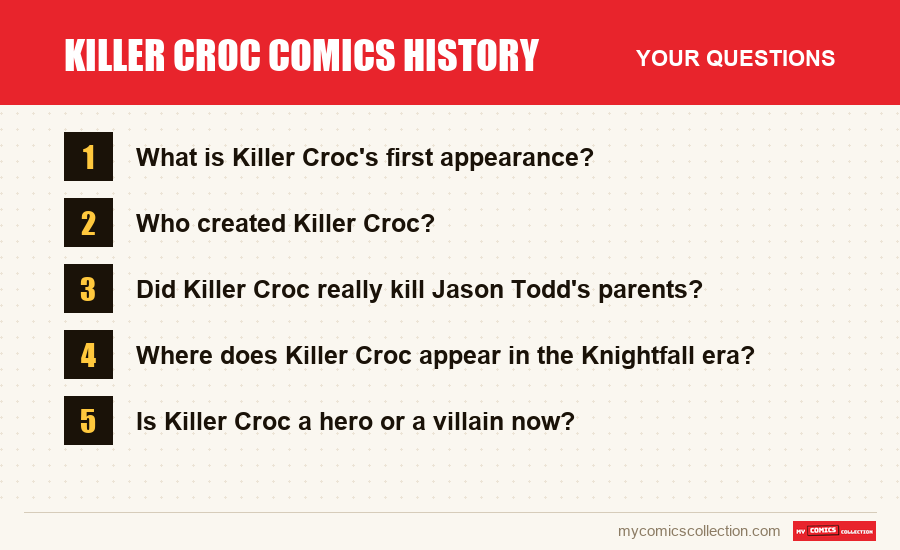
Killer Croc has cameos in Detective Comics #523 (February 1983) and Batman #357 (March 1983), with his full first appearance in Detective Comics #524 (March 1983). Gerry Conway is the writer credited with creating him. The three-issue spread is why listings often disagree about which issue to call the debut.
Writer Gerry Conway created Killer Croc, with artists Gene Colan and Don Newton credited on the character's debut. Conway is the creator to name on a listing or catalog entry. If you collect by creator, his author page gathers the other issues tied to his name in our blog.
In his earliest version, he is shown killing Jason Todd's parents. That detail was later retconned so that Two-Face was the killer. The change was made in later continuity and did not alter the 1983 issues themselves, which is why older copies still tell the first version of the story.
In Batman #471, Bane breaks both his arms during a mall rampage while Jean-Paul Valley wears the Batman costume, and Batman #489 tells the sewer story. In Knightfall, Croc escapes in the Arkham breakout and Dick Grayson, as Batman, catches him for the police.
He is both, depending on the book. In DC Rebirth he becomes a Suicide Squad anti-hero, and in the All In period he helps Batman against Vandal Savage. He also remains a Gotham criminal in Batman and Robin vol. 3 #1 and #2, so the label depends on the series.
Holding a copy of Detective Comics #524 or Batman #357? Get an estimate based on its grade and edition.
Estimate my comic