
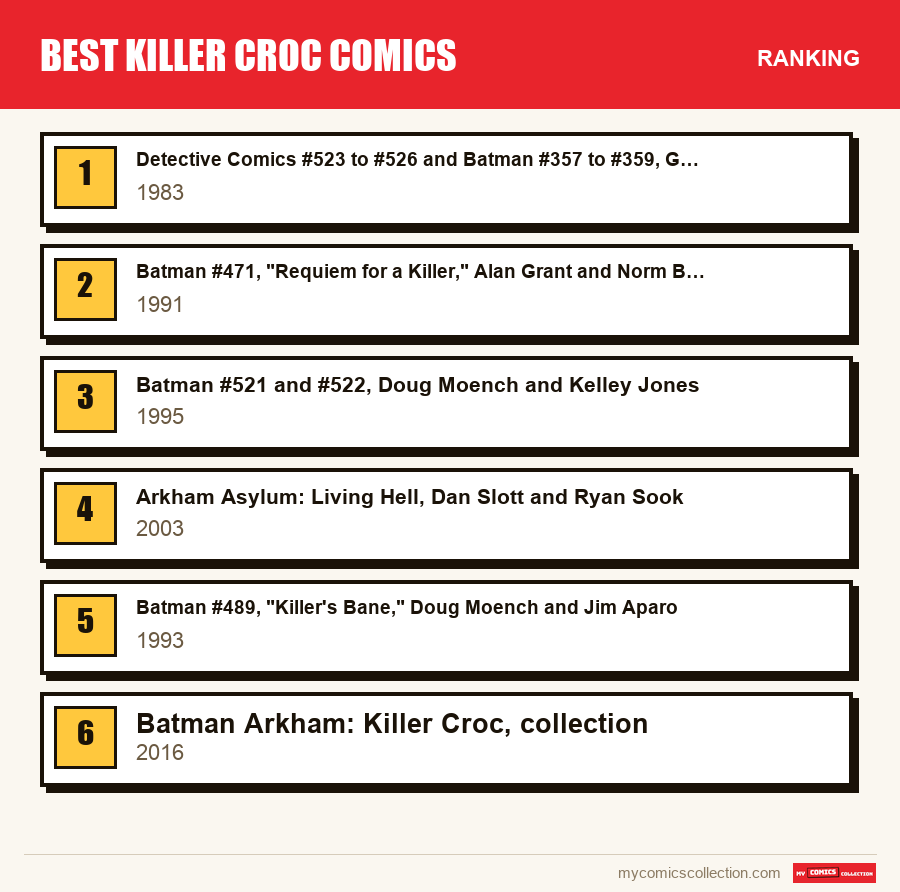
The best Killer Croc comics begin with his 1983 debut in Detective Comics and Batman, written by Gerry Conway. Start with that first run (Detective Comics #523 to #526 and Batman #357 to #359), then read Batman #471 by Alan Grant and Norm Breyfogle (1991), Batman #521 and #522 by Doug Moench and Kelley Jones (1995) and Arkham Asylum: Living Hell by Dan Slott and Ryan Sook (2003).
Waylon Jones is the monster of Batman's rogues gallery: a scaly hulk, more at home in the sewers than in a boardroom, whom writers have played in turn as a brute, a gangster or a pitiful creature. That flexibility makes his bibliography uneven, which is why a ranking helps. Here are six reads, from 1983 to 2016, that show what he can become when he is taken seriously.
As always in this guide, only verified information (creators, issue numbers, dates) is stated as fact; the analysis is our own, with no reproduction of protected panels or dialogue.
His first appearance
Killer Croc was created by Gerry Conway and Gene Colan. He gets a glimpse in Detective Comics #523 (February 1983), drawn by Gene Colan, in a passing role. He returns in Batman #357 (March 1983), drawn by Don Newton, where he extorts protection money from a circus, and above all in Detective Comics #524 (March 1983), by the same Conway and Newton team, where he kills a small-time mob boss nicknamed the Squid. It is in this last issue that the character first plays a real role.
This three-step chronology matters to the collector: price guides and listings often cite #357 because that issue is also the one where Jason Todd makes a fleeting appearance, as our article on that issue explains. If you are after the character himself, read the three issues together; if you are after the best-known key, #357 is one. In every case, check the condition of the spine and corners first.
1: Detective Comics #523 to #526 and Batman #357 to #359, Gerry Conway, with Gene Colan, Don Newton, Curt Swan and Dan Jurgens (1983)
This is the character's complete birth, to be read as a block. Gerry Conway writes every issue; the art changes from episode to episode, with Don Newton drawing Batman #357 and Detective Comics #524 and #526, Curt Swan #525 and Dan Jurgens Batman #359. Croc moves from the background to the spotlight: he kills the Squid, becomes the main villain of #525, where he sets his own house on fire to escape through the sewers, then in Batman #359 (May 1983) he appears to defeat Batman before disappearing, and the episode closes on the kidnapping of Jason Todd's parents.
Detective Comics #526 (May 1983) wraps up the affair: manipulated by the Joker, Croc fights Batman in single combat, Jason Todd takes him down by dropping a pipe on his head, and we learn that Croc killed the boy's parents. What this read gives the character: a definition. Croc is a monstrous thug here, tied to the circus and the underworld, not yet the tragic hulk of later years. Who it is for: readers who want the source, and those interested in Jason Todd's beginnings. For the next step on this path, see our history of Jason Todd.
2: Batman #471, "Requiem for a Killer," Alan Grant and Norm Breyfogle (1991)
Cover-dated November 1991, this issue is written by Alan Grant and drawn, penciled and inked, by Norm Breyfogle, who also does the cover. A series of strange thefts leads Batman into the sewers of Gotham, to a hidden fallout shelter where Croc's loved ones live. The monster catches Batman's scent and attacks. The story lingers on the character's present humanity more than on his origin.
What it offers: a dimension. Croc stops being a beast to be put down and becomes a man to be understood, which paves the way for the interpretations of the following decade. It is aimed at the reader who prefers characterization to action, and at those who enjoy Norm Breyfogle's nervous linework. How to read it: as a single issue, without knowing the 1983 run, although you will enjoy it more if you have read the first part of this ranking.
3: Batman #521 and #522, Doug Moench and Kelley Jones (1995)
This two-parter, cover-dated August and September 1995, is written by Doug Moench and drawn by Kelley Jones, with John Beatty on inks. Croc escapes from Arkham and the trail leads Batman to the Louisiana bayou, where he crosses paths with Swamp Thing in #522. The character is shown in the middle of a physical regression, which makes these issues a variation on the theme of the monster drifting toward the animal.
What they offer: a gothic atmosphere, which suits the character better than urban stories. They are aimed at the reader who appreciates Kelley Jones's heavy inks and elongated silhouettes, and at those who like crossovers with the Swamp Thing universe. How to read them: in one sitting, in two issues, accepting that staging takes precedence over plot. The setting also changes how you read Croc: far from the docks and alleys of Gotham, the swamp makes him a creature going home, and no longer a thug on the run.
4: Arkham Asylum: Living Hell, Dan Slott and Ryan Sook (2003)
A six-issue series published in 2003, written by Dan Slott and drawn by Ryan Sook, with Wade Von Grawbadger inking most of the issues and Jim Royal on #3; the covers are painted by Eric Powell. The hero is Warren White, a financier who pleads insanity to avoid prison and ends up committed to Arkham. Batman stays at the edge of the story. Croc, for his part, plays a major role: he has a score to settle with the head of security, who has already lost a hand because of him, and that grudge runs across several issues.
What this series offers: everyday life in Arkham seen from below, with Croc as a permanent threat to the central character. It is aimed at those looking for a dark, ironic story outside the classic hero formula. It reads on its own and was reprinted in 2014 in a deluxe hardcover that collects all six issues.
Do you collect this series?
Track what you own, what you are missing and what your collection is worth. 7-day trial.
Start my trial →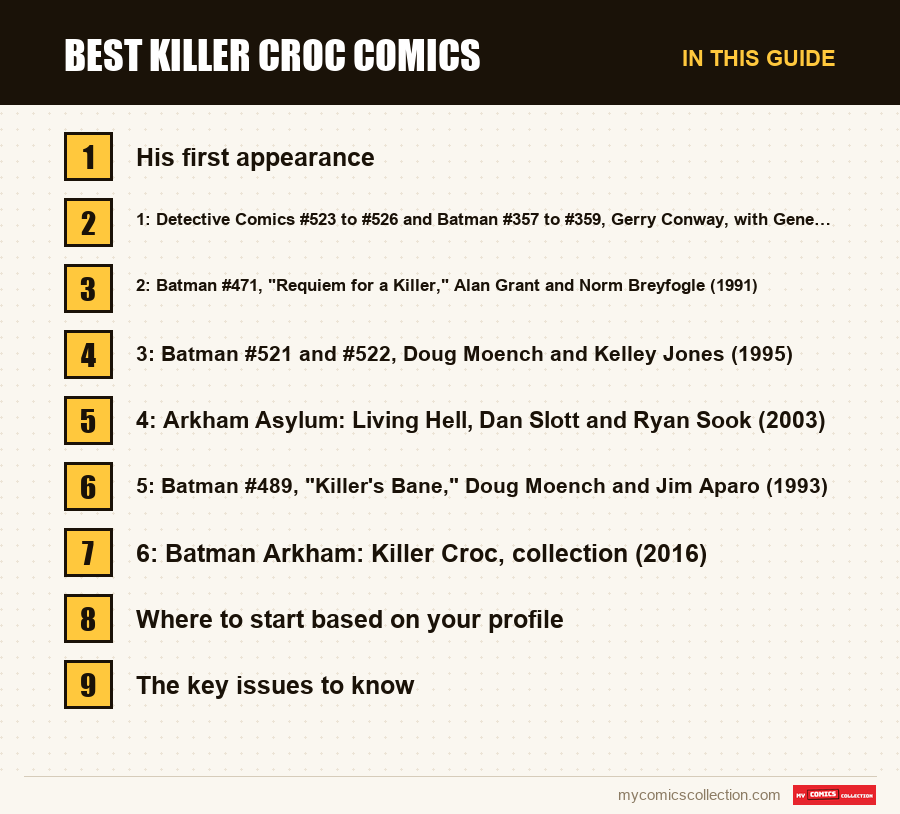
5: Batman #489, "Killer's Bane," Doug Moench and Jim Aparo (1993)
Cover-dated February 1993, this issue is written by Doug Moench and drawn by Jim Aparo. Croc spreads panic; Robin and Jean-Paul Valley, who is filling the role of Batman, step in trying to avoid a confrontation, but Valley gets carried away. Bane arrives first and reduces Croc to helplessness, showing in passing that he knows the Batman on the scene is an impostor. Croc's role here is that of a trigger: he serves to set the stage for Bane.
It is therefore a read to place after the first three, for a reader interested in the Knightfall saga and in how it builds up, which our selection on Bane covers in detail. What it offers the character: a humiliation that fixes his rank among Batman's enemies. It reads as a single issue, but it only makes full sense when placed back in its context.
6: Batman Arkham: Killer Croc, collection (2016)
This collection gathers a path through Croc's career from his debut. It includes a story by Gerry Conway drawn by Curt Swan and then by Dan Jurgens, a tale by Alan Grant drawn by Norm Breyfogle, a story by Doug Moench with Kelley Jones, a tale by Anderson Gabrych drawn by Tommy Castillo, another by Mike Raicht drawn by David Yardin and Cliff Richards, and a last one by Tim Seeley drawn by Francis Portela, which revisits the character's origin.
What it offers: easy access to scattered issues, one by one. It is aimed at the reader who does not want to chase single issues. How to read it: in order, then cross-checking it against the entries above to spot the episodes that really matter. The finale by Tim Seeley and Francis Portela is the most useful for those who want to revisit Waylon Jones's past, while the tale by Mike Raicht, drawn by David Yardin and Cliff Richards, is for those who want a dark crime story rather than a horror tale.
Where to start based on your profile
If you are new to the character, open Arkham Asylum: Living Hell: the series runs six issues and requires no prior knowledge. If you love gothic horror, go through Batman #521 and #522. If you want to understand why Croc ended up becoming a full character, read the 1991 #471 after the 1983 issues.
If you collect first appearances, and your budget of time and shelf space is limited, concentrate on Detective Comics #523 and #524 and on Batman #357. If you prefer a single volume, the 2016 collection is the easiest route. And if you follow the Knightfall saga, slot the 1993 #489 into your reading order, keeping in mind that the character serves as a foil there.
The key issues to know
The origin keys are Detective Comics #523 (February 1983, cameo), Batman #357 (March 1983, where Jason Todd also makes a brief appearance) and Detective Comics #524 (March 1983, first real role). Next come Batman #358 (April 1983), which carries the character's name in its title, Batman #359 (May 1983) and Detective Comics #526 (May 1983), where we learn the fate of Jason Todd's parents.
The character turning points are in Batman #471 (November 1991) and in #521 and #522 (1995). The buying method is the same everywhere: favor a copy with a clean spine and unyellowed paper, ask for photos of the cover and interior pages, read the full description of a copy that has already been graded, and compare several completed sales before deciding. For where #357 sits in the market, see our selection of the best Batman runs.
Frequently asked questions
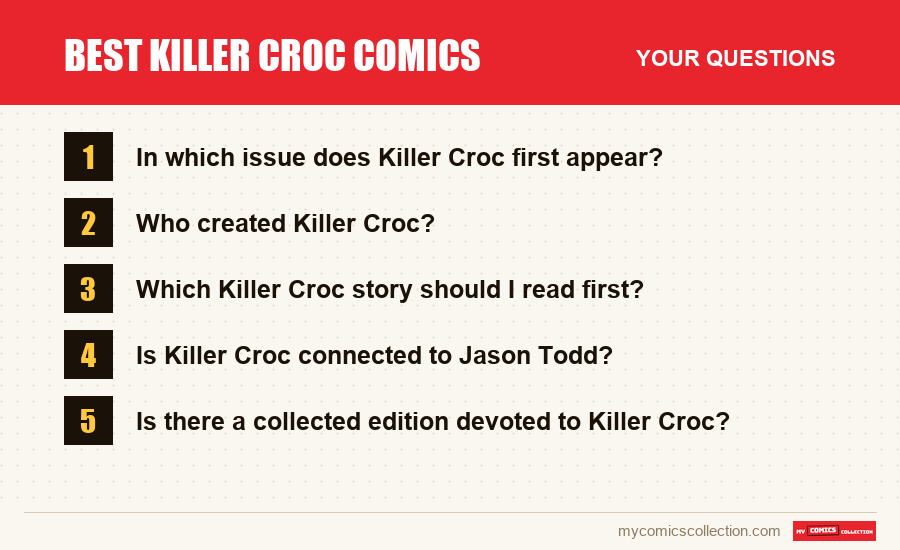
He shows up briefly in Detective Comics #523 (February 1983), then in Batman #357 and Detective Comics #524 (March 1983). The latter, by Gerry Conway and Don Newton, gives him a real scene: he eliminates a mob boss.
The character is credited to Gerry Conway on script and Gene Colan on art. Gene Colan drew the cameo in Detective Comics #523, and the rest of the 1983 run was drawn by several artists, including Don Newton, Curt Swan and Dan Jurgens.
The 1983 issues for the source, or Arkham Asylum: Living Hell (2003) by Dan Slott and Ryan Sook for a complete six-issue story in which Croc plays a major role. Both can be read without knowing the rest of Batman continuity.
Yes, in the 1983 issues. Jason Todd makes a brief appearance in Batman #357, and he is the one who takes Croc down in Detective Comics #526 (May 1983), the issue where we learn that Croc killed his parents. This story is part of the boy's first adventures.
Yes, Batman Arkham: Killer Croc (2016) collects stories by Gerry Conway, Alan Grant, Doug Moench, Anderson Gabrych, Mike Raicht and Tim Seeley. It lets you read a path from his debut without hunting down the original single issues one by one.
Do you own a Batman #357 or a Detective Comics #524? Get it appraised before you sell or insure it.
Appraise my comic