In short
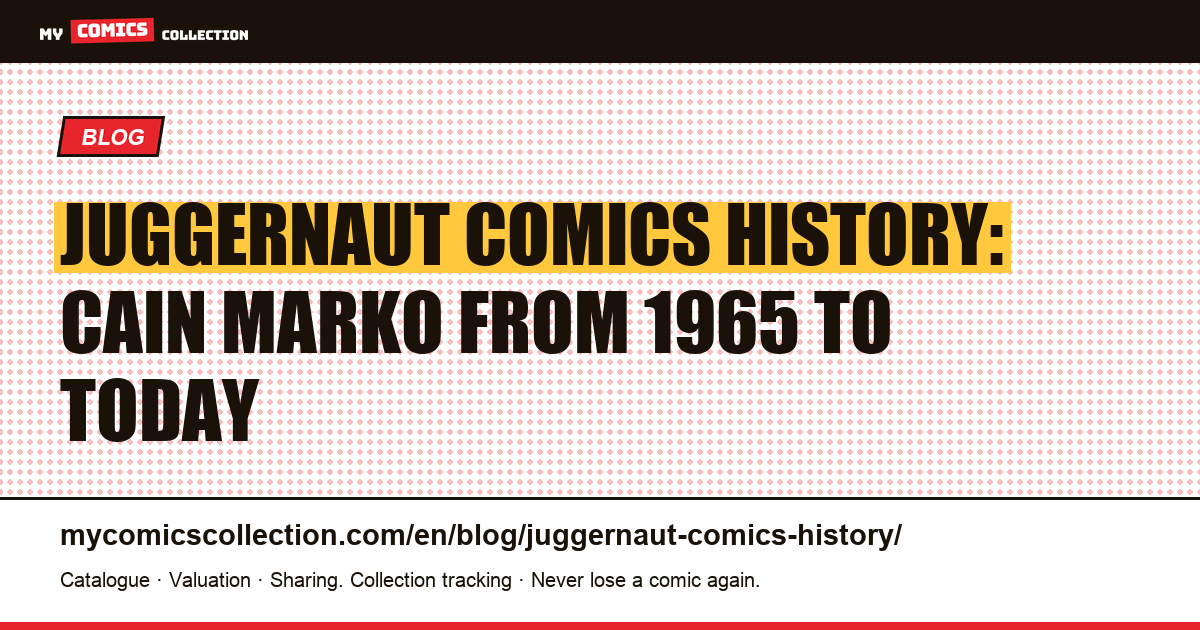
Cain Marko, the Juggernaut, first shows up in X-Men #12 (July 1965) as Charles Xavier's resentful stepbrother, a Stan Lee and Jack Kirby creation. A temple gem of the mystic Cyttorak makes him unstoppable once he moves. Chris Claremont paired him with Black Tom Cassidy in the 1970s, Spider-Man stalled him in 1982, and later writers turned him into an X-Man, a host for a hammer of the Worthy and a solo lead in 2020.
Juggernaut is often summed up as a wall of muscle that heroes must work around. His publication record tells a longer story: a resentful stepson who becomes a recurring menace, a reluctant ally, a vessel passed from owner to owner and, eventually, a man trying to live without the power that defined him.
Issue numbers, cover dates and credits in this timeline were confirmed one at a time, and anything that could not be confirmed was dropped. The reading of Cain's arc is ours, and no pages or dialogue are reproduced.
Stan Lee, Jack Kirby and the stepbrother (1965)
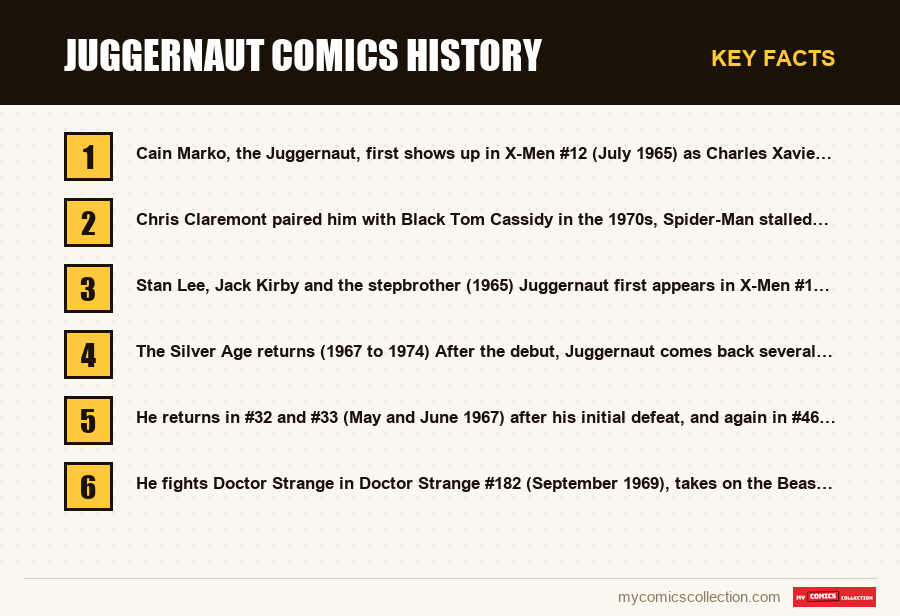
Juggernaut first appears in X-Men #12, cover dated July 1965, with the story continuing in #13 (September 1965). Stan Lee is credited as writer and Jack Kirby as writer and artist on the debut. The name comes from Jagannath, the Hindu deity whose enormous chariot was said to keep rolling even when people fell in its path, which explains the whole premise: something that cannot be stopped once it starts.
Cain Marko is the stepbrother of Charles Xavier. Xavier's mother married Kurt Marko, Cain's father, and Cain resented Charles, whom Kurt Marko favored. In Korea, Marko finds a temple to Cyttorak and touches a gem that transforms him. A cave-in seems to kill him; he comes back to attack the X-Men and is defeated with help from the Human Torch.
The origin is the character's whole engine. Juggernaut's strength is borrowed and mystical, which is why later writers could take it away, move it or replace it without breaking him. His bitterness toward Xavier is personal, which is why he keeps returning to the same team.
The Silver Age returns (1967 to 1974)
After the debut, Juggernaut comes back several times in the original X-Men series. He returns in #32 and #33 (May and June 1967) after his initial defeat, and again in #46 (July 1968). Along the way he is banished to the Crimson Cosmos with Doctor Strange's help, and later Eternity banishes him to an alternate universe.
The same period spreads him beyond the X-Men. He fights Doctor Strange in Doctor Strange #182 (September 1969), takes on the Beast in Amazing Adventures #16 (January 1973) and fights the Hulk in The Incredible Hulk volume 2 #172 (February 1974), where he is eventually defeated by Professor X, Cyclops and Marvel Girl. These appearances establish a pattern that lasts for decades: Juggernaut works as a test of other heroes, and the writer who borrows him decides how to bring the force to a halt.
Claremont, Cockrum and Black Tom (1976 to 1981)
With the second-generation team in place, Juggernaut becomes a villain of the new era. X-Men #101 (1976) brings him back against the international lineup, alongside Black Tom Cassidy, who had been glimpsed as a shadowy figure in #99 (June 1976) and appears fully in #101. Chris Claremont and Dave Cockrum created Black Tom, and Cockrum was penciling the series from #94 to #105. The storyline runs through #103.
The partnership matters more than any single fight. Black Tom and Juggernaut meet in prison and become allies and close friends, and Tom becomes the closest thing the character has to a friend. Juggernaut leaps after Tom into the sea in the 1970s story, and from then on the pair operate as a team. A mindless obstacle becomes a character with loyalty, which is exactly the extra dimension that lets him survive into the 1980s.
The partnership carries into the early 1980s. In Spider-Woman #37 and #38 (April and June 1981), the duo resurface in a scheme in which Black Tom uses Siryn to steal vibranium, which shows how far the duo's reach extends beyond the mutant titles.
Spider-Man, Colossus and the 1980s (1982 to 1989)
The Amazing Spider-Man #229 and #230 (June and July 1982) put Juggernaut against a hero who cannot match his strength. Roger Stern wrote the issues, as he did every issue of the series from #229 to #252, and in the story Juggernaut captures Madame Web for Black Tom and wrecks New York until Spider-Man traps him in concrete. The solution is the point: a hero without comparable power wins by using terrain and timing. For the writer's wider work on the title, see our page on Roger Stern.
In Uncanny X-Men #183 (July 1984), written by Claremont, with John Romita Jr. penciling the run from #175 to #185, a bar fight sets Juggernaut against Colossus, and the pairing is a neat mirror: two enormous men, one of them gentle and the other bitter. Juggernaut also appears in Marvel Team-Up #150 (February 1985), Uncanny X-Men #194 (June 1985), Secret Wars II #7 (January 1986) and X-Men #217 and #218 (April and June 1987), and #194 is the one that brings him up against the Sentinel Nimrod.
The late 1980s show his range. Excalibur #3 (December 1988) sets him against the British team, and Thor #411 and #412 (December 1989) carry him into the Acts of Vengeance crossover. By the end of the decade he has fought Spider-Woman, Spider-Man, Thor and the X-Men.
A crossover regular in the 1990s (1991 to 1999)
The 1990s use Juggernaut as a guest-villain across the line. He appears in Thor #429 (February 1991), X-Force #2 to #5, Doctor Strange, Sorcerer Supreme #44, The Incredible Hulk volume 2 #402 and #403, Deadpool: The Circle Chase #1 and #2 and Venom: The Madness #1 and #2. In Malibu's Ultraverse he also joins the Exiles and later leads The All New Exiles (1995 to 1996).
The mystical side of the character gets attention near the end of the decade. X-Men Unlimited #12 (September 1996) features him, the one-shot Juggernaut #1 (April 1997) gives him his own title for a single issue, and during Onslaught he is imprisoned in the Gem of Cyttorak but escapes. He then turns up in Juggernaut: The Eighth Day #1 (November 1999) and in The Avengers volume 3 #23 to #25 (December 1999 to February 2000), a sign that the Cyttorak material now travels well outside the mutant books.
Do you collect this series?
Track what you own, what you are missing and what your collection is worth. 7-day trial.
Start my trial →
Reform, the X-Men and World War Hulk (2002 to 2008)
The early 2000s remake the character the most. In Uncanny X-Men #410 to #413 (September to December 2002), the opening of Chuck Austen's run with Ron Garney credited as artist on #410, Juggernaut is added to the X-Men roster. He befriends a young mutant named Sammy Paré; Black Tom's murder of Sammy comes later, in X-Men volume 2 #163 (December 2004), and Juggernaut's rage strands the combatants in the Mojoverse.
Juggernaut then joins New Excalibur in #13 to #15 (January to March 2007). During World War Hulk, in World War Hulk: X-Men #1 to #3 (August to October 2007), he shuns Xavier and regains his power; Xavier eventually concludes that Cain cannot be redeemed.
That conclusion is worth noting as analysis: the 2000s try the long road of reform, and the writers decide it cannot hold. The reset allows the 2010s to treat him again as a threat and as a vessel.
Cyttorak's power changes hands (2009 to 2019)
A new phase begins with X-Men: Legacy #219 (February 2009) and The Incredible Hulk #602 (November 2009), where Skaar wins his first fight with Juggernaut by throwing him into space. During The Gauntlet he becomes Captain Universe, then loses the Uni-Power after the Siege storyline. These appearances show that the character no longer needs a heroic or villainous label to be used.
The mystical side is reshuffled in 2011 by Fear Itself, an event that Matt Fraction wrote and Stuart Immonen illustrated. A hammer turns Juggernaut into Kuurth, Breaker of Stone, as seen in Fear Itself #2 and #7 and across the run of Thunderbolts from #144 to #158. In Uncanny X-Men #542, written by Kieron Gillen, Colossus bargains with Cyttorak and takes the power to face Kuurth; our Colossus guide covers that side of the exchange.
The power does not stay away from Marko for good. The gem is also claimed by Ahmet Abdol, the former Living Monolith, before Cain holds the power again. He is apprehended by S.H.I.E.L.D., summoned to the X-Mansion by Doctor Voodoo, and later joins Magneto's Brotherhood. The gem itself is destroyed in Uncanny X-Men volume 5 by Darkchylde, the form General Callahan's forces push Magik into.
A solo series and Krakoa (2020 onward)
Marko leads a five-issue series, Juggernaut (2020), by Fabian Nicieza and Ron Garney, collected in March 2021 as Juggernaut: No Stopping Now. In it Marko gains new armor from the Crimson Bands of Cyttorak. The bands let writers keep the silhouette and the strength after the gem that had defined him for half a century is gone.
The same years put him on the Krakoan stage. He joins Damage Control, becomes a Krakoan citizen and is elected to the X-Men. In X-Men: Hellfire Gala 2023 #1 he is badly beaten by Nimrod, and in X-Men volume 6 #27 and #28 Firestar helps him escape Orchis captivity, an arc that turns the old enemy of the X-Men into one of their own.
The key issues across his history
- X-Men #12 (July 1965): debut, by Stan Lee and Jack Kirby, continued in #13 (September 1965).
- X-Men #101 (1976): the clash with the international team and the full appearance of Black Tom Cassidy, by Chris Claremont and Dave Cockrum.
- The Amazing Spider-Man #229 and #230 (1982): Black Tom's scheme and Madame Web, written by Roger Stern.
- Uncanny X-Men #183 (July 1984): the bar fight with Colossus.
- Juggernaut #1 (April 1997): the one-shot with his own title.
- Uncanny X-Men #410 (2002): the start of the X-Men membership, with Ron Garney credited on this issue.
- Uncanny X-Men #542 (2011): Kuurth's Fear Itself rampage through California and the passing of Cyttorak's power to Colossus.
- Juggernaut #1 (2020): the solo series by Fabian Nicieza and Ron Garney.
How to follow Juggernaut in a collection
Start with X-Men #12 and #13, then follow the Claremont and Cockrum stretch in #101 to #103. The 1980s material is scattered across other titles, so it helps to pair The Amazing Spider-Man #229 and #230 as a unit and buy the two issues together. Check the volume before buying a single issue: the first Uncanny X-Men run closed at #544 and a new volume began in January 2012. The 2020 series is a closed five-issue run that is easy to complete. A shorter route is laid out in the ranked shortlist.
Frequently asked questions
Juggernaut debuts in X-Men #12, cover dated July 1965, with the story continuing in #13 in September 1965. Stan Lee is credited as writer and Jack Kirby as writer and artist. It introduces Cain Marko, the stepbrother of Charles Xavier, and the Gem of Cyttorak that gives him his power.
Yes, Cain Marko is Charles Xavier's stepbrother. Kurt Marko, Cain's father, married Xavier's mother, and Cain resented the stepson his father favored. That resentment drives his first appearance in X-Men #12 and is the personal reason he keeps returning to fight Xavier's team.
Black Tom Cassidy is his longtime criminal partner and close friend, met in prison. Created by Chris Claremont and Dave Cockrum, Tom appears fully in X-Men #101 (1976) after a shadowy glimpse in #99. Their bond drives many stories, including the one where Tom kills Sammy Paré.
Yes, several times. Cyttorak's power moves around: it passes to Colossus during Fear Itself in 2011, returns to Marko, and the gem is finally destroyed in Uncanny X-Men volume 5 by Darkchylde. The 2020 Juggernaut series by Fabian Nicieza and Ron Garney then gives him new armor from the Crimson Bands of Cyttorak.
Read X-Men #12 and #13 for the origin, X-Men #101 to #103 for the Black Tom partnership, and The Amazing Spider-Man #229 and #230 for the best-known fight outside the X-Men. Then add Uncanny X-Men #542 and the 2020 Juggernaut series for the modern arc.
Holding an early X-Men issue or a Spider-Man key from the 1980s? Get an estimate of what you own.
Estimate my comic