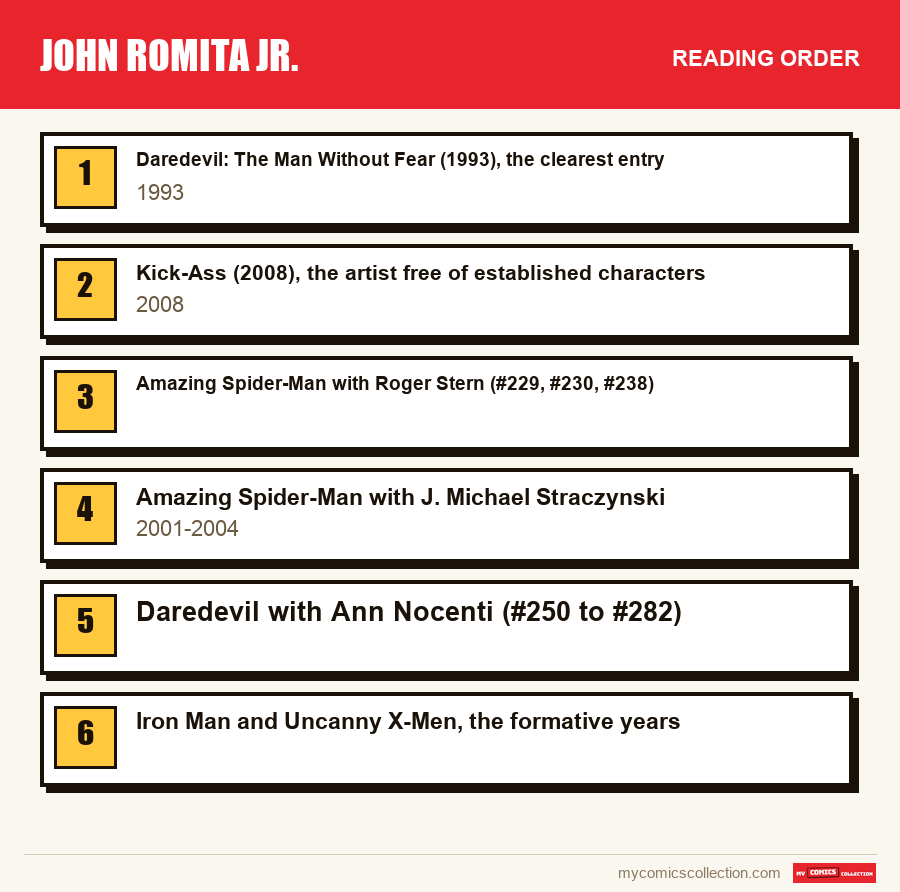
To read John Romita Jr., open Daredevil: The Man Without Fear (1993, five issues, written by Frank Miller), then Kick-Ass (2008) with Mark Millar. Continue with Amazing Spider-Man in the Roger Stern era (#229, #230, #238), the "Coming Home" arc by J. Michael Straczynski (2001), the long Daredevil run with Ann Nocenti (1988-1990), and finish with Iron Man and Uncanny X-Men. The path goes from the self-contained miniseries to the serial.
Drawing Spider-Man in every era, from 1977 to the 2025 relaunch, has ended up masking the rest of John Romita Jr.'s career: the artist also drew noir stories, violent superhero series and universes created with Mark Millar. This guide does not redo the biography, it offers a reading itinerary that takes into account the fact that an artist is read through the writers.
As always in this guide, only verified information (creators, issues, dates) is stated as fact; the analysis is our own, with no reproduction of protected pages or dialogue.
Step 1: Daredevil: The Man Without Fear (1993), the clearest entry
The five-issue miniseries brings together Frank Miller on script, Romita Jr. on pencils and Al Williamson on inks. It goes back over Matt Murdock's youth: the accident, the training, the meeting with Elektra, the birth of the vigilante. Since the story starts from zero, there is nothing to know before opening it, and the story is complete in five issues.
It is the best starting point because it shows what the artist can do when the script leaves room. The bodies are heavy, the alleys are narrow, the city weighs on the characters. In several interviews, Romita Jr. named this project as the best storytelling work, which gives a reliable indication of what you are about to read.
A collected edition gathers the five issues, which can also be found one by one as single issues without much trouble. Our ranking of Daredevil runs places it among the hero's other great periods, and the Daredevil reading guide explains where it falls in the character's chronology.
Step 2: Kick-Ass (2008), the artist free of established characters
Kick-Ass, eight issues written by Mark Millar starting in 2008, changes register completely. A teenager with no powers decides to become a neighborhood vigilante, and the series deals unflinchingly with the difference between the dream and what happens when you try it. The project belongs to its two creators, which explains a tone that no publishing house would have approved as is.
For anyone discovering Romita Jr. through the Marvel series, this step is the surprise of the path: a familiar line, applied to a story with no imposed costume and no continuity to respect. A film came out in 2010 based on this starting point; our comparison between the film and the comic notes what the screen changed.
Collecting Kick-Ass takes little effort: eight issues, a collected edition, and a first printing to favor if you want the original condition. It is a simpler purchase than the Marvel series of the 1980s, whose completion means dozens of issues.
Step 3: Amazing Spider-Man with Roger Stern (#229, #230, #238)
The first big rendezvous with Spider-Man fits in a few issues. In Amazing Spider-Man #229 and #230, writer Roger Stern and Romita Jr. pit the hero against the Juggernaut in "Nothing Can Stop the Juggernaut," an arc readers often cite among the best of the series. Issue #238, dated March 1983, introduces the Hobgoblin, whom the two creators make together.
These issues read well without knowing the previous years, because Stern tells each episode so that it is understood on its own. The artist brings massive silhouettes and square faces, recognizable at a glance in the fight panels. To place the writer, the Roger Stern hub gathers the writer's articles.
For collecting, #238 is a key issue, with all the attention that implies. We devoted a full profile to it. The Juggernaut two-parter remains accessible in single issues and appears in the collected editions of the era.
Step 4: Amazing Spider-Man with J. Michael Straczynski (2001-2004)
The 2001 return to the series is the artist's second summit on Spider-Man. The "Coming Home" arc, in issues 30 to 35 of volume 2, received an Eisner Award in 2002, with Scott Hanna on inks. Issue #36, dated December 2001, is the issue devoted to the September 11 attacks, which remains one of the most discussed of the series.
This rung demands more stamina than step 3: the arc sits within a Peter Parker serial where plots chain together over months. It is, however, much easier to approach than you might think, because "Coming Home" works as a starting point. Volume 2 then picks up the cumulative numbering, so the same creators reunite on issues 500 to 508 in 2003 and 2004.
This numbering detail directly interests the collector: the series has several volumes, and you need to know which volume you are talking about before buying. Our article on the volumes and numbering of Amazing Spider-Man explains it in detail.
Do you collect this series?
Track what you own, what you are missing and what your collection is worth. 7-day trial.
Start my trial →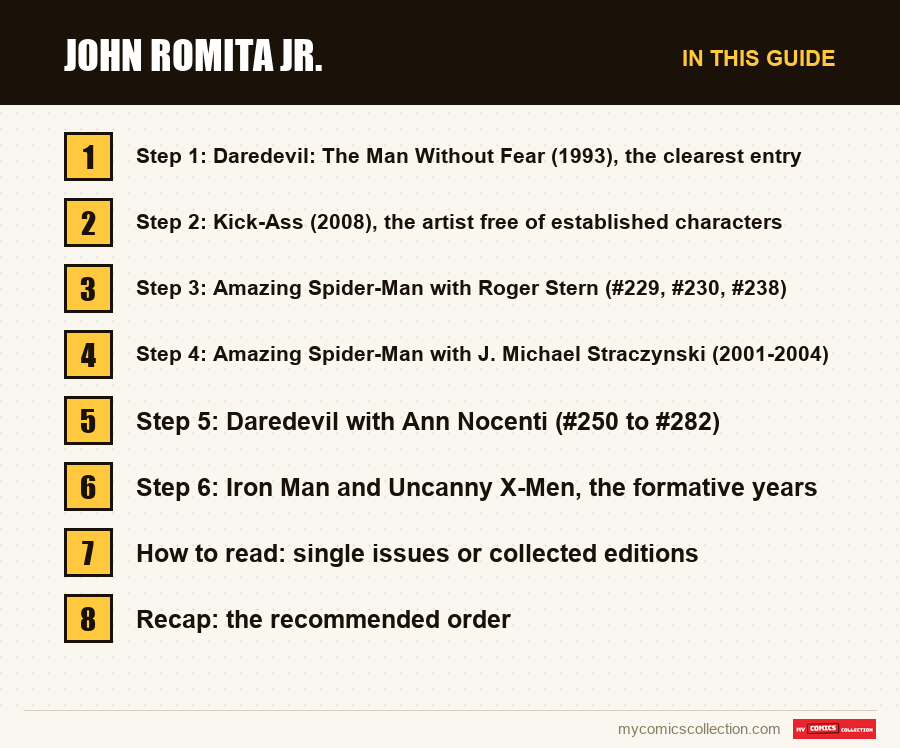
Step 5: Daredevil with Ann Nocenti (#250 to #282)
After two Spider-Man steps, back to Daredevil, but for a long period: from 1988 to 1990, from issue 250 to issue 282, with writer Ann Nocenti. This is the period when Romita Jr. says the artist rediscovered a taste for the craft, because for the first time the work included a share in the plots. The duo creates Typhoid Mary, a Daredevil adversary who keeps a place in the series long afterward.
The tone is more political and darker than in the usual superhero series of the time. The stories deal with justice, faith, the city, and often leave the hero without a clear victory. It is not light reading, and it is better placed after The Man Without Fear, which gives the landmarks.
Collecting such a period rests on completion: thirty-three consecutive issues, some of which are scarcer than others. Among these issues, the list of key Daredevil issues points to those to hunt first. For collected editions, a chronological edition makes reading more comfortable than chasing single issues.
Step 6: Iron Man and Uncanny X-Men, the formative years
The last step, the most demanding: the series that established the artist. On Iron Man, from 1978 to 1982, with David Michelinie and Bob Layton, Romita Jr. draws the arc devoted to Tony Stark's alcoholism, which culminates in issue 128, and takes part in the creation of Bethany Cabe and Justin Hammer. In this period, Layton often finalizes the sketches, which gives a different look from the later work.
On Uncanny X-Men, from 1983 to about 1986, from issue 175 to issue 211, with Chris Claremont, Romita Jr. co-creates Forge. The artist has downplayed this period, and we present it for what it is: an apprenticeship, useful for understanding the evolution of the line, less so for immediate reading pleasure. The artist would return in 1993 with Scott Lobdell.
These two series are read mostly by those who want to see where the style comes from. They are for the reader who has already enjoyed the previous steps. For a path centered on the X-Men, our X-Men reading guide places them in the series.
How to read: single issues or collected editions
The short stories, The Man Without Fear and Kick-Ass, read in collected form without losing anything, and their original single issues are easy to find if you want the object. For the two Spider-Man periods, chronological collected editions are the best choice: they respect the order of the episodes and keep you from missing an issue in a multi-part arc.
For Daredevil with Nocenti, the question arises differently: thirty-three issues, some easier to find than others. Read it in collected form first, then complete the single issues starting with the ones that introduce a character. Our article on John Romita Jr.'s career gives the full chronology of the series, if you want to place a reading within the whole.
A note on the recent periods. On the rival publisher's side, the DC parenthesis opens with Superman in 2014 and continues with an All-Star Batman in 2016. The return to Amazing Spider-Man dates from 2022, with Zeb Wells, then the 2025 volume written by Joe Kelly; with Paolo Rivera, Romita Jr. drew one of the main covers of issue 1000, released on September 30, 2026. These recent issues do not yet have an established value: their evolution will depend on the length of the series and on successive print runs. We discuss them in the collecting guide to issue 1000.
For fans of harder scripts, two complementary reads: Wolverine under Mark Millar's pen, with the "Enemy of the State" cycle, and the core of "World War Hulk," in 2007. They are not part of the main path, but they show the power of the line applied to the outsized.
Recap: the recommended order
Here is the path, from the most accessible to the most demanding.
- Daredevil: The Man Without Fear (1993): five issues, script by Frank Miller, no prerequisites.
- Kick-Ass (2008): eight issues with Mark Millar, outside Marvel continuity.
- Amazing Spider-Man #229, #230 and #238: the Roger Stern era, from the Juggernaut to the Hobgoblin.
- Amazing Spider-Man vol. 2, #30 to #36: the J. Michael Straczynski period.
- Daredevil #250 to #282: the long period with Ann Nocenti.
- Iron Man and Uncanny X-Men: the formative years, to understand the evolution of the style.
With a single evening, read step 1. With a weekend, add Kick-Ass and the Juggernaut two-parter. The rest is a project of several weeks, to be carried out in order.
Frequently asked questions
With Daredevil: The Man Without Fear, the 1993 five-issue miniseries, written by Frank Miller and inked by Al Williamson. It is complete, requires no prior reading, and the artist cites it as the best storytelling work. Then move on to Kick-Ass or to the Spider-Man period of the Stern era.
The landmarks are issues 229 and 230, which pit Spider-Man against the Juggernaut, and issue 238, dated March 1983, where the Hobgoblin is born. The writer of these episodes is Roger Stern. Romita Jr. also drew Madame Web and Hydro-Man in issues 210 and 212, with Dennis O'Neil.
Yes. Kick-Ass is an eight-issue series published starting in 2008, written by Mark Millar and drawn by Romita Jr. It belongs to no shared universe: a teenager invents himself as a vigilante. The 2010 adaptation takes up the same starting point, with differences that our comparison details.
No, the reverse is preferable. The 1993 miniseries retells the origins of Matt Murdock and stands on its own. The Nocenti period, from issue 250 to issue 282 (1988-1990), follows an already established hero and gains from being read after it, once Romita Jr.'s tone on this character has been identified.
Yes, between 2014 and 2020 or so. The list runs from Superman, taken over with Geoff Johns, to Superman: Year One, written by Frank Miller in 2019, by way of an All-Star Batman and the series The Silencer. This period comes after the main steps of this path.
Is an Amazing Spider-Man #238 or a Daredevil from the Nocenti period sleeping in your boxes? Appraise it according to its real condition before keeping or selling it.
Appraise my comic