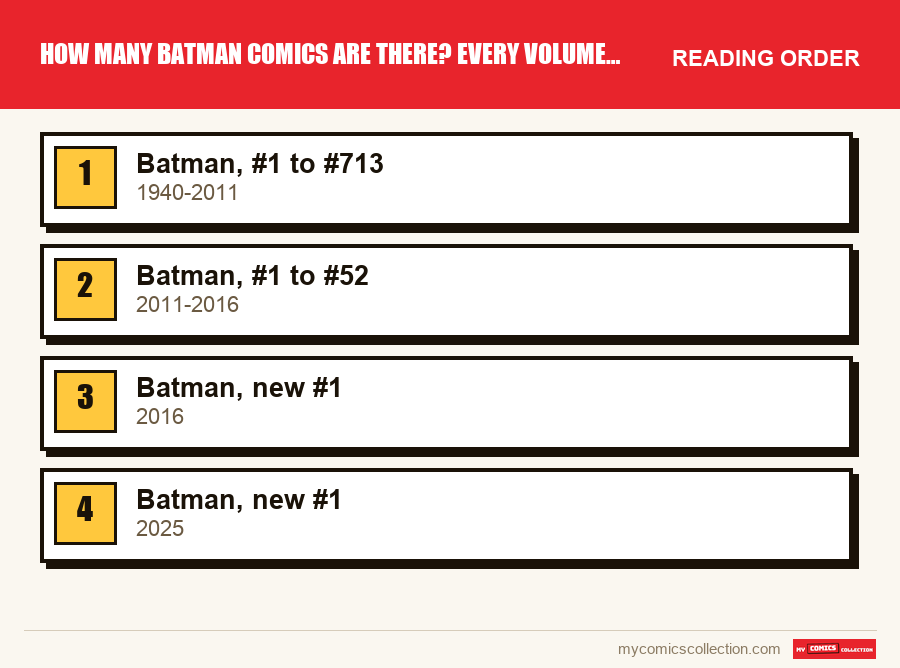
How many Batman comics are there? The Batman title has run through four main volumes since April 1940: the first runs from #1 to #713 in 2011, the second from #1 to #52 between 2011 and 2016, the third was born with DC Rebirth in 2016 and the fourth with DC All In in 2025. The first volume is by far the longest, and each of the three relaunches restarts at #1 with no legacy numbering, so the total depends on what you are willing to count.
Ask a comic shop owner how many issues of Batman exist and you will get a question back: which ones? The Dark Knight has one of the oldest series in American publishing, and its counter has been reset at every major overhaul of the DC universe. This article lays out the volumes in order, gives the boundaries we can establish, and explains how to add them up without making mistakes.
As always in this guide, only verified information (creators, issue numbers, dates) is stated as fact; the analysis is our own, with no reproduction of protected art or dialogue.
Series 1: Batman, #1 to #713 (1940-2011)
The first issue of Batman appeared in the spring of 1940, with a spring cover date and a newsstand release in April. Bob Kane and Bill Finger created the character in Detective Comics #27 the year before; the self-titled series gave him a whole magazine of his own, and its first issue already featured both the Joker and Catwoman. Collectors of high-end pieces will find this issue in our page on the value of Batman #1 from 1940.
This first volume lasts more than seventy years and ends with #713, titled "Storybook Endings," released in August 2011, when DC announced that its series would be canceled or relaunched with new #1 issues after Flashpoint. The writers are numerous: Bill Finger, Denny O'Neil, Len Wein, Gerry Conway and Grant Morrison are among the most notable, and the artists range from Bob Kane to Neal Adams and then Tony Daniel, who wrote and drew #692.
This volume crosses several ages of American comics, which is what makes its final boundary misleading. Between #1 and #713, the tone moves from the crime stories of the late 1940s to the darker tales of the 1970s, then to the great self-contained stories of the 1980s and 1990s. Each era has its own publishing landscape: paper, cover price, release schedule, and therefore its own difficulties for anyone who wants to complete the run without gaps.
A few landmarks mark the eras. In #232, Denny O'Neil and Neal Adams bring in the immortal Ra's al Ghul: our article on this 1971 issue details what is at stake. From #404 to #407, the retelling of Bruce Wayne's early days is titled Year One; the script comes from Frank Miller and the art from David Mazzucchelli. The Hush storyline starting in #608 brings together Jeph Loeb and Jim Lee. And Grant Morrison begins his long run on the character with #655, alongside Andy Kubert.
Series 2: Batman, #1 to #52 (2011-2016)
In September 2011, DC starts from scratch with The New 52 program. The second volume of Batman is handed almost from start to finish to Scott Snyder on writing and Greg Capullo on art; James Tynion IV writes the backup stories from #8 on. The team puts the Court of Owls at the center of its first arcs and follows with Zero Year, which runs from #21 to #33 and revisits the vigilante's early days.
The volume closes with #52, published in May 2016. Its makeup shows why counting takes some method: besides the fifty-two regular issues, it contains a #0 from September 2012 for DC's "Zero" month and the four in-between issues numbered 23.1 to 23.4. You also need to add four annuals.
If you want to read the Snyder and Capullo epic in order, our reading order for Batman: Endgame describes the story that pits the hero against the Joker in this period.
Series 3: Batman, new #1 (2016)
The third volume begins in June 2016, after the one-shot Batman: Rebirth, as part of DC Rebirth, an initiative that seeks to restore elements of the pre-New 52 DC universe. Tom King writes the start of the series; Gotham Girl appears right in #1. Over the years, several writers take turns: James Tynion IV from #85, Joshua Williamson from #118, then Chip Zdarsky from #125. Jeph Loeb and Jim Lee return with Hush 2 from #158, in March 2025. Among the artists are David Finch, Mikel Janín and Jorge Jiménez.
This is also the series where counting gets the most complicated: the start of the King era, the Tynion takeover, then the successive handoffs give the impression of one long story, when in fact it is a single counter to which several teams have contributed. Those who read in publication order should therefore follow the issue number, not the writer.
The release rhythm changes along the way: the series moves to a schedule of two issues per month, then goes back to one at #106 in 2021, under the Infinite Frontier banner, with Jorge Jiménez on art for that issue. No final boundary is written here. In any case, the counter of this third volume exceeds one hundred and fifty issues, since Hush 2 begins at #158.
To place this volume within a continuous reading, the page the best Batman runs ranks the notable creative teams, including Tom King's (see also the page dedicated to Tom King).
Series 4: Batman, new #1 (2025)
In September 2025, the DC All In publishing line relaunches Batman with a fourth volume. Matt Fraction writes and Jorge Jiménez draws, a team announced in February of that same year. The counter restarts once again at #1, which makes this title the fourth series to bear exactly the name Batman since 1940.
For a collector, the consequence is concrete: four series share the same title, the same icon on the cover and issue numbers that repeat from one volume to the next. In your spreadsheet, each row benefits from carrying four data points: volume, issue number, cover date and creative team, so that you never end up ordering the same #5 twice.
This repetition of numbers forces the collector to read the cover carefully: the volume number and the cover date make it possible to tell, for example, a #5 from 2016 from a #5 from 2025. Our page on the Absolute line covers the Absolute Batman series separately, since it does not belong to this lineage.
Do you collect this series?
Track what you own, what you are missing and what your collection is worth. 7-day trial.
Start my trial →
Renumbering: the arithmetic of the total
Unlike Detective Comics, whose counter was restored in 2016, Batman has no cumulative numbering displayed on its current covers: three relaunches have restarted at #1. Any calculation that holds up, based on the boundaries written above, is therefore done volume by volume.
- First volume: 713 regular issues, from #1 to #713. Catalogs bring it to 715 by adding the #0 from 1994, an issue tied to Zero Hour, and the #1,000,000 from 1998, tied to DC One Million.
- Second volume: 52 regular issues. With the #0 and the four issues 23.1 to 23.4, you reach fifty-seven.
- First and second volumes together: 713 plus 52, or 765 regular issues, not counting the special editions.
- Third and fourth volumes: their exact count changes every month and we do not write it down.
The difference between 765 and 772, for example, comes only from whether or not you agree to count the out-of-sequence issues: two in the first volume (the #0 and the #1,000,000), five in the second (the #0 and four .1 issues). It is up to each collector to decide whether these numbering variants belong on their want list.
A tip on method: for each volume, write down the low boundary, the high boundary and the list of out-of-sequence issues. You then get a grid that you can check off without ever mixing up two covers that carry the same number.
Annuals and spin-off series
The Batman Annual issues form a chapter of their own. A first series of annuals counts seven issues from 1961 to 1964. Seventeen more appear from 1982 to 2000, continuing the same numbering, then four from 2006 to 2011. In all, the first volume of Batman has twenty-eight annuals. Mike W. Barr and Trevor Von Eeden, for example, signed #8 from 1982. The second volume has its own series of annuals, restarted at #1 in 2012, which counts four issues.
Many titles orbit the main series: Detective Comics, whose history is just as rich, but also spin-off series devoted to the family of characters. We make no claim to be exhaustive here: each spin-off series deserves its own count, with its own boundaries.
Separately, the big events sometimes spread across several titles. To find your way, our reading order for Batman R.I.P. shows how a Grant Morrison story unfolds across the main series and other issues.
Completing the series: where to begin
Completing Batman in the broad sense is a project of several decades, and most advanced collectors begin by choosing a scope. Here is a method that avoids duplicate purchases.
- Pick one volume and nothing else to start. The second, from #1 to #52, is the most compact and can be completed at a reasonable pace; the first calls for a longer plan.
- Decide in advance what to do about the out-of-sequence issues: #0, .1 to .4, #1,000,000. Write the decision in your list so you never have to revisit it.
- Spot the key issues of each era in our selection of key issues and treat them separately: a top-tier copy does not follow the same rules as an ordinary issue.
- For recent periods, favor trade paperbacks or current issues over chasing cover variants, which do not count toward a complete series.
- Date every cover: since two volumes sometimes carry the same number, the cover date and the volume must appear in your inventory.
Finally, keep in mind that the later volumes do not replace the earlier ones: a collector who wants to own the character's beginnings will also turn to Detective Comics, but that is another series with its own counter.
Frequently asked questions
Since 1940, there are four volumes. One runs up to #713 (2011), another runs from #1 to #52 under the New 52, a third accompanies DC Rebirth from 2016 and a last one opens DC All In in September 2025. The last three restart at #1.
The first volume, from #1 in 1940 to #713 in August 2011. The #0 and #1,000,000 of this first volume bring its cataloged total to 715, not counting annuals.
After the Flashpoint event, DC announced in 2011 that its series would be canceled or relaunched with new #1 issues, under the name The New 52. Batman therefore ended its first volume at #713 and opened a second volume in September 2011, with Scott Snyder and Greg Capullo.
They belong to the second volume, but outside the regular sequence of fifty-two issues. Depending on whether you count them, along with the #0 from September 2012, the volume comes to fifty-two or fifty-seven single issues. Set your rule from the start and apply it to every volume.
No. They are two distinct titles, each with its own numbering: Detective Comics has existed since 1937 and saw the character born in its #27, while Batman begins in 1940. A count of Batman therefore does not include the issues of the other series.
Did you find a 1940s Batman or an issue from the New 52 in your boxes? Get a first estimate.
Estimate my comic