The Batman: Endgame reading order covers six issues of Batman (vol. 2), #35 to #40, published in 2014-2015 by writer Scott Snyder and penciler Greg Capullo. Read Death of the Family (#13-17) first, then Zero Year (#21-33), pick up Batman Eternal if you like, run the six issues of the story arc, then the tie-ins Batman Annual #3, Detective Comics: Endgame #1, Batgirl: Endgame #1, Gotham Academy: Endgame #1 and Arkham Manor: Endgame #1.
Six issues, one creative team, a face-off billed as a celebration of seventy-five years of Batman and the Joker: the arc has what it takes to attract a reader who wants a tight story. But it sits inside a run of several years, in the middle of a period when almost the whole Batman family of titles shares a single schedule. This guide gives you the order, step by step, and tells you what you can leave aside.
As always in this guide, only verified information (creators, issue numbers, dates) is stated as fact; the analysis is our own, with no reproduction of pages or protected dialogue.
What to read first
Endgame is presented as the conclusion of the Joker story Scott Snyder built in Batman (vol. 2). Launched in September 2011, this New 52 series runs through #52, in May 2016. You do not need to read all of it to approach the arc, but three milestones make the reading much richer.
First milestone: Death of the Family, in Batman #13 to #17. It is the Joker's return to the series, and the point the 2014 arc extends directly: Endgame marks the character's first appearance in comics since that story. Our Death of the Family reading order details that arc and its tie-ins; it is the prelude to prioritize.
Second milestone: Zero Year, in Batman #21 to #33, starting in June 2013. This arc goes back to Batman's early days in Gotham. It includes four "Villains Month" one-shots numbered #23.1 to #23.4, and #28 is drawn by Dustin Nguyen. You can read it as a standalone story that sheds light on what follows.
Third milestone, optional but useful: Batman Eternal, a weekly 52-issue series launched in April 2014 and finished in 2015. Issues #35 to #40 of Batman take place after the events of Eternal, and Scott Snyder presented Batman #34 as a catch-up issue on Eternal, without revealing its conclusion, which sets up the arc. If you want to save time, read that single issue.
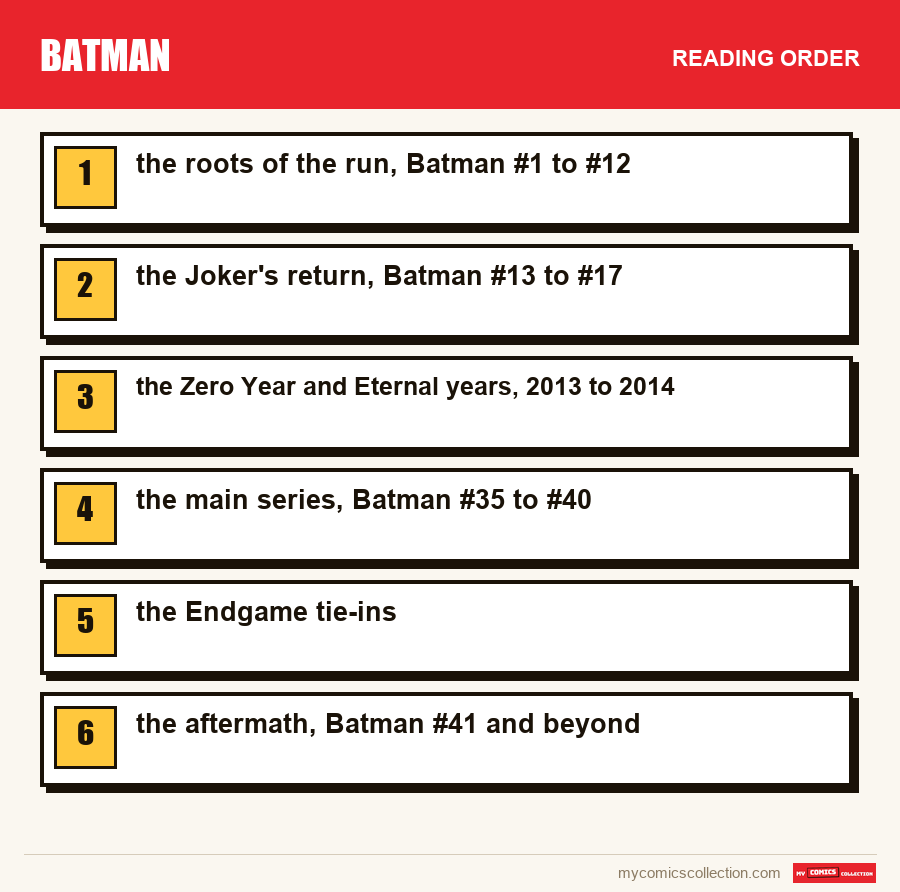
Phase 1: the roots of the run, Batman #1 to #12
To understand what Snyder and Capullo do with Gotham, start at the beginning of volume 2. The Court of Owls fills issues #1 to #7: this is the arc where the Court and the Talons appear. Issues #8 to #12 and Annual #1 are gathered under the title The City of Owls, and Night of the Owls is a crossover tied to issues #8 and #9 (June and July 2012). From #8 on, backup stories are written or co-written by James Tynion IV.
These issues are not essential for Endgame, which concentrates on Batman and the Joker. They do, however, show the full scale of the duo's style: a Gotham that changes dimension with each arc. Issue #0 from September 2012, published for DC's "Zero Month" initiative, can be read separately.
Phase 2: the Joker's return, Batman #13 to #17
This is the most important narrative preamble. Death of the Family establishes the Joker as the run's main antagonist; #17 closes the arc in 2013. Read these five issues in one sitting: they put you in the mindset of the relationship between the two characters as Snyder writes it.
The tie-ins for this arc, spread across the neighboring Batman family series, appear on our dedicated page. They are not necessary for what follows, and the Endgame reading order works very well without them.
Phase 3: the Zero Year and Eternal years, 2013 to 2014
Between the Joker's return and the final arc, the series goes through Zero Year (#21 to #33), then through a moment when all the series in the Batman group share the same schedule. During Endgame, most of the family's titles are set at the end of the Eternal storyline. This synchronization explains why most of the Endgame tie-ins carry the word "Endgame" in their title: they are designed as echoes of the main series in the other books.
In practical terms, here is how to proceed: read Zero Year in full if you like origin stories; otherwise, go from Death of the Family to Batman #34, the catch-up issue, then open #35. Either way, you arrive at the arc with what you need.
Phase 4: the main series, Batman #35 to #40
The arc spans six issues, published in 2014-2015. The creative team is stable: Scott Snyder on script, Greg Capullo on art, Danny Miki on inks, FCO Plascencia on colors, Steve Wands on lettering.
The arc celebrates seventy-five years since the first appearance of Batman and the Joker, and Snyder presents it as the conclusion of his Joker story, begun with Zero Year and continued in Death of the Family. It was also conceived as the last Batman story for the Snyder and Capullo duo, which explains the sense of conclusion it carries.
We will not walk you through it issue by issue: the arc's appeal lies precisely in its sequence, and the Joker's return in #35 is designed as a moment of surprise. Our advice on method is simple: read the six issues in order, without interruption, and save the tie-ins for afterward.
Phase 5: the Endgame tie-ins
The five publications attached to the arc are as follows:
- Batman Annual #3
- Gotham Academy: Endgame #1
- Batgirl: Endgame #1
- Detective Comics: Endgame #1
- Arkham Manor: Endgame #1
These issues are collected in the trade paperback Joker: Endgame (October 2015). Each belongs to a series neighboring Batman: if you follow one of them, that is where the tie-in makes the most sense.
Read them after the main series. Since each is a standalone issue, their order among themselves matters little; start with the series you already collect.
Do you collect this series?
Track what you own, what you are missing and what your collection is worth. 7-day trial.
Start my trial →
Phase 6: the aftermath, Batman #41 and beyond
The sequel to the arc is called Superheavy and covers Batman #41 to #50, as part of the DCYOU initiative. The run's epilogue then plays out in #51 ("Gotham Is") and #52 ("The List"), which is the last issue of the series in May 2016. We do not detail this sequel so as not to reveal the outcome of Endgame, but know that it exists and reads in continuity.
The Joker crossovers list the character's other appointments with the neighboring series.
The tie-ins you can skip
No tie-in is necessary to understand the end of the arc: the main series stands on its own. Here is why you can leave them aside without regret.
- Gotham Academy: Endgame #1: it is aimed first at readers of the Gotham Academy series.
- Arkham Manor: Endgame #1: it belongs to the Arkham Manor series and mostly serves its regular readers.
- Batgirl: Endgame #1 and Detective Comics: Endgame #1: they show the event's echo in neighboring series, without changing the main storyline.
- Batman Annual #3: it mainly interests fans of annuals and of everything surrounding the arc.
For Batman Eternal, the principle is the same: Batman #34, designed to bring the reader up to speed, can replace reading the 52 issues.
Single issues or trade paperbacks: how to read it
With single issues, you read issue by issue: the six copies of Batman #35 to #40, then the tie-ins. The advantage is control of your budget issue by issue and the option to stop after the arc. The drawback is the tie-ins scattered across five different series.
With trade paperbacks, two volumes complement each other. Batman Vol. 7: Endgame (September 2015) collects issues #35 to #40; Joker: Endgame (October 2015) gathers the tie-ins listed above. The Batman by Scott Snyder & Greg Capullo Omnibus Vol. 2, published in November 2021, is an oversized edition for those who prefer that format.
Our method: if you want the arc and nothing else, the first trade paperback is enough. If you are a collector, compare the exact contents of each volume before buying, and check our guide to building a Joker collection to place the arc within the whole.
The key issues to know
The collecting logic of a recent arc shows up in three places: the beginning, the end and the side items.
- Batman #35: the opening issue. Its importance comes from the surprise of the Joker's return, which was not announced before release and was revealed only in the last pages.
- Batman #40: the last issue of the arc, to shelve with the rest of the series so the set stays coherent.
- Batman #13: the launch issue of Death of the Family, a landmark of the run for Joker fans.
- Batman #41: the start of Superheavy, often sought by collectors who want the direct sequel.
- The Endgame #1 tie-ins: five issues that are easier to find as a lot than one by one.
As for method, do not stop at a single listing: compare condition, any variant print runs and sold listings. The major Joker artists also help you spot the covers worth a detour.
Recap: the complete order
- Batman (vol. 2) #1 to #12, optional (September 2011 to 2012)
- Batman #13 to #17, Death of the Family (2012-2013)
- Batman #21 to #33, Zero Year (starting June 2013)
- Batman #34, to catch up on Batman Eternal
- Batman #35 to #40, Endgame (2014-2015)
- Batman Annual #3
- Detective Comics: Endgame #1 and Batgirl: Endgame #1
- Gotham Academy: Endgame #1 and Arkham Manor: Endgame #1
- Batman #41 to #50, Superheavy
- Batman #51 and #52, end of the volume (May 2016)
Frequently asked questions
The arc fills six issues of Batman (vol. 2), #35 to #40, published in 2014-2015. Scott Snyder writes it and Greg Capullo draws it, with Danny Miki on inks. The tie-ins form a second set: Batman Annual #3 and four single issues carrying the subtitle "Endgame."
It is not mandatory, but it is recommended. Endgame picks up the thread the Joker left at the end of Death of the Family, that is, Batman #13 to #17. You will understand the stakes better by reading those five issues first, then moving on to #35.
No. Batman Eternal is a weekly 52-issue series, launched in April 2014. Endgame takes place after its events, and Batman #34 was designed to bring the reader up to speed without revealing the conclusion of Eternal. That single issue is enough for anyone who has not read the weekly series.
The volume Batman Vol. 7: Endgame, released in September 2015, contains issues #35 to #40. Joker: Endgame (October 2015) gathers the tie-ins. A Snyder and Capullo omnibus, volume 2, has existed since November 2021 for those who prefer the oversized format.
The direct sequel is Superheavy, in Batman #41 to #50, published as part of the DCYOU initiative. The volume ends with #51 ("Gotham Is") and #52 ("The List"), in May 2016. Read them in order, without skipping an issue.
Do you have Batman issues by Snyder and Capullo to appraise? Check the condition of your run before completing it.
Estimate my comic