The Joker was born in 1940 through the writing of Bill Finger , the artwork of Jerry Robinson , and the direction of Bob Kane: three names whose authorship has long been disputed. Since then, five landmark creative teams have each reinvented the Clown Prince of Crime: O'Neil & Adams, Englehart & Rogers, Moore & Bolland, and Snyder & Capullo. The result is one of the most complex villains in the entire history of comics.
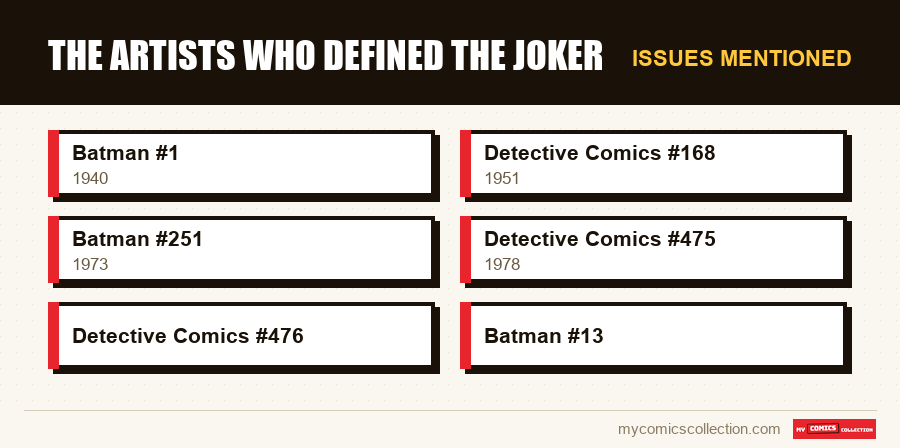
Debuting in Batman #1 (Spring 1940), the Joker was unlike any villain before him: a calculating serial killer from his very first story: one he was actually meant to die in. A CGC 9.4 copy of Batman #1 sold for $2,220,000 at Heritage Auctions in January 2021, a record for the title driven by the dual first appearances of the Joker and Catwoman. One essential caveat: eBay medians from our estimator for the Batman series are heavily diluted by modern reprints and facsimile editions: they bear no relation to the value of an original 1940 copy.
This guide traces each creative team's contribution using verifiable data only: eBay medians (eBay.fr + eBay.com, June 2026) and records documented by Heritage Auctions, CGC, and the specialist press. No price is cited for series where our estimator returns fewer than 15 listings.
Bill Finger, Bob Kane and Jerry Robinson (1940): a disputed creation
The birth of the Joker is one of comics history's most contested creations. Bob Kane was Batman's credited author; Bill Finger wrote the scripts without credit (DC only formally acknowledged his contribution in 2015); Jerry Robinson, then Kane's eighteen-year-old assistant, claims to have drawn the character's first sketch, inspired by actor Conrad Veidt in the 1928 silent film The Man Who Laughs. The current official credit lists all three men. What is beyond dispute: Batman #1 (1940) establishes the character's foundations immediately: a calculating, smiling, remorseless killer. His origin was later fleshed out in Detective Comics #168 (1951), "The Man Behind the Red Hood," which revealed that the Joker had once been the Red Hood before falling into a vat of chemicals. A CGC 9.4 copy of Detective Comics #168 realised $324,000 at auction in November 2022: eBay listing volume is far too thin to produce a reliable median for this issue.
Denny O'Neil & Neal Adams (1973): the killer returns
Through the 1960s, the Joker had been defanged by the campy Batman TV series (1966), with Cesar Romero playing him as a harmless clown, and the comics had followed suit. It was Batman #251 (September 1973) that restored him as a genuine murderer. "The Joker's Five-Way Revenge!", written by Denny O'Neil and drawn by Neal Adams, shows the Joker methodically killing his former henchmen out of pure whim. Adams's cover (the Joker swimming alongside a shark, grinning) is among the most referenced images of the Bronze Age. Our estimator returns a median of €9 across 65 listings: the mass market remains accessible. In high grade, a CGC 9.8 copy set the issue record at $38,000 in ComicLink's June 2024 sale.
Steve Englehart & Marshall Rogers (1977-1978): logical madness
Englehart and Rogers took over Detective Comics with issue #471 (August 1977) and produced one of the most influential Joker interpretations ever published. The high point is Detective Comics #475 (February 1978), "The Laughing Fish": the Joker disfigures fish with his rictus grin, then demands a federal trademark on the animals, and begins killing government officials who try to explain why that is legally impossible. This internally coherent but deranged logic gave the character a new dimension: genuinely menacing precisely because he is neither random nor rational. The direct follow-up, Detective Comics #476, appeared in March-April 1978. Our estimator returns a median of €84 across 28 listings for #475 and a median of €46 across 20 listings for #476. This run directly influenced Tim Burton's Batman (1989) and was adapted as the "Laughing Fish" episode of Batman: The Animated Series (1993).
Alan Moore & Brian Bolland (1988): The Killing Joke
Batman: The Killing Joke (1988) remains the most analysed Joker story in comics history. Alan Moore explores the hypothesis of a tragic origin, the Joker as a failed comedian whose life collapsed after one bad day, while deliberately leaving that account unverified within the narrative itself. Brian Bolland's artwork is clinically precise, each panel composed as a demonstration of craft. The story also introduced Barbara Gordon's traumatic injury, whose consequences echoed through the DC universe for decades. First-print copies in CGC 9.8 trade between $150 and $250 in recent sales: a sustained level without a single dominant public auction record. Moore and Bolland provided the DNA that every subsequent Joker film has drawn on, whether consciously or not.
Scott Snyder & Greg Capullo (2012-2013): Death of the Family
Within the New 52 relaunch, Scott Snyder and Greg Capullo opened their celebrated Batman run in 2011. Their arc "Death of the Family" (Batman #13-17, October 2012: February 2013) delivered a mythological Joker: not a man but a force, who frames himself as Batman's greatest enemy and necessary mirror. Capullo drew a Joker whose face is literally detached from his skull: an image that became immediately iconic. Batman #13, the opening chapter, remains the most sought-after single issue of the run; eBay listings are too dispersed across the general series to produce an isolated reliable median. Their collaboration marks one of the last great editorial reinventions of the character in mainstream comics.
The Joker on screen: from Jack Nicholson to Joaquin Phoenix
Every major screen adaptation has reignited collector interest in key issues. Jack Nicholson (1989) made the Joker a mainstream pop icon; Heath Ledger (The Dark Knight, 2008) turned the character into a cultural reference point that transcended comics entirely. The standalone Joker film (2019), directed by Todd Phillips and starring Joaquin Phoenix, grossed $1.079 billion worldwide: a remarkable performance for a supervillain film without traditional action set pieces. The sequel, Joker: Folie à Deux (2024), saw a sharp commercial decline. Each release has produced a measurable uptick in secondary-market interest for Batman #251, The Killing Joke , and Detective Comics #168.
Own a Joker comic? Get a free valuation with our tool based on real eBay sales to find its low, median, and high value.
Frequently asked questions
Credit is shared between Bill Finger, Jerry Robinson and Bob Kane. Finger wrote the scripts behind the scenes (his contribution was only acknowledged by DC in 2015), Robinson says he drew the first sketch, and the current official version credits all three men.
In Batman #1, dated spring 1940. He is already a serial killer there and was meant to die in that founding story, which also introduces Catwoman.
Batman #251 (September 1973), "The Joker's Five-Way Revenge!", by Denny O'Neil and Neal Adams. After the softened image of the 1966 series, he once again eliminates his former accomplices.
Not definitively. Alan Moore proposes the idea of a failed comedian whose life collapses on one bad day, but deliberately leaves doubt about whether the story is true. The origin of the Red Hood appears in Detective Comics #168.
Batman #1 (1940), Detective Comics #168, Batman #251, Detective Comics #475 ("The Laughing Fish") and #476, The Killing Joke (1988) and Batman #13 by Snyder and Capullo. Each Joker film renews interest in Batman #251, The Killing Joke and Detective Comics #168.