The Death of the Family reading order starts with Batman vol. 2 #13 to #17 (2012-2013, New 52), where Scott Snyder and Greg Capullo bring the Joker's return to Gotham. Read those five issues straight through first, then add the tie-ins that interest you: Batgirl, Nightwing, Batman and Robin, Detective Comics, Catwoman, Suicide Squad, Red Hood and the Outlaws and Teen Titans. Finish with Batman #17.
Few Joker arcs read as well in two layers as this one: a five-issue spine from a single creative team, and a cluster of neighboring series that each show, from their own window, what the clown's return does to the people closest to Batman. This article gives you the order issue by issue and tells you where to stop if you prefer the straight line.
As always on this guide, we only state verified facts (creators, issue numbers, dates); the analysis is ours, with no reproduction of protected art or dialogue.
What to read before
Death of the Family doesn't require a whole library, but it plays better if you know the starting point of the series. Batman vol. 2 launched in 2011 from Scott Snyder and Greg Capullo, and the same duo wrote this arc. The first twelve issues of the series set up the immediate backdrop: a Gotham where Batman has to rethink what he thought he knew about his city, under pressure from the Court of Owls, which the duo created. The Court saga fills the opening of the run. Reading those issues before the arc isn't mandatory, but it shows you just how much the Joker is about to undo.
Second landmark: the Joker's absence. In New 52 continuity, the character disappears for a long stretch before returning in Batman #13. The arc uses that absence as its dramatic engine, and the staging of his return lands better if you've read the earlier issues rather than jumping straight to #13.
Third landmark, a more cultural one: the title echoes A Death in the Family, the 1988 story in which a Robin sits at the heart of the narrative. You don't need to have read it, but if you want to catch the nod, our page on Batman: A Death in the Family places that story in the late 1980s.
Finally, if you know the roles of Batman's allies (Robin, Nightwing, Batgirl, Catwoman, Alfred, Commissioner Gordon), the tie-in collection will read even more clearly. The Batman reading guide brings that cast back into focus if you're coming from a different run.
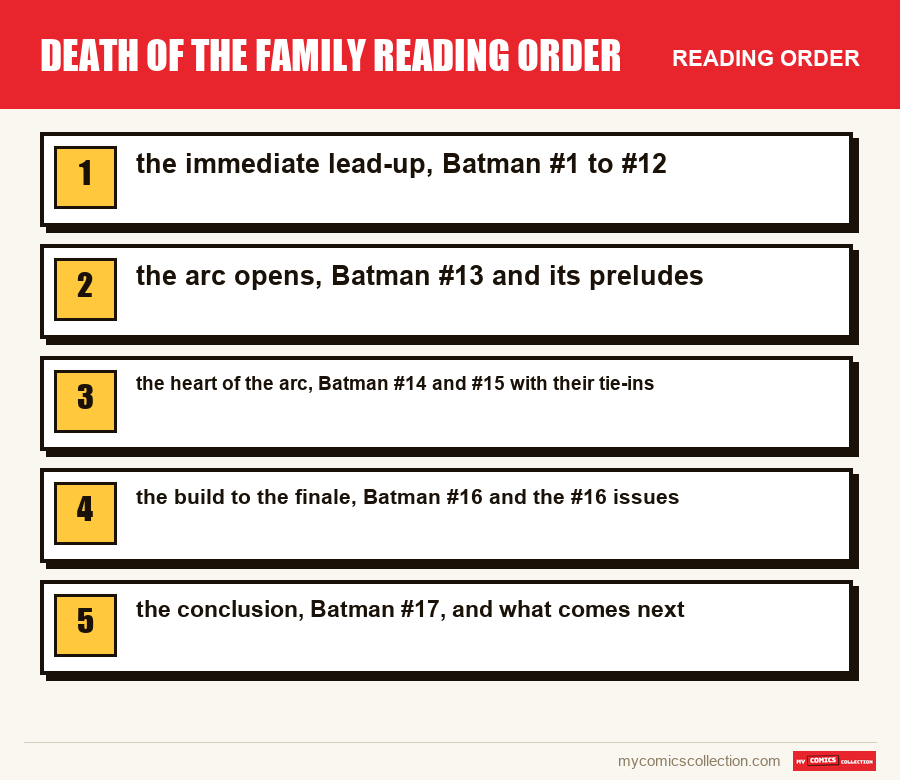
Phase 1: the immediate lead-up, Batman #1 to #12
Take the time to read the start of the run before the arc. The series launched in 2011 with Scott Snyder writing and Greg Capullo drawing, and its first issues establish the threat of the Court of Owls. What matters for our order is the tone: the Joker arc arrives after a string of stories in which Bruce Wayne is challenged on his own turf, and the clown's return flips the perspective by targeting people rather than the city.
A tip on method: if you'd rather save time, read at least the last issue before the arc, then move on to #13. You'll miss some developments of the main investigation, but you won't be lost in the arc itself, which stands on its own.
Phase 2: the arc opens, Batman #13 and its preludes
The first chapter in the main series is Batman #13 (2012). It's the launch issue: it presents the Joker's return and sets the premise of the arc. The credits on that issue: Snyder writing, Capullo on pencils, Jonathan Glapion on inks, FCO Plascencia on colors. The arc runs five issues, through #17 in 2013, and issues #13 to #16 also publish backup stories written by James Tynion IV with Scott Snyder and drawn by Jock.
Two neighboring series offer a prelude issue. Batgirl #13, written by Gail Simone and drawn by Ed Benes, closes the series' "Knightfall" story and opens Barbara Gordon's part in the event, which issues #14 to #16 continue under the name "Collision." Catwoman #13, written by Ann Nocenti and drawn by Rafa Sandoval, plays the same role for Selina Kyle and carries over into #14.
Our recommended order for this phase: Batman #13, then Batgirl #13 and Catwoman #13. Each series keeps its own voice, but the three issues give the same starting point: the Joker is back and he has a plan.
Phase 3: the heart of the arc, Batman #14 and #15 with their tie-ins
Issue #14 of Batman continues the Snyder and Capullo story. It's among the most talked-about issues of the arc, and it's the one to have in hand if you collect the highlights. After it, three series unfold their own episode.
- Catwoman #14 (Ann Nocenti and Rafa Sandoval) wraps up Selina Kyle's part.
- Suicide Squad #14 and #15, written by Adam Glass and drawn by Fernando Dagnino, make up the "Running with the Devil" story: the squad crosses paths with the Joker's return.
- Batgirl #14 (Gail Simone, with Ed Benes and Daniel Sampere on art) begins the "Collision."
Then Batman #15 restarts the main series. Place the same-numbered issues from the family series right after it.
- Batman and Robin #15 (Peter J. Tomasi and Patrick Gleason): the arc seen through Damian Wayne.
- Nightwing #15 (Kyle Higgins and Eddy Barrows): the arc as seen from Nightwing's own series.
- Detective Comics #15 (John Layman and Jason Fabok).
- Red Hood and the Outlaws #15 (Scott Lobdell and Timothy Green II), in a crossover with Teen Titans #15 (Scott Lobdell and Fabian Nicieza, art by Brett Booth).
This arrangement follows a reading logic, not the exact on-sale order: the idea is never to read a tie-in before the main chapter of the same number, so the echoes make sense.
Phase 4: the build to the finale, Batman #16 and the #16 issues
Issue #16 of Batman sets up the conclusion. The tie-ins take their turn again: Batman and Robin #16, Nightwing #16, Detective Comics #16, Red Hood and the Outlaws #16 and Teen Titans #16 finish their episodes, while Batgirl #15 and #16 end the "Collision." The tie-in line therefore stops at #16 for most series, which clears the ground for the ending.
The contrast is worth noting: the side series each explore a personal bond with Batman, while the main series stays focused on the face-off. Reading the #16 tie-ins right before you tackle Batman #17 builds an anticipation that the final issue resolves.
Do you collect this series?
Track what you own, what you are missing and what your collection is worth. 7-day trial.
Start my trial →
Phase 5: the conclusion, Batman #17, and what comes next
Batman #17 (2013) is the last issue of the arc. Spoiler warning: we won't say anything about the final scene, which you need to discover by reading. Just know that the issue concludes the face-off between Batman and the Joker, and that it leaves the character once again out of the picture.
For the Joker's story in this continuity going forward, Scott Snyder returns to him in Batman: Endgame (Batman #35 to #40, 2014-2015, again with Greg Capullo). In between, the series goes through Batman: Zero Year (Batman #21 to #27 and #29 to #33, 2013-2014), which revisits Bruce Wayne's early years as a vigilante. Read Zero Year if you want the context, then Endgame to close the Joker cycle.
The tie-ins you can skip
The central thread fits in five issues: Batman #13 to #17 tell the arc with no outside help. The tie-ins add perspectives, they don't fill gaps. So you can read them a la carte.
If you only keep one, go for Batgirl, whose four-issue thread (#13 to #16) forms an almost standalone story under Gail Simone's pen. Next come Nightwing and Batman and Robin, which focus on central members of the family. Catwoman, Detective Comics, Suicide Squad, Red Hood and the Outlaws and Teen Titans are easier to leave aside if you don't already follow those series: their link to the arc is real, but most of their plot happens elsewhere.
Optional doesn't mean negligible: a tie-in mostly serves the reader who already follows the parent series, and the one who wants to see the arc from another point of view. If you read the run in collected editions, the question settles itself, see below.
Single issues or trade paperbacks: how to read it
You have two approaches. In single issues, follow phases 2 to 5 above: the main issue first, then the same-numbered tie-ins. In trade paperbacks, the logic is different, because each series has its own volume.
The trade paperback Batman Vol. 3: Death of the Family collects Batman #13 to #17: it's the shortest path to the arc. The tie-ins also exist as per-series volumes whose titles carry the same subtitle: Batgirl Vol. 3, Batman and Robin Vol. 3, Catwoman Vol. 3, Nightwing Vol. 3, Red Hood and the Outlaws Vol. 3 and Teen Titans Vol. 3. These volumes include other issues beyond the arc: the Batgirl volume, for example, collects Batgirl #14 to #19, and the Nightwing one picks up Nightwing #13 to #18.
One volume brings together the event and its tie-ins: Joker: Death of the Family, which collects the Batman issues (#13, #14 and #17), plus Catwoman, Batgirl, Suicide Squad, Batman and Robin, Nightwing, Detective Comics, Red Hood and the Outlaws and Teen Titans. It's the most practical collection if you want the arc and its echoes without buying a dozen volumes.
Collector's method: before buying a trade paperback, check the list of issues contained on the back or on the publisher's page, and compare it with the one in this article. A volume can include issues from before or after the arc, which changes the order in which you'll read.
The key issues to know
For a collector, the interest centers on the main series. Batman #13 is the opening issue, the one many readers hunt for first; Batman #14 is cited as the arc's best-selling issue; Batman #17 closes the story and draws fans of memorable endings. In reading order, these three issues mark out the arc.
On the tie-in side, the opening issues of Batgirl and Catwoman (#13), along with Batgirl's four-issue run, are natural landmarks. The Teen Titans and Red Hood and the Outlaws issues are linked by the crossover: if you're looking for one, it makes sense to pick up the other.
When buying, look at what has actually sold on each of these issues before trusting an asking price. For an issue from this period, the condition of the copy and the cover variant weigh more than the date. The appraisal service lets you place your copies before selling or insuring a set.
Recap: the complete order
- Batman #1 to #12 (2011-2012): recommended lead-up, Snyder and Capullo.
- Batman #13 (2012): the arc opens.
- Batgirl #13 (Gail Simone, Ed Benes): prelude.
- Catwoman #13 (Ann Nocenti, Rafa Sandoval): prelude.
- Batman #14.
- Catwoman #14.
- Suicide Squad #14 (Adam Glass, Fernando Dagnino).
- Batgirl #14.
- Batman #15.
- Suicide Squad #15.
- Batman and Robin #15 (Peter J. Tomasi, Patrick Gleason).
- Nightwing #15 (Kyle Higgins, Eddy Barrows).
- Detective Comics #15 (John Layman, Jason Fabok).
- Red Hood and the Outlaws #15 and Teen Titans #15 (Scott Lobdell and his co-writers).
- Batgirl #15.
- Batman #16.
- Batman and Robin #16, Nightwing #16, Detective Comics #16, Red Hood and the Outlaws #16, Teen Titans #16, Batgirl #16.
- Batman #17 (2013): conclusion.
- Possible follow-up: Batman #21 to #27 and #29 to #33 (Zero Year, 2013-2014), then Batman #35 to #40 (Endgame, 2014-2015).
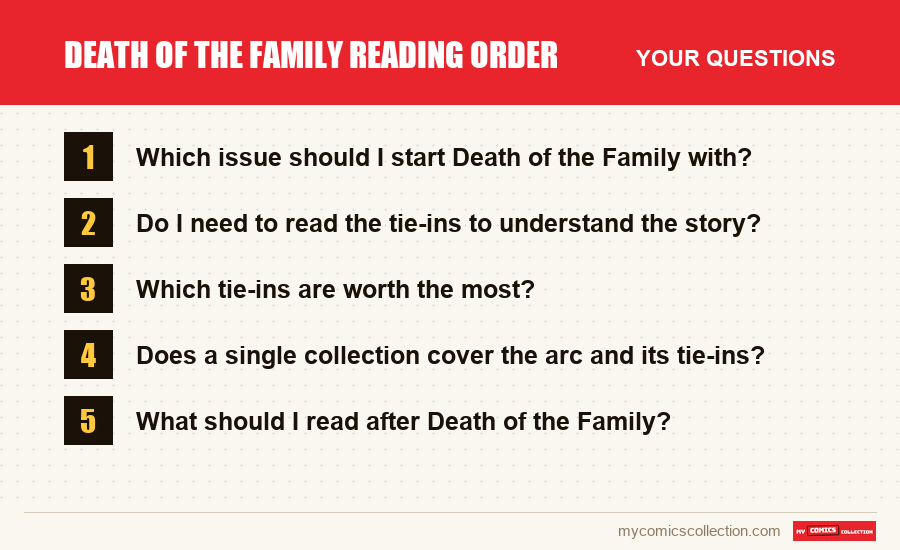
Frequently asked questions
Start with Batman vol. 2 #13, which opens the arc under Snyder and Capullo's byline. If you want the Batgirl or Catwoman prelude, read their #13 issues next. Reading the main series straight through, from #13 to #17, remains the simplest path.
No. Batman #13 to #17 tells the complete arc. The tie-ins show how the Joker's return touches Batgirl, Nightwing, Robin, Catwoman and others. They enrich the reading without filling any gap, and you can pick them based on the characters you already follow.
The Batgirl thread (#13 to #16, by Gail Simone) forms an almost standalone story and remains the most recommended. Nightwing and Batman and Robin come next, since they follow central figures of the family. The other series mostly suit readers who already follow them.
Yes: Joker: Death of the Family collects Batman issues and tie-ins from Catwoman, Batgirl, Suicide Squad, Batman and Robin, Nightwing, Detective Comics, Red Hood and the Outlaws and Teen Titans. If you only want the main series, Batman Vol. 3: Death of the Family is enough.
Continue in Batman with Zero Year (#21 to #27 and #29 to #33, 2013-2014), which revisits Bruce Wayne's early days, then Endgame (#35 to #40, 2014-2015), where Scott Snyder and Greg Capullo pick up the Joker thread again.
Do you own issues of Batman vol. 2 or Death of the Family tie-ins: get your lot appraised before reselling it or completing it.
Appraise my comic