Strikes WGA (Writers Guild of America, May 2 - September 27, 2023, 148 record days ) And SAG-AFTRA (actors, July 14 - November 9, 2023, 118 days) froze Hollywood for almost six months in 2023. In 2025, the results on the spec comics market are measurable: Fantastic Four: First Steps postponed to July 2025, Avengers: Doomsday postponed to May 2027, Blade paused indefinitely, contrast with Deadpool & Wolverine rescued in July 2024 and Thunderbolts* maintained in May 2025. Consequences for the collector: revalued sleepers, extended accumulation windows and new IA clauses in WGA and SAG contracts.
The spec comics market, this mechanism by which a collector buys a key issue in advance by betting on the announcement or release of a Marvel Studios or DC Studios adaptation, is based on a production schedule. When this calendar jumps, the entire spec ecosystem is reconfigured. The strikes of the Writers Guild of America and the SAG-AFTRA in 2023 caused precisely this earthquake. The WGA started the strike on May 2, 2023 and did not end it until September 27, 2023, i.e. one hundred and forty-eight days, a record in the history of the screenwriters' union. SAG-AFTRA, the union of radio and television actors and artists, followed on July 14, 2023 and did not sign an agreement until November 9, 2023, after one hundred and eighteen days of stoppage.
During these six months, no writing in pre-production could progress on the WGA side, and no filming could take place on the SAG-AFTRA side, with the exception of productions under independent waiver. Marvel Studios, DC Studios, Sony Pictures and Warner Bros have had their entire slates shifted. When the studios published their new release dates in November 2023, then adjusted again to 2024 and 2025, the adaptation calendars, the calendars on which the comics spec is based, had become illegible. The Marvels released in November 2023 suffered a historic flop, Blade lost his script in pre-production, Captain America: Brave New World was postponed to February 2025, and Avengers: The Kang Dynasty was canceled and then transformed into Avengers: Doomsday. For the spec collector, this series of upheavals has redrawn the map of sleepers to watch in 2025.
The effect was not limited to delays. The final contracts signed in November 2023 by the WGA and in July 2024 by SAG-AFTRA contain new clauses on generative artificial intelligence, on deepfake actors and on digital double protocols. These clauses reshape what an adapted comic can become in the next five years. To understand the 2025 impact and anticipate the 2026-2027 impact, this report takes up the complete chronology of the strikes, identifies the re-evaluated sleepers, examines the IA clauses and proposes a post-strike collector strategy adapted to the postponed MCU and DCU calendar.
Mandatory investment warning. This article provides a documentary assessment of the impact of the WGA and SAG-AFTRA 2023 strikes on the spec comics market as observed in 2025. It does not in any way constitute financial advice, investment advice, a purchase recommendation, nor a guaranteed projection of added value. The comic book market is a volatile collectible market. Ratings can fall as well as rise, sometimes violently after the release of a disappointing film or the cancellation of an announced project. The comics spec involves a real risk of capital loss. Release dates discussed are those communicated by Marvel Studios, DC Studios and Sony Pictures as of the date of writing, June 2026, and may be revised at any time by the studios. No past correlation between film announcement and rating increase guarantees that the same mechanism will recur. Buy as a priority the comics that fascinate you as a reader and collector, never by overinvesting a budget that you could not accept losing. Consult specialized platforms (Heritage Auctions, GoCollect, ComicsPriceGuide, eBay sold listings) before any significant purchase, and consider diversifying your collection beyond just spec bets.
WGA and SAG-AFTRA 2023 strike timeline: dates, duration, key events
To understand the 2025 impact on the spec comics market, we must first reconstruct the exact calendar of the two strikes. They each have their own logic, but they overlapped for eleven weeks, from July 14, 2023 to September 27, 2023, creating a total shutdown of Hollywood production for almost three consecutive months. This overlap is what distinguishes 2023 from previous WGA strikes, notably that of 2007-2008 which did not mobilize the actors.
WGA: screenwriters’ strike from May 2 to September 27, 2023
The Writers Guild of America brings together American television and film screenwriters, organized into two geographic sections, WGA East and WGA West. The collective contract (MBA, Minimum Basic Agreement) signed in 2020 expired on May 1, 2023. Negotiations with the AMPTP (Alliance of Motion Picture and Television Producers), which represents the major studios Disney, Warner Bros, Universal, Paramount, Sony and Netflix, failed at the end of April 2023. The WGA launched the strike on Tuesday May 2, 2023 at midnight in the morning, after a massive vote by its members.
The main demands focused on three axes. First, the sharing of residuals in the streaming economy: remuneration for broadcasting is much less favorable to screenwriters on the platforms than on traditional cable channels. Second, the minimum size of writers rooms (writing teams), to guarantee a minimum number of screenwriters per series, a practice eroded by streaming mini-rooms. Thirdly, and this is the point that resonates the most for the spec comics market, the use of generative artificial intelligence in writing, a subject which did not exist in the previous 2020 contract.
The strike lasted one hundred and forty-eight days, from May 2 to September 27, 2023, a record in the history of the Hollywood screenwriters' union. The previous long WGA strike, that of 2007-2008, lasted one hundred days. The final contract was signed after a new marathon of negotiations at the end of September, ratified by the members at the beginning of October 2023, and became effective for a period of three years. During those five months, no Marvel Studios, DC Studios or Sony Pictures pre-production involving new writing could take place in the United States, which immediately froze development schedules.
SAG-AFTRA: the actors’ strike from July 14 to November 9, 2023
The Screen Actors Guild: American Federation of Television and Radio Artists, a merger of the two historic unions in 2012, brings together American radio and television actors and artists. Its collective contract with the AMPTP expired on June 30, 2023, temporarily extended until July 12, the date on which negotiations definitively failed. SAG-AFTRA called the strike on July 14, 2023, joining WGA writers who had already been on strike for ten weeks.
It is this superposition that has brought Hollywood to an almost total standstill. As long as only the writers were on strike, certain productions already written could still be filmed. Once the actors were on strike, no more filming under AMPTP contract could take place. Some independent productions, under waiver negotiated individually with SAG-AFTRA, were able to continue, including Deadpool & Wolverine which achieved special status due to its relationship with Disney and the complexity of the Marvel-Fox project.
The SAG-AFTRA demands overlapped with those of the WGA on streaming and AI, with one specificity: protection against deepfakes and the use of digital doubles without explicit consent. The fear expressed by SAG-AFTRA negotiators, that an actor scanned once could see his image reused without a new agreement or new remuneration, structured a major part of the final contract.
The SAG-AFTRA strike lasted one hundred and eighteen days, from July 14 to November 9, 2023. The final contract, signed after preliminary agreement on November 8 and ratified by members in early December 2023, contains one of the first detailed clauses on generative AI and performance capture in a major American collective contract. This contract, like that of the WGA, runs for three years, i.e. until 2026, which implies new negotiations to come.
The role of the AMPTP and the return to work November 2023
AMPTP negotiated the two contracts successively. On the financial side, the double strike cost the industry several billion dollars according to Milken Institute estimates, and disrupted the 2024 and 2025 release schedules of all studios. When work resumed on November 9, 2023 for the actors, and September 27, 2023 for the screenwriters, the studios had to urgently recalibrate their schedules. The Marvels, released on November 10, 2023, the day after the end of the SAG-AFTRA strike, could not be promoted correctly by its actors during filming and post-production, which contributed to its commercial flop (with around $206 million in global box office for a budget close to $270 million, according to figures published in early 2024).
It was from November 2023 that the shift announcements began to rain in, completely redesigning the MCU and DCU calendar for 2024, 2025, 2026 and 2027. It is this shifted calendar which now structures the 2025 comics spec.
MCU and DCU film delays: direct impact on the spec comics calendar
The delay in cinema releases is the most direct mechanism by which strikes have had repercussions on the spec comics market. When Fantastic Four is postponed from May 2024 to July 2025, it is not just a matter of studio communication. For the spec collector, this is an additional fourteen month accumulation window on key issues Fantastic Four, without a violent increase in rating linked to the exit. Here is the detail of the main shifts observed and their significance for the spec.
Fantastic Four First Steps: May 2024 to July 2025
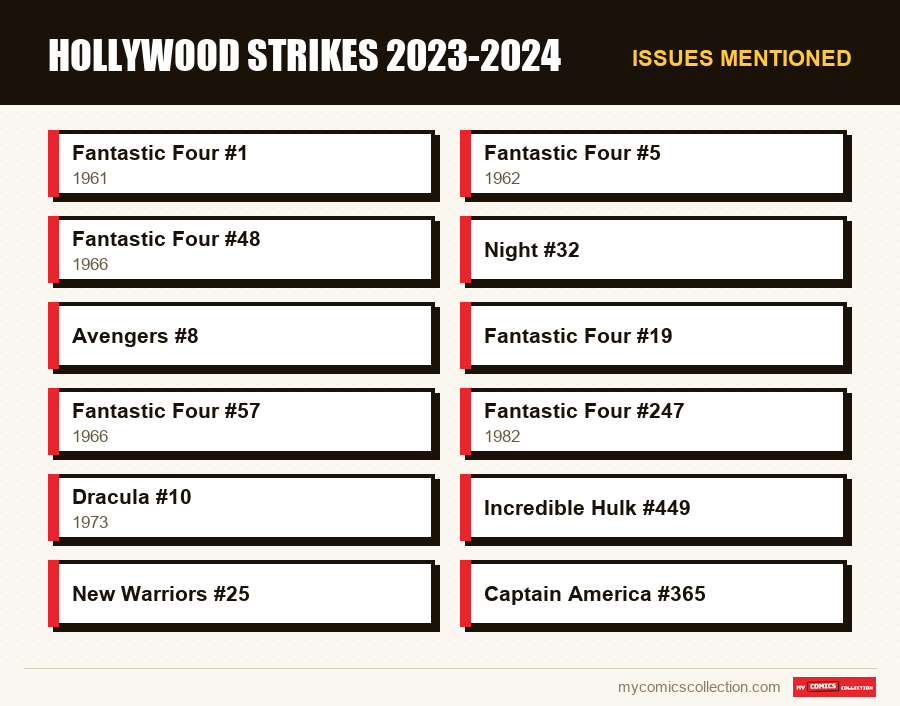
The Fantastic Four: First Steps, initially announced for May 2024, then for February 2025, was finally distributed on July 25, 2025. This delay of fourteen months compared to the initial date directly affected the spec on Fantastic Four #1 (November 1961), Fantastic Four #5 (July 1962, first appearance of Doctor Doom), Fantastic Four #48 (March 1966, first appearance of Galactus and the Silver Surfer), and the entire Lee-Kirby Silver Age run. For a detailed analysis of the pre-movie Fantastic Four key issues, see Fantastic Four comics before the 2025 film.
The effect observed on the secondary market during the 2023-2025 window was a plateau on Fantastic Four key issues. No outbreak comparable to that observed on Werewolf by Night #32 before the Marvel Studios Halloween 2022 Special. Collectors who accumulated in 2023 and 2024 during the relative silence were able to buy at calm prices, while the film was no longer on the short-term agenda. The window of opportunity lasted until spring 2025, when the first official trailers began to reignite public attention.
Avengers: Doomsday: Rescheduled to May 2027
The project Avengers: The Kang Dynasty, initially announced for May 2025, was extensively reworked after Jonathan Majors' legal difficulties at the end of 2023 and beginning of 2024 and the decision by Marvel Studios to reorient the major narrative arc phase 6. The project became Avengers: Doomsday, starring Robert Downey Jr. announced in July 2024 at San Diego Comic-Con as Doctor Doom. The release is now scheduled for May 7, 2027.
For the spec, this repositioning has two consequences. The first: the Kang key issues (Avengers #8 from 1964, first appearance, but above all Fantastic Four #19 from 1963 for Rama-Tut, the earlier incarnation) lost their status as immediate sleepers. Their rating, after a 2021-2023 surge driven by Loki season 1 then Quantumania, has entered a correction phase. The second consequence: Doctor Doom becomes the centerpiece of the new arc, which redirected the attention towards Fantastic Four #5 (July 1962), the character's first full appearance, and on narratively important issues like Fantastic Four #57 (December 1966, Doom steals Silver Surfer's cosmic power) or Fantastic Four #247 (October 1982, Ruler Doom of Latveria).
Blade Marvel Studios: indefinitely postponed
The project Blade, in which Mahershala Ali was announced at San Diego Comic-Con 2019, illustrates the extreme case of the film being put on indefinite hiatus. Announced for November 2023, then for September 2024, then for November 2025, the project lost several directors and several writing teams in rapid succession, a process made worse by the WGA strike. As of mid-2026, there is no firm release date confirmed by Marvel Studios.
For the spec, this is a signal of caution. The key issues Blade , notably Tomb of Dracula #10 (July 1973, Blade's first appearance by Marv Wolfman and Gene Colan) have gone through a full cycle of speculation and correction. The rating soared in 2020-2021 with the announcement of the Mahershala Ali casting, then stagnated in 2022-2023, and corrected in 2024-2025 in the face of successive delays. The case Blade illustrates a key rule of the spec market: a project without a firm date always ends up losing its speculation premium.
Thunderbolts*: maintained in May 2025
Thunderbolts*, released on May 2, 2025, is one of the rare phase 5 productions to have kept its initial date despite the strikes. The project was announced for July 2024, postponed to December 2024, then maintained until May 2025. This relative stability can be explained by a script completed before the WGA strike and filming partially carried out in 2024 under the new SAG-AFTRA contract. For a dedicated spec analysis, see spec Thunderbolts comics MCU 2027.
Thunderbolts key issues (Incredible Hulk #449 from January 1997 for the team's first appearance, New Warriors #25 from April 1992 for Songbird, Captain America #365 from January 1990 for the Crossbones of the film version) experienced a moderate increase in the first half of 2025, without a spectacular surge. The spec market has learned since the episode Eternals 2021 that the release of a film does not guarantee an increase in ratings, especially for secondary teams.
Deadpool & Wolverine: rescued in July 2024 by waiver SAG
Deadpool & Wolverine, released on July 26, 2024, is the most emblematic case of production that escaped the direct impact of strikes. The film obtained a specific SAG-AFTRA waiver to finish filming in the summer of 2023, a status negotiated individually with the union. The result: a worldwide box office gross of over $1.3 billion, becoming the highest-grossing R-rated film in history at the time of its release.
On the spec side, the effect was massive on New Mutants #98 (February 1991, first appearance of Deadpool), already the most watched rating on the modern market. The price, which was around 800 dollars in CGC 9.8 in 2022, soared to 1,400 dollars in the summer of 2024 before correcting to around 1,100 at the end of 2024. Wolverine key issues also (Incredible Hulk #181 from November 1974, first full appearance) have not seen any major movement, these issues already being established in the blue-chip Silver-Bronze market. It's a textbook case: the success of a film only really benefits key issues that are still underrated.
Spec sleepers reassessed 2024-2025 by schedule delays
The 2023-2025 delays have reconfigured what speculators call the sleepers, these underrated numbers which could experience a revaluation on the occasion of an announcement or a release. Here are the most discussed sleepers at the start of 2025 and the logic behind them.
Sleepers Doom: the post-Kang reorientation
With Robert Downey Jr. as Doctor Doom announced for Avengers: Doomsday May 2027, several secondary Doom issues received new attention. Super-Villain Team-Up #1 (August 1975), starring Doom and Namor, went from negligible rating to active sleeper. John Byrne run numbers on Fantastic Four (FF #236 to #279, from 1981-1985) where Doom occupies a central place in several arcs, have also seen their visibility increase. Iron Man #150 (September 1981, double issue Stark vs. Doom in the Middle Ages, by David Michelinie and Bob Layton) has been cited regularly as a Doom-adjacent sleeper.
The post-strikes sleeper logic is as follows: when a major character is confirmed on a long schedule (May 2027 for Doom), the central key issues (FF #5 for the first Doom) are already listed. Sleepers are the peripheral issues where the character appears in an important arc but which remain under the secondary market radar. For the collector, these sleepers offer a better ratio of entry price and potential increase, without any guarantee. For the complete method, see spec keys 2027 Marvel DC movies series.
Sleepers Fantastic Four Silver Age
With the effective release of First Steps in July 2025, the market confirmed that central key issues Fantastic Four #1, #5, #48, #49, #50 have not experienced a spectacular surge. On the other hand, several FF Silver and Bronze Age sleepers attracted attention: Fantastic Four #67 (October 1967, first appearance of Adam Warlock in his cocoon), Fantastic Four #112 (July 1971, classic Hulk vs. Thing), and Marvel Two-in-One #50 (April 1979, Thing past vs Thing present by John Byrne).
The sleeper mechanism on Silver Age can be explained: the major key issues are already listed and liquid, so the film effect is absorbed by variation in the auction premium without a violent outbreak. Sleepers are the narratively rich but off-top list issues, which can be rediscovered by an influx of new collectors attracted to the film.
Complementary Thunderbolts and Avengers Sleepers
The relative success of Thunderbolts* in May 2025 redirected attention to the team's secondary sleepers. Civil War #6 (December 2006), where Bullseye integrates the Norman Osborn version of Thunderbolts, and Thunderbolts #110 (March 2007), first appearance of Team Norman Osborn by Warren Ellis and Mike Deodato, have been cited. The logic is identical: team with variable composition, sleepers correspond to the first appearances of team variants.
Sentry Sleepers and Cosmic Characters
Several 2024-2025 leaks have mentioned Sentry for Phase 6 or 7 MCU. Sentry #1 (September 2000, Paul Jenkins mini-series) remains accessible under 100 dollars in raw NM and around 400 in CGC 9.8 mid-2025. New Avengers #1 (January 2005, first Sentry appearance in the Bendis era) is even more accessible. The sleeper status is based on the confirmation of an MCU casting, which is not yet official as of the date of this review.
Generative AI clause WGA final contract November 2023: long-term spec implications
The WGA contract signed at the end of September 2023, ratified at the beginning of October 2023, contains the first detailed clause on the use of generative artificial intelligence in the writing of television and cinema scripts signed in a major American collective contract. The implications for the spec comics market are less immediate than release delays, but structurally more profound.
The IA WGA clause provides three main protections. First, generative AI cannot be credited as the author of a scenario. Second, a studio cannot require a screenwriter to use generative AI as a working tool. Third, AI-generated material cannot be considered literary or source material within the meaning of the collective contract, meaning that a screenwriter who reworks an AI draft is considered the author of the entire new screenplay.
For the spec comics market, this clause has two potential long-term effects. First effect, human writing is protected as the canonical source of adaptation, which maintains the link between a film script and an identifiable source comic. If the AI could be credited as author, the comic-storyline adaptation chain would be broken, and with it part of the spec mechanism. Second effect, studios which nevertheless wish to use generative AI for the development of projects will have to do so upstream of the official scriptwriting process, which could speed up pre-production on projects which pass the validation filters. For a full analysis of the AI impact on the market, see Generative AI impact on the 2025 comics market.
The WGA clause runs for three years, until 2026. The next negotiation will be an opportunity to expand or restrict these protections depending on the evolution of AI technologies and the industry. For the long-term spec collector, this is a signal to watch for: a relaxation of the clause in 2026 could accelerate the production of new content, and therefore the rotation of source adaptations, with a possibly positive effect on the sleepers already identified.
IA clause SAG-AFTRA contract July 2024: deepfake protections and performance capture
The SAG-AFTRA contract signed in November 2023, ratified in early December 2023, contains the other major IA clause of this round of negotiations. It focuses on the deepfakes of actors and on the use of digital doubles, subjects which did not exist with the same acuteness in the previous contract. A specific update on performance AI was added in July 2024 in a side letter signed by negotiators, strengthening protections on performance capture.
The SAG-AFTRA protections cover three distinct cases. First case, the digital double of an actor (digital replica) cannot be created without explicit consent and specific remuneration. Second case, the use of a deceased actor in digital performance requires the authorization of the rights holders and equivalent remuneration. Third case, generative AI cannot replace a main actor without new contractual negotiations, even for filming extensions or reshoots.
For the spec comics market, these protections have an indirect but important effect. First effect, projects involving deceased actors for narrative tributes (Stan Lee case, cases of deceased actors like Chadwick Boseman) are now regulated. This limits potential remixes that could have reactivated old comic book arcs. Second effect, the heavy capture performances (case of Andy Serkis Gollum, case of Josh Brolin Thanos) are secure, which maintains the narrative value of the source arcs, and therefore the connection with the adapted comics. To understand why many Marvel creators are leaving the majors for Substack, see Marvel creators joining Substack 2025.
Collecting this series?
Track what you own, what you are missing and what your collection is worth. 7 day trial.
Start my trial →Post-Strikes 2025 collector strategy: offbeat pre-film accumulation
For the spec collector in 2025, the lesson of the strikes is twofold. On the one hand, the accumulation windows have extended on key issues linked to offbeat films. On the other hand, certain spec bets prior to the strikes saw their premium melt when the calendars were pushed back without certainty. This is the strategy that emerges from this assessment, formulated as a methodological framework without any guarantee.
Identify extended accumulation windows
When a movie is shifted without undoing, the accumulation window lengthens proportionally. Fantastic Four First Steps pushed back from May 2024 to July 2025 offered fourteen additional months of quiet market to accumulate Fantastic Four Silver Age. Avengers: Doomsday postponed to May 2027 offers an even longer window, eighteen to twenty months, on second-tier Doom key issues.
The practical rule: regularly check the schedule announced by Marvel Studios and DC Studios (updated at each San Diego Comic-Con and each CinemaCon), cross-check with credible leaks from The Hollywood Reporter, Variety, Deadline, and adjust your watchlist accordingly. Official announcements trigger public attention on average nine to twelve months before a film's actual release, which defines the reasonable window of purchase before a potential surge. For a complete method framework, see the most relevant comics 2025 best-of.
Diversify beyond a single character
The case Blade illustrates concentrated risk: a project without a firm date ends up deflating its spec premium. The cautious collector diversifies his bets between several characters whose adaptations are confirmed in different horizons. May 2025 Thunderbolts, July 2025 First Steps, July 2025 Superman DCU, May 2027 Avengers Doomsday covers a range of dates that reduces the risk of the entire portfolio being impacted by a single delay or cancellation.
Favor narrative sleepers rather than keys already listed
The First Steps report confirms an observation already documented: the major key issues (FF #1, FF #5) no longer surge at the release of a major film, because they are already established in the blue-chip market. Narrative sleepers, these important numbers for the story of a character but outside the top list, offer a better ratio of entry price and potential increase. For Doom, it's Iron Man #150 or Super-Villain Team-Up #1 rather than Fantastic Four #5. For Galactus, it is Thor #160 or Silver Surfer #1 (1968) rather than Fantastic Four #48.
Adopt a rigorous cataloging discipline
With moving calendars, the collector needs a clear vision of his portfolio. Cataloging each issue purchased, its condition, its purchase price, its purchase date and its current rating allows resale or conservation decisions to be made on a cold reading rather than an emotional reaction. A dedicated software solution like the collection manager or rigorous manual monitoring is now essential for those who invest regularly.
DC Studios James Gunn: DCU timeline and impact on the DC spec
The DC counterpart of the 2023-2027 MCU calendar is carried by James Gunn and Peter Safran, co-directors of DC Studios since November 2022. Their DCU slate was announced in January 2023, just before the WGA strike, then adjusted several times in 2024 and 2025 to absorb the impact of the strikes. The post-strike strategy on the DC side can be read mainly through three projects.
Superman DCU James Gunn: July 2025 maintained
Superman by James Gunn, scheduled for July 11, 2025, was maintained despite the strikes. The script was completed before the WGA strike, and filming took place in 2024 after the end of the SAG-AFTRA strike. This is the film that opens the DCU Gunn-Safran era, after the Elseworlds transition ( The Batman Part II , Joker Folie à Deux).
For the comics spec, the expected effect on Superman key issues was more moderate than anticipated. Action Comics #1 (June 1938, first appearance of Superman) is already the most highly rated piece in the world of comics, beyond the reach of any spec logic. Action Comics #2 (July 1938), Superman #1 (June 1939) are already installed. Superman sleepers instead focus on specific story arcs: Action Comics #775 (March 2001, What's so funny about truth, justice and the American way? by Joe Kelly and Doug Mahnke, considered one of the best modern Superman stories) saw its visibility increase in the perspective of Superman DCU.
Lanterns HBO series 2026: effect on the Green Lantern spec
Lanterns, a DC Studios series produced for HBO and announced for 2026, must focus on Hal Jordan and John Stewart. Several postponements of filming in 2024 and early 2025 have shifted the initial release from the end of 2025 to the second half of 2026. For the spec, this is an opportunity to identify second-tier Green Lantern key issues which could experience a revaluation.
Green Lantern #76 (April 1970, start of the Denny O'Neil and Neal Adams run, Green Lantern-Green Arrow), Green Lantern #87 (December 1971, first appearance of John Stewart) and Showcase #22 (October 1959, first appearance of Hal Jordan Green Lantern Silver Age) are the issues to be documented in the watchlist. Showcase #22 is already installed in expensive Silver Age market. Green Lantern #87 remains accessible but experienced an initial rise in 2020-2021 during previous HBO Max announcements.
Ripple effect on the DC spec in general
The start of the Gunn-Safran DCU in the summer of 2025 relaunched the DC spec as a whole, after a 2018-2024 period marked by the contrasting results of the Snyderverse films. Lobo , Mister Terrific , Hawkgirl, several secondary characters entering the DCU have become sleepers, with introductory keys from the 80s and 90s generally still accessible.
2024-2026 impact assessment: a calmer, more disciplined spec market
The 2025 assessment of the spec comics post-strike market can be summarized in five main observations, formulated as an observation, never as a projection or recommendation.
First observation: the accumulation windows were longer than in previous cycles, which allowed for calmer purchases on the key issues Fantastic Four, Doom, and the general Phase 6 spec panel. The methodical collector was able to build his portfolio without haste, which reduces the risk of paying a short-term surge premium.
Second observation: the correlation between film announcement and increase in central key issue ratings has further eroded. The market has learned since the episode Eternals 2021 that the release of a film does not guarantee an increase, especially for issues already listed on an active secondary market. It is rather on narrative sleepers that the increases are now occurring, and in a less violent manner than in the 2020-2021 cycles.
Third observation: the NFT comics bubble, which had absorbed a significant part of spec budgets in 2021-2022, burst in 2023-2024, redirecting flows towards the traditional physical market. For a full analysis of the NFT bubble burst, see NFT comics bubble assessment 2021-2025. The return to the physical market provided support for blue-chip key issues but did not relaunch the modern spec with the same intensity as in 2020-2021.
Fourth observation: the relative stability of the Silver and Bronze Age market has been confirmed. The major key issues of the 60s and 70s (first appearances, canonical events) continued their slow progression, regardless of the strikes. This is an illustration of the rule of blue-chip comics: their rating depends more on the generational dynamics of collectors than on studio announcements. For a pillar approach to comics investing, see comics investment update 2027 strategy pillar.
Fifth observation: the new IA WGA and SAG-AFTRA clauses structure a future where human writing and actor performance remain at the center of the creative process. For the spec comics market, this means that the comic-script-screen adaptation chain remains readable, and that the key issues sources remain identifiable. This is important qualitative news, even if it does not immediately translate into a rating increase.
For the 2025-2027 collector, these five observations outline a calmer, more disciplined spec environment, more aligned with narrative fundamentals than with short-term rumors. This is probably the time to build a methodical watchlist on the MCU and DCU 2027-2030 calendars, favoring narrative sleepers and diversification, rather than concentrated bets. An approach that the new spec Captain America Brave New World and the post-Marvels Secret Invasion spec illustrate in practice. To fit your spec budget into a global collector strategy, see the pillar collector France guide pillar.
FAQ: Hollywood strikes 2023-2024 and spec comics market 2025
How long exactly are the 2023 WGA and SAG-AFTRA strikes?
The WGA (Writers Guild of America) strike lasted one hundred and forty-eight days, from May 2 to September 27, 2023, which constitutes a record in the history of the screenwriters' union. The SAG-AFTRA (radio-television actors and artists) strike lasted one hundred and eighteen days, from July 14 to November 9, 2023. The two strikes overlapped for eleven weeks, from July 14 to September 27, 2023, creating a near-total shutdown of Hollywood production during this period. It is this superposition, unprecedented compared to the 2007-2008 WGA strike, which caused the magnitude of the 2024-2025 impact on cinema release calendars.
Which MCU and DCU films were delayed the most by the strikes?
Several major projects have been postponed. Fantastic Four: First Steps, originally announced for May 2024, was released in July 2025. Avengers: The Kang Dynasty, scheduled for May 2025, became Avengers: Doomsday scheduled for May 2027. Blade is on indefinite hiatus with no firm date in mid-2026. Conversely, Deadpool & Wolverine was released in July 2024 thanks to a specific SAG-AFTRA waiver, Thunderbolts* was maintained in May 2025, and Captain America: Brave New World was released in February 2025. On the DCU side, Superman by James Gunn was maintained for July 2025, and Lanterns on HBO is postponed to the second half of 2026.
How did the strikes change the spec on Doom key issues?
The cancellation of Avengers: The Kang Dynasty and its replacement with Avengers: Doomsday starring Robert Downey Jr. as Doctor Doom announced in July 2024 redirected spec attention towards Doom. Fantastic Four #5 (July 1962, first complete appearance) remains the central key issue, already rated at high Silver Age levels. Secondary Doom sleepers like Super-Villain Team-Up #1 (August 1975), Iron Man #150 (September 1981, Stark vs. Doom in the Middle Ages) and the Byrne run on Fantastic Four #236 to #279 saw increased visibility. Conversely, the Kang key issues (Avengers #8 from 1964, Fantastic Four #19 from 1963) began a phase of rating correction in 2024-2025.
What do the IA clauses of the 2023-2024 WGA and SAG-AFTRA contracts provide?
The WGA contract signed in September 2023 provides that generative AI cannot be credited as an author, that a studio cannot require a screenwriter to use it as a tool, and that material generated by AI does not have the status of literary source material within the meaning of the collective contract. The SAG-AFTRA contract signed in November 2023, supplemented by a side letter in July 2024, regulates digital replicas of actors (consent and remuneration required), the use of deceased actors in digital performance (authorization of rights holders), and limits generative AI as a substitute for the main actor without new negotiation. These two contracts run for three years, with new negotiations planned from 2026.
Should you buy now or wait for the next studio announcements?
This question cannot receive a universal answer, because it depends on the collector profile, the budget, and the level of risk accepted. The general logic resulting from the post-strike assessment is as follows: the current accumulation windows, opened by calendar shifts, can offer calmer prices than those which will prevail nine to twelve months from a release. But there is no guarantee of the increase in rating after release, as the case of Eternals 2021 has shown. The prudent rule: only buy what you would be happy to keep even without an increase, diversify between several characters with different calendars, and only devote a limited portion (5 to 15%) of the overall collection budget to the spec. The comics spec involves a real risk of capital loss and does not constitute a regulated financial investment.