Generative AI hit the comics market between 2022 and 2025 in successive waves: Stable Diffusion (2022), Midjourney v5 (2023), explosion 2024. DC Comics officially banned AI covers in May 2024 (statement Jim Lee, Chief Creative Officer). Marvel follows with an implicit anti-AI policy after the J. Scott Campbell controversies. The WGA strike 2023 imposed an anti-AI cinema clause which ricochets into publishing. The spec market is already valuing pre-AI 2023-2024 covers.
The year 2024 marks a brutal turning point for the American comics industry. In the space of eighteen months, DC Comics, Marvel Comics and most independent publishers have had to publicly position themselves on the use of generative artificial intelligence in editorial production. Covers suspected of being generated by Midjourney, boards accused of AI tracing, fan sites ravaged by automatic images, chatGPT scenarios proposed in pitch: the tsunami spared no actor. As of June 9, 2026, the results are measured in official policies, departures of creators to Substack, public controversies and reconfiguration of the speculative market.
The issue goes beyond aesthetics. For a collector, the question is now binary: does a cover suspected of being generated or retouched by AI discount on the secondary market? Conversely, will verifiable pre-AI 2022 covers, signed and traced by hand, experience a rarity premium equivalent to that which hand-painted covers from the 1990s ended up receiving? The first 2024-2025 data from eBay, Heritage Auctions and ComicConnect are starting to provide some answers, even if the methodology remains fragile.
This article provides an analytical assessment of the impact of generative AI on the 2024-2025 comics market, by crossing official editorial sources, public declarations from Marvel/DC/Image decision-makers, documented creator controversies, and the first secondary market signals. The figures and dates cited come from official press releases or verifiable interviews. The 2026-2027 projections remain what they are: analytical hypotheses, to be weighed.
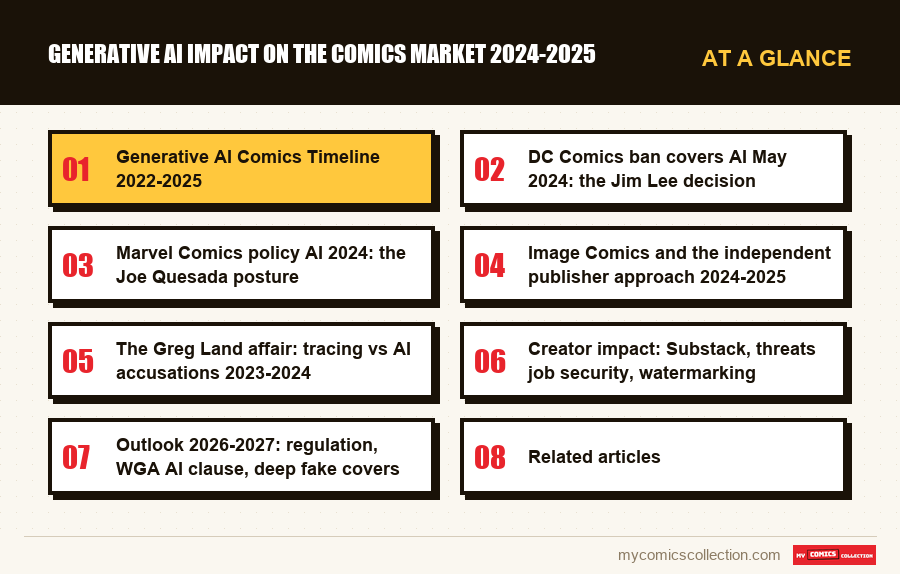
Generative AI Comics Timeline 2022-2025
The arrival of generative AI in the comics landscape is taking place in four technical waves, each redefining the threshold of what is feasible by a machine alone. Understanding this timeline is essential to grasping the speed with which the industry had to react, often at the wrong time.
Summer 2022: Stable Diffusion v1.4 and Midjourney v3. The public release of Stable Diffusion in August 2022 marks the starting point. For the first time, an open source model allows any user, with a consumer graphics card, to generate images in seconds. Midjourney v3, in parallel, offers higher quality via Discord. The first enthusiastic amateur comics begin to circulate on Reddit and Twitter, without signature, often without AI mention. At this point, the professional industry views the technology as a gimmick, incapable of producing a publishable cover. Marvel and DC artists joke about it at conventions.
Spring 2023: Midjourney v5. Version 5 of Midjourney, released in March 2023, is a game-changer. The model now handles hands, complex anatomy, and textures convincingly to the untrained eye. The first public controversies broke out in April 2023 when several independent cover artists were accused of having used AI for their commissions. The debate is polarized between two camps: defenders see the tool as a legitimate assistant, opponents see it as a massive theft of intellectual property, the models having been trained on decades of scrapped comics without authorization. There tradition Image Comics of the creator-owner collides head-on with this practice.
May 2023: start of the WGA strike. The Writers Guild of America begins a strike that will last 148 days (May 2 to September 27, 2023). Among the central demands: an anti-AI clause stipulating that studios cannot require screenwriters to rework AI-generated material, and that original scripts cannot be used to train models without agreement. The strike directly impacts Hollywood but the legal precedent immediately spreads to comic book publishing, which shares the same IP channel with cinema. The fallout from this strike is analyzed in detail in Hollywood strikes 2023-2024 impact comics spec.
Winter 2024: Sora and AI video. In February 2024, OpenAI unveils Sora, capable of generating one-minute high-resolution videos from a text prompt. The threat extends from still images to animation. For comics, this means that the barrier between printed page and cinema adaptation is becoming more fluid, with implications for adaptation rights. The same year saw the explosion of specialized anime/comics style models: Niji v6, DALL-E 3 integrated with ChatGPT, Adobe Firefly. The technical distinction between human work and AI work becomes virtually undetectable to the naked eye on standard printing media. It is in this context that DC Comics announces its official policy.
DC Comics ban covers AI May 2024: the Jim Lee decision
On May 17, 2024, during a panel at the Spirit of Comics Retailer Awards, Jim Lee, Chief Creative Officer of DC Comics, publicly announced that DC will no longer accept covers or panels generated by artificial intelligence. The statement was immediately picked up by The Hollywood Reporter, Bleeding Cool, ComicBook.com and Bounding Into Comics. It constitutes to date the most formally stated anti-AI editorial policy by a Big Two.
The exact context of the statement deserves to be given. Lee, former co-founder of Image Comics in 1992 and historical artist of X-Men #1 (1991, 8.1 million copies sold), spoke to an audience of American independent retailers. He said: “We do not publish comics created with AI generative art.” The wording, short and categorical, leaves no room for ambiguity. No assistance, no generation of funds, no automatic upscaling: the policy targets the use of AI throughout its creative chain.
Three factors precipitated this decision. First, the growing pressure from contract cover artists. Several star DC artists, including Lee Bermejo, Frank Cho and Dan Mora, had publicly expressed their fears on social media in the weeks leading up to the announcement. Second, legal precedent: the US Copyright Office confirmed in March 2023, then reaffirmed in early 2024, that works generated entirely by AI without substantial human intervention cannot benefit from copyright protection. For a publisher whose IP is the only asset, this is prohibitive. Third, shareholder pressure: DC is owned by Warner Bros. Discovery, whose studios are directly impacted by the WGA strike and SAG-AFTRA.
However, the practical application of the policy remains complex. DC has not published any verification protocols or explicit sanctions for contributors caught in the act. The freelance contracts were quietly updated in the summer of 2024, incorporating a clause according to which the artist guarantees that the work delivered is by their hand and does not use AI-generated elements. The burden of proof remains on the publisher, which in practice means a self-reporting system without systematic auditing. THE spec keys 2027 Marvel DC now include this risk for post-2022 covers.
Marvel Comics policy AI 2024: the Joe Quesada posture
Marvel Comics, unlike DC, has never published an official anti-AI policy. The House of Mickey Mouse preferred an approach through public declarations from emblematic figures, without formal public contractual commitment. This absence of structured policy has created a vagueness that several controversies have filled.
Joe Quesada, former Chief Creative Officer of Marvel (2000-2010, then Senior VP until 2022), spoke publicly on several occasions in 2023 and 2024 on the issue. During an interview with Comic Book Resources in July 2024, Quesada said: "I don't think AI art has any place in mainstream comic publishing right now. The training data is essentially stolen." The statement technically no longer engages Marvel directly, with Quesada now serving as an external consultant, but it has been interpreted as the house's unofficial position. C.B. Cebulski, the current Editor-in-Chief, has not published any contradiction.
The J. Scott Campbell controversy at the end of 2023 illustrates the unease. Campbell, star cover artist for Marvel for twenty years, was accused on Twitter (X) of having used Midjourney for funds for several exclusive comic-shop covers. The artist vigorously denied this, attributing the similarities to his own style and the phenomenon of AI models trained on his own works. No definitive proof has been released, and Marvel has not commented publicly. But Campbell has drastically reduced its Marvel production volume from spring 2024, without official announcement of contractual termination.
The lack of formal Marvel policy has two structural explanations. First, Marvel publishes around 70 variant covers per month across all of its titles, compared to 40-50 at DC. The administrative cost of a widespread AI audit would be prohibitive. Then, Marvel belongs to Disney, whose animation studios already use AI assistants in certain phases of production. A too clear-cut anti-AI policy would have created group inconsistency. The result: Marvel de facto applies the same criteria as DC on the star covers of flagship series (Amazing Spider-Man, X-Men, Avengers), but remains more permissive on secondary variants. The implications for the modern market 2020-2026 are being digested by informed collectors.
Image Comics and the independent publisher approach 2024-2025
Image Comics, founded in 1992 by Todd McFarlane, Jim Lee, Rob Liefeld, Erik Larsen, Marc Silvestri, Whilce Portacio and Jim Valentino, is in a unique position. The publisher is structurally creator-owner: each artist or screenwriter retains the rights to their work. The AI question is therefore posed differently, at the level of the author and not the publisher.
Eric Stephenson, president of Image since 2008, has held a nuanced public position. At the Image Expo panel in April 2024, Stephenson said Image's policy was to respect the creative choice of each author, while clearly signaling in print the possible use of AI. The logic is consistent with Image DNA: Image is a printer-distributor, the author remains in control. To date, no Image title has been removed for undeclared AI use.
The results on the ground are more mixed. Several Image titles in 2024-2025 have experimented with covers generated partially or totally by AI, with explicit mention. The most discussed case is that of a variant cover of The Walking Dead Deluxe in September 2024, where the artist publicly mentioned using Stable Diffusion for the setting and then plotting the characters. The cover was removed from the standard editions but kept for direct markets. A minor controversy ensued, with no lasting impact on the title. THE spec keys 2027 notes these covers as at risk of haircut.
As for alternative independents (Boom! Studios, Dark Horse, IDW, Oni Press), the majority have opted for discreet restrictive policies. Dark Horse has included an anti-AI clause in its freelance contracts from June 2024, without public communication. Boom! Studios has applied the same policy since fall 2024. IDW, which has been experiencing documented financial difficulties since 2023, has opted for the bare minimum: ban on flagship titles (Teenage Mutant Ninja Turtles, Sonic, Star Trek), tolerance elsewhere. The Image and indie situation is analyzed by crossing it with the history Image Comics 30 years.
The Greg Land affair: tracing vs AI accusations 2023-2024
Greg Land, Marvel designer since 2002 (Uncanny X-Men, Iron Man, Mighty Avengers), has been making accusations of tracing based on photographs of models or other comics for years. The old controversy was revived in 2023-2024 by a new trial of intent: its boards would now be retouched or supplemented by generative AI.
Context is important. Land has been documentedly accused, since 2006, of copying poses, faces and compositions from fashion photos, film stills or previous comics. Several specialized blogs (Comics Should Be Good, The Comics Journal) have published damning visual comparisons. Marvel has never sanctioned Land, who remains one of the publisher's most prolific regular artists, with more than 200 issues to his credit.
In 2024, the accusations have mutated. Several Twitter and Reddit threads have claimed to identify "AI artifacts" in Land's recent work: malformed fingers, unrealistic hair textures, facial asymmetries characteristic of Midjourney v5. The controversy peaked in March 2024 with a Reddit thread comparing boxes of X-Men Forever to Stable Diffusion outputs. Land never responded publicly. Marvel stood by Land on his titles, implicitly signaling that the accusations had not been deemed editorially serious.
The Land affair sheds light on two dynamics 2024-2025. First, the technical impossibility of proving the use of AI in a finalized and printed work: no watermark, no reliable metadata, no visible signature. Then, the confusion between photo tracing (legal but ethically controversial practice) and generative AI (new practice, legally vague). For the collector, the lesson is clear: the "AI proof" on a published work remains anecdotal, and the rumors have not, at this stage, triggered a significant discount on the secondary market for Land covers. The context of strike Hollywood 2023-2024 impact comics has nevertheless cooled buyers on modern variants in general.
Collecting this series?
Track what you own, what you are missing and what your collection is worth. 7 day trial.
Start my trial →Creator impact: Substack, threats job security, watermarking
The impact of generative AI on comic creators can be measured on three levels: the flight to alternative platforms (mainly Substack and Patreon), the documented anxiety over job security, and the emergence of technical defense practices (watermarking, certification of authenticity).
The Substack movement started in 2020, but accelerated in 2023-2024. Several star screenwriters (Jonathan Hickman, Saladin Ahmed, James Tynion IV, Chip Zdarsky for some of his projects) have switched all or part of their creative activity to Substack, where they retain 100% of the rights and directly reach their readers via subscription. The AI threat has accelerated this migration: an independent creator can, on Substack, guarantee the absence of AI to their readership and obtain a trust bonus. The details of this transition are analyzed in Substack indie creators 2025 Marvel leave.
Anxiety over job security is documented by several internal surveys. A survey conducted by The Comics Beat in September 2024 among 412 American freelance comics reveals that 67% consider AI to be an existential threat to their profession within 5 years, compared to 23% who see it as an opportunity for assistance. Colorists and letterers are the most exposed: these two professions, more mechanical than storyboarding or inking, can already be partially automated with tools like Adobe Firefly or specialized Photoshop plugins. Several veteran colorists saw their commission volume halved between 2023 and 2025.
Technical defense practices emerge in response. Creative watermarking, that is to say the integration of hidden signatures in works (steganography, invisible watermarks), is promoted by several unions. The Glaze tool, developed by the University of Chicago in 2023, allows artists to "disrupt" their works so that they are unusable as AI training data. Nightshade, its successor released in January 2024, goes further by actively poisoning models. Adoption remains in the minority (less than 15% of published artists according to estimates) but is growing. For collectors, the presence of a certified creative watermark becomes a sign of provenance, to be included in the authentication arsenal.
Collector's spec 2025: pre-AI covers to be valued, AI-tainted at a discount?
For the secondary market, the operational question is: has the massive arrival of generative AI created a category of “pre-AI” comics that deserves a rarity premium? And conversely, are covers or boards suspected of AI use already subject to a verifiable discount?
On the first question, the first 2024-2025 data suggest an emerging but modest premium on pre-2023 featured covers signed by the most recognized artists (Alex Ross, Jim Lee, Frank Miller, Joe Quesada, Tim Sale). Heritage Auctions published a report in March 2025 indicating that original covers dating from before June 2022 (i.e. before the release of Stable Diffusion 1.4) sold on average 18% above pre-2023 estimates. The margin is not spectacular, but it is statistically significant on a sample of more than 200 lots. “Pre-AI” rarity is becoming a marketing argument for auction houses, without yet constituting a major premium factor. The market remains dominated by other factors: artist, character, period, state. THE best of 2025 writing identifies the titles to follow in this logic.
On the second question, the discount for suspected AI covers is more difficult to establish. First, because suspicion does not constitute proof. Then, because the covers concerned are mainly store exclusive variants, a niche segment where prices are already very volatile. The only documented case of a clear discount remains that of a variant Detective Comics published in summer 2024, withdrawn from the market by the publisher after internal confirmation of undeclared AI use: the secondary value of the variant fell from €80 to around €25 in six months. But the sample is too small to generalize.
The 2026-2027 projection, for a collector structuring his heritage, consists of favoring three categories. First, covers signed by veteran pre-2022 artists whose authentication is traceable. Second, comics with existing original art (as opposed to pure digital covers): the physical existence of an original work in pencil, ink or paint guarantees non-AI. Third, publishers having published a formal anti-AI policy (DC since May 2024, several indies). On sleepers like those listed in underrated comics 2026 sleeper issues, this AI filter is added to the classic criteria. The tool free estimate does not yet distinguish between AI/non-AI variants in its eBay aggregation, which calls for additional manual analysis.
Outlook 2026-2027: regulation, WGA AI clause, deep fake covers
The year 2026 opens a phase of consolidation and potential regulation. Three fronts deserve the attention of comic collectors and investors: public regulation of generative AI in the United States and Europe, the contractual expansion of the WGA anti-AI clause, and the emergence of new risks such as deep fake covers and digital counterfeits.
On the regulatory front, the European AI Act, which entered into force in August 2024, imposes transparency obligations on content generated by AI. Limited risk models (Midjourney, Stable Diffusion, DALL-E) must clearly label their outputs. The application to printed comics nevertheless remains unclear: the responsibility lies with the user, therefore with the artist or publisher, but no effective control mechanism exists for printed works. In the United States, the proposed NO FAKES Act (introduced to the Senate in 2024) rather targets deep fakes of real people, without direct impact on cover comics. THE French collectors benefit from European transparency without certainty of application.
The WGA AI clause, negotiated during the 2023 strike, becomes a contractual precedent. SAG-AFTRA obtained similar clauses in November 2023. Comic book publishers, without an equivalent formal union, negotiate on a case-by-case basis. Several internal Marvel and DC sources indicate that the 2025-2026 contracts now include limited transfer clauses for AI training rights: an artist cannot be forced to transfer their work as training data for a model. The practical scope remains to be tested in court.
The risk of deep fake covers is increasing in parallel. In December 2024, several fake variant covers falsely attributed to Alex Ross circulated on eBay, generated by AI and reproduced in print on demand. Heritage Auctions issued a public warning in January 2025 inviting verification of the provenance of post-2022 Alex Ross covers. Physical authentication (CGC Signature Series, Witnessed Programs) is becoming the standard. For the comics of spec in 2026-2027, requiring CGC or CBCS authentication on any purchase over €300 is now a basic prudential rule.
The structural projection of our editorial team, at 18-24 months, is as follows. One, the market will be segmented into two: a premium "verified hand-drawn pre-AI" tier which will capture a premium of 15 to 30%, and a mainstream tier where the AI question will fade behind the artist/character factor. Two, original covers (original art) will outperform printed comics on the horizon, because they are by nature non-reproducible by AI. Three, publishers who have published a formal anti-AI policy (DC, Dark Horse, Boom!) will benefit from a small but real secondary trust bonus.
FAQ: Generative AI comics 2025
Has DC Comics really banned AI covers in 2024?
Yes, the official announcement was made on May 17, 2024 by Jim Lee, Chief Creative Officer of DC Comics, during the Spirit of Comics Retailer Awards. The declaration “We do not publish comics created with AI generative art” commits the publisher throughout its creative chain. No sanction policy has been published, but freelance contracts have been updated in summer 2024 with a self-declaration clause.
Does Marvel Comics have an official AI policy?
No, Marvel has not issued any formal anti-AI policy. Joe Quesada, ex-CCO Marvel until 2022, publicly expressed an unfavorable position on the use of generative AI in an interview in July 2024, but without contractually committing the publisher. C.B. Cebulski, current Editor-in-Chief, has not commented. The de facto policy consists of increased vigilance on featured covers, without systematic audit.
Are pre-AI comic covers already gaining value?
The first 2024-2025 data indicate a modest premium of around 15-20% on original art dating before June 2022, signed by veteran artists (Jim Lee, Alex Ross, Frank Miller). The margin is not spectacular and remains to be confirmed on larger samples. For serially printed comics, the pre-AI premium is not significant at this stage.
How to identify a suspected AI cover?
Visual identification remains very difficult for the untrained eye. Classic indices (malformed fingers, facial asymmetries, inconsistent textures) are less and less reliable with the 2024-2025 models. The most relevant safeguards are the existence of verifiable physical original art, CGC or CBCS Signature Series authentication, and official communication from the publisher. Without these elements, suspicion does not constitute proof.
Should we avoid modern 2023-2025 comics as an AI precaution?
No, the generalized exclusion position would be excessive and costly. The Big Two apply significant vigilance to their flagship titles. Boutique exclusive variants remain the highest risk area. A prudent approach consists of favoring covers by signed, veteran artists on flagship series, and avoiding exclusive variants without traceable original art. The AI assessment is included as one criterion among others in the selection.