The 2021-2025 NFT comics bubble burst for five cumulative reasons: collapse of the crypto market (FTX Nov 2022, bear market 2022-2023), lack of real utility of tokens (no physical property, no derivative rights), environmental concerns (Ethereum proof-of-work before Merge Sept 2022), serial scams (rug pulls, wash trading, circumvented royalties) and discreet abandonment of publishers major. VeVe (Marvel partnership 2020) saw its average rating drop by 90%, DC left the McFarlane NFT FanDome 2021 adventure in 2023, Marvel Toy Token closed at the end of 2023. The 2024-2025 market rediscovers the value of the physical: Action Comics #1 CGC 8.5 sold for $6 million at Heritage in April 2024, CGC slab boom, Heritage Annual record auctions 2024 at $220 million comics.
In 2021, NFT comics were presented as the future of collecting. Disney signed with Ecomi to distribute Marvel on the VeVe application (launched in 2018, Marvel partnership expanded 2020-2021), DC Comics announced its own NFT platform at FanDome in October 2021 with Todd McFarlane on an exclusive Batman variant, Niftys launched a commemorative collection with Stan Lee's estate and OpenSea crossed the historic peak of $5 billion in volume in January 2022 monthly. Specialized comics media promised a revolution: traceable provenance, automatic royalties for artists, direct access to the reader without an intermediary. Four years later, the observation is clear: the bubble has burst, the major publishers have discreetly withdrawn and serious collectors are returning to CGC graded physical comics.
The 2021 context was euphoric. NBA Top Shot (Dapper Labs, publicly launched July 2020) had normalized the idea of sports “moments” in NFTs sold for $200,000 each. Beeple was selling Everydays: the First 5000 Days 69 million dollars at Christie's in March 2021. The Bored Ape Yacht Club (BAYC) launched in April 2021 reached floor prices exceeding $400,000 in April 2022. In this climate of widespread crypto speculation, comic book publishers wanted to take their share. Marvel began issuing Spider-Man “Toy Tokens” in August 2021 via Orbis Blockchain, DC announced its proprietary platform in October 2021 during the virtual FanDome, and indies rushed to Niftys, MakersPlace or OpenSea to distribute exclusive signed covers.
The state of the market in 2025 tells a radically different story. OpenSea monthly volume has fallen below $200 million (vs. $5 billion in January 2022, or -96%), BAYC floor odds have fallen to less than 25 ETH (vs. 152 ETH at April 2022 peak), and almost all NFT comic collections launched between 2021 and 2023 are showing discounts of 80 to 95% on their price of mint. Marvel quietly stopped its Toy Tokens at the end of 2023, DC has not published an NFT drop since 2022, and VeVe is holding its own but with a slowly eroding user base and a collapsed average rating. This comprehensive review retraces the chronology, identifies the structural causes of the failure and draws lessons for a collector in 2026.
This article is strictly informative and journalistic. It does not in any way constitute investment advice, a financial recommendation, nor an incentive to buy, sell, hold or issue digital assets (NFTs, tokens, cryptocurrencies) or physical comics. The figures cited come from public sources (OpenSea, DappRadar, Heritage Auctions, Comichron, official Marvel releases, DC, VeVe, Ecomi) and reflect the situation on the date of publication of this article. The digital asset market is extremely volatile: the value of an NFT can drop by 90% or more in a matter of weeks, or even become completely illiquid. The physical comics markets also experience bullish and bearish cycles (post-pandemic peak 2020-2022, normalization 2023-2025) and the past performance of a blue-chip comic is never a guarantee of its future performance. Investing in NFTs or comics involves a risk of partial or total loss of the capital invested. Transaction costs (Ethereum gas fees, OpenSea commissions, buyer premium Heritage 20%, eBay 13.25%), storage costs (CGC slab, insurance, cold wallet security) and taxation (capital gains, BIC depending on the regime, annual crypto declaration in France) must be taken into account before any decision. It is essential to consult an independent financial advisor, a chartered accountant and, where appropriate, a tax lawyer before making any significant financial commitment. The publisher of this article accepts no liability for any financial losses arising from decisions made on the basis of information published here.
Timeline of the NFT comics bubble 2020-2025: from boom to burst
The complete timeline of the NFT comics bubble spans five years and is divided into four identifiable phases: initiation (2020-mid-2021), euphoria (mid-2021 to early 2022), brutal correction (2022-2023) and liquidation (2023-2025). Understanding this sequence is essential for analyzing structural errors made by publishers and collectors.
The seed phase begins in July 2020 with the public launch of NBA Top Shot by Dapper Labs on the Flow blockchain. NBA “moments” (tokenized video clips lasting a few seconds) generate $230 million in volume between January and March 2021, and the mainstream press is discovering NFTs. At the same time, VeVe (Ecomi ecosystem application, launched at the end of 2018 in Singapore) signs its expanded partnership with Marvel Entertainment during 2020-2021 and launches its first Spider-Man, Iron Man and Captain America drops in August 2021. The average price of a VeVe Marvel “digital collectible” at the show is around $25, with ultra-rare editions (50 copies) reaching 1,500 at $3,000 on the intra-app secondary market in the first few weeks.
The euphoria phase begins in September 2021 and peaks in January-March 2022. OpenSea breaks its monthly volume record on January 9, 2022 with $5 billion traded on the platform, more than the monthly GDP of several small states. The Bored Ape Yacht Club reached a record floor price of 152 ETH on April 28, 2022 (or approximately $430,000 at today's rate). It is in this window that comic book publishers sign their big deals: DC Comics announces at FanDome in October 2021 its proprietary NFT platform with an exclusive Todd McFarlane Batman variant and a free NFT for DCU Infinite account holders. Marvel Comics begins issuing Toy Tokens via Orbis Blockchain in August 2021, with a first Spider-Man drop at $60 per token. Niftys, a platform specializing in cultural NFTs, is launching a commemorative collection with the Stan Lee estate in November 2021, the standard editions of which sell for $99 and the rare editions for $1,999. Beeple, Pak and XCOPY sales occupy the specialized crypto media feeds on a daily basis.
The correction phase begins in May 2022 with the collapse of Terra Luna (UST depeg, $18 billion in capitalization wiped out in 72 hours on May 9-12, 2022). The crypto market enters a deep bear market: Bitcoin loses 65% between November 2021 ($69,000) and June 2022 ($18,000). OpenSea volume drops from 5 billion in January to 600 million in June 2022 (-88%). In November 2022 (November 8-11), the fall of the FTX exchange results in $8 billion in user losses and causes a general crisis of confidence in the crypto ecosystem. NFT ratings are collapsing: the average of collections launched between January and March 2022 shows -75% floor price in December 2022 according to DappRadar. Marvel Toy Tokens drops are no longer selling, VeVe users are stopping their weekly purchases, and DC is quietly suspending all of its NFT projects between late 2022 and early 2023.
The liquidation phase runs from 2023 to 2025. Marvel unofficially closes the Toy Tokens branch at the end of 2023 without a public statement, simply leaving the Orbis Blockchain contracts inactive. DC never resumes communication on the project announced at FanDome 2021. Niftys closes its site at the end of 2023 after leaving uncertainty surrounding the viability of its collections for several months. VeVe survives but with traffic divided by 6 between January 2022 and June 2024 according to SimilarWeb, and an average secondary price of Marvel digital collectibles which goes from 25 dollars on issue to 1-3 dollars for resale on the internal market. At the same time, the market for graded physical comics is rebounding massively: Heritage Auctions ends 2024 with $220 million in comic sales, its historic record, including $6 million for a single lot (Action Comics #1 CGC 8.5 in April 2024). The contrast is clear: the “Web3 revolution” has failed and physical slab has once again become the standard.
VeVe Digital Collectibles 2018-2025: the Marvel-Disney textbook case
VeVe is the emblematic application of the NFT comics attempt. Launched at the end of 2018 by the New Zealand company Ecomi (later rebranded as ImmutableX then OMI), it offers “digital collectibles” distributed via a proprietary mobile application (iOS and Android) rather than via an open marketplace. The choice of the closed ecosystem, on the GoChain blockchain then bridged to Ethereum via Immutable X, was to resolve the gas fees and scalability problems of OpenSea. The promise was simple: Disney signs a global agreement with Ecomi in 2020-2021 to distribute Marvel on VeVe, and each user can purchase digital Spider-Man, Iron Man, Hulk or Captain America figurines in limited editions (typically 5,000 to 25,000 copies for common, 50 to 500 for ultra-rare).
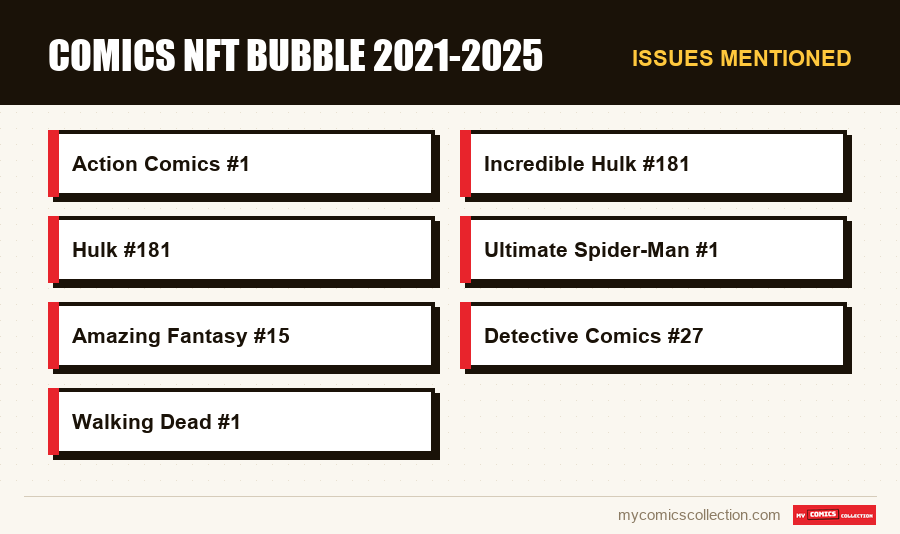
The emblematic moment of the Marvel deployment on VeVe remains the drop of Incredible Hulk #181 in NFT in summer 2021. The famous Herb Trimpe cover from 1974, which contains the first complete appearance of Wolverine, is tokenized in several VeVe editions. The Common edition (10,000 copies) is sold for $60 at issue, the Rare edition (1,500 copies) for $200, the Ultra-Rare edition (50 copies) for up to $2,500 on the intra-app secondary market in the first weeks. At the same period, the physical comic Hulk #181 in CGC 9.8 White Pages sells for around $75,000 at Heritage. The differential between the physical value and the NFT value is immense, but VeVe promoters argue that the digital version is accessible to a much wider audience and that Ultra-Rare editions represent a new class of collectible asset.
The reality of the VeVe secondary market in 2025 is stark. According to consolidated VeVe Market data and public DappRadar 2024-2025 analyses, the average secondary price of a Marvel digital collectible purchased at $25 in 2021-2022 is now around $1 to $3 on resale (depending on rarity), an average discount of 88 to 96%. Ultra-Rare editions are holding up better but are down 60 to 80% from their peak. The Hulk #181 NFT Common which sold for $60 to $120 at peak will find itself in 2025 below $8 on the VeVe secondary. The Ultra-Rare edition of 50 copies remains clinging to 400-700 dollars (vs. 2,500 at peak), i.e. -72% to -84%.
The contrast with the physical is edifying. A Incredible Hulk #181 CGC 9.8 White Pages sold for $580,000 in October 2025 at Heritage, an absolute record confirming the post-Deadpool & Wolverine (2024). Even a Hulk #181 CGC 9.0 raw NM, more accessible, will trade between 9,000 and 12,000 dollars in 2025. The physical comic generated between 2021 and 2025 a capital gain of 60% in CGC 9.8 (from ~360k to ~580k), while the NFT version lost 90% of its value. For a collector who would have allocated $600 on two Hulk #181 NFT Commons at $300 each in June 2021, the 2025 balance is $16 (-97%). For a collector who would have allocated the same amount on a key raw NM modern comic (for example Ultimate Spider-Man #1 Marvel 2024 ratio 1:25 bought for 150 dollars), the 2025 value often exceeds 400 to 600 dollars.
VeVe survives in 2025 but with an economic model under pressure. The platform stopped publicly communicating its monthly volumes in 2023, SimilarWeb traffic fell from 6.2 million visits in January 2022 to around 950,000 visits in September 2024 (-85%). Marvel drops are becoming rarer and with much lower print runs (often 1,000 to 3,000 Common copies compared to 10,000 to 25,000 in 2021). The Disney-Ecomi partnership seems to be maintained but without any new major milestone communicated since 2023. The platform remains a textbook case for studying the mechanics of the NFT bubble in comics: strong initial support, rapid speculative return in Ultra-Rare editions, post-bear market crypto structural collapse.
Marvel NFT direct: Toy Token 2022-2023, the aborted experiment
Beyond the Disney-Ecomi partnership distributed via VeVe, Marvel Comics attempted in 2022 and 2023 a direct and proprietary NFT approach called “Marvel Toy Token” (sometimes also “Marvel Digital Collectibles”). The project, operated via the Orbis blockchain (an Ethereum side-chain) and accessible via a dedicated portal separate from VeVe, was to allow Marvel to directly control the distribution of Spider-Man, Captain America and X-Men digital figurines, without an application intermediary. The first Spider-Man drops arrive in August 2021, followed by Captain America in November 2021, and Eternals editions (linked to the MCU film) in December 2021.
The price of mint Toy Token is around $60 for Standard Editions and $200 to $700 for Limited Editions. The total of each drop is generally capped between 3,000 and 10,000 copies. The secondary market is hosted on the same Orbis platform, which prevents arbitrage with OpenSea or Rarible and limits real liquidity. From the crypto bear market of May-June 2022, volumes on Orbis fell drastically: drops planned for Q3 2022 were delayed, then silently canceled during Q4 2022. No new Marvel Toy Token drops were launched after the start of 2023. The platform remained accessible for holders but no longer generated significant transactions. At the end of 2023, Marvel leaves the infrastructure inactive without official communication.
The commercial failure of the Toy Token is due to several cumulative factors. First, the absence of external liquidity: a holder cannot resell their token on OpenSea, which drastically reduces the base of potential buyers and depreciates the value. Secondly, the absence of tangible utility: a Spider-Man Toy Token gives neither access to a physical comic, nor commercial use rights on the image, nor an exclusive advantage on Disney+ releases. Third, the disastrous timing of the launch (just before the May 2022 crypto crash). Fourth, internal competition with VeVe which distributed similar Marvel products with a more mature experience. Marvel has never published a detailed retrospective on the failure of the Toy Token, but the project is considered a textbook case of failed crypto investment by a major media group (parent Disney).
For the collector, the lesson is clear: a comic book publisher that launches its own proprietary NFT infrastructure without external liquidity, without tangible utility and without controlled print runs creates a bubble that bursts at the first crypto correction. This mechanic is found in several other attempts (DC Comics McFarlane FanDome 2021, Niftys Stan Lee 2021, IPI Token) which all met the same fate. The only surviving model in 2025 remains VeVe, and with massively reduced volumes.
DC Comics McFarlane NFT FanDome 2021: the short-lived announcement
DC Comics announced its proprietary NFT platform on October 16, 2021 during DC FanDome 2021 (global virtual event). The announcement was spectacular: a partnership with Todd McFarlane for an exclusive Batman variant tokenized in NFT, distribution planned via a dedicated proprietary platform, and a “free claim” for all holders of a DC Universe Infinite account (DC's digital comics streaming service). Jim Lee, then Chief Creative Officer of DC, personally announced the project on stage by presenting the NFT 2022 roadmap including Batman, Superman, Wonder Woman drops and exclusive variants signed by the in-house artists (Greg Capullo, Jock, Yanick Paquette).
The first effective drop arrives in November 2021: the Batman McFarlane variant is distributed free of charge to DCU Infinite users and certain rare editions put on sale on the proprietary DC NFT platform. Issue prices range between $60 and $300 depending on rarity. The internal secondary market generates a few transactions at $1,500 to $3,500 for ultra-rare editions in the first weeks, a 5- to 12-fold increase over the issue price. The peak of enthusiasm is short: from January 2022, volumes fall and secondary prices fall by 40% on average. Several drops planned for Q1 2022 (including a variant Wonder Woman and a set Justice League) are reported.
The collapse is confirmed during 2022. No major drop is launched after spring 2022. DC communication on the NFT subject is gradually disappearing from corporate publications. The dedicated site remains accessible but without new content. In 2023, Warner Bros Discovery (DC's parent company) records the discreet release of the project without a public press release, and the site will close during 2023. No official DC communication on NFTs has been released since the end of 2022. The project announced at FanDome 2021 ultimately only gave rise to two or three actual drops out of the twenty initially planned. The secondary rating of Batman McFarlane DC NFTs falls below $20 in 2025 (vs. 1,500-3,500 at peak), or -98%.
The DC case illustrates another dynamic: the publisher who launched its NFT project from the position of a media group (WarnerMedia, now Warner Bros Discovery) without long-term commitment and without a clear roadmap beyond the first drop. When market conditions deteriorate, abandonment is immediate because the project has never constituted a strategic asset for the parent company. The lesson for the collector is the opposite of what was promised: the “unfalsifiable property” of an NFT does not protect against abandonment by the publisher, which renders the token effectively without use value.
NFT independent comics: Niftys, IPI Token, MakersPlace and cascading failure
The 2021-2023 independent NFT comics ecosystem saw several notable initiatives, all of which ultimately failed. The most publicized remains the Stan Lee collection distributed by Niftys in November 2021. The project, operated in partnership with the estate of the creator of Spider-Man, Iron Man and X-Men (who died in November 2018), offered Stan Lee digital “moments” (tokenized interviews, digital signatures, exclusive illustrations). Standard editions (10,000 copies) sold for $99, rare editions (500 copies) for $999, and a unique ultra-rare edition put up for auction reached a peak of $28,000. The tone of the operation was strongly emotional and heritage, which appealed to some historical Marvel fans.
The Niftys collapse is rapid. From mid-2022, secondary volumes fall and the platform communicates less and less. In 2023, several collectors are warning about the inaccessibility of certain tokens and the slowdown in transfers. At the end of 2023, Niftys closes its public site without a retrospective or recovery plan for holders. Stan Lee NFTs remain technically existing on the Polygon blockchain but without a user interface to easily display, transfer or resell them. The effective secondary rating of the 2025 collection is less than $5 per Common token, despite the apparent rarity and Stan Lee's name. The Lee estate has not made any public communications on the subject since 2022.
The IPI Token, launched in 2022 by a blockchain startup specializing in intellectual property, was to allow independent designers and screenwriters to tokenize their derived rights and share the revenue with their holders. The project attracted a few independent American comic artists (notably in the Image and Boom! Studios movement) but never reached the necessary critical mass. The IPI token lost 99% of its value between its ATH of June 2022 and its price at the end of 2024. The platform remains partially active but with no new major drops announced since 2023.
MakersPlace, a general NFT platform but with a strong illustration and comics component, hosted between 2021 and 2023 several drops from comics artists (Stanley Lau, Frank Cho, J. Scott Campbell). Limited editions initially sold for $200 to $800 and reached record highs at $5,000 to $12,000 for the highest-priced artists. Almost all of these NFTs lost 70% to 95% of their value between 2022 and 2025, according to public resale listings. Several artists have publicly regretted their participation, some having seen their reputation damaged among the physical fan base. The dominant 2024-2025 sentiment among American comic artists has become predominantly unfavorable to NFTs, which makes a new cycle of drops unlikely in the short term.
Collecting this series?
Track what you own, what you are missing and what your collection is worth. 7 day trial.
Start my trial →The structural causes of the NFT comics failure: six-point analysis
The failure of the NFT comics model cannot be explained by a single cyclical factor (the 2022 crypto bear market) but by a combination of six structural causes which made the model fragile from its conception. Understanding these six causes is essential to assess whether a possible 2026-2028 NFT relaunch would have any chance of success: the answer being mostly negative according to collectible market analysts.
First cause: extreme crypto volatility. NFT comics are denominated in ETH or MATIC, two assets whose value in dollars can lose 70% in six months (case of the 2022 bear market). A collector who buys a 1 ETH NFT at $4,200 in November 2021 sees his position worth 1 ETH at $1,100 in June 2022, or -74% in USD without even the NFT itself having lost value in ETH. This double volatility (crypto + NFT) creates a cumulative risk that traditional physical comic collectors have never experienced. Novice buyers have massively underestimated this mechanic.
Second cause: the lack of real utility. Owning a Marvel Spider-Man NFT does not give ownership of a physical comic, nor a commercial use right over the image, nor exclusive access to a film, nor a share in the publisher's revenue. The token is cryptographic proof of registration on a blockchain, nothing else. To compare, a physical CGC slab comic gives tangible physical property, grade quality certified by a third party (CGC), a public listing on secondary markets (eBay, Heritage, ComicLink), possible insurance and easy asset transfer. The utility differential is massive and unfavorable to NFTs.
Third cause: environmental impact and public opinion. Until the Ethereum Merge of September 2022 (transition from proof-of-work to proof-of-stake), Ethereum NFTs consumed energy equivalent to that of a small European country. The mainstream press took up the subject and strongly criticized comic book publishers participating in the NFT ecosystem for climate reasons. Marvel and DC, two groups owned respectively by Disney and Warner Bros. Discovery (two companies sensitive to their ESG image), have backed down under pressure. Even after the Merge and the drastic drop in Ethereum's energy consumption (-99.95% according to estimates from the Ethereum Foundation), the negative perception remained anchored in public opinion and among hardcore comic fans.
Fourth cause: serial scams. The NFT market was crossed between 2021 and 2023 by a continuous wave of scams: rug pulls (teams which disappear with the funds after the mint), wash trading (false volumes generated by the founders themselves to inflate the apparent popularity), circumvented royalties (platforms which remove royalties for artists to attract more volumes), copyminting (NFTs created from works without agreement of the original artist). Several independent comic collections have been identified as scams by the community, eroding general trust. The most high-profile case remains the arrest in 2023 of the founder of the “Pixelmon” project who had raised $70 million on the basis of false promotional images.
Fifth cause: regulatory pressure. The US SEC has initiated several proceedings between 2022 and 2024 against NFT platforms considered to be distributing unregistered securities. OpenSea, Yuga Labs (BAYC), Dapper Labs (NBA Top Shot) have all received cease-and-desist notices or been subject to formal investigations. In Europe, the MiCA (Markets in Crypto-Assets) regulation adopted in 2023 and gradually applicable from 2024-2025 imposes heavy constraints on token issuers. This regulatory pressure has cooled comic publishers, whose lawyers have reconsidered the risk/benefit ratio of a new drop.
Sixth cause: the abandonment of major publishers. As DC, Marvel, and Niftys quietly exited the market between 2022 and 2023, the network effect reversed: fewer official drops meant less visibility for collectors, fewer transactions, less liquidity, and therefore collapsing secondary ratings. The exit of the “big players” hastened the exit of the “small players” and individual collectors. This is the classic mechanism for the liquidation of a bubble: confidence collapses in cascade and each actor seeks to exit before the others. In 2025, no major comic book publisher will invest in NFTs: VeVe remains the exception under Disney contract, but with an economic model under pressure.
The return of physical objects 2024-2025: CGC slab boom and Heritage records
While NFTs collapsed, the market for graded physical comics experienced a historic boom 2024-2025. The contrast between the two dynamics is edifying and supports the diagnosis of a structural return to materiality in comics collecting. Several indicators converge: CGC volumes on the rise, Heritage Auctions records, multiplication of slabs on eBay, return of physical hobby shops.
The CGC (Certified Guaranty Company) slab, a certified plastic box containing a comic graded on a scale of 0.5 to 10, has become the market standard. In 2024, CGC processed a record volume of more than 1.8 million graded comics (vs. 1.1 million in 2020, +64%). The competing company CBCS and the new PGX capture a minority but growing share. The slab fulfills functions that the NFT cannot fulfill: physical protection of the comic, objective certification of quality by a third party, standardization of prices on the secondary market (a CGC 9.8 is strictly comparable from one sale to another), ease of storage and transport, transferable heritage value. The slab/raw shift has accelerated 2024-2025: on eBay closed, more than 65% of the total value of comics sold for more than $500 now goes through CGC slabs, compared to 48% in 2020.
Heritage Auctions published its 2024 consolidated results in early 2025: $220 million in comic sales (absolute record, +18% vs. 2023), i.e. more than the annual OpenSea volumes of all NFT comic collections in 2024. The absolute record of the decade fell on April 4, 2024 during the sale of a Action Comics #1 (1938, first appearance of Superman) in CGC grade 8.5 sold for $6 million by Heritage, the absolute record for a comic at that date (since surpassed in May 2025 by another 8.5 copy sold for $9.12 million). This April 2024 sale had a massive media effect and confirmed the legitimacy of the blue-chip physical comic as a premium asset class.
Other 2024-2025 records reinforce the trend: Amazing Fantasy #15 CGC 9.6 to 3.4 million in September 2025, Detective Comics #27 CGC 6.0 to 2.85 million in July 2025, Incredible Hulk #181 CGC 9.8 White Pages at $580,000 in October 2025. For the record, the documented peak of the NFT comics market has never exceeded $28,000 (ultra-rare single edition Stan Lee Niftys November 2021), or 215 times less than the 2025 physical record. The valuation gap between physical and digital is structural and growing.
On the hobby shop side, the post-pandemic recovery has been confirmed for 2024-2025. According to ComicsPRO (association of US comic shops), the number of active physical establishments in the United States increased from 2,580 in 2022 to 2,740 in 2025 (+6.2%), after a decade of continuous decline. The average monthly ticket for a regular in-store customer increased from $78 to $95 between 2022 and 2025 (+22%). The return of sketch covers signed in conventions (see comics best titles 2025 best-of editorial), CGC Signature Series and premium variants illustrates this renewed preference for materiality. The 2025 collector is looking for something tangible, something gradable, something signable: not something tokenized.
This dynamic also fuels the modern market with strong speculative potential. The ratio variants 1:25 and 1:100 (see comics spec 2026 key issues to mount) are experiencing sustained demand, and MCU rumors continue to drive physical issues (effect Hollywood strikes 2023-2024 impact comics spec 2025 on release schedules). Long cycle analyzes (see raw vs graded investment 2026) confirm that the graded segment remains the most liquid and the most capitalized.
Collector lessons 2026: digital vs physical, prioritizing your priorities
The 2021-2025 report delivers several operational lessons for the collector who is structuring his 2026 strategy. These lessons are as valid for the French beginner who is discovering the American comics market as for the experienced collector who manages a six-figure portfolio in value. Five key points emerge.
First lesson: absolute priority goes to the physical grade. Over the period 2021-2025, the performance differential between physical blue-chip comics and NFT comics is massive and unfavorable to digital. A balanced portfolio between Golden Age (Action Comics, Detective Comics, Amazing Fantasy) in mid-grade CGC and key Modern Age (Walking Dead #1, Ultimate Spider-Man #1, Frank Miller Daredevil runs) generated between 15 and 60% capital gains over 4 years depending on the segment, while the equivalent NFT portfolio lost 80 to 95%. The rule for 2026: 100% of the comics allocation must go towards graded physics, and 0% towards NFT. For details of the strategies, see modern comics invest 2020-2026.
Second lesson: prefer liquid resale platforms. eBay, Heritage Auctions, ComicLink, ComicConnect and Catawiki have all proven their resilience over the 2021-2025 period. Their volumes have increased or remained stable, their costs are transparent, their grades are recognized. Conversely, proprietary NFT marketplaces (Niftys, Toy Token Marvel, DC NFT) have all closed or reduced their activity. The lesson: prefer established and liquid platforms, check the institutional solidity of the operator before any significant commitment. SeeComicConnect vs Heritage Auctions comparisonet buy comics at auction strategy ComicConnect Heritage.
Third lesson: portfolio traceability remains central. Individually tracking each comic purchased (date, price, platform, grade, fees) has become important as portfolios grow. The CGC slab facilitates traceability (unique serial number engraved), but the collector must manage his inventory using a modern tool. A Comics Manager (see comics manager complete guide) accepts barcode scanning, variant ratios, eBay/CGC listing tracking and export for insurance. This discipline has become the 2024-2025 standard among serious French and international collectors.
Fourth lesson: be wary of promises of disruptive innovation. The 2021-2025 NFT comics sequence has demonstrated that “revolutionary” promises (traceable provenance, artist royalties, Web3 community) are not enough to create value if basic utility is absent. The 2026 collector must apply the same rule of caution to any innovation presented as a “game changer”: generative AI comics (see comics AI generative impact market 2025), creator substitutions on Substack (see comics Substack creators indies 2025 Marvel leave), new forms of digital distribution. The rule: observe 3 to 5 years before allocating significant capital.
Fifth lesson: France and Europe remain solid markets. The boom in French conventions 2024-2025 (Comic Con Paris 92,000 entries 2025), the solidity of the publishers Panini Marvel France, Urban Comics and Delcourt, the progressive development of Catawiki as a European platform and the French hobby shops which are resisting show that the French collector has access to a mature ecosystem, without the need to switch to digital. To structure a French collector strategy, see comics France collector guide pillar. To estimate an existing collection, see free estimate and explore the files comics from the MCC catalog.
The NFT comics bubble peaked in January 2022 (OpenSea volume $5 billion) and deflated in stages until 2025 (-96%). Major publishers quietly abandoned between 2022 and 2023. Individual collectors lost on average 80 to 95% of their capital allocated to NFT comics, while the graded physical market recorded absolute records (Action Comics #1 CGC 8.5 to $6 million April 2024 then $9.12 million May 2025). The structural lesson: materiality remains the basis of comics collecting, and digital innovation must prove real utility before being considered as an asset class.
FAQs
Why did the NFT comics bubble burst between 2022 and 2023?
Five cumulative causes: the collapse of the post-FTX crypto market (November 2022, $8 billion in user losses), the absence of real utility of tokens (no physical ownership, no derived rights), environmental criticism of Ethereum proof-of-work until the Merge of September 2022, serial scams (rug pulls, wash trading) which have eroded trust, and the discreet abandonment of major publishers (Marvel Toy Token end 2023, DC after FanDome 2021, Niftys closing 2023). OpenSea volume dropped from $5 billion in January 2022 to around $200 million in 2025, or -96%.
What happened to the VeVe Marvel collections after the crash?
The VeVe Marvel collections technically survive but with massive discounts. A Common digital collectible sold for $25 at issue in 2021 typically trades between $1 and $3 in 2025 on the internal secondary market (-88 to -96%). Ultra-Rare editions of 50 copies (like certain Hulk #181 variants) hold up better at $400-700 (vs. $2,500 at peak), i.e. -72 to -84%. VeVe remains operational but with traffic divided by 6 between January 2022 and 2024 according to SimilarWeb, and less frequent drops with reduced circulations.
Why did Marvel stop its NFT Toy Tokens in 2023?
The absence of external liquidity (the Toy Tokens were confined to the Orbis blockchain without an OpenSea bridge), the absence of tangible utility (the token gave neither image rights nor exclusive Disney+ access), the disastrous timing of the launch (August 2021, just before the crypto crash of May 2022), and the internal competition with VeVe (mature Disney-Ecomi partnership) made the project unviable. Marvel left the infrastructure inactive at the end of 2023 without official communication, a classic mechanism for discreet abandonment by a media group.
Has the graded physical comics market really broken records 2024-2025?
Yes, and in a historical way. Heritage Auctions sold an Action Comics #1 CGC 8.5 for $6 million on April 4, 2024 (absolute record on that date), surpassed in May 2025 by another 8.5 copy selling for 9.12 million. The annual volume of Heritage 2024 comics reached 220 million dollars (record). At the same time, CGC has graded more than 1.8 million comics in 2024 (vs. 1.1 million in 2020, +64%), and ComicsPRO lists 2,740 active hobby shops in the United States in 2025 (vs. 2,580 in 2022). Materiality has massively regained ground.
Should you buy NFT comics in 2026?
Almost all collectible market analysts recommend against NFT comics allocation in 2026, for the structural reasons identified: lack of tangible utility, crypto volatility combined with NFT volatility, abandonment of major publishers, regulatory pressure (SEC US, MiCA Europe), negative public perception. An effective 2026 comics portfolio preferably allocates 100% to graded physics (Golden Age blue-chip + Modern Age key issues + premium variants) and 0% to NFTs. This article is strictly informational and does not constitute investment advice; consult an independent financial advisor before making any commitment.